
- CTEM is a five-stage operating cycle defined by Gartner, not a product you can buy. No single platform covers all five stages.
- Most tools marketed as CTEM platforms address two or three stages, typically discovery, prioritization, and validation. Scoping and mobilization remain organizational work.
- The real cost of a CTEM program is not the license. It is the analyst time to scope exposure surfaces, the process work to mobilize remediation teams, and the integration effort to stitch scanner feeds together.
- Buying a CTEM platform without owning the scoping and mobilization stages produces a better dashboard, not a better security posture.
- The fourteen platforms in this article are grouped by which stages they actually cover, so you can map them against the gaps your current stack leaves open.
The best CTEM platforms are XM Cyber, Tenable One, and Cymulate for teams that need broad stage coverage; Zafran and Nagomi for organizations that want to extract more signal from existing scanner investments; and Pentera or SafeBreach for teams whose primary gap is continuous validation. No single platform automates all five CTEM stages. Scoping and mobilization require organizational process, regardless of which tool you buy.
What Is CTEM and Why Does the Five-Stage Definition Matter for Buying Decisions?
Continuous Threat Exposure Management is a Gartner-defined program cycle, not a product category. Gartner introduced the term to describe a systematic process for identifying, assessing, and reducing an organization’s exploitable exposure on a continuous basis. The five stages, as Gartner describes them, are: scoping, discovery, prioritization, validation, and mobilization.
Scoping defines which attack surfaces the program covers in a given cycle. Discovery inventories assets and vulnerabilities within that scope. Prioritization ranks findings by actual exploitability in your environment, not just CVSS severity. Validation uses breach and attack simulation or manual testing to confirm that a finding is exploitable and that controls do or do not stop it. Mobilization gets the right finding to the right remediation owner and tracks it to closure.
The reason the stage definition matters for procurement is this: every vendor in this space will say their product supports CTEM. Almost none of them tell you which stages they actually automate and which stages they assume you have already solved. Teams that buy a platform expecting a complete program end up with better visibility into vulnerabilities they still cannot get fixed, because nobody addressed who owns remediation or how the security team will negotiate priorities with infrastructure.
Scoping is a governance conversation. Mobilization is a workflow and culture problem. No license solves either.
How to Map the Five CTEM Stages Against Your Current Stack Before Buying Anything
Before evaluating any platform, map what you already have against the five stages. This is what SecurityOpsWire calls the CTEM Stage Ownership Audit: for each stage, identify whether you have a tool, a process, or a gap. Buy only for the gaps.
- Scoping: Do you have a documented definition of which attack surfaces are in scope for each program cycle? Who updates it when you acquire a company or launch a new product? If the answer is “whoever remembers to,” you have a process gap, not a tooling gap.
- Discovery: Do you have asset inventory that covers cloud workloads, external attack surface, SaaS, OT, and on-premises endpoints? Most organizations have partial coverage and multiple scanners producing different asset counts for the same infrastructure.
- Prioritization: Are your vulnerability findings ranked by exploitability in your environment, or by CVSS score? CVSS-only prioritization routinely surfaces thousands of critical findings, most of which are not reachable from an attacker’s entry point.
- Validation: Do you run automated or manual tests to confirm that a control actually stops a given attack path? Most teams rely on the assumption that a deployed control works.
- Mobilization: Do you have a repeatable process for getting a prioritized finding to the team that owns the affected asset, with enough context for them to act, and a ticket or tracking mechanism to confirm closure? This is where most CTEM programs quietly die.
The platforms below are organized by which stages they cover most credibly. A vendor strong at discovery and prioritization but weak at mobilization integration is not a full CTEM platform. It is a better vulnerability management tool, and that is still valuable if discovery and prioritization are your gaps.
Which CTEM Platforms Cover the Most Stages, and What Does That Actually Mean?
Coverage breadth varies significantly across the market. The table below maps each platform against the five CTEM stages based on their publicly documented capabilities. A checkmark means the platform has a native, documented feature for that stage. A partial mark means it relies primarily on ingesting data from other tools rather than generating the signal itself.
| Platform | Scoping | Discovery | Prioritization | Validation | Mobilization |
|---|---|---|---|---|---|
| XM Cyber | Partial | Yes | Yes | Yes | Partial |
| Tenable One | Partial | Yes | Yes | Partial | Partial |
| Cymulate | Partial | Partial | Yes | Yes | Partial |
| Picus Security | No | Partial | Yes | Yes | Partial |
| Pentera | No | Partial | Partial | Yes | No |
| SafeBreach | No | No | Partial | Yes | Partial |
| Zafran | No | Partial | Yes | No | Yes |
| Nagomi | No | Partial | Yes | No | Partial |
| Qualys ETM | Partial | Yes | Yes | No | Partial |
| Rapid7 | Partial | Yes | Yes | Partial | Partial |
| CyCognito | Partial | Yes | Yes | No | No |
| Armis | Partial | Yes | Yes | No | Partial |
| Hive Pro | No | Partial | Yes | Partial | Partial |
| Balbix | Partial | Yes | Yes | No | Partial |
None of these platforms fully automates scoping. That is the pattern worth noting before you sign any contract.
The 14 Platforms, Evaluated by Stage Coverage and Operational Fit
1. XM Cyber: Best for Attack Path Modeling Across Hybrid Environments
XM Cyber centers its platform on continuous attack path modeling. The core idea is that a vulnerability’s severity only matters relative to whether an attacker can reach a critical asset through it. The platform maps attack paths from every possible entry point to defined crown jewels, then identifies which choke points, if fixed, would collapse the largest number of paths simultaneously.
This is the right mental model for prioritization. Instead of giving you 40,000 findings ranked by CVSS, XM Cyber tells you that 23 of your critical findings are on paths that cannot reach any sensitive data, and 12 medium findings sit on three converging paths that all lead to your Active Directory domain controller. That distinction is what CTEM prioritization is supposed to produce.
The platform covers discovery, prioritization, and validation credibly. Its mobilization capabilities depend on integrations with ITSM tools. Scoping, meaning which assets and scenarios get included in each cycle, is a configuration decision the security team makes, not something the platform manages programmatically. XM Cyber does not publish pricing; contact them for a quote based on asset count and environment size.
Best fit: Organizations with hybrid environments and a security engineering function capable of configuring crown jewel definitions and reviewing path analyses. Not the right entry point for a two-person security team that needs a simpler starting point.
2. Tenable One: Best for Organizations Already Running Tenable’s Scanner Fleet
Tenable One is a unified exposure management platform. According to Tenable’s product page, it covers asset inventory, vulnerability prioritization, identity exposure analysis, and cloud security posture, with more than 300 data integrations spanning IT/Device, OT/IoT, Cloud, Identity, Web Apps, and Attack Surface categories. If you already run Tenable’s scanners, Tenable One consolidates that data into a unified asset and exposure view and applies Tenable’s Vulnerability Priority Rating, which weighs threat intelligence and exploitability data alongside CVSS scores.
Tenable’s documentation describes the platform as covering asset inventory, vulnerability prioritization, identity exposure analysis, and cloud security posture. The validation stage is partially covered through integrations rather than native breach-and-attack simulation. Mobilization relies on connector-based integrations with ServiceNow and Jira.
The honest evaluation of Tenable One is that it is a strong upgrade for Tenable shops but a harder sell if you are running a mix of scanners. Importing third-party scanner data is possible, but the prioritization logic is most useful when the underlying findings come from Tenable’s own sensors. Pricing is not publicly listed; Tenable quotes per asset.
Best fit: Mid-market to enterprise teams with existing Tenable infrastructure that want a unified exposure view without ripping out their scanner fleet.
3. Cymulate: Best for Continuous Control Validation With CTEM Program Structure
Cymulate is a breach and attack simulation platform that has extended into broader exposure management. Its primary strength is the validation stage: it runs continuous simulations across email security, web gateway, endpoint, lateral movement, and data exfiltration vectors, and scores your controls against each.
Cymulate added exposure management capabilities that tie simulation results back to asset risk, pushing it closer to a multi-stage CTEM platform. The prioritization logic connects which vulnerabilities are exploitable in your environment based on what the simulations show, rather than relying solely on external threat intelligence feeds. This is a meaningful distinction: it is telling you what an attacker can actually do in your environment, not just what CVEs are currently being exploited in the wild.
The platform integrates with major ITSM tools for mobilization, though the depth of that integration varies. Discovery relies primarily on importing asset data from existing tools rather than native scanning. Cymulate does not publish list pricing publicly.
Best fit: Security teams that want automated control validation as the core function and are willing to import discovery data from existing scanners. Also useful for red teams looking to automate scenario coverage between engagements.
4. Picus Security: Best for MITRE ATT&CK-Mapped Control Validation
Picus Security runs continuous threat simulations mapped to MITRE ATT&CK techniques. According to Picus’s product page, the platform runs assessments across Security Control Validation, Exploit-Chain Validation, and TTP-Chain Validation, with support for compensating controls. When a simulation reveals a control gap, the platform surfaces findings with remediation guidance scoped to the security products in your environment, rather than generic recommendations.
Prioritization is strong, drawing on threat intelligence to weight which ATT&CK techniques are currently being used by active threat groups. Validation is the core competency. Discovery and scoping are outside the platform’s native capabilities. Mobilization support comes through integrations, including ticketing tool connectors.
The operational cost of Picus is relatively low compared to fully agentless BAS platforms. The simulation agents are lightweight, and the management interface does not require dedicated headcount to produce useful output weekly. Pricing is not publicly disclosed.
Best fit: SOC and detection engineering teams that want to validate their SIEM and EDR coverage against current threat actor techniques, and need specific fix guidance rather than general exposure scores.
5. Pentera: Best for Automated Penetration Testing as Continuous Validation
Pentera automates penetration testing workflows. Where BAS platforms simulate attack techniques against controls, Pentera actually attempts to exploit vulnerabilities in a controlled way, confirming real exploitability rather than simulated coverage. The distinction matters for teams that have been burned by findings that were technically present but practically unexploitable.
Pentera’s coverage is strongest at the validation stage. The platform identifies credentials, tests lateral movement paths, and reports exploitability with evidence. Prioritization flows from what the platform can actually exploit, which is inherently more precise than CVSS-weighted scoring. Discovery is limited to what is reachable from defined entry points rather than comprehensive asset inventory.
The operational consideration with Pentera is safe operation in production. The platform requires careful scoping to avoid affecting live systems. That scoping work, defining which networks, subnets, and credentials are in scope for automated testing, is real effort and should not be underestimated. Pentera does not publish pricing publicly.
Best fit: Organizations with mature security programs that want continuous evidence of exploitability rather than theoretical prioritization. Requires a team with enough operational maturity to safely configure automated exploitation in their environment.
6. SafeBreach: Best for Enterprise BAS Programs With Broad Scenario Libraries
SafeBreach runs breach and attack simulations across an extensive library of attack scenarios. According to SafeBreach’s product page, the platform combines breach and attack simulation with attack path validation capabilities through its SafeBreach Validate offering, backed by what the company describes as more than a decade of enterprise expertise and a team of threat researchers. Results map to MITRE ATT&CK, giving security teams a view of which techniques their controls stop and which they miss.
SafeBreach’s primary CTEM stage coverage is validation. Its prioritization contribution comes from scoring control gaps by the frequency with which the underlying techniques appear in real threat actor activity. Discovery and scoping are out of scope for the native platform. Mobilization support includes reporting and integrations with ticketing systems.
The platform is built for enterprise environments with dedicated security engineering resources. Getting full value from the scenario library requires ongoing management to map results to your specific threat model and to update simulation targets as your environment changes. SafeBreach does not publish list pricing.
Best fit: Enterprise security teams running formal red and blue team programs that want continuous automation between point-in-time assessments.
7. Zafran: Best for Extracting More Value From Existing Vulnerability Scanner Data
Zafran takes a different architectural approach from most platforms in this list. Rather than scanning your environment directly, Zafran ingests vulnerability findings from upstream scanners and then cross-references those findings against the security controls already deployed in your environment to determine which vulnerabilities are actually exposed. According to Zafran’s product page, the platform unifies findings across cloud, on-premises, and AppSec sources, and normalizes and deduplicates findings across those inputs.
The logic is straightforward: if you have a WAF rule that blocks the exploitation method for a given CVE, that CVE’s effective risk in your environment is lower than its CVSS score suggests. Zafran pulls configuration data from your existing security tools to make that assessment at scale. The result is a prioritized list of findings where the control coverage is already factored in.
Mobilization is one of Zafran’s stronger areas relative to the market. The platform is designed to push prioritized findings into remediation workflows with context about why a specific finding ranked where it did. Discovery and scoping remain dependent on upstream tools. Zafran does not publish pricing publicly.
Best fit: Organizations that have already invested in one or more vulnerability management platforms and are getting too many high-severity findings to act on. Zafran’s value is highest when scanner data is abundant but clear prioritization is missing.
8. Nagomi: Best for Mapping Threat Actor Profiles Against Control Coverage
Nagomi approaches prioritization through threat actor profiling. The platform maps your deployed security controls against the techniques used by threat groups that are likely to target your industry, and identifies which techniques those controls would stop versus which they would miss.
This is a different framing from pure vulnerability management. Rather than asking “which CVEs are critical,” Nagomi asks “which attack techniques used by the groups most likely to target us are we actually prepared to stop?” That question is arguably more relevant for most security leaders, who care about realistic threat scenarios rather than theoretical exploitability.
Like Zafran, Nagomi ingests data from existing tools rather than replacing them. Discovery is upstream. Validation is limited to what can be inferred from control coverage analysis rather than live simulation. Mobilization support is present but varies by integration. Pricing is not publicly disclosed.
Best fit: Organizations in high-threat industries, financial services, healthcare, critical infrastructure, that have a defined threat model and want to validate their control stack against it continuously.
9. Qualys Enterprise TruRisk Management: Best for Organizations Already Running Qualys VMDR
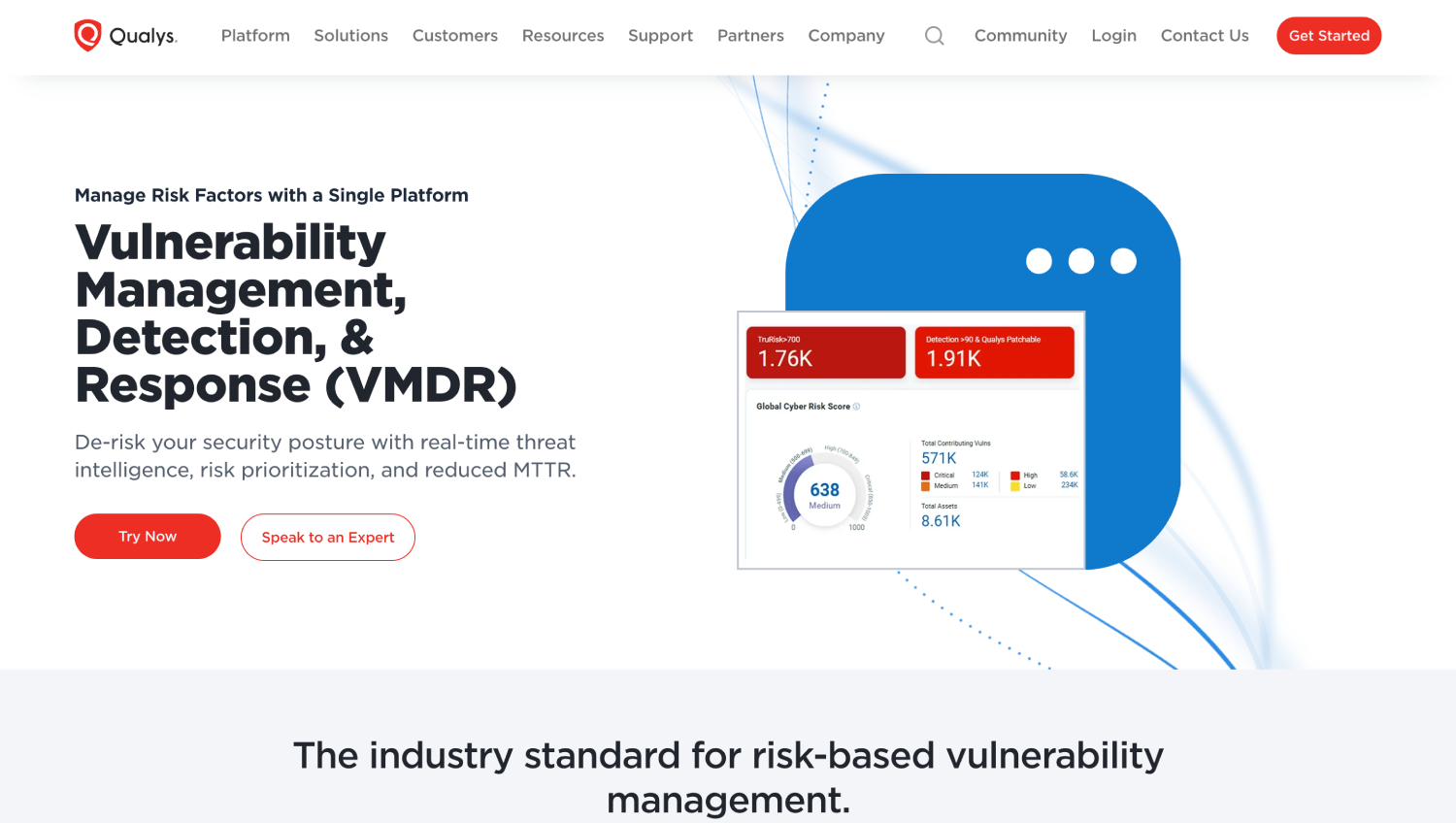
Qualys positions its Enterprise TruRisk Management platform as an exposure management solution built on its existing vulnerability management, cloud security, and web application scanning capabilities. The TruRisk scoring model weights vulnerability findings by business context, asset criticality, and threat intelligence to produce a risk score intended to reflect actual organizational exposure rather than raw vulnerability count.
Discovery is strong for organizations already running Qualys sensors. Prioritization through TruRisk scoring is the platform’s core CTEM contribution. Validation is limited. Mobilization relies on integrations with ITSM tools. Like Tenable One, this platform’s value is highest for teams already invested in the Qualys toolset, where the underlying scan data is already flowing. Cross-vendor scanner ingestion is possible but adds integration complexity.
Best fit: Enterprises running Qualys VMDR at scale that want to add business-context prioritization without switching platforms.
10. Rapid7: Best for Teams That Want Exposure Management and MDR in One Contract
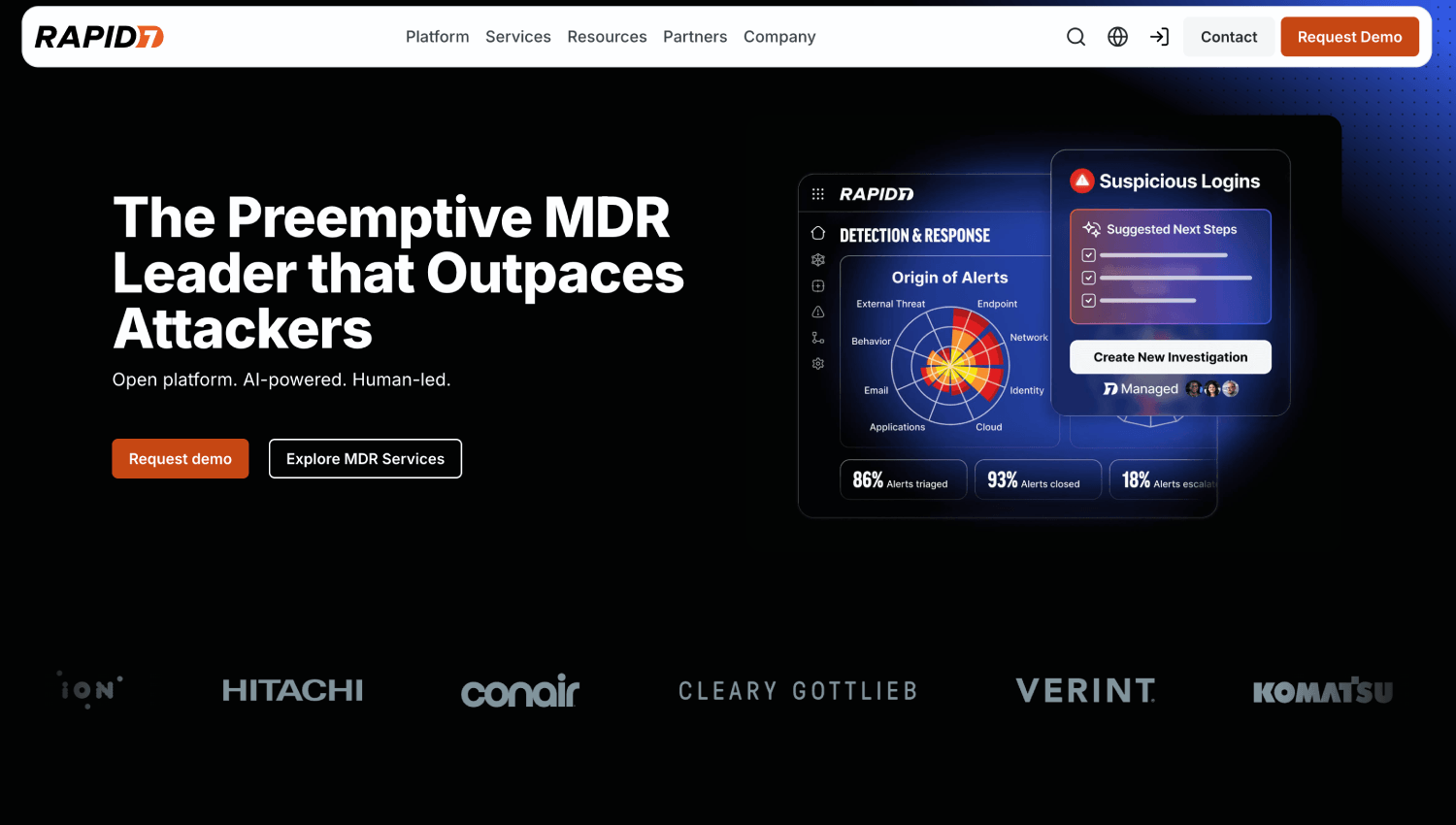
Rapid7 offers exposure management through its Command platform, which consolidates vulnerability risk management, cloud risk assessment, and surface command capabilities. Rapid7’s differentiation is the combination of exposure management with its managed detection and response services, which means findings can feed directly into an MDR workflow rather than sitting in a dashboard.
Discovery coverage spans on-premises and cloud environments. Prioritization uses Rapid7’s risk scoring, which incorporates exploitability data. The MDR integration is meaningful for the mobilization stage: findings that reach a severity threshold can trigger an MDR analyst workflow, which is closer to true mobilization than a Jira ticket integration alone. Validation through native BAS is limited; Rapid7 partners with or integrates with simulation tools for that stage.
Best fit: Mid-market organizations that want exposure management and 24/7 response capability under one contract, and do not have the internal headcount to run both independently.
11. CyCognito: Best for External Attack Surface Discovery and Continuous Monitoring
CyCognito focuses on external attack surface management. The platform discovers internet-facing assets, including assets the security team does not know it has, by simulating how an attacker would map the organization from outside. It then tests discovered assets for exploitable vulnerabilities and prioritizes findings by attack likelihood.
CyCognito is strongest at the discovery and prioritization stages for external surface. It does not cover internal network attack paths, OT environments, or SaaS exposure natively. Validation is limited to what the platform can safely test externally. Mobilization requires integration with downstream tools.
For organizations where the primary unknown is “what does our internet-facing attack surface look like,” CyCognito is a direct answer. For organizations that have their external surface well-inventoried and need internal exposure analysis, it is a partial solution. Pricing is not publicly disclosed.
Best fit: Organizations with distributed infrastructure, recent M&A activity, or shadow IT exposure that have meaningful gaps in their external asset inventory.
12. Armis: Best for OT, IoT, and Unmanaged Asset Environments
Armis built its platform for environments where traditional agents cannot be deployed: OT systems, medical devices, IoT infrastructure, and unmanaged endpoints. The platform uses passive network monitoring and device fingerprinting to discover and assess devices that most vulnerability management tools miss entirely.
Discovery is Armis’s clearest strength, specifically for the unmanaged device categories that fall outside conventional scanner coverage. Prioritization applies risk scoring to discovered devices based on device type, network connectivity, and known vulnerability data. Validation and mobilization capabilities are more limited than the dedicated BAS and exposure management platforms.
For a healthcare network with thousands of medical devices, or a manufacturing environment with industrial control systems, Armis fills a discovery gap that no amount of CVSS tuning on a traditional scanner can address. For a pure cloud-native environment, it is not the right tool. Armis does not publicly disclose pricing.
Best fit: Healthcare, manufacturing, energy, and critical infrastructure environments with significant unmanaged device populations.
13. Hive Pro: Best for Threat-Intelligence-Led Prioritization in Lean Security Teams
Hive Pro positions its platform around threat-informed defense, combining vulnerability management data with threat actor intelligence to prioritize findings by the likelihood that a specific threat group will exploit a specific vulnerability against your industry. The platform ingests vulnerability scanner data and applies its threat intelligence layer on top.
For security teams with limited analyst capacity, the appeal is clear: instead of triaging 10,000 findings, the team sees a list weighted by current threat actor activity relevant to their sector. The platform also provides risk quantification in business terms, which helps with board reporting and prioritization conversations with IT and infrastructure teams.
Discovery and validation are dependent on upstream tools and integrations. Mobilization includes reporting and integration capabilities. Hive Pro does not publicly disclose pricing.
Best fit: Lean security teams in mid-market organizations that need to make a defensible case for prioritization decisions without a large analyst team doing manual triage.
14. Balbix: Best for Cyber Risk Quantification Alongside Exposure Management
Balbix combines asset inventory, vulnerability assessment, and risk quantification into a unified platform. The distinguishing feature is the risk quantification layer, which translates exposure data into financial terms, helping security leaders communicate risk in the language their CFO and board use.
Discovery covers cloud, on-premises, and endpoint assets through agent and agentless collection. Prioritization applies a risk score that factors in asset criticality, vulnerability severity, threat intelligence, and compensating controls. Validation is not a native capability. Mobilization relies on integrations with ITSM systems.
Balbix is particularly useful when the security team’s primary challenge is not knowing what to fix, but convincing the business to fund it. The financial risk quantification output is more useful in a board conversation than a list of CVEs, and it connects vulnerability data to business impact in a way that most pure VM platforms do not. Pricing is not publicly disclosed.
Best fit: Security leaders who need to present exposure data in financial risk terms to non-technical stakeholders, and organizations with a mix of cloud and on-premises assets that need a unified risk view.
How Do CTEM Platforms Consume Existing Scanner Data, and Does That Create Problems?
Most platforms in this list accept inbound scanner data via API or flat file import from Tenable, Qualys, and Rapid7. The integration quality varies significantly, and it is one of the most underexamined aspects of a CTEM evaluation.
The core problem with scanner data aggregation is deduplication. If your Tenable scanner and your Qualys scanner both find the same vulnerability on the same host, you need the platform to recognize that as one finding, not two. Platforms handle this differently. Some use asset identity resolution based on hostname, IP, and MAC address combinations. Others require you to configure a canonical identifier. In environments with dynamic infrastructure, cloud-provisioned hosts, or aggressive DHCP, deduplication errors produce inflated finding counts that undermine the prioritization logic the platform is supposed to provide.
The second problem is staleness. Scanner data has a timestamp, and exposure changes continuously. A platform that ingests a weekly scan export and presents it as your current exposure profile is not a continuous program. Continuous feeds via API are better, but they require the upstream scanner to be generating continuous data, which many on-premises scanners do not do by default.
Before you buy any CTEM platform that relies on scanner ingestion, run a proof of concept with your actual scanner output and ask the vendor to demonstrate how it handles duplicate findings across sources and how it signals when ingested data is stale.
What Does a CTEM Program Actually Cost Beyond the License Fee?
None of the fourteen platforms in this article publish standard list pricing. All of them require a quote based on asset count, environment complexity, and contracted modules. That is a meaningful signal about the cost range: these are not self-serve products with a credit card checkout.
The license cost is also not the largest variable in CTEM program expense. Consider a hypothetical mid-market organization running 5,000 managed assets across three AWS accounts, an on-premises data center, and a SaaS portfolio. The security team has four people: a security manager, two engineers, and a vulnerability analyst.
For that team, the real costs of a CTEM program break down roughly as follows. First, integration engineering time: connecting the CTEM platform to existing scanners, ITSM tools, and cloud APIs takes weeks of engineering work, not hours. Second, scoping governance: defining which assets are in scope for each CTEM cycle, documenting the criteria, and updating the scope as the environment changes is ongoing security manager time. Third, mobilization process design: building the workflow that gets a prioritized finding from the platform into a ServiceNow ticket assigned to the right infrastructure team owner, with enough context for that owner to act, requires both technical and organizational work that no platform automates fully. Fourth, analyst time for triage and program management: even a well-configured platform produces findings that require human judgment before routing. That is at minimum a quarter of a full-time analyst’s time.
Teams responding to pricing questions on security forums frequently note that the license fee is manageable, but the total program cost, including the people and process work, is two to three times the tool cost. That ratio is worth building into any CTEM budget conversation.
Which CTEM Platform Fits Which Team Size and Security Maturity Level?
| Team Profile | Primary Gap | Recommended Starting Point | Why |
|---|---|---|---|
| 2-5 person team, no dedicated VM analyst | Prioritization from existing scanner noise | Zafran or Nagomi | Ingests existing scanner data without replacing it; reduces triage burden without adding another scanner |
| Mid-market, Tenable or Qualys already deployed | Unified exposure view across scanner and cloud data | Tenable One or Qualys ETM | Maximizes existing investment; adds business context to existing findings |
| Enterprise with red team program | Continuous validation between point-in-time assessments | Cymulate, SafeBreach, or Picus | BAS platforms automate the validation stage that manual red team assessments cover only periodically |
| Enterprise with hybrid environment, AD dependency | Attack path analysis and choke point identification | XM Cyber | Attack path modeling provides the prioritization logic that CVSS scoring cannot produce in hybrid environments |
| Healthcare, manufacturing, critical infrastructure | OT and unmanaged device visibility | Armis | Passive discovery is the only viable approach for OT and medical device environments |
| Organizations with significant M&A or shadow IT | Unknown external attack surface | CyCognito | External attack surface discovery from the attacker’s perspective, including assets the team does not know it has |
| Security leaders needing board-level risk reporting | Financial risk quantification | Balbix or Hive Pro | Translates vulnerability exposure into business risk terms without requiring custom reporting work |
Frequently Asked Questions About CTEM Platforms
What does CTEM stand for, and who defined it?
CTEM stands for Continuous Threat Exposure Management. Gartner defined the term to describe a systematic, cyclical program for identifying, assessing, and reducing an organization’s exploitable exposure on a continuous basis. It is a program methodology, not a product category. Gartner describes it as having five stages: scoping, discovery, prioritization, validation, and mobilization. No single commercial platform automates all five stages.
Does any single CTEM platform cover all five stages?
No platform covers all five stages natively. The closest candidates, XM Cyber, Tenable One, and Cymulate, cover three to four stages with varying depth. Scoping is consistently absent as a platform feature because it requires organizational governance decisions about which attack surfaces are in scope for a given program cycle. Mobilization is the second most common gap, with most platforms relying on ITSM integrations rather than native workflow management to get findings to remediation owners.
How do CTEM platforms differ from traditional vulnerability management tools?
Traditional vulnerability management tools scan for, categorize, and report vulnerabilities, typically ranked by CVSS severity. CTEM platforms are intended to go further by incorporating attack path analysis, control validation, and exploitability context to produce a smaller set of findings that are both exploitable in your specific environment and reachable from realistic attacker entry points. The practical difference is prioritization quality: a CTEM platform should produce 50 findings worth acting on this week, not 40,000 findings ranked by criticality.
What is the difference between breach and attack simulation and CTEM?
Breach and attack simulation is a technique, and CTEM is a program methodology. BAS platforms automate the validation stage of the CTEM cycle by running continuous simulations to confirm whether security controls stop specific attack techniques. Platforms like Cymulate, SafeBreach, and Picus are BAS tools that have extended into adjacent CTEM stages. Running a BAS platform is not the same as running a CTEM program, any more than running a scanner is the same as running a vulnerability management program.
Which CTEM platforms ingest data from multiple vulnerability scanners?
Zafran, Nagomi, Hive Pro, and Balbix are designed explicitly to ingest findings from multiple upstream scanners rather than generating their own scan data. XM Cyber, Cymulate, and Picus can accept external findings but produce their own assessment data as well. Tenable One and Qualys ETM are optimized for their own scanner toolsets and accept third-party data with varying integration depth. Before committing to any platform, verify that it can ingest your specific scanner versions and how it handles deduplication across sources.
How long does it take to operationalize a CTEM platform?
Time to initial value varies significantly by platform type and organizational readiness. Platforms that ingest existing scanner data, like Zafran and Nagomi, can produce prioritized findings within days of integration. Platforms that require agent deployment, attack path configuration, or BAS agent installation, like XM Cyber or Pentera, typically require four to twelve weeks before the output is reliable enough to act on. The mobilization stage, building the process to get findings to remediation owners, adds additional time regardless of platform type and is often the step teams underestimate most.
What is the scoping stage of CTEM, and why can’t a platform do it for me?
Scoping defines which assets, attack surfaces, and business processes are included in a given CTEM program cycle. A platform cannot make this decision because it requires answers to questions only the organization can provide: Which systems are critical to business operations? Which regulatory boundaries apply? What is the risk appetite for testing-related impact during validation? What infrastructure is owned versus third-party? These are governance decisions. A platform can inventory what exists; it cannot decide what matters. That decision belongs to the security leader and the business stakeholders they work with.
Are CTEM platforms worth it for mid-market organizations with small security teams?
For teams of two to five people already running a vulnerability scanner, the highest-value CTEM investment is usually a prioritization layer that ingests existing scanner data rather than a full platform replacement. Zafran and Nagomi are designed for exactly this scenario. Full CTEM platforms that require significant configuration, agent deployment, and ongoing management produce less value for small teams because the operational overhead competes with the analyst time needed to act on findings. Buy for your actual gap, not for the full five-stage framework you cannot yet operationalize.
CTEM Is a Program, and That Distinction Determines Whether You Succeed
The platforms in this list are real tools that solve real problems. XM Cyber genuinely changes how a team thinks about which vulnerabilities to fix when the attack path analysis shows that your top 100 CVSS findings are unreachable from any external entry point. Zafran genuinely reduces triage burden when you are drowning in scanner output and cannot distinguish which findings your existing controls already block. Pentera genuinely provides evidence of exploitability that no CVSS score can replicate.
The risk is buying any of them as a substitute for program design. A CTEM program requires someone to own the scoping decision, someone to own the mobilization workflow, and an organization willing to let security findings drive infrastructure team priorities. No license delivers those things. Teams that skip the organizational work and buy the platform anyway will end up with a more sophisticated dashboard showing findings that still do not get fixed.
The SecurityOpsWire CTEM Stage Ownership Audit described at the start of this article is the right starting point. Map your five stages against current tool ownership and process ownership. Buy only for the stages where both are missing. That is a smaller purchase than most vendors will propose, and it is the one that actually improves your posture.
Security teams evaluating how AI and automation are changing adjacent program areas may find relevant context in SecurityOpsWire’s analysis of AI agent red teaming platforms for enterprise security teams, which covers how automated adversarial testing is evolving in environments where traditional BAS approaches have limits. For teams thinking about detection and response alongside exposure management, the AI agent security platform evaluation guide covers how to assess automated security tooling without falling for category marketing.