
- Image scanning finds vulnerable packages in a container layer. It does not tell you whether the vulnerable code path executes in the running workload. That gap is where most cloud native application security programs break down.
- Runtime reachability analysis is the capability that separates the tools on this list from a CNAPP with a bolt-on scanner. Without it, a thousand medium findings compete equally for engineer time.
- CNAPP vendors (Wiz, Orca) approach application security from the cloud posture side and are improving fast. Purpose-built ASPM vendors (Cycode, Apiiro, Endor Labs) start from code and work outward. Neither fully replaces the other yet.
- The operational cost that matters most is not licensing. It is the tuning debt carried by whichever team owns the findings queue after the tool goes live.
- Before you sign anything, run one real finding through the tool’s interface: can it trace from the vulnerable library in the repository to the specific pod running that image in production? If the answer requires two tools and a spreadsheet, keep evaluating.
The best cloud native application security tools connect a specific vulnerable code path in a repository to the running container that exposes it in production, then tell you whether that path is reachable at runtime. Wiz, Orca, Sysdig, Upwind, Aqua Security, Snyk, Cycode, Apiiro, Endor Labs, Kodem, Oligo, and Aikido Security all compete here, but they approach the code-to-cloud trace from different starting points, which determines which tool fits which team.
What Does “ASPM” Actually Mean and Why Does It Matter for Cloud-Native Teams?
Application Security Posture Management (ASPM) is a category that aggregates findings across the software development lifecycle, from source code and dependencies through build pipelines, registry images, and running workloads, and correlates them into a unified risk picture. Gartner coined the term, and every vendor has since adopted it with varying degrees of sincerity. CNAPP starts at the cloud control plane and works toward code. ASPM starts at code and works toward the cloud. The overlap is real and the boundary is blurry, but the direction of reasoning matters when you are trying to answer a specific question: is the CVE in that library actually reachable in the service that just got deployed to production?
Container scanning, which most teams already run, answers a narrower question: does this image layer contain a package at a version with a known vulnerability? That is useful. It is also the reason teams end up with findings queues measured in thousands. Reachability analysis asks whether the vulnerable function in that package is called by the application code. A package can be present in an image and never executed. Most are. The tools that perform reachability analysis, whether through static call graph analysis, runtime observation via eBPF probes, or both, are the ones that turn those thousands of findings into the ten that actually warrant engineer attention this sprint.
The SecurityOpsWire Code-to-Cloud Trace: One Finding, Five Checkpoints
Before evaluating any tool on this list, run a real finding through what we call the SecurityOpsWire Code-to-Cloud Trace. It is a five-checkpoint test you can run in a pre-sales environment or a trial without needing full deployment.
- Repository origin. Can the tool identify the specific commit, branch, and developer who introduced the vulnerable dependency?
- Build pipeline presence. Does the tool show whether the image was built with that package version in your CI/CD system, and can it block the build before registry push?
- Registry state. Is the vulnerable image tag currently present in your container registry, and is it marked as deployed?
- Runtime deployment. Which specific pod, in which namespace, on which cluster, is running that image right now?
- Reachability verdict. Is the vulnerable code path executed at runtime, based on observed call graphs or eBPF telemetry?
A tool that answers all five in one workflow is genuinely doing code-to-cloud security. A tool that answers three and requires a pivot to another console is doing container scanning with a good UI. Most tools on this list clear three or four checkpoints well. Only a handful clear all five without a manual handoff.
Do CNAPP Vendors Cover Application Security Credibly?
Wiz and Orca are the two CNAPP vendors most frequently mentioned when buyers ask whether their existing cloud security platform already covers cloud-native AppSec. The honest answer is: partially, and improving.
Wiz performs SCA scanning of container images and infrastructure-as-code, correlates vulnerabilities with the cloud graph to show whether a vulnerable workload is internet-exposed, and surfaces package-level findings in its Security Graph. What it does not do natively is runtime call graph reachability. Wiz can tell you a vulnerable package is deployed in an exposed pod. It cannot tell you whether the application actually calls the vulnerable function. That is a meaningful gap for teams trying to reduce noise below the image layer. Wiz does not publicly disclose pricing.
Orca Security takes a similar agentless approach, scanning cloud workloads via side-scanning without deploying agents. Its SCA coverage extends to container images and cloud-managed services. Orca’s Attack Path Analysis provides context about whether a vulnerable workload sits on a path to a sensitive data store, which is valuable cloud-side context. Like Wiz, it does not perform runtime reachability at the function level. Orca does not publicly disclose pricing.
Both tools are the right default for teams whose primary job is cloud posture and who need application security coverage as one signal among many. They are not the right primary tool for an AppSec team whose job is to triage developer findings and prove to engineers that a vulnerability is worth patching. For a fuller treatment of where ASPM and CNAPP programs diverge in scope and ownership, the SecurityOpsWire comparison of AI Security Posture Management program design covers adjacent program-level questions about posture tooling ownership.
How Does Runtime Reachability Change Prioritisation in Practice?
Consider a mid-sized SaaS company running 40 microservices across two Kubernetes clusters in AWS. A weekly image scan surfaces 1,200 findings across all deployed images. Of those, perhaps 80 are rated critical by CVSS score. The security team has two people. They cannot triage 80 critical findings per week and also do anything else.
A reachability-aware tool looks at those 1,200 findings and asks which vulnerable functions are actually invoked by application code at runtime. The answer, consistently, is a small fraction. One tool in this space, Kodem Security, specifically positions its runtime intelligence engine around this reduction. Oligo Security focuses on library-level runtime observability to identify which open-source packages are actively used versus present-but-dormant in production. Both are purpose-built around the idea that presence is not the same as execution. The practical result is that a team of two can focus on the findings where a vulnerable path is confirmed to execute, rather than treating every detected package as equal risk.
The prioritisation change is not just about reducing noise. It changes the conversation with engineering leadership. “This library is vulnerable” produces a shrug when there are hundreds of libraries. “This specific function in this library is called by the payment processing service, which is internet-exposed, and we have observed it executing” produces a patch ticket with a deadline.
The 10 ASPM Tools: What Each One Actually Does and Where It Fits
1. Wiz
Wiz is the most common CNAPP platform in enterprise cloud environments and is often the starting point for this conversation because many teams already own it. Its strength is cloud-side context: internet exposure, identity paths to sensitive data, and cross-account blast radius. Its SCA scanner finds vulnerable packages in images and IaC. The code-to-cloud trace goes from registry to cloud, not from repository to runtime call graph. Wiz fits teams that need cloud security posture with AppSec as a secondary signal. Pricing is not publicly disclosed.
2. Orca Security
Orca covers similar ground to Wiz via agentless scanning. Its differentiator is the depth of data it extracts from workload snapshots without requiring agents: OS packages, application libraries, credentials in memory, and configuration files. For teams that cannot deploy agents due to operational constraints, Orca’s agentless coverage is a genuine advantage. The trade-off is that agentless scanning is point-in-time. Runtime behavior between scans is invisible. Pricing is not publicly disclosed.
3. Sysdig
Sysdig is built on Falco, the open-source runtime security project, and uses eBPF-based kernel instrumentation to observe system calls at runtime. This gives it genuine runtime telemetry that CNAPP agentless vendors lack. Sysdig can correlate a container vulnerability with runtime process behavior, which gets closer to true reachability than image-only analysis. Its CNAPP platform covers image scanning, cloud posture, and runtime detection in a single agent. The operational cost is the agent: daemonset deployment across every node, tuning Falco rules to reduce noise, and managing rule updates. Sysdig fits teams that already run Falco or want runtime detection alongside posture. Pricing is not publicly disclosed.
4. Upwind Security
Upwind is one of the newer entrants, positioning specifically around runtime context for vulnerability prioritisation. It uses eBPF to observe which packages are loaded and which functions are called at runtime, and surfaces that context alongside static SCA findings. The explicit design goal is reducing the signal-to-noise ratio by marking findings as “runtime reachable” or “not executed.” For teams evaluating whether runtime reachability is worth the agent overhead, Upwind is a focused bet on that specific capability. Pricing is not publicly disclosed.
5. Aqua Security
Aqua Security has one of the longest track records in container security, predating the CNAPP category. Its platform covers image scanning, Kubernetes admission control, runtime policy enforcement, and supply chain security. Aqua’s agent-based approach provides runtime workload protection including the ability to block anomalous process execution in containers. SCA coverage extends to the build pipeline and registry. The platform is comprehensive, which also means it is complex to deploy at full capability. Teams that need runtime enforcement (blocking, not just alerting) alongside scanning will find Aqua’s policy engine more mature than most. Aqua does not publicly disclose pricing.
6. Snyk
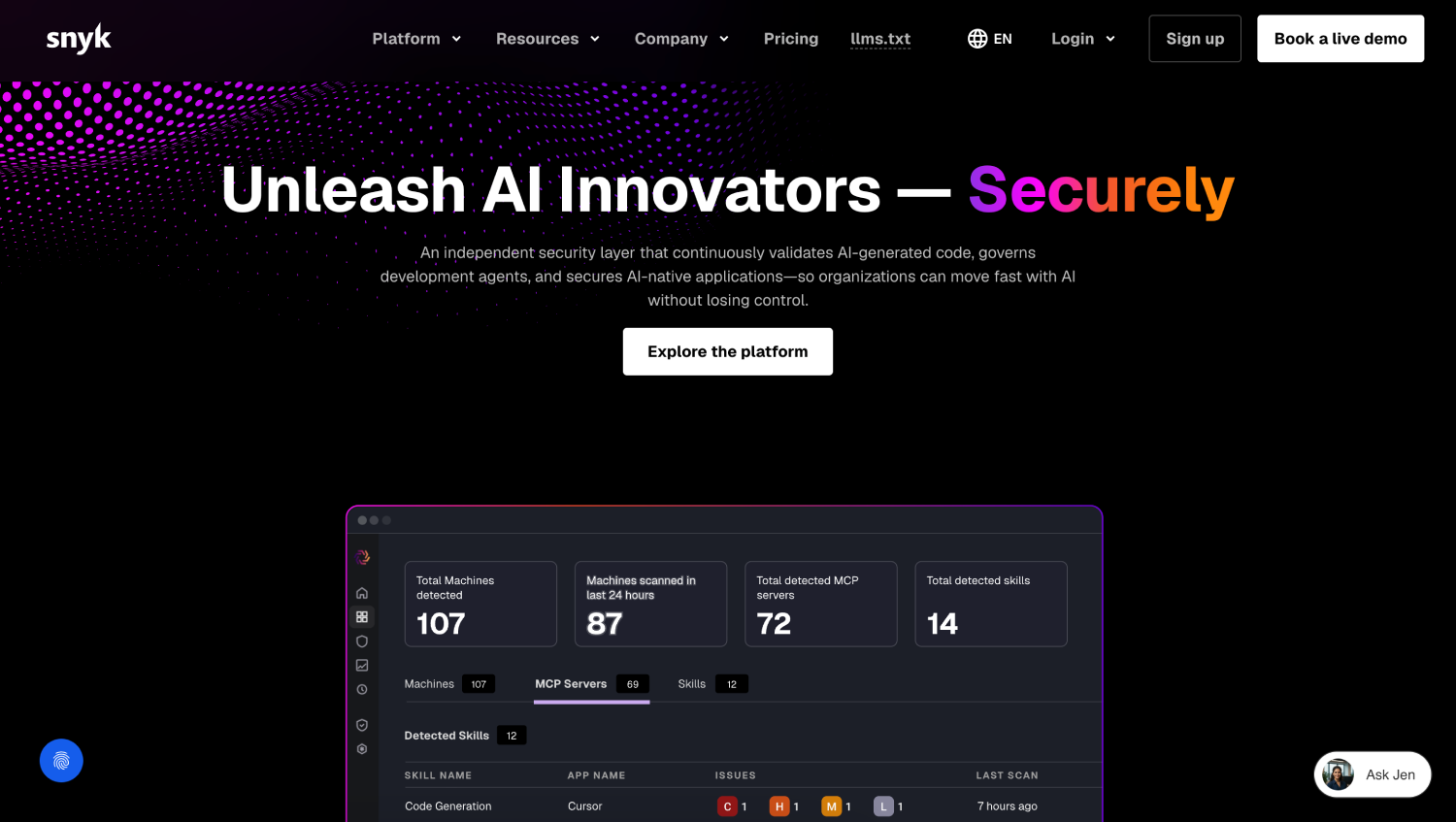
Snyk starts from the developer side: IDE plugins, CI/CD integration, and SCA scanning that surfaces findings where the code is written rather than where it runs. Its Snyk Container product scans images in registries and CI pipelines. Snyk’s risk prioritisation uses reachability analysis for supported languages, surfacing whether a vulnerable function is in the call graph of the application code. The limitation is that Snyk’s reachability is static call graph analysis, not runtime observation. It cannot tell you that a function was called in a specific production pod at 2 AM. For developer-first AppSec programs where the goal is to fix things before they deploy, Snyk’s workflow integration is the strongest on this list. Snyk publishes pricing tiers on its pricing page; enterprise pricing for container and runtime features requires a quote.
7. Cycode
Cycode positions as an ASPM platform with application security pipeline coverage, including secrets detection, SCA, SAST, and IaC scanning. Its approach centers on correlating findings across code, CI systems, and container registries into a consolidated risk view rather than producing separate queues per scanner. Cycode’s code-to-cloud trace is strong on the left side of the pipeline (repository through registry) and lighter on the runtime side. It fits AppSec programs that need a single findings surface for developer-facing results across multiple scanning tools. Pricing is not publicly disclosed.
8. Apiiro
Apiiro focuses on application risk management through code analysis and developer behavior signals. It builds a risk graph from repository metadata, code change patterns, and application architecture relationships. Where most tools scan for known vulnerability patterns, Apiiro also models design-level risk: which services handle sensitive data, which teams have high-risk change velocity, and where architectural decisions introduce attack surface. The code-to-cloud trace in Apiiro is strong on the code and architecture side; runtime integration is less central to its model. It fits mature AppSec programs that want to go beyond vulnerability lists to architectural risk reduction.
9. Endor Labs
Endor Labs is built around the open-source dependency problem. Its core capability is dependency lifecycle management: understanding not just which packages are vulnerable but which are actually reachable in application code, which are unused, and which have operational risk beyond CVEs (unmaintained projects, license issues, dependency confusion surface). Endor Labs uses static call graph reachability to reduce SCA noise. For teams whose primary problem is an overwhelming open-source vulnerability queue, Endor Labs is among the most focused tools for that specific problem. It is not a full CNAPP replacement. Pricing is not publicly disclosed.
10. Aikido Security
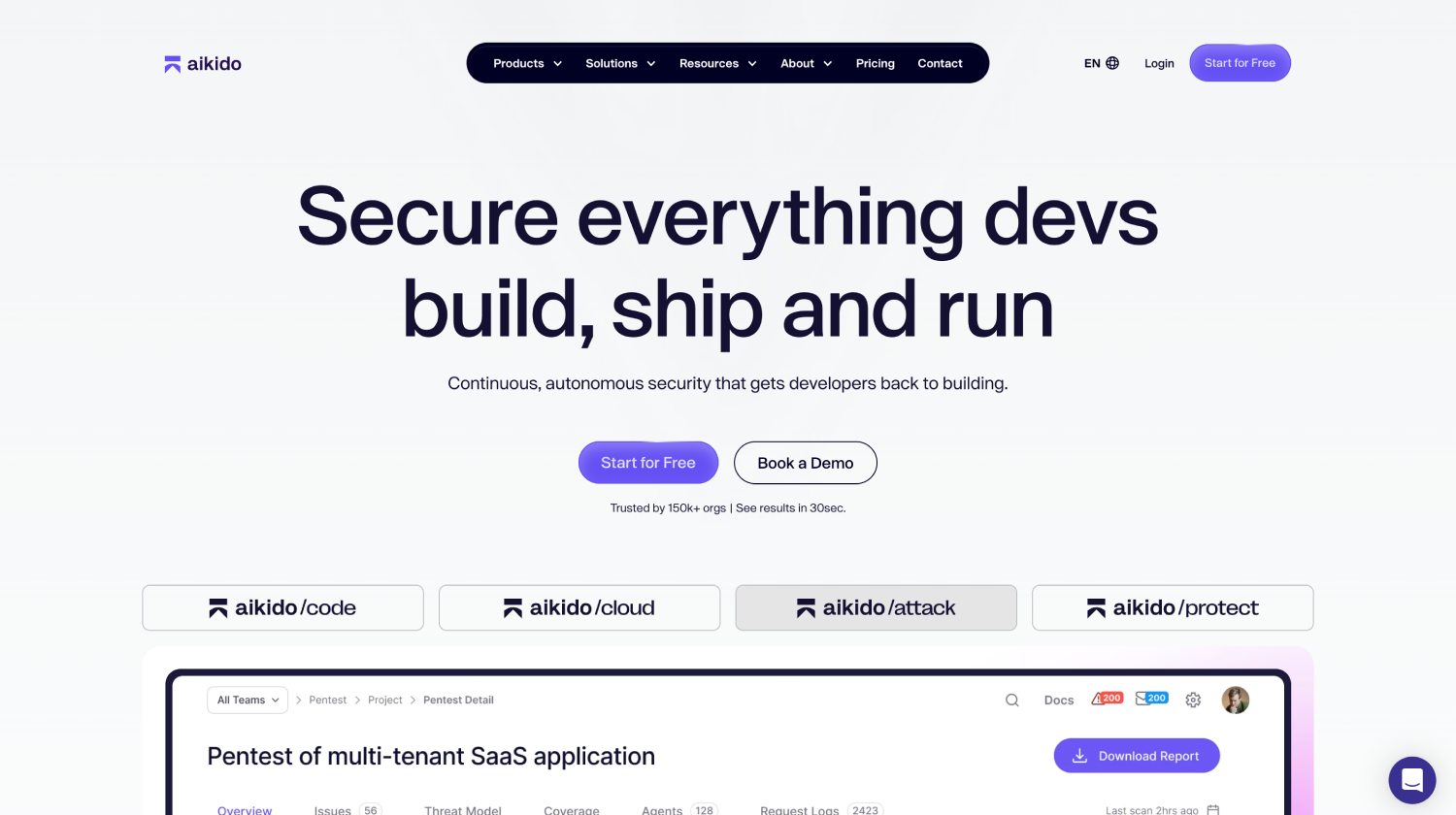
Aikido Security targets the mid-market with a combined AppSec and cloud security platform that covers SAST, SCA, secrets detection, container scanning, and cloud posture in a single product. Its positioning is consolidation for teams that cannot staff a tool per discipline. Aikido uses reachability analysis in its SCA engine to reduce noise, and its cloud posture coverage includes Kubernetes configuration review. For a 50-to-300-person company with a small security team that needs broad AppSec coverage without running five separate tools, Aikido’s all-in-one approach reduces the coordination overhead that comes with a best-of-breed stack. Aikido publishes pricing on its pricing page.
Feature Comparison: Which Tools Perform the Code-to-Cloud Trace?
| Tool | Static SCA | Call Graph Reachability | Runtime eBPF Telemetry | Registry-to-Pod Trace | CI/CD Pipeline Gates | Primary Buyer |
|---|---|---|---|---|---|---|
| Wiz | Yes | No | No (agentless) | Yes (cloud graph) | Limited | Cloud/SecOps |
| Orca | Yes | No | No (agentless) | Yes (cloud graph) | Limited | Cloud/SecOps |
| Sysdig | Yes | Partial (runtime process) | Yes (Falco/eBPF) | Yes | Yes | SecOps/Platform |
| Upwind | Yes | Yes (runtime-observed) | Yes (eBPF) | Yes | Limited | SecOps/AppSec |
| Aqua | Yes | Partial | Yes (agent) | Yes | Yes | Platform/SecOps |
| Snyk | Yes | Yes (static) | No | Partial (registry) | Yes | AppSec/Developer |
| Cycode | Yes | Partial | No | Partial | Yes | AppSec |
| Apiiro | Yes | Partial (design-level) | No | No | Yes | AppSec |
| Endor Labs | Yes | Yes (static) | No | No | Yes | AppSec/Dev |
| Aikido | Yes | Yes (SCA) | No | Partial | Yes | Mid-market AppSec |
| Kodem | Yes | Yes (runtime-observed) | Yes (eBPF) | Yes | Limited | AppSec/SecOps |
| Oligo | Yes | Yes (runtime-observed) | Yes (eBPF) | Yes | Limited | AppSec/SecOps |
How Does Pricing Overlap With an Existing CNAPP Contract?
This is the question that actually matters at renewal time. If you already own Wiz or Orca, you are paying for cloud posture, image scanning, and SCA as part of that contract. Adding a purpose-built ASPM tool (Cycode, Endor Labs, Apiiro) means paying for a second SCA engine and reconciling two findings queues. That duplication has a real operational cost beyond licensing: someone has to decide which tool’s findings are authoritative when they disagree, and they will disagree on severity ratings and reachability verdicts.
The practical question is whether the CNAPP vendor’s SCA and reachability capabilities are good enough for your AppSec program, or whether the gap is costing you more in missed findings and engineer time than a second tool would cost in licensing and integration overhead. For teams running mostly Kubernetes with active development teams deploying multiple times per day, the gap is usually real. For teams with slower release cycles and smaller container footprints, the CNAPP’s coverage may be sufficient.
None of the vendors on this list publish per-workload or per-developer pricing publicly. Every conversation starts with a scoping call. The model that matters more than the list price is whether the vendor charges per developer seat, per workload scanned, per repository, or per finding, because those models produce very different costs at different scales. Ask your CNAPP vendor explicitly whether their SCA and reachability features are included in your current tier or require an add-on module before you start an ASPM evaluation.
Teams considering how security tooling consolidation interacts with their broader platform buying strategy may find the SecurityOpsWire analysis of AI agent security platform evaluation criteria useful for the general methodology of comparing platform breadth against point-tool depth, even though the domain differs.
Which Tool Fits Which Environment?
The right tool depends on where your AppSec program sits in its maturity, how your team is divided between security engineering and cloud operations, and which part of the code-to-cloud trace you are currently blind to.
- Already own a CNAPP, need runtime reachability: Upwind, Kodem, or Oligo. All three add runtime eBPF-based reachability as their primary value proposition and are designed to complement rather than replace a CNAPP.
- Developer-first AppSec, findings need to reach engineers in the IDE: Snyk. Its developer tooling integration is the most mature on this list.
- Need to consolidate five scanners into one findings queue: Cycode or Apiiro. Both are designed around aggregation and correlation across existing tools.
- Open-source dependency management is the primary problem: Endor Labs. Purpose-built for dependency lifecycle, not a general AppSec platform.
- Mid-market, small team, need broad coverage without complexity: Aikido Security. The trade-off is depth for breadth.
- Full platform with runtime enforcement and Kubernetes admission control: Aqua or Sysdig. Both have the most mature Kubernetes security controls of the agent-based options.
What Does Kubernetes Application Security Require Beyond Container Scanning?
Kubernetes application security is not container security. Container scanning checks what is in an image. Kubernetes security requires checking how that image runs: what network policies govern its pod, what service account permissions it inherits, whether its admission controller allows privilege escalation, and whether runtime process behavior matches expected workload patterns.
The tools that address Kubernetes security most completely are those with admission control integration (Aqua, Sysdig), runtime process monitoring (Sysdig, Upwind, Kodem, Oligo), and Kubernetes RBAC analysis (Wiz, Orca, Aqua). Kubernetes security as defined by the project itself covers four layers: cloud infrastructure, cluster configuration, container runtime, and code. The tools on this list cover the last two layers best. Cloud infrastructure and cluster configuration are where CNAPP vendors have their strongest coverage.
Teams building Kubernetes security programs from scratch should also review the CIS Kubernetes Benchmark, which provides a hardening baseline that precedes tool selection. No tool on this list substitutes for a configured cluster that follows the benchmark’s recommendations on API server flags, etcd encryption, and network policy enforcement.
Frequently Asked Questions
What is the difference between ASPM and CNAPP for cloud-native application security?
CNAPP (Cloud-Native Application Protection Platform) starts from the cloud control plane and works toward code: it finds misconfigured cloud resources, exposed workloads, and vulnerable images from the infrastructure layer down. ASPM (Application Security Posture Management) starts from the code repository and works toward the cloud: it aggregates findings from code scanners, dependency analyzers, and pipeline tools and correlates them with deployed workloads. The coverage overlap is real, but the direction of reasoning and the primary buyer differ. CNAPP findings are typically owned by cloud security and SecOps teams. ASPM findings are typically owned by AppSec and development teams.
Does runtime reachability analysis require an agent on every node?
Runtime reachability via eBPF instrumentation requires a privileged daemonset on each Kubernetes node, which gives the probe visibility into kernel system calls and network connections for all containers on that node. This is not a per-pod agent; one daemonset pod covers all workloads on the node. The operational overhead is real but manageable at scale. Static call graph reachability (used by Snyk and Endor Labs) requires no runtime agent because it analyzes source code rather than observed execution. The trade-off is accuracy: static analysis can miss dynamically loaded code paths that eBPF-based runtime observation would catch.
Can Wiz or Orca replace a dedicated ASPM tool for cloud-native AppSec?
For cloud security posture with SCA coverage as a secondary signal, yes. For a dedicated AppSec program that needs developer workflow integration, reachability-based prioritisation, and pipeline enforcement, no. Both Wiz and Orca are improving their AppSec capabilities, but they start from the cloud side and their SCA findings are optimized for cloud risk context rather than developer remediation workflows. Teams that need deduplicated findings routed to engineering sprints will find a purpose-built ASPM tool more effective for that specific workflow.
What is the operational cost of deploying eBPF-based runtime security across a large Kubernetes cluster?
The primary costs are node-level resource consumption (eBPF probes have overhead that varies by vendor implementation and by workload I/O patterns), rule tuning to reduce false-positive alerts from the runtime detection layer, and upgrade coordination during Kubernetes version bumps (kernel version changes can affect eBPF probe compatibility). Teams that have run Falco in production report that tuning the rule set is the ongoing cost that surprises them most. Budget time for initial rule baseline work before going live in production, and expect to revisit rules after each major application deployment change.
How do these tools handle secrets detection in container images and repositories?
Most tools on this list perform secrets scanning as part of their pipeline coverage. Cycode and Apiiro include secrets detection as a core capability of their ASPM platforms. Snyk covers secrets in its code scanning product. Aqua and Sysdig scan images for embedded credentials. The important distinction is whether secrets detection covers only known patterns (API key formats, connection strings) or also performs entropy-based detection for high-randomness strings that do not match a known format. For teams whose primary secrets concern is developer-committed credentials in repositories, the repository-side scanners (Cycode, Snyk, Aikido) have deeper coverage than the image-side scanners.
What is container security posture and how does it differ from runtime security?
Container security posture refers to the configuration state of containers and container orchestration: whether images are built from minimal base images, whether containers run as root, whether Kubernetes admission policies enforce security contexts, and whether network policies restrict east-west traffic. It is assessed at build time and deployment time. Runtime security monitors what containers actually do while they are running: what processes execute, what network connections are made, and whether behavior deviates from a baseline. Both matter. A container with good posture can still be compromised by a vulnerability in application code that executes at runtime. Neither replaces the other.
Is there a meaningful difference between static and runtime reachability for vulnerability prioritisation?
Static call graph reachability tells you whether a vulnerable function appears in the call chain of your application based on code analysis. Runtime reachability tells you whether that function was actually invoked in a running production workload based on observed execution. Static analysis is faster and works before deployment but can produce false positives when code paths are conditionally loaded or dynamically generated. Runtime observation is more accurate but requires a deployed workload and an eBPF agent or similar instrumentation. The most reliable prioritisation combines both: static analysis to filter before deployment, runtime observation to confirm in production. Tools like Upwind, Kodem, and Oligo are designed around that combination.
How should a security team handle overlapping findings between their CNAPP and a new ASPM tool?
Define authoritative ownership before both tools go live. Cloud posture findings (exposed resources, IAM misconfigurations, network policy gaps) belong to the CNAPP and are owned by cloud security. Application vulnerability findings (SCA, SAST, secrets) belong to the ASPM tool and route to AppSec and development. Where the two tools overlap on image scanning, pick one as authoritative for severity rating and suppress duplicate findings from the other. The worst operational outcome is two tools producing different severity ratings for the same CVE in the same image, with no defined owner. That state produces paralysis, not prioritisation.
The Finding That Changes Everything
Most cloud-native AppSec programs are not failing because they lack data. They are failing because they have too much of it with no way to sort signal from presence. Every tool on this list can find the vulnerable library. The question that determines program effectiveness is which tool can confirm that the vulnerable code path is executing in the specific pod handling your most sensitive traffic, and surface that fact to the engineer who can fix it before the next deployment window.
The CNAPP vendors are moving toward that answer from the cloud side. The purpose-built ASPM vendors are moving toward it from the code side. The runtime-first tools (Upwind, Kodem, Oligo, Sysdig) are already there for teams willing to run an eBPF agent. Which one is right depends on where your program currently breaks down. If findings never reach developers, start on the left side of the pipeline. If developers get findings but cannot prioritize them, start on the right side with runtime reachability. If both problems exist simultaneously, that is the more common situation, and it is the argument for a two-tool architecture with clear ownership boundaries rather than one platform that does everything adequately.
Security teams evaluating broader AI-driven application risk may also find relevant framing in the SecurityOpsWire coverage of the AI agent security market, where similar code-to-runtime traceability questions are emerging for agentic workloads running in containerized environments. The tooling is different, but the architectural problem of connecting a behavior in running code back to its origin in a repository is the same one cloud-native AppSec has been working on for years.