
- Most AI SOC platforms today are reasoning over alert context using large language models, not executing static playbook branches. The failure mode shifts from “playbook breaks on edge case” to “model reaches a plausible but wrong conclusion.”
- SIEM integration depth is the most decision-relevant technical variable. Platforms that sit natively inside your SIEM (Charlotte AI, Microsoft Security Copilot) get faster context; those that layer on top (Dropzone, Prophet, Radiant) need every integration tuned before triage accuracy stabilizes.
- Triage accuracy claims in vendor demos are measured against sanitized datasets. The right pilot benchmark is your own environment’s alert mix over 30 days, with false-negative rate tracked separately from false-positive rate.
- Pricing collisions between the AI layer and the underlying SIEM ingest cost are real. Several vendors charge per investigation or per alert, which compounds badly when your SIEM already bills per GB ingested.
- The strongest shortlist decision is made by matching SIEM, team size, and alert volume simultaneously. No platform wins across all three dimensions.
The best AI SOC platforms in use today include Dropzone AI, Prophet Security, CrowdStrike Charlotte AI, Microsoft Security Copilot, Radiant Security, Intezer, Torq, Swimlane, D3 Security Morpheus, Stellar Cyber, Exaforce, Qevlar AI, Crogl, Legion AI, and Conifers. Each approaches triage and investigation differently: some act as autonomous agents layered over your existing SIEM, some extend the SIEM natively, and some replace tier-1 analyst workflows entirely. The right choice depends on which SIEM you run, your alert volume, and whether your team can validate model conclusions without a dedicated detection engineer.
Why the “We Already Tried SOAR” Objection Is Valid But Outdated
The skepticism on forums is fair. A lot of teams spent two years building Splunk SOAR or Palo Alto XSOAR playbooks, watched them go stale after three analyst departures, and ended up with automation that triggered on the wrong condition and closed tickets that needed human eyes. That experience is real and it should inform how you evaluate this generation of tools.
The architectural difference is that current AI SOC platforms are not executing a decision tree. They are passing alert context, enrichment data, asset inventory, and historical incident records to a large language model and asking it to reason toward a triage decision. The output is a prose explanation of why an alert is or is not suspicious, not a binary true/false branch. That changes the failure mode entirely. SOAR breaks silently when a condition is not handled. An LLM-based platform produces a conclusion that looks confident but may rest on a wrong assumption about your environment. You are trading brittle automation for plausible-sounding errors.
Whether that trade is worth making depends on your team’s capacity to audit model outputs. If you have analysts who can review the reasoning chain, the AI layer genuinely reduces mean time to triage on high-volume, low-complexity alerts. If your team is too small to audit anything and just wants the alerts to go away, you are accepting risk of missed detections that look closed.
What Do AI SOC Platforms Actually Automate End to End?
The honest answer is that “end to end” means different things across vendors. The common coverage, across most platforms in this list, is alert ingestion, automated enrichment (threat intelligence lookups, VirusTotal, Shodan, identity context from your IdP), initial triage classification, and a recommended disposition with a written rationale. That is tier-1 work, and it is the work that consumes analyst capacity without requiring senior judgment.
Investigation, which means correlating related alerts into a coherent incident narrative, tracking lateral movement, and building a timeline, is where platforms diverge sharply. Dropzone AI and Radiant Security push further into autonomous investigation. Torq and Swimlane remain workflow orchestration at their core, with AI layered on top of existing playbook structures. D3 Security Morpheus sits between the two. Microsoft Security Copilot is a copilot in the literal sense: it assists analysts rather than acting autonomously.
Response actions, meaning blocking an IP, isolating an endpoint, disabling an account, are available in several platforms but require explicit human authorization in most enterprise configurations. Fully autonomous response without a confirmation step is rare in production and almost universally disabled by customers in regulated industries.
The SecurityOpsWire Triage Accuracy Framework for AI SOC Pilots
Before running a pilot, your team needs a shared definition of what “accuracy” means, because vendors measure it differently. Some report precision (of the alerts we closed as benign, what percentage were actually benign). Some report recall (of the true positives in the alert stream, what percentage did we surface). Almost none report false-negative rate in their marketing materials, but false negatives are what get you breached.
The SecurityOpsWire Triage Accuracy Framework defines four measurements a pilot must produce before you can make a decision:
- Benign disposition accuracy: Of all alerts the AI closed as false positive, what percentage did a senior analyst agree were correctly dismissed? Target 95 percent or above before reducing human review. Below 90 percent means the model is too aggressive and you need to tune it or accept increased false-negative exposure.
- Escalation recall: Of the alerts your analysts confirmed as true positives during the pilot window, what percentage did the AI flag for escalation? This is the number vendors do not show you voluntarily.
- Investigation quality score: For escalated alerts, does the AI’s written investigation summary give the responding analyst enough context to act without re-running enrichment themselves? Grade each summary pass/fail. Target 80 percent pass rate.
- Tuning debt at day 30: How many custom rules, suppression lists, or prompt adjustments did your team have to make to get the accuracy numbers above? A platform that requires 40 suppression rules in 30 days has a different operational cost profile than one that required three. This predicts whether you will need dedicated headcount to maintain it.
Run this against your own alert mix, not the vendor’s demo environment. Sanitized demo datasets have no noisy SIEM alerts from your cloud config changes, your CI/CD pipelines, or your backup jobs. Those are the alerts that break every AI model’s confidence calibration.
Which Platforms Sit Inside the SIEM and Which Layer on Top?
This architectural question determines integration effort, context richness, and pricing interaction with your existing SIEM contract. Native platforms can query raw log data and correlated events. Overlay platforms receive only the alerts your SIEM chooses to fire, which means they cannot catch what your SIEM missed.
| Platform | Architecture | Primary SIEM Integrations | Pricing Model |
|---|---|---|---|
| CrowdStrike Charlotte AI | Native to Falcon platform / Next-Gen SIEM | Falcon LogScale (native), limited third-party | Add-on to existing Falcon licenses; not separately disclosed |
| Microsoft Security Copilot | Native to Microsoft Sentinel and Defender XDR | Sentinel (native), Defender XDR (native), third-party via connectors | Consumption-based (Security Compute Units); Microsoft publishes SCU pricing publicly |
| Dropzone AI | Overlay / agent-based | Splunk, Microsoft Sentinel, Elastic, QRadar, Chronicle | Per-investigation pricing; not publicly disclosed, quoted per environment |
| Prophet Security | Overlay | Splunk, Sentinel, CrowdStrike, Elastic | Not publicly disclosed; quoted per environment |
| Radiant Security | Overlay | Splunk, Sentinel, QRadar, Elastic, Chronicle | Not publicly disclosed; quoted per environment |
| Intezer | Overlay / alert-intake model | Splunk, Sentinel, QRadar, ServiceNow, via API | Not publicly disclosed; quoted per environment |
| Torq | Workflow orchestration with AI layer | Splunk, Sentinel, Chronicle, QRadar, Elastic | Not publicly disclosed; consumption-based tiers |
| Swimlane | Workflow orchestration with AI layer (Turbine) | Splunk, Sentinel, QRadar, Elastic, Chronicle | Not publicly disclosed; quoted per environment |
| D3 Security Morpheus | SOAR with AI orchestration layer | Splunk, Sentinel, QRadar, Elastic, ArcSight | Not publicly disclosed; quoted per environment |
| Stellar Cyber | Open XDR / built-in SIEM replacement | Replaces or supplements SIEM; ingests raw telemetry | Not publicly disclosed; asset-based pricing model |
| Exaforce | Overlay / agent-based | Splunk, Sentinel, Chronicle, QRadar | Not publicly disclosed; quoted per environment |
| Qevlar AI | Overlay / autonomous investigation | Splunk, Sentinel, QRadar, Elastic | Not publicly disclosed; quoted per environment |
| Crogl | Overlay / reasoning-layer | Splunk, Sentinel, Chronicle | Not publicly disclosed; quoted per environment |
| Legion AI | Overlay / autonomous SOC agent | Splunk, Sentinel, QRadar | Not publicly disclosed; quoted per environment |
| Conifers | Overlay / detection and response agent | Splunk, Sentinel, Chronicle, Elastic | Not publicly disclosed; quoted per environment |
How Does Pricing Interact with Your SIEM Ingest Cost?
This is the math that most evaluations miss. Consider a team running Splunk Enterprise Security at a volume where they are already paying for 200GB of daily ingest. A per-investigation pricing model from an overlay AI SOC platform means every alert that generates an AI investigation is a separate billing event. If your environment produces 2,000 alerts per day and the AI investigates 80 percent of them, your investigation volume is 1,600 per day. At even modest per-investigation pricing, that number compounds against your existing Splunk bill faster than the procurement team usually anticipates.
Platforms that charge per alert or per investigation introduce a structural incentive problem: teams start filtering what they send to the AI layer to control cost, which defeats the coverage purpose. Flat-rate or seat-based models avoid this but tend to be priced at higher base contracts. Neither model is inherently better. Whether your alert volume is predictable enough to model a per-investigation cost accurately before you sign is the right question to answer in procurement.
Microsoft Security Copilot’s Security Compute Unit model is the most transparent of the public pricing structures available. Microsoft’s documentation describes the SCU consumption model, though specific per-unit rates are not confirmed through that documentation alone and should be verified directly with Microsoft. The key behavior to understand is that complex multi-step investigations consume more SCUs than simple lookups, which makes usage unpredictable during high-volume incident periods. Most other vendors in this list do not publish pricing, and any figure you see in a third-party comparison is either out of date or was shared under a specific deal context that may not apply to your environment.
Platform-by-Platform Analysis: What Each One Actually Does
CrowdStrike Charlotte AI
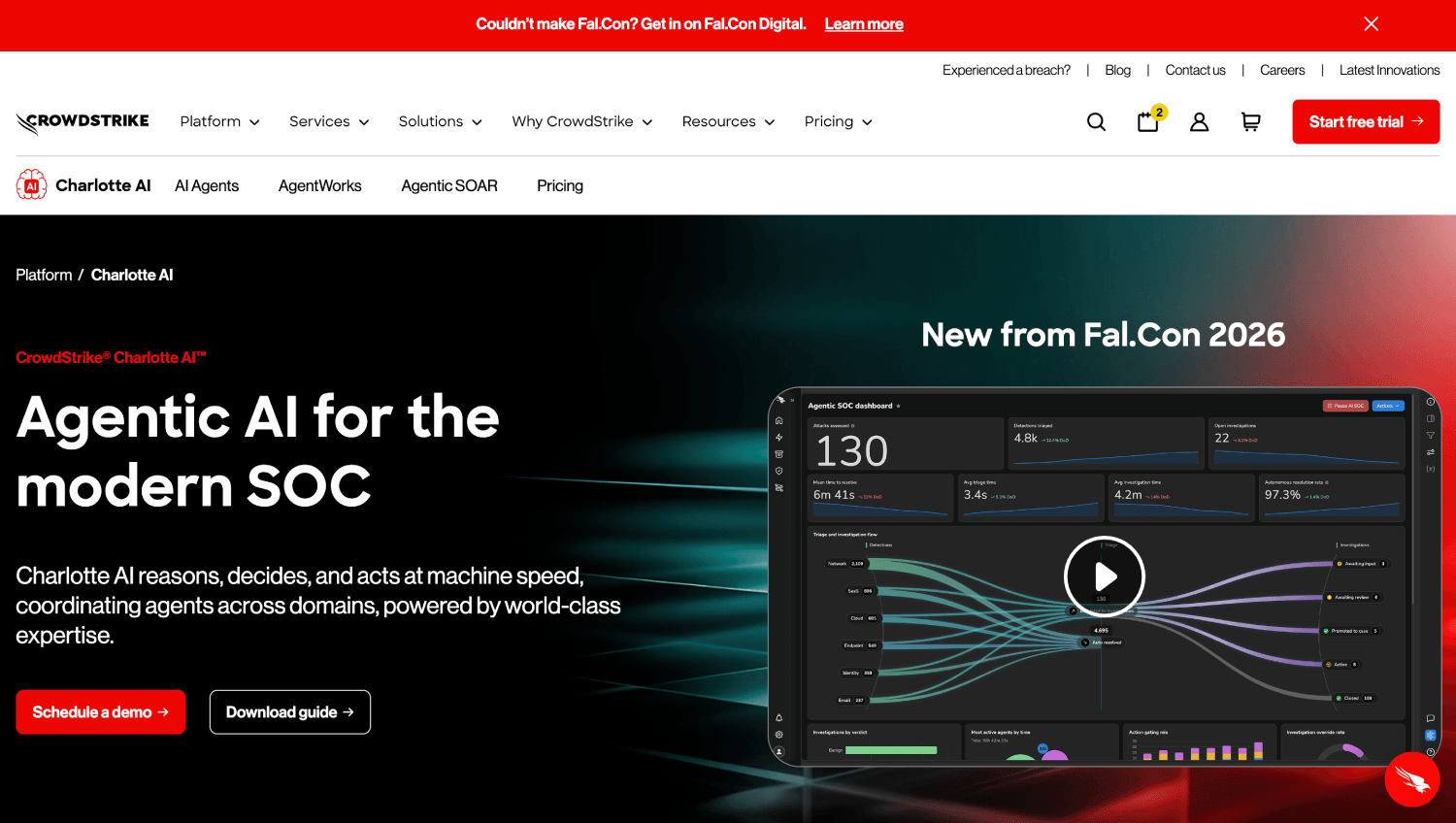
Charlotte AI is a generative AI layer built into the CrowdStrike Falcon platform, operating natively over Falcon telemetry and the Falcon Next-Gen SIEM. Its primary use case is natural language query over Falcon data and AI-assisted triage of Falcon-sourced detections. The model can correlate detections, summarize threat activity, and draft investigation timelines without leaving the Falcon console. According to CrowdStrike’s product page, Charlotte AI has achieved greater than 98 percent decision accuracy with agentic detection triage , a figure benchmarked against decisions from the CrowdStrike Falcon Complete MDR team, not a general accuracy rate across all deployment configurations. The constraint is significant: deep functionality requires Falcon for telemetry. Teams running Palo Alto Cortex or SentinelOne as their EDR get limited value from Charlotte AI without migrating those data sources into LogScale. Evaluate Charlotte AI if you are already a Falcon-first shop. Do not evaluate it to bridge a multi-vendor telemetry gap.
Microsoft Security Copilot
Microsoft Security Copilot is the most mature of the copilot-style interfaces in this list, with the deepest native integration into Sentinel, Defender XDR, Intune, and Entra ID. The value is highest for teams that have significant Microsoft telemetry breadth: when Copilot can pull from identity, endpoint, email, and cloud signals simultaneously, the investigation summaries are genuinely richer than what most analysts would build manually under time pressure. The SCU pricing model requires active monitoring or costs will spike during active incidents. Copilot gives Microsoft-heavy environments with senior analysts a meaningful boost in investigation throughput , analysts direct the queries and interpret the output, so it works best when someone in the room knows what to ask. It is not a replacement for analysts who know what to ask.
Dropzone AI
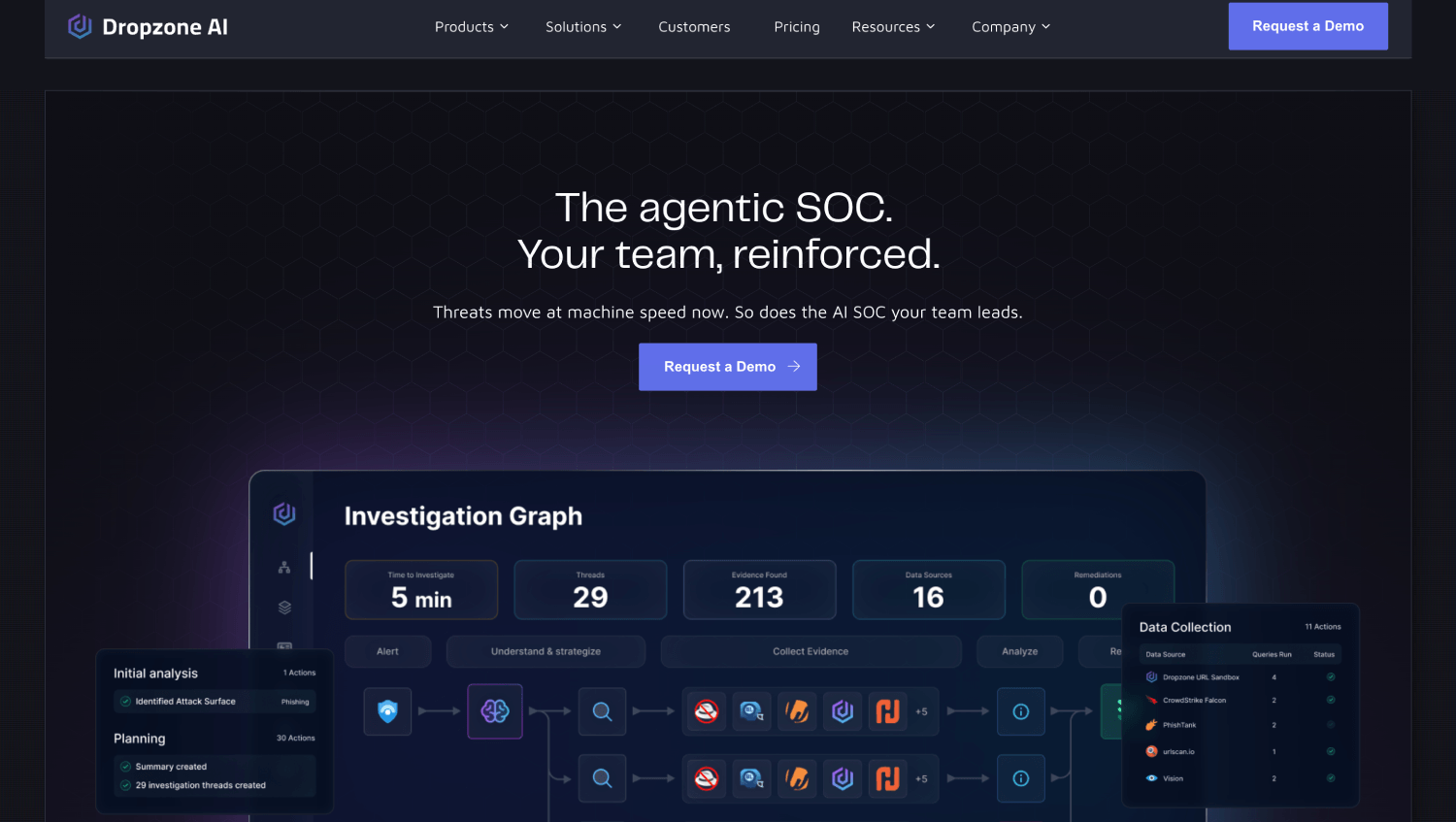
Dropzone AI runs autonomous alert investigations end to end, producing a written report for each alert that includes enrichment, reasoning, and a recommended disposition. It connects to SIEMs via API and uses a combination of tool calls and LLM reasoning to mimic the steps a tier-1 analyst would take: checking IP reputation, correlating historical activity, verifying asset ownership. The platform does not require playbook authoring in the traditional sense; instead, you configure its knowledge base about your environment (what is normal for your cloud accounts, which IP ranges are trusted). Dropzone is a strong candidate for teams under 10 analysts who are drowning in volume and cannot hire faster than the alert backlog grows. The SIEM integration breadth across Splunk, Sentinel, Elastic, QRadar, and Chronicle is a genuine advantage for heterogeneous environments. Pricing is not publicly disclosed.
Prophet Security
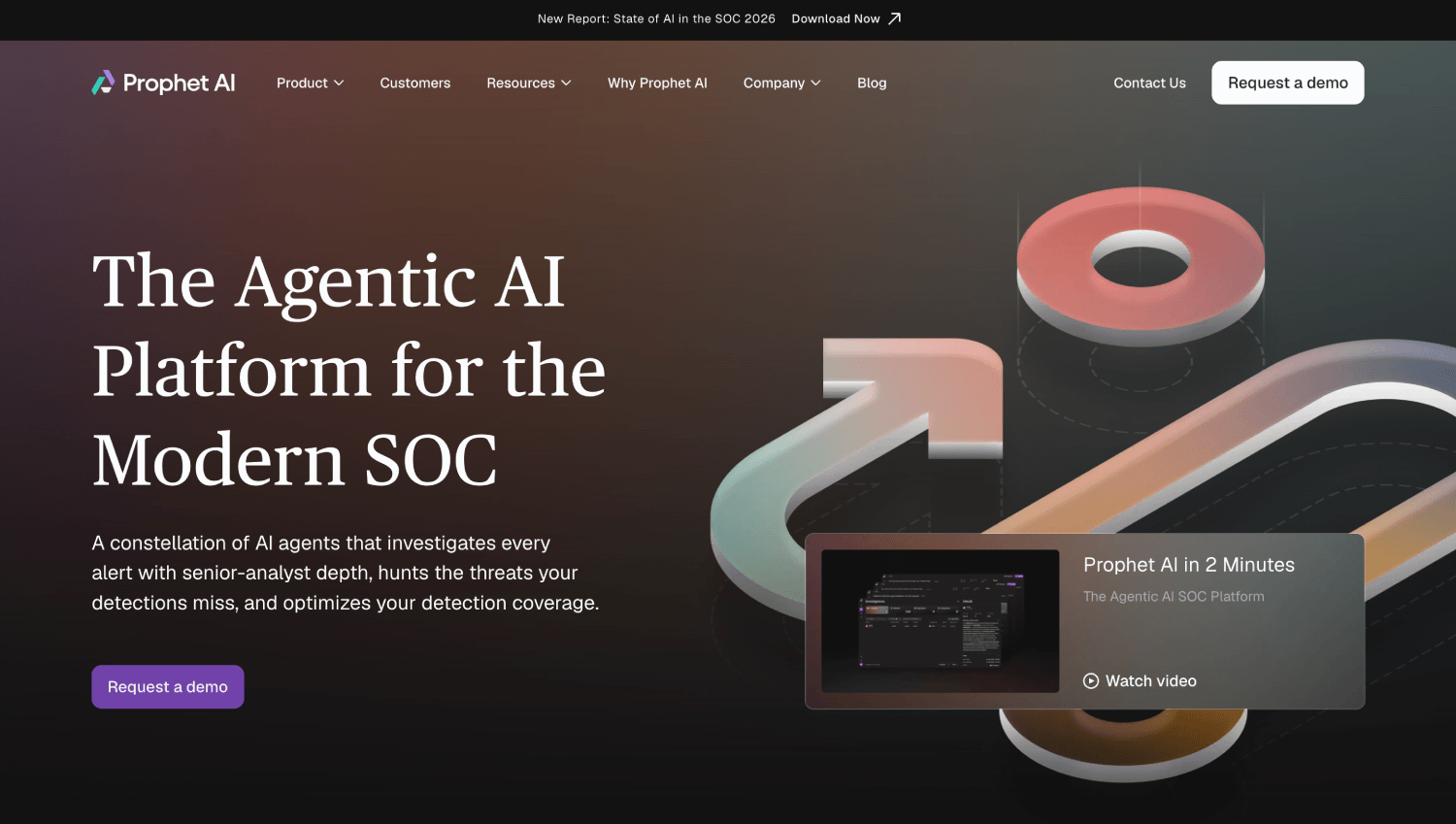
Prophet Security positions itself as an AI analyst that investigates alerts autonomously and writes a full investigation report before a human analyst touches the ticket. The differentiation from Dropzone is architectural emphasis: Prophet places heavier weight on identity context, pulling from your IdP (Okta, Entra, Google Workspace) to assess whether suspicious behavior is user-consistent. That makes it particularly useful for environments where identity-based detections make up a large share of alert volume, which is most cloud-first organizations. Prophet supports Splunk, Sentinel, CrowdStrike, and Elastic. Pricing is not publicly disclosed.
Radiant Security
Radiant Security takes a similar autonomous investigation approach and has emphasized its AI SOC model for MSSP deployments as well as direct enterprise use. Its architecture ingests alerts from the SIEM and enriches them against a broad set of threat intelligence and contextual data before rendering a verdict. Radiant supports Splunk, Sentinel, QRadar, Elastic, and Chronicle. One architectural note: Radiant builds environment-specific behavioral baselines over time, which means triage accuracy in the first two weeks of deployment is lower than at the 60-day mark. Set pilot expectations accordingly. Pricing is not publicly disclosed.
Intezer
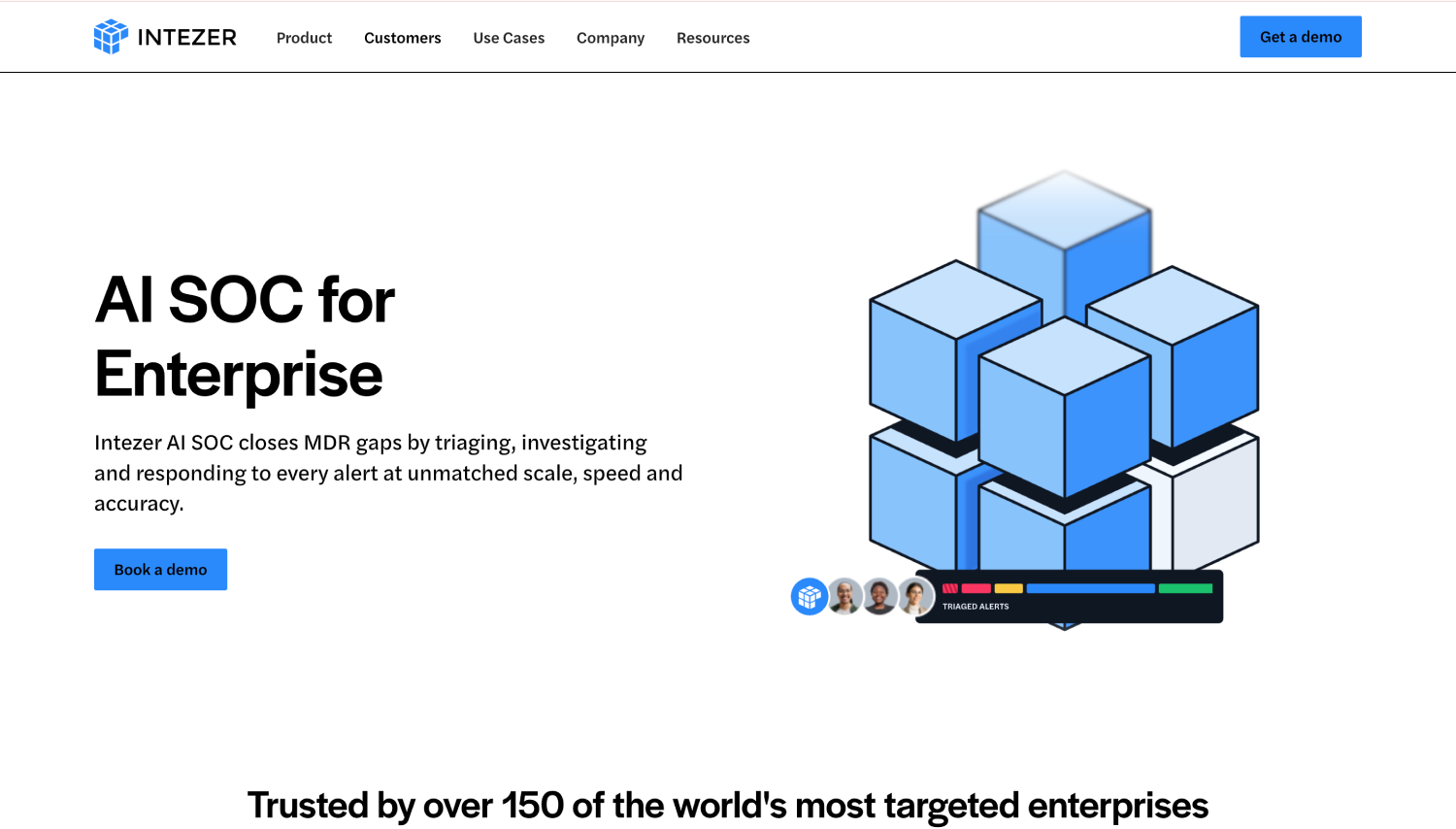
Intezer is currently positioned as an AI SOC analyst platform. Its code similarity and genetic malware analysis capabilities give it an edge on alert triage involving malware samples and endpoint detections. Intezer integrates with Splunk, Sentinel, QRadar, and ServiceNow via API, and it supports EDR alert ingestion from multiple sources. Teams with heavy endpoint alert volume and frequent malware-related triage should put Intezer higher on their shortlist than teams whose primary alert sources are cloud infrastructure logs. Pricing is not publicly disclosed.
Torq
Torq is a hyperautomation platform with AI capabilities layered on top of a workflow orchestration engine. It is closer to an evolved SOAR than a pure AI analyst. The AI layer in Torq’s platform helps build workflows from natural language descriptions and can recommend next steps during an investigation, but the underlying execution model is still workflow-based. That is a feature for teams with mature playbooks that want to automate their existing procedures rather than replace analyst judgment entirely. It is a limitation for teams expecting autonomous triage without workflow authoring. Torq integrates broadly across security tooling categories. Pricing is not publicly disclosed.
Swimlane
Swimlane has been a SOAR vendor for years, and its Turbine AI layer extends that foundation rather than replacing it. The AI capabilities focus on case management assistance, recommended playbook selection, and anomaly surfacing within existing workflows. Teams that built institutional knowledge into Swimlane playbooks get genuine value from Turbine without rebuilding their automation logic. Teams looking to eliminate playbook maintenance as a concept will find Swimlane’s model uncomfortable, because the AI sits on top of playbooks rather than under them. It integrates across Splunk, Sentinel, QRadar, Elastic, and Chronicle. Pricing is not publicly disclosed.
D3 Security Morpheus
D3 Security’s Morpheus is an AI orchestration layer built over D3’s SOAR engine. The architecture gives it broad integration coverage across legacy SIEMs including ArcSight, which none of the pure-AI-overlay vendors support well. Morpheus is worth evaluating for teams running ArcSight or mixed SIEM environments that include older infrastructure. The AI capabilities focus on playbook automation assistance and investigation correlation. Pricing is not publicly disclosed.
Stellar Cyber
Stellar Cyber is an open XDR platform that includes a built-in SIEM, which changes the evaluation model entirely. For teams considering Stellar Cyber, the question is not “does it integrate with my SIEM” but “am I willing to migrate my SIEM to this platform or run it as a supplemental layer.” Stellar Cyber correlates across ingested telemetry using AI-driven threat detection and includes native triage capabilities. Teams actively considering SIEM consolidation or those evaluating open XDR architectures should include it on their shortlist. Pricing is asset-based and not publicly disclosed.
Exaforce
Exaforce is a newer entrant positioning itself as an agentic SOC platform with emphasis on reducing analyst toil through autonomous investigation. It integrates with Splunk, Sentinel, Chronicle, and QRadar. The platform emphasizes context continuity across investigations, meaning the AI carries forward what it learned from earlier investigations in the same environment rather than starting cold on each alert. That contextual memory is the meaningful architectural distinction from platforms that treat each alert in isolation. Pricing is not publicly disclosed.
Qevlar AI
Qevlar AI focuses specifically on autonomous investigation of complex alerts, with a reasoning engine designed to follow multi-hop investigation paths: alert fires, AI checks related logs, correlates with identity events, pivots to network data, and renders a conclusion with the full chain shown. The emphasis on showing the reasoning chain rather than just the conclusion is operationally important for teams that need to audit model outputs before acting. It supports Splunk, Sentinel, QRadar, and Elastic. Pricing is not publicly disclosed.
Crogl
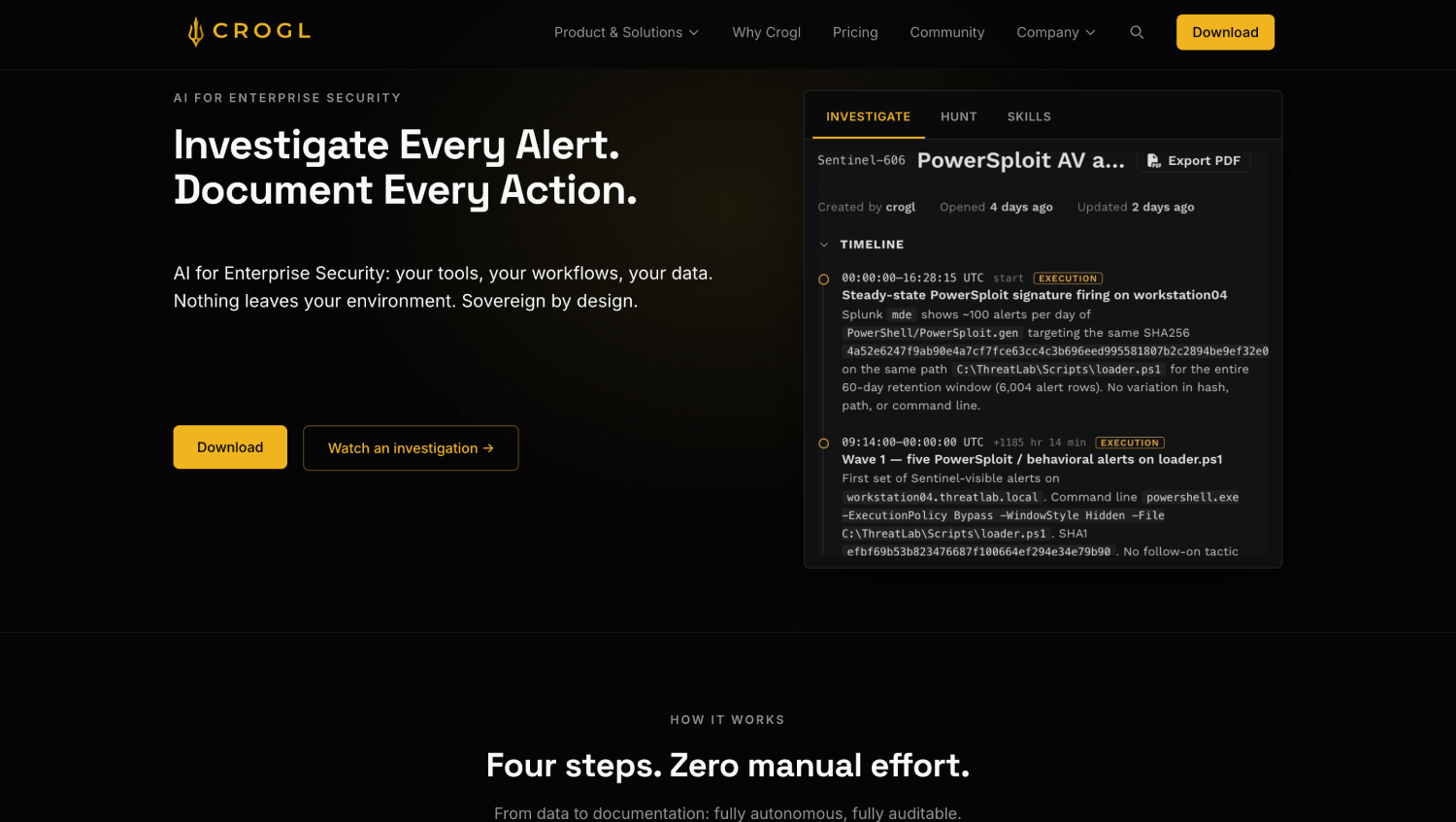
Crogl is a reasoning-layer overlay that connects to Splunk, Sentinel, and Chronicle and performs AI-driven investigation by querying those data sources directly rather than waiting for alerts to fire. The distinction matters: instead of only analyzing what your SIEM surfaced, Crogl can actively look for related evidence in raw log data. That changes its value proposition for teams where SIEM detection coverage has gaps they are aware of but have not closed. Pricing is not publicly disclosed.
Legion AI
Legion AI positions itself as a fully autonomous SOC agent designed to handle the complete tier-1 and tier-2 analyst workflow. It integrates with Splunk, Sentinel, and QRadar. The claims around autonomous operation without human-in-the-loop review at each step put it at the aggressive end of the autonomy spectrum, which makes it more interesting for mature SOC teams comfortable with auditing AI outputs in batch rather than in real time, and more risky for teams that have not previously built detection review processes. Pricing is not publicly disclosed.
Conifers
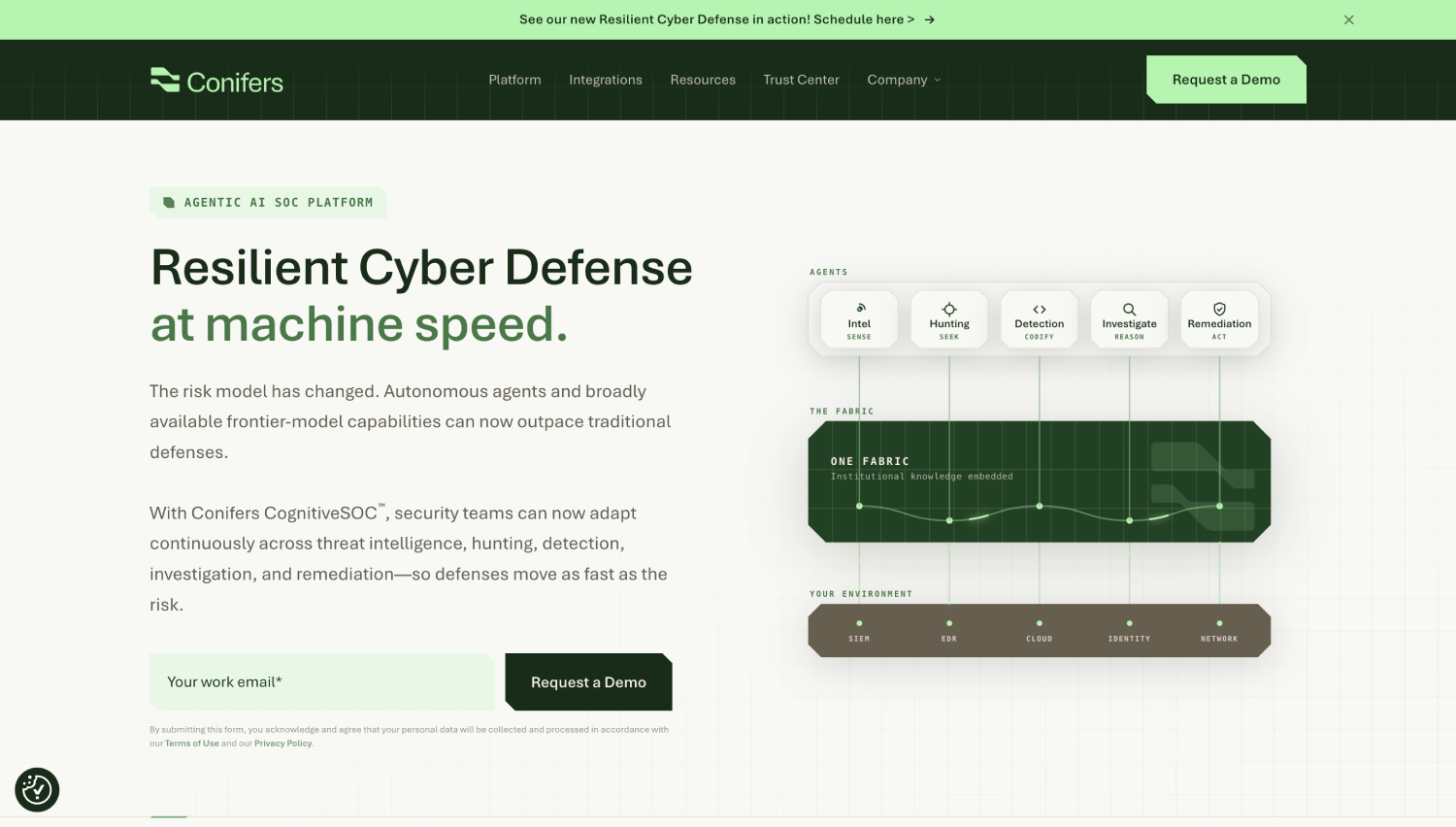
Conifers is a detection and response platform that uses AI agents to handle alert triage, investigation correlation, and response orchestration. It supports Splunk, Sentinel, Chronicle, and Elastic. Conifers has placed emphasis on being environment-aware from initial deployment, using an onboarding process that captures your asset inventory, identity structure, and normal traffic patterns before investigations begin. That upfront context capture is designed to reduce the first-30-days accuracy degradation that affects most AI SOC platforms during baseline learning. Pricing is not publicly disclosed.
How to Build a Shortlist by SIEM and Alert Volume
The practical shortlist logic runs through three gates in order: SIEM match, team size, and alert composition. Run through them before sending a single RFP.
Gate 1: SIEM match. If you run Microsoft Sentinel as your primary SIEM, start with Microsoft Security Copilot and Prophet Security. Both have documented, deep Sentinel integrations. If you run Splunk, every platform on this list has a Splunk integration, which means SIEM compatibility is not a differentiator and you move to Gate 2. If you run QRadar or ArcSight, your shortlist is shorter: D3 Morpheus, Intezer, Radiant, and Stellar Cyber all have QRadar integration documentation. ArcSight narrows it to D3 Morpheus as the most documented option.
Gate 2: Team size and oversight capacity. If you have fewer than five analysts and no dedicated detection engineer, favor platforms that minimize tuning burden and provide human-readable reasoning chains by default: Dropzone AI, Conifers, and Qevlar AI. If you have a detection engineering function and want AI to extend what senior analysts can cover rather than replace the analyst tier, Swimlane Turbine, Torq, and Charlotte AI (if you are Falcon-heavy) are better fits.
Gate 3: Alert composition. Heavy endpoint and malware alert volume points toward Intezer. Heavy identity and cloud alert volume points toward Prophet Security. Mixed multi-source environments without a dominant category are the intended target for Dropzone AI, Radiant, and Stellar Cyber.
If you are deploying AI agents across other parts of your security stack alongside a SOC platform, the adjacent risk surface is worth understanding. The AI agent security platform comparison on SecurityOpsWire covers what happens when the agents themselves become an attack surface, which is a real consideration for agentic SOC deployments where the AI has permission to query your IdP, execute searches, or close tickets autonomously.
What Accuracy Should a Team Expect on Tier-1 Triage?
Vendors claim high triage automation rates in marketing materials. Those figures are not fabricated, but they are measured in controlled conditions. A more useful framing is to think about where accuracy degrades rather than what the ceiling is.
Accuracy drops reliably in four conditions. First, during the first 30 days before the platform has learned your environment’s baseline behavior. Second, on alert types the platform was not trained on heavily, typically operational technology alerts, or highly custom application logs without standard schema. Third, during incident response, when alert volume spikes and correlated events from a single attack chain look like independent alerts to a model without full incident context. Fourth, after significant changes in your environment, such as a major cloud migration or an acquisition that doubles your endpoint count without a corresponding update to the platform’s asset context.
Say a security team at a mid-sized financial services firm runs 1,800 alerts per day through an AI SOC overlay on top of Splunk. In the first two weeks, the platform correctly dismisses 78 percent of confirmed benign alerts without analyst review, escalates 85 percent of true positives to the queue, and generates investigation reports that pass the quality gate 71 percent of the time. By day 45, after environment-specific tuning and 12 custom suppression rules, benign accuracy rises to 93 percent, escalation recall to 91 percent, and report quality to 84 percent. That trajectory is representative of what teams report across several platforms. The week-one number is not the operating number.
Agentic SOC Platforms vs AI-Assisted SOC Tools: The Architectural Difference That Matters
The word “agentic” has become the default marketing adjective for anything that does more than one step without a human click. It is worth having a precise definition before you use it in a procurement conversation.
An agentic SOC platform, in the specific technical sense, uses an AI agent that can call external tools, reason about the output, decide on the next tool call, and iterate until it reaches a conclusion or a stopping condition. This is different from a platform that runs a fixed sequence of enrichment steps and applies an LLM at the end to classify the result. The distinction matters for how the platform handles novel alert types: a true agentic system can decide to query a data source it was not pre-configured to query, because the reasoning step determines that source is relevant. A fixed-pipeline system cannot.
Dropzone AI, Qevlar AI, Crogl, and Prophet Security have published architecture descriptions consistent with agentic patterns. Charlotte AI, Swimlane Turbine, and Torq are closer to LLM-enhanced workflow systems. The others sit at various points between those poles, and the honest answer is that vendor marketing blurs the line aggressively. Asking a vendor to show you the tool-calling trace from a real investigation, not a demo, is the fastest way to assess where they actually sit on the spectrum.
The agentic framing also connects to a broader control problem. When a SOC agent can autonomously query your IdP, execute Splunk searches with broad scope, and write back to your ticketing system, the agent’s permissions become an attack surface. Security teams building agentic SOC workflows should define a least-privilege permission model for the agent just as they would for a service account. The model used for securing agent-to-tool access via Model Context Protocol is directly applicable to agentic SOC deployments where the AI is calling security tools on your behalf.
What Breaks When You Deploy an AI SOC Platform at Scale?
The category’s failure modes are different from SOAR’s, but they are not smaller. Four operational problems surface consistently at scale.
The first is alert flooding from low-fidelity sources. If your SIEM fires on every failed SSH login from an internal scanner, the AI SOC platform will investigate each one, generate a report for each one, and the analysts will spend time reviewing AI reports rather than reviewing actual alerts. The garbage-in problem does not disappear with AI triage; it just moves upstream. Tuning your SIEM detection logic before deploying an AI SOC layer is not optional, it is a prerequisite.
The second is model drift when your environment changes. Most platforms build environmental baselines at deployment. If you spin up a new AWS account, migrate to a new IdP, or acquire a company, the platform’s baseline may not update automatically. Unannounced changes in the environment are the most common source of AI triage regressions in production.
The third is the audit and accountability gap. When an AI SOC platform closes a ticket as benign and the incident was real, who is responsible? In a regulated environment, your incident response procedures need to specify how AI disposition decisions are logged, reviewed, and attributed. Most platforms do not help you answer this question out of the box.
The fourth is integration sprawl. Every platform on this list wants to connect to your SIEM, EDR, IdP, threat intelligence feeds, ticketing system, and cloud platforms. Each integration is a credential, a permission scope, and a potential misconfiguration. Teams that have worked through proper AI agent discovery and monitoring know that the inventory of what the AI can touch grows faster than most security teams expect.
Frequently Asked Questions
What does an AI SOC platform actually do differently from a traditional SOAR?
A traditional SOAR executes predefined playbooks: if condition A is true, take action B. An AI SOC platform uses a language model to reason over alert context and produce a triage decision and investigation summary without requiring every possible condition to be pre-defined. The failure mode shifts from “unhandled condition breaks the playbook” to “model reaches a confident-sounding but incorrect conclusion.” Both fail; they fail differently. AI SOC platforms reduce playbook maintenance burden at the cost of introducing model interpretability risk.
Which AI SOC platform works best with Splunk?
Every platform on this list has a documented Splunk integration, which means Splunk compatibility is not a differentiator. For Splunk environments, the shortlist decision comes down to alert composition and team size. Intezer fits heavy endpoint and malware alert volume. Prophet Security fits identity-heavy environments. Dropzone AI and Radiant Security are general-purpose overlays that work well on mixed Splunk alert streams. Avoid using Splunk compatibility alone as a selection criterion; it eliminates nothing from the list.
How should a team define the triage accuracy bar for a pilot?
Measure four numbers, not one: benign disposition accuracy (target 95 percent before reducing human review), escalation recall for true positives (request this number explicitly from the vendor during the pilot, it is not volunteered), investigation report quality (pass/fail graded by a senior analyst), and tuning debt at day 30 (count of suppression rules and custom adjustments required). Base all measurements on your own environment’s alert mix over at least 30 days. Demo datasets are not predictive of production performance.
Do AI SOC platforms replace tier-1 analysts?
In high-volume, low-complexity alert categories, they effectively replace the mechanical work of tier-1 triage. They do not replace the judgment of knowing which closed ticket to reopen when a second signal arrives, or the institutional knowledge of which asset owner to call during an active incident. Teams that have deployed AI SOC platforms at scale consistently report that analyst time shifts from alert processing toward validation, tuning, and higher-complexity investigations rather than headcount reduction. Whether that shift justifies the cost depends on the value your organization places on analyst time.
How does Microsoft Security Copilot pricing work?
Microsoft Security Copilot charges based on Security Compute Units (SCUs), a consumption model tied to how many AI operations your team runs. Complex investigation queries consume more SCUs than simple lookups. Microsoft’s documentation describes the SCU model, and pricing is visible in the Azure pricing calculator. The practical implication is that costs during a high-volume incident, when analysts are running many queries under pressure, are higher than during normal operations. Budget for variance, not just average consumption.
Can AI SOC platforms handle cloud-native environments, or are they built for traditional SOC alert types?
Coverage varies significantly. Platforms that started with endpoint or malware triage (Intezer) have deeper accuracy on those alert types. Platforms designed from the ground up for cloud environments (Stellar Cyber as an XDR, and some overlay vendors like Conifers) handle cloud infrastructure alerts with more contextual accuracy. The key question to ask any vendor is what percentage of their training or evaluation data comes from cloud-native alert sources, specifically AWS CloudTrail, Azure Activity Logs, and GCP Audit Logs, as opposed to endpoint and network telemetry.
Is there a risk that the AI SOC platform itself becomes an attack surface?
Yes, and it is an underexamined risk in most evaluations. An agentic SOC platform that has read access to your SIEM, query execution rights over your IdP, and write access to your ticketing system holds significant privilege. If the agent’s credentials are compromised, or if a prompt injection attack via a crafted alert manipulates the model’s behavior, the blast radius is proportional to those permissions. Define a least-privilege permission model for the agent at deployment. Treat the AI’s service account identity with the same rigor you would apply to a privileged human account.
What is the right team size to get value from an AI SOC platform?
Teams with two to four analysts and alert volumes that exceed what those analysts can meaningfully review see the fastest ROI, because the alternative is unreviewed alerts rather than displaced analyst time. Teams with 20-plus analysts and mature detection engineering functions get more value from AI copilot tools that assist senior analysis than from autonomous triage products. The worst-fit scenario is a team with no detection engineering capacity and no process for auditing AI disposition decisions, because neither human review nor quality control exists to catch model errors before they become missed incidents.
The Frame That Actually Matters for This Decision
The Reddit skepticism about AI SOC tools is not wrong, it is just aimed at the previous generation of the technology. SOAR playbook fatigue is a real operational memory most security teams carry. The honest case for the current generation is not that the problems go away; it is that the problems change shape. Brittle automation that breaks on unhandled conditions is replaced by probabilistic reasoning that can handle novel conditions but cannot guarantee correctness. For many teams, that is a better trade. For teams without the oversight capacity to validate model outputs, it may not be.
The evaluation posture that pays off is treating an AI SOC platform the way you would treat a new junior analyst: with defined scope, active review of their work for the first 90 days, clear escalation criteria, and a process for catching errors before they compound. The teams that get burned are the ones that treat the platform as a black box to which alerts are fed and conclusions are trusted. The teams that get value are the ones that instrument the model’s performance the same way they would instrument a detection rule, with metrics, review cadence, and a process for tuning when accuracy drifts.
If your organization is expanding AI usage beyond the SOC and into broader security operations, the control surface for AI agents across your stack is worth examining alongside this decision. The security controls for AI agents operating across enterprise environments , covered in the AI agent security vs AI-SPM analysis on SecurityOpsWire , intersect directly with the governance questions that agentic SOC platforms raise, particularly around what the AI is permitted to do without a human approval step and how that permission scope is audited over time.