
- GitHub Advanced Security covers scanning inside a repository: code scanning via CodeQL, secret scanning, and dependency review. It does not correlate findings across scanners, map vulnerabilities to running services, model reachability, or track posture at the program level.
- GHAS licensing splits into Secret Protection and Code Security, each billed per active committer per month. The per-committer model scales predictably for small teams and gets expensive fast for large, distributed engineering organizations.
- Application Security Posture Management adds the correlation and context layer that GHAS does not provide: which finding is reachable in production, who owns the affected service, and where a vulnerability sits in the SBOM chain.
- The right ASPM tool for a GitHub-centric team depends on whether the gap is correlation (ArmorCode, Apiiro), supply chain visibility (Endor Labs, Ox Security), developer-native remediation (Snyk, Semgrep, Jit), or program-level posture tracking (Cycode, Legit Security, Arnica, Aikido).
- Integration model matters as much as feature set: GitHub App, GitHub Action, and webhook integrations carry different trust boundaries, permissions scopes, and operational overhead.
The best ASPM tools for GitHub-centric engineering teams fall into three categories: correlation and posture platforms (ArmorCode, Apiiro, Cycode, Legit Security) that aggregate findings from GHAS and other scanners into a single risk view; supply chain and reachability tools (Endor Labs, Ox Security) that extend beyond what GitHub’s dependency graph shows; and developer-native security tools (Snyk, Semgrep, Jit, Aikido, Arnica) that embed directly into GitHub workflows and reduce the distance between a finding and a fix. Most GitHub teams need elements from more than one category.
What Does GitHub Advanced Security Actually Cover, and Where Does It Stop?
GitHub Advanced Security bundles three distinct capabilities: code scanning (powered by CodeQL and third-party SARIF-compatible scanners), secret scanning with push protection, and dependency review tied to the GitHub dependency graph. For teams on GitHub Enterprise Cloud or GitHub Enterprise Server, these are the scanning primitives GHAS provides.
The licensing model as of mid-2025 splits into two separately purchased add-ons: Secret Protection at $19 USD per active committer per month and Code Security at $30 USD per active committer per month, verified against the GitHub Advanced Security source page at time of publication. The per-committer structure is predictable for engineering teams under a few hundred developers; it becomes a material line item as headcount grows, particularly when contractor and bot commits count toward the active committer threshold. For the current definition of active committer and billing rules for public versus private repositories, consult the GitHub Advanced Security page directly, as GitHub does not publish those specifics in a consistently accessible location and the details are subject to change.
Where GHAS stops is at the repository boundary. It surfaces findings per repository. It does not automatically correlate a critical CodeQL alert in one repo with a dependency alert in a downstream service that consumes the same package. It does not map findings to a running production service, apply reachability analysis to determine whether a vulnerable function is actually called in the execution path, or maintain a normalized risk score across multiple scanner types. Those capabilities are what ASPM adds.
How Do ASPM Tools Integrate with GitHub: App, Action, or Webhook?
The integration architecture determines how much trust and permission the tool holds inside your GitHub organization, and how it behaves at scale.
A GitHub App integration operates with fine-grained, repository-scoped permissions and is the model most enterprise ASPM platforms prefer. The tool installs into the GitHub org, requests specific permissions (read access to code, pull requests, or check runs), and receives webhook events. This model supports installation-level rate limits separate from your organization’s API quota, and the permissions surface is auditable through the GitHub UI.
A GitHub Actions integration runs as a step inside a workflow YAML file. The tool executes in the CI pipeline, scans the code in the runner context, and posts results back via the SARIF upload API or via comments on pull requests. This model gives teams tight control over when scanning runs and what secrets the scanner can access, but it requires workflow file changes in every repository and scales awkwardly across hundreds of repos without automation.
A webhook integration listens for organization-level or repository-level events (push, pull request, code scanning alert) and sends payloads to the ASPM platform’s ingest endpoint. This is a lighter touch but provides no in-workflow enforcement; it is best suited for aggregation and reporting rather than blocking builds on policy violations.
Most of the platforms below use GitHub App as the primary integration model, with Actions available for scanner execution when the platform’s own scanner runs inside CI rather than as a hosted service.
The SecurityOpsWire ASPM Coverage Test: Four Questions Before You Buy
Before scoping third-party ASPM spend, run every candidate tool through these four questions. The answers reveal whether you are buying additional scanning, correlation, posture management, or some combination.
- Scanner or aggregator? Does the tool run its own scans (SAST, SCA, secrets), or does it pull findings from GHAS and other scanners you already run? If you already pay for GHAS Code Security, a tool that only runs its own SAST scan may duplicate spend without adding correlation value.
- Reachability or severity-only? Does the tool apply call-graph analysis or runtime context to determine whether a vulnerable function is reachable in the actual codebase? Tools that filter and prioritize only by CVSS score still surface hundreds of findings teams cannot action.
- Service mapping or repo mapping? Can the tool connect a repository finding to the production service it runs in, the team that owns it, and the risk tier of that service? Repo-level findings with no service context shift triage burden back to developers.
- Per-committer or per-repo pricing? Understand how the cost model interacts with your engineering headcount and GitHub billing. A tool with per-developer pricing compounds on top of GHAS per-committer cost. Some tools price per application or per scan target, which can be cheaper for large teams with a bounded number of services.
10 ASPM Tools Built for GitHub-Centric Engineering Teams
1. ArmorCode
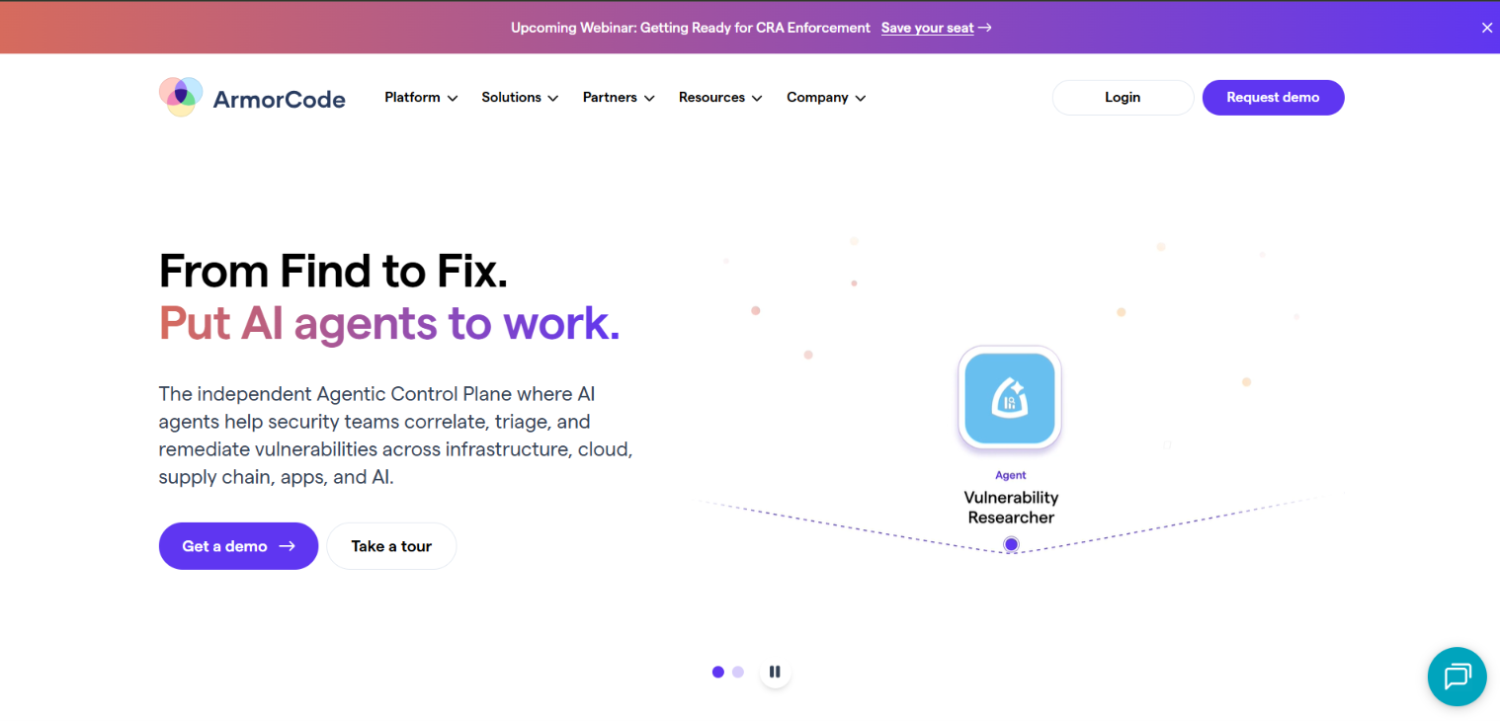
ArmorCode is an ASPM platform focused on aggregating findings from existing scanners rather than running its own. It ingests SARIF output from GHAS code scanning, secret scanning alerts, Dependabot findings, and results from third-party tools, then normalizes them into a unified risk model. The platform applies deduplication across scanner types, so a vulnerability found by both CodeQL and Snyk appears once with correlated evidence rather than as two separate tickets.
For GitHub teams, the GitHub App integration maps findings to code owners using the CODEOWNERS file, routing alerts to the right team without manual assignment. ArmorCode also tracks remediation SLAs at the program level, which matters for teams reporting to a board or handling compliance obligations. It does not run SAST itself, so it complements rather than replaces GHAS Code Security. Pricing is not publicly disclosed; ArmorCode quotes per environment.
2. Apiiro
Apiiro takes a risk-graph approach to application security posture. Rather than treating findings as a flat list, it builds a graph of code components, contributors, APIs, data flows, and business context, then overlays security findings on that graph. For GitHub-centric teams, this means a critical finding in a payment processing service gets treated differently from the same finding in an internal tooling repo.
Apiiro integrates via GitHub App and ingests git history to build its risk model, which means it detects risky code changes in pull requests before merge, not just after scanning completes. The supply chain module tracks third-party dependencies and flags newly introduced risky packages at the PR stage. Pricing is not publicly disclosed.
3. Cycode
Cycode covers the full development lifecycle from SCM to pipeline to registry. Its GitHub integration monitors the SCM layer specifically: branch protection configurations, repository visibility settings, who has admin access to which repos, and whether workflows have been tampered with. These controls sit above the code scanning layer and are not covered by GHAS natively.
Cycode’s ASPM module aggregates findings from its own scanners (SAST, SCA, secrets, IaC) and from third-party tools, presenting a unified posture view. The SCM security layer is where Cycode differentiates most clearly from pure aggregation platforms: it treats the GitHub organization configuration as an attack surface, not just a delivery mechanism. Pricing is not publicly disclosed.
4. Legit Security
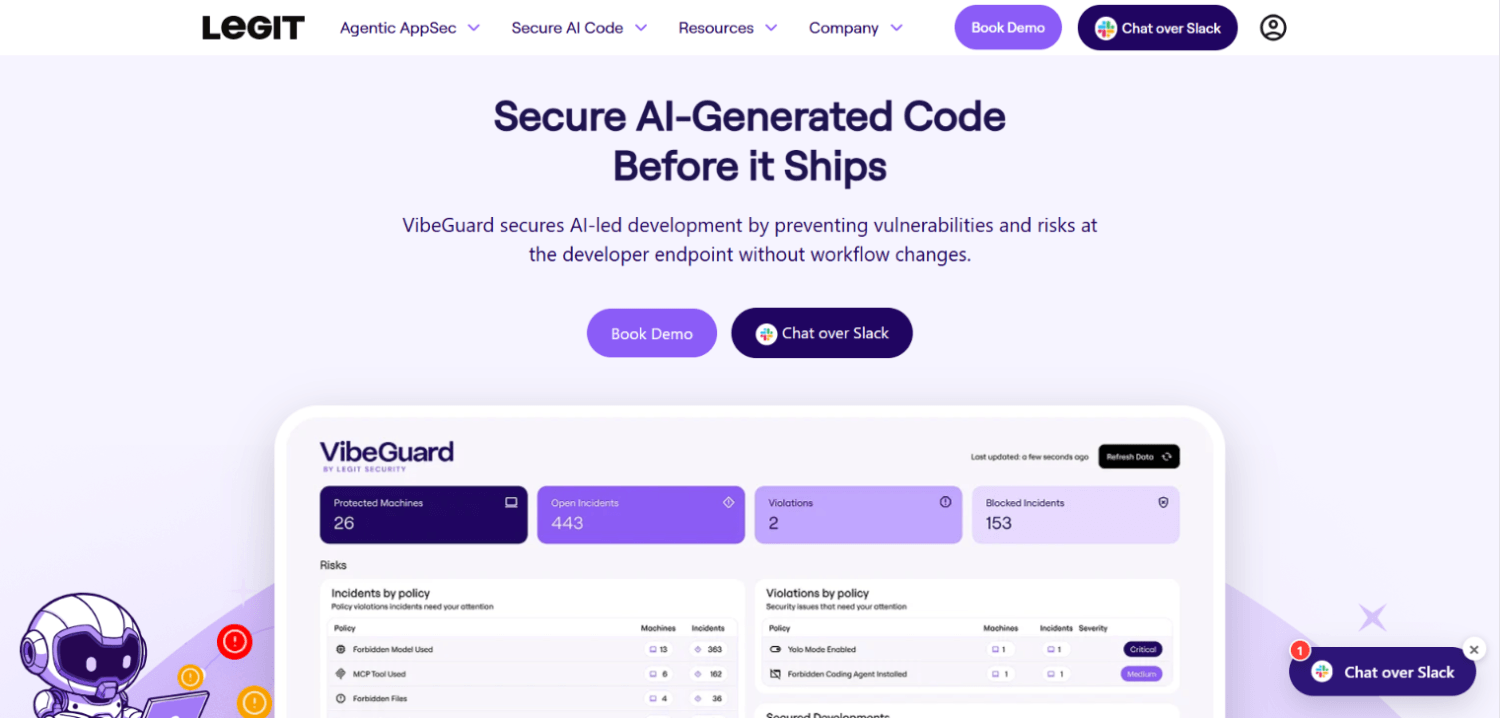
Legit Security focuses on software supply chain security and pipeline posture. Its GitHub integration discovers all repositories, workflows, Actions, and third-party integrations in an organization, then assesses them against supply chain security controls: are workflows pinning Actions by SHA, are secrets scoped appropriately, are artifacts signed, is SLSA attestation present?
For teams that have grown their GitHub Actions usage organically and now have hundreds of workflow files with inconsistent security posture, Legit provides visibility that GHAS does not. It also tracks code integrity from commit to deployment, identifying points in the pipeline where code could be tampered with. Pricing is not publicly disclosed.
5. Ox Security
Ox Security positions as an end-to-end application security platform with a heavy emphasis on supply chain and pipeline integrity. Its GitHub integration covers the repository layer, the Actions layer, and artifact integrity through to deployment. Ox ingests findings from GHAS and other scanners, then applies its own prioritization model, which considers exploitability context and whether a vulnerable dependency is actually reachable in the execution path.
The pipeline security module specifically tracks Actions used in workflows, flagging Actions pulled from unverified publishers or pinned to mutable tags. This addresses a category of supply chain risk that GHAS secret scanning and code scanning do not cover directly. Pricing is not publicly disclosed.
6. Arnica
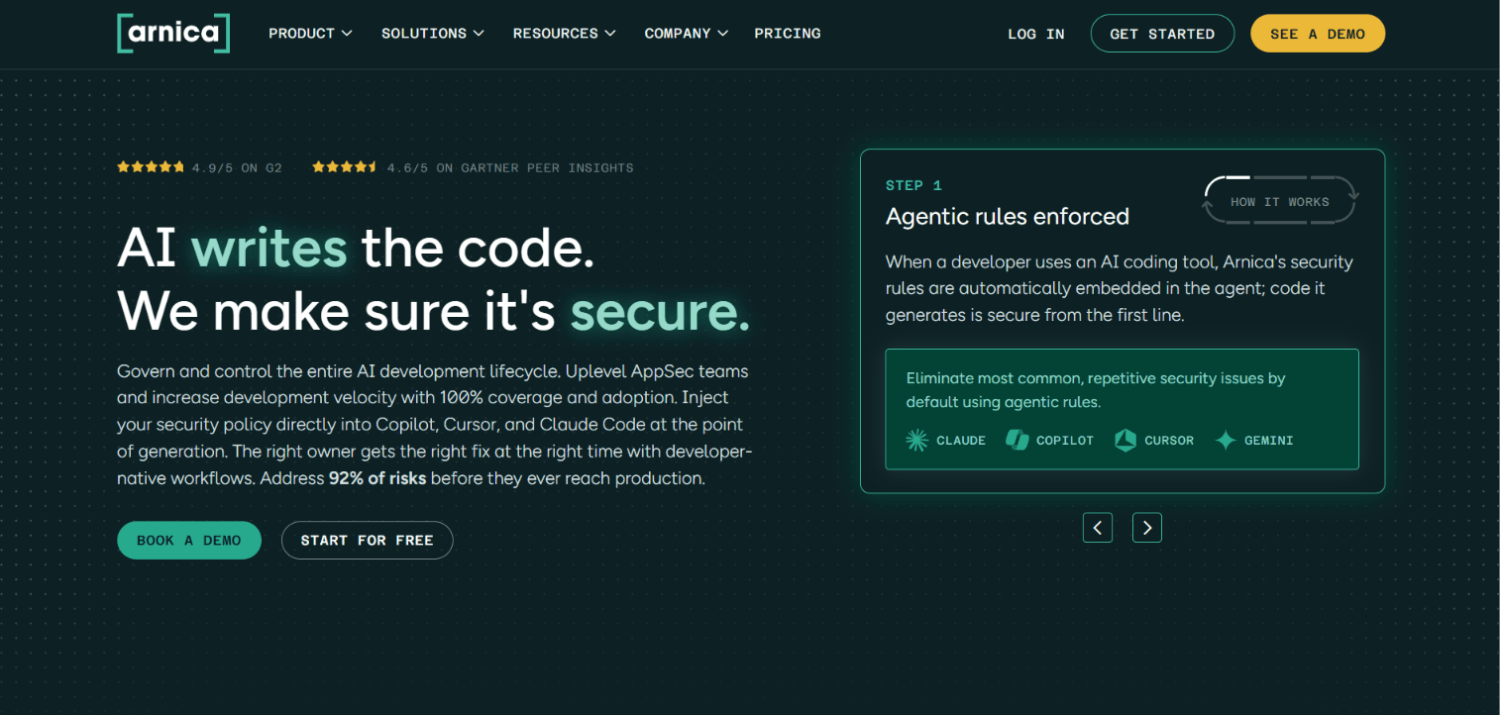
Arnica takes a different angle from most tools in this list. Its primary focus, as described on the Arnica site, is governance and control of AI-generated code , specifically enforcing agentic rules across the AI development lifecycle. For GitHub teams, this surfaces a dimension that GHAS does not address: governing the security posture of code produced by AI coding assistants and autonomous agents, alongside the identity risk layer inside the SCM.
A developer with admin access to a secrets vault repository who has not worked in that codebase in six months is a different kind of risk from a vulnerable dependency. Arnica connects non-human identity exposure inside repositories to the access patterns around it. Pricing is not publicly disclosed.
7. Semgrep
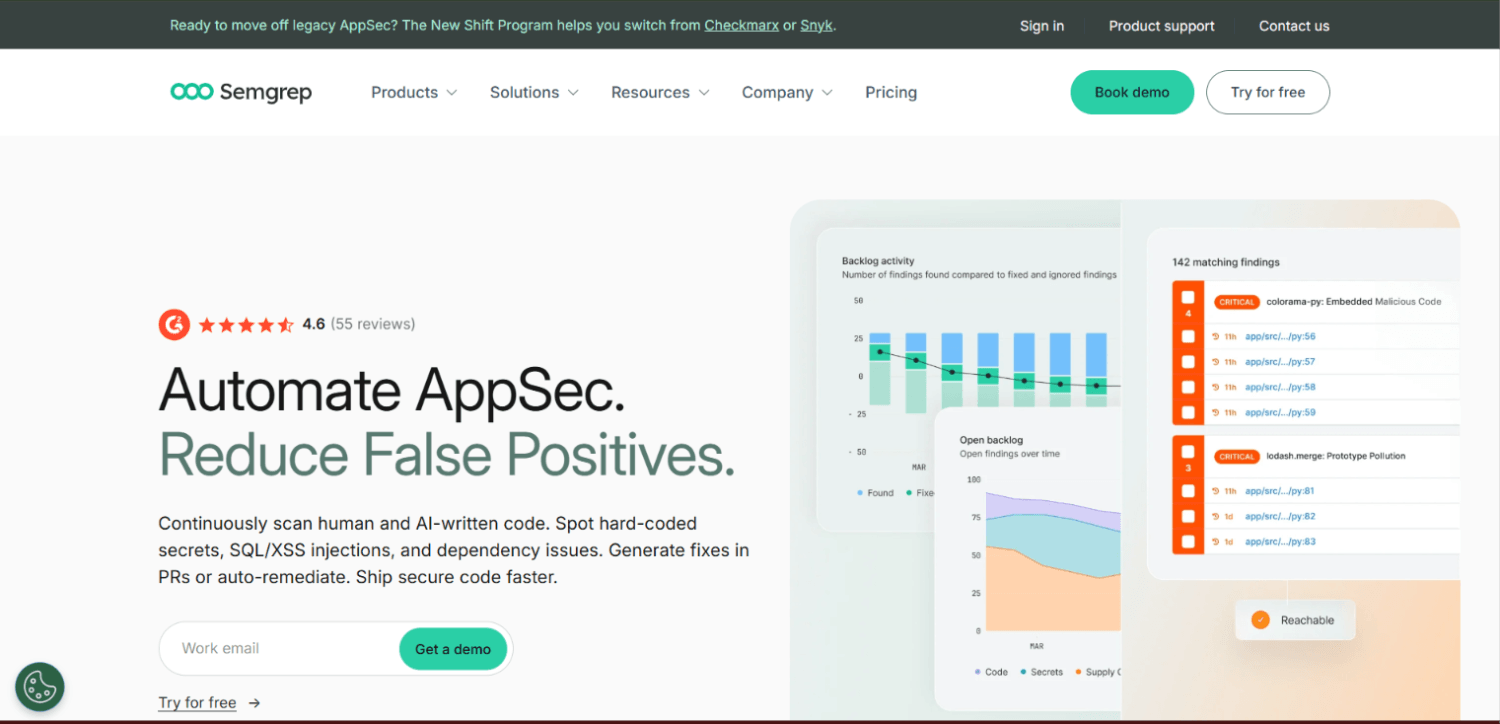
Semgrep runs as both a SAST scanner and an ASPM platform. The scanner is open source and widely used; the commercial platform adds cross-file analysis, Supply Chain (SCA), and Secrets modules, plus a central findings management layer that tracks posture over time. For GitHub teams, Semgrep installs as a GitHub Action or via GitHub App and posts findings directly to pull requests as inline code review comments.
Semgrep’s differentiation is rule customization. Its rule language lets security engineering teams write detection logic in the same syntax as the scanner runs, which means custom rules for internal frameworks, banned API patterns, or credential handling policies are practical to maintain. GHAS CodeQL can do this too, but CodeQL’s query language has a steeper learning curve. Semgrep publishes pricing for its Team tier at that URL; Enterprise pricing is quoted per environment.
8. Snyk
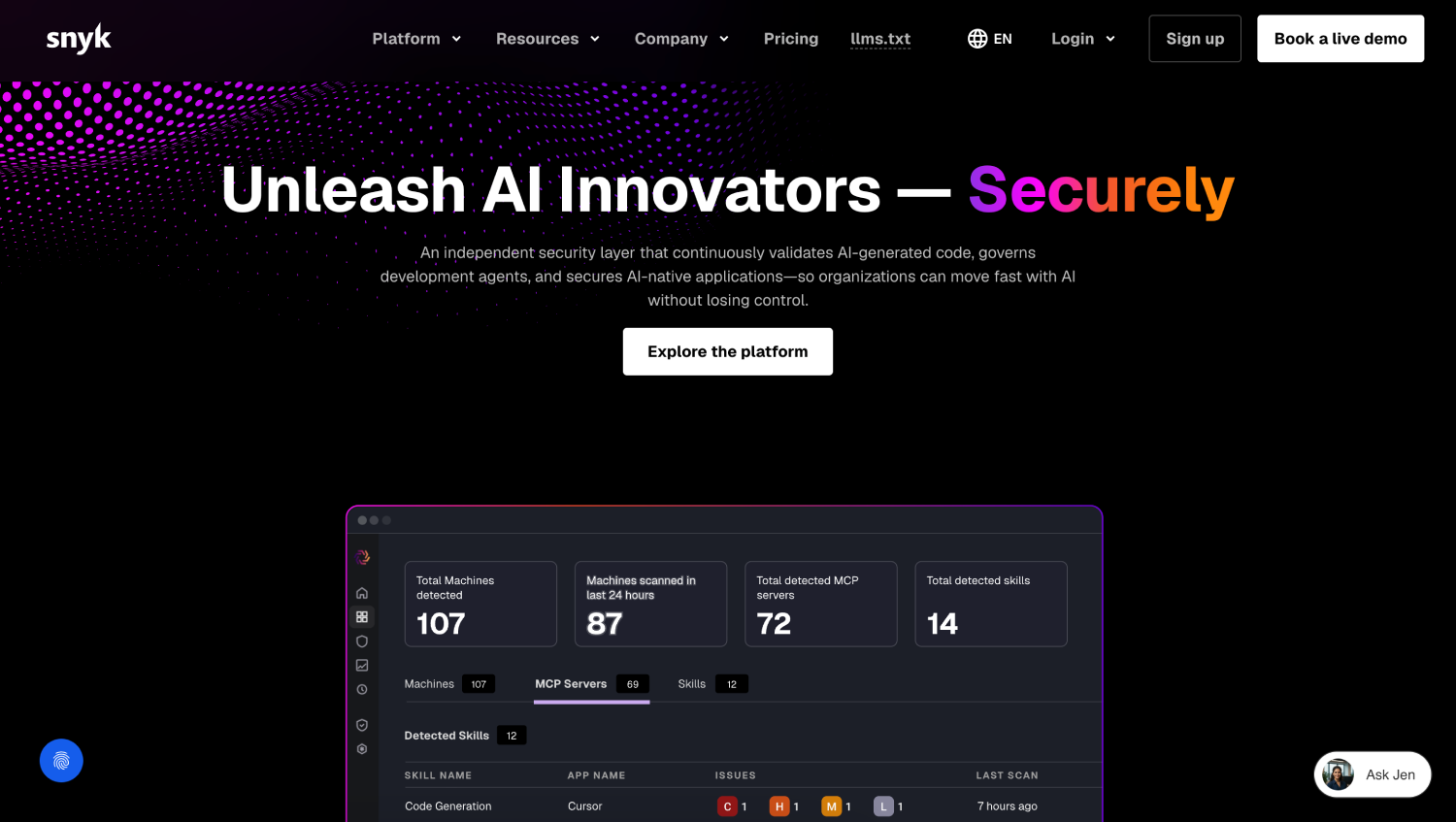
Snyk is the most commonly evaluated alternative when teams hit GHAS coverage gaps. Its GitHub integration is mature: GitHub App installation, PR checks that block merges on new high-severity findings, and a developer-facing fix PR generation that proposes the dependency upgrade automatically. Snyk covers SAST (Snyk Code), SCA (Snyk Open Source), container scanning (Snyk Container), and IaC (Snyk IaC).
The posture management question with Snyk is whether the platform’s reporting layer constitutes ASPM or just aggregated scanner output. Snyk’s AppRisk module is positioned as the ASPM layer: it maps applications to their constituent repositories, tracks coverage (which repos have Snyk enabled), and prioritizes findings by risk tier. For teams already paying for GHAS, the per-developer Snyk pricing model means evaluating whether the additional scanner coverage and AppRisk posture layer justify the combined cost. Snyk publishes its Free and Team tier pricing at that URL; verify current rates at time of purchase, as Enterprise pricing requires a quote.
9. Endor Labs
Endor Labs specializes in dependency lifecycle management and reachability analysis. Its core capability is building a call graph of a codebase and determining which vulnerabilities in third-party dependencies are actually reachable through the code’s execution path. This is a direct answer to the “we have 400 open SCA findings and do not know which to fix first” problem that GHAS Dependabot surfaces but does not resolve.
For GitHub teams, Endor Labs installs via GitHub App and integrates with Actions to run reachability analysis at the PR stage. It also tracks the entire dependency lifecycle: not just known CVEs but also package reputation, maintainer activity, and whether a dependency has been abandoned. The SBOM generation capability produces accurate SBOM artifacts tied to what is actually reachable, rather than every transitive dependency listed in a manifest. Pricing is not publicly disclosed.
10. Jit
Jit targets small and mid-size engineering teams that want comprehensive application security coverage without a dedicated AppSec team to operate it. Its model is a security plan layer on top of open source and commercial scanners: you define which security controls your application needs (SAST, DAST, SCA, secret scanning, IaC scanning), and Jit orchestrates the right scanner for each via GitHub Actions workflows.
For a team that does not want to configure and maintain individual scanner integrations across dozens of repositories, Jit reduces that operational overhead significantly. The trade-off is that the posture layer is lighter than dedicated ASPM platforms like ArmorCode or Apiiro; Jit is better at getting coverage deployed than at correlating findings into a risk model. The platform suits a 50-to-200 person engineering organization that needs to close AppSec coverage gaps quickly rather than an enterprise team building a mature ASPM program. Pricing is not publicly disclosed.
Aikido Security
Aikido Security covers a similar space to Jit but with a more opinionated interface. It runs its own scanners (SAST, SCA, container, IaC, secret detection, DAST) and presents findings in a developer-friendly dashboard designed to reduce alert fatigue through aggressive deduplication and business context filtering. GitHub integration is via GitHub App; Aikido automatically discovers all repositories in the organization and begins scanning without requiring workflow file changes.
The distinction from Jit is that Aikido controls its own scanner stack rather than orchestrating third-party tools, which means fewer integration surfaces to maintain but less flexibility to swap individual scanners. For teams that want to replace GHAS rather than extend it, Aikido’s combined scanner coverage and posture dashboard makes it a direct comparison point. Aikido publishes pricing tiers as of June 2025; verify current rates at time of purchase.
How Do Findings Get to the Right Code Owner in a GitHub Organization?
Routing a finding to the engineer who can fix it is an operational problem that GHAS partially solves through the CODEOWNERS file. When code scanning detects a vulnerability in a file, GitHub can notify the code owners of that file. The limitation is that CODEOWNERS maps files to teams, not services to risk tiers, and it does not route findings from multiple scanners through a unified assignment workflow.
ASPM platforms handle this in different ways. ArmorCode uses CODEOWNERS mappings directly and lets AppSec teams layer additional routing rules on top. Cycode maps repositories to business units through its own asset inventory. Apiiro’s risk graph associates findings with the contributors most active in the affected code, which is a different model from file ownership but often surfaces the right person faster for complex codebases.
For teams integrating ASPM findings into Jira or GitHub Issues, the critical operational question is whether the ASPM platform creates one ticket per finding or one ticket per unique vulnerability across affected repos. Per-finding ticket creation at scale overwhelms an engineering team’s sprint planning. ArmorCode, Snyk AppRisk, and Cycode all offer grouping and deduplication logic that controls ticket volume, though the specific configuration requires tuning.
ASPM Tool Comparison for GitHub Teams
| Tool | Primary Focus | GitHub Integration Model | Runs Own Scanner | Reachability Analysis | SCM Posture (Org Config) | Pricing Model |
|---|---|---|---|---|---|---|
| ArmorCode | Finding aggregation and posture | GitHub App | No (aggregator) | Via third-party scanners | No | Not public |
| Apiiro | Risk graph and PR-stage risk | GitHub App | Yes | Yes (code graph) | Partial | Not public |
| Cycode | SCM security and ASPM | GitHub App | Yes | Partial | Yes | Not public |
| Legit Security | Supply chain and pipeline posture | GitHub App | No (posture layer) | No | Yes | Not public |
| Ox Security | End-to-end supply chain | GitHub App | Yes | Yes | Yes | Not public |
| Arnica | AI code governance and access risk | GitHub App | No | No | Yes | Not public |
| Semgrep | SAST and SCA with posture layer | GitHub App or Action | Yes | No | No | Partial (Team tier public) |
| Snyk | Developer security and AppRisk | GitHub App | Yes | Yes (Snyk Open Source) | No | Partial (Team tier public) |
| Endor Labs | SCA and reachability | GitHub App and Action | Yes | Yes (call graph) | No | Not public |
| Jit | Coverage orchestration | GitHub Actions | No (orchestrator) | No | No | Not public |
| Aikido | All-in-one scanner and dashboard | GitHub App | Yes | No | No | Partial (tiers on site) |
How Does Per-Developer ASPM Pricing Compare with GHAS Per-Committer Cost?
GHAS pricing anchors to active committers, billed per month per private or internal repository. For current list pricing and the precise definition of active committer, consult the GitHub Advanced Security page or contact GitHub sales directly, as GitHub does not maintain a consistently public list price for Enterprise plans. The per-committer model means organizations with large numbers of developers making infrequent commits to sensitive repositories pay for those developers every month.
Consider a software company with 300 engineers, 20 of whom work primarily on the core product monorepo and the rest on internal tooling and microservices. Under per-committer billing, all 300 are likely active committers in any given month. GHAS costs apply to the full headcount. A third-party ASPM tool that prices per application or per repository instead can change the cost calculus significantly for that environment: 300 developers writing code across 40 services might trigger per-application pricing across 40 scan targets rather than per-developer billing across 300 people.
Aikido publishes tiered pricing on its site , starting at a flat rate up to a certain number of repositories , which can undercut per-developer pricing for mid-market engineering teams; verify current rates at time of purchase as pricing pages change. Tools like ArmorCode and Apiiro price per environment and do not publish list rates. When evaluating, require the vendor to quote based on your actual repository count, active committer count, and scanner count, not a representative scenario. The spread between what you expect to pay and what you will actually pay after 12 months of growth is where ASPM budgets go wrong.
For teams evaluating whether ASPM spend is justified on top of GHAS, the framing to use with finance is not “we need another scanner.” It is “we have findings from four scanner types and no automated way to know which 5% matter for production risk.” That is the posture management problem, and it is where purpose-built ASPM creates clear value over scanner expansion alone. Teams wrestling with similar consolidation questions across other security domains will recognize this pattern from ASPM evaluation for cloud-native environments, where the scanner-versus-posture distinction plays out in the same way.
Which Tools Work Best for Specific GitHub Team Configurations?
Small teams (under 50 engineers) with no dedicated AppSec
Jit or Aikido. Both reduce the operational overhead of configuring and maintaining individual scanner integrations. Aikido’s automatic repository discovery via GitHub App means a single installation covers the entire organization without touching workflow files. Jit offers more flexibility on which scanners run, which suits teams with a preference for specific open source tools. Neither provides enterprise-grade posture correlation, but for a team without a security engineer to operate a posture platform, that trade-off is correct.
Mid-market teams (50-300 engineers) with one or two security engineers
Snyk or Semgrep paired with a lightweight posture layer. Both have strong GitHub integrations, developer-facing workflows that reduce fix friction, and posture modules (Snyk AppRisk, Semgrep’s findings dashboard) that a small security team can operate without a dedicated ASPM program. Endor Labs is worth evaluating if the primary pain point is SCA noise from Dependabot, since its reachability analysis directly addresses that problem.
Enterprise teams with a mature AppSec program
ArmorCode, Apiiro, or Cycode. These platforms are designed for organizations that already run multiple scanners and need a correlation, prioritization, and reporting layer on top. ArmorCode fits teams that want scanner-agnostic aggregation. Apiiro fits teams that want risk to be calculated from code semantics and contributor behavior, not just CVE severity. Cycode fits teams where SCM security controls (branch protections, workflow integrity, access governance) are as important as vulnerability finding management.
Teams with supply chain as the primary risk driver
Legit Security or Ox Security. Both treat the software supply chain as the primary threat surface and provide visibility into pipeline integrity that GHAS does not natively offer. Endor Labs is the right choice specifically for dependency reachability and package reputation scoring. Given how frequently GitHub Actions supply chain compromises surface in security research, the pipeline posture layer these tools provide addresses a real gap in the GHAS coverage model.
Frequently Asked Questions
Does GitHub Advanced Security replace a dedicated ASPM tool?
GHAS provides repository-level scanning: CodeQL for code scanning, secret scanning with push protection, and dependency review. It does not correlate findings across scanners, map vulnerabilities to running services, apply reachability analysis to determine whether a vulnerable function executes in production, or maintain a program-level risk score. ASPM tools add that correlation and context layer. For most engineering organizations running more than one scanner type, GHAS alone leaves a gap at the posture management level.
What is the difference between a GitHub App and a GitHub Action integration for ASPM?
A GitHub App integrates at the organization level with scoped permissions and receives webhook events without requiring workflow file changes in individual repositories. A GitHub Actions integration runs as a workflow step inside CI, giving teams control over execution context but requiring workflow file management across every repository. GitHub App integrations scale more easily across large organizations; Actions integrations give tighter control over scanner execution environment and secrets access.
How does reachability analysis differ from CVSS-based prioritization in SCA tools?
CVSS severity scores assess how dangerous a vulnerability is in the abstract. Reachability analysis determines whether the specific vulnerable function or code path in a dependency is actually called by the application’s code during execution. A critical-severity CVE in a library function that is never called in the application’s execution graph poses less immediate risk than a medium-severity CVE in a function that handles authentication for every request. Tools like Endor Labs and Snyk Open Source apply call-graph analysis to make this distinction programmatically, reducing the volume of findings that need human triage.
How do ASPM tools route findings to the right developer in a large GitHub organization?
Most platforms start with the GitHub CODEOWNERS file to map files and directories to owning teams. On top of that, platforms like Apiiro use contributor activity history to identify who has been most active in the affected code. ArmorCode layers custom routing rules that can assign findings by repository, language, severity, or application tier. The operational challenge is keeping the ownership mapping current as teams reorganize; platforms that sync ownership from GitHub’s CODEOWNERS automatically require less manual maintenance than those requiring a separate configuration layer.
What does ASPM cover that a SIEM does not for application security?
A SIEM ingests logs and events from running systems and correlates them for threat detection. ASPM operates on the development artifact layer: source code, dependencies, pipeline configurations, container images, and SBOM data. ASPM surfaces vulnerabilities and misconfigurations before deployment; a SIEM detects suspicious behavior after software is running in production. The two are complementary. Teams building out both should note that some ASPM platforms export findings into SIEM-compatible formats, which allows security operations teams to track vulnerability remediation timelines alongside incident data. Security teams evaluating how posture management feeds into broader detection workflows will find parallels in how continuous threat exposure management platforms bridge pre-production risk and production detection.
Is Semgrep a full ASPM platform or primarily a SAST scanner?
Semgrep operates as both. The open source scanner is a SAST tool. The commercial platform adds SCA (Semgrep Supply Chain), secrets detection, and a findings management layer that tracks posture over time and routes findings to code owners. Whether that findings management layer constitutes ASPM depends on what a team needs from the category. Semgrep does not provide service-to-repository mapping, runtime context, or SCM posture monitoring. Teams that need those capabilities will need to pair Semgrep with a dedicated posture platform or evaluate whether an aggregation layer like ArmorCode adds sufficient value on top.
How should a team decide between buying additional ASPM and expanding GHAS coverage?
The decision hinges on whether the primary gap is scanner coverage or posture correlation. If the team is missing SAST coverage for a specific language that CodeQL supports poorly, expanding GHAS with a language-specific scanner makes sense. If the team has SAST, SCA, and secret scanning running but cannot tell which findings matter for production risk or which team owns remediation, the gap is posture management and additional scanners will not close it. Run the SecurityOpsWire ASPM Coverage Test above before engaging with any vendor.
Where GHAS Ends and ASPM Begins
The clearest way to frame the boundary is this: GHAS tells you what is wrong in your code repositories. ASPM tells you which of those things are wrong in a way that matters for your business, who is responsible for fixing it, and whether the rate of remediation is keeping pace with the rate of new findings. Those are different problems, and the distinction holds regardless of which tools you are evaluating.
GitHub-centric teams that treat GHAS as their complete application security program are not wrong to use it as a foundation. They are wrong to assume the foundation covers the posture layer. The organizations that get the most from ASPM investment are those that have already deployed consistent scanning across their repositories and now face the triage and prioritization problem that comes with it. If every repository shows 200 open findings and the security team cannot confidently rank them, the constraint is not scanner coverage. It is context.
The tool selection question is ultimately a question about which gap is largest. For many teams, the answer changes as the program matures. A team that starts with Jit or Aikido to close coverage gaps will eventually outgrow the posture layer those tools provide. A team that starts with ArmorCode or Apiiro without having consistent scanning in place first will find the correlation layer has nothing meaningful to correlate. Start with an honest assessment of what GHAS already gives you, map that against the four questions in the Coverage Test above, and the right category of tool becomes clear before you sit through a single vendor demo. For teams also thinking about how AI-generated code introduces new classes of risk into the repository, the intersection with AI agent security is worth tracking as part of the same AppSec program conversation.