
- Your cloud IAM console shows a fraction of the non-human identities (NHIs) that can authenticate against your environment. OAuth grants, embedded API keys, CI/CD tokens, and SaaS-to-SaaS connections live in repos, pipeline configs, and integration metadata that no directory enumerates.
- Discovery method determines coverage. Tools that read only cloud provider APIs miss secrets in code. Tools that scan only repos miss runtime-issued tokens. The best inventories combine at least three sources: cloud logs, code repositories, and SaaS API polling.
- Ownership attribution is the hardest operational problem in NHI inventory, not discovery. Finding an orphaned service account takes minutes. Assigning a human owner to a three-year-old credential tied to a departed engineer takes real process design.
- False positives on stale identity detection are driven by rotation policy gaps, not tool sensitivity. A credential that has not been used in 90 days is dormant, not necessarily orphaned. Tools that distinguish these two states save remediation triage time.
- SaaS-to-SaaS OAuth grants are the fastest-growing NHI category and the least covered by legacy IAM tooling. Treat them as a distinct inventory class requiring API-level enumeration from the SaaS provider side.
The best non-human identity discovery tools are Entro Security, Astrix Security, Veza, Saviynt, Token Security, Palo Alto Prisma Cloud, CyberArk, Britive, and Teleport. Each discovers NHIs from a different primary source: cloud APIs, code repositories, SaaS integration graphs, or network telemetry. The right choice depends on where most of your NHIs live and how mature your current inventory process is.
Why Your Cloud IAM Console Is Not an NHI Inventory
Every AWS IAM console, Azure Entra ID panel, and GCP IAM page lists the machine identities the platform itself manages. That is a starting point, not an inventory. Service accounts created by a developer directly in a SaaS tool, API keys embedded in a GitHub Actions workflow, OAuth tokens issued to a Slack integration, and short-lived credentials minted by a CI/CD system at runtime are all authenticating against your environment, and none of them appear in that console view.
The structural reason, as noted in research on the NHI governance vacuum, is that NHIs are created through code, configuration files, and pipelines, not through the same provisioning workflow as human identities. They do not get reviewed in access certifications. They do not trigger joiners-movers-leavers processes. They accumulate.
A mid-size engineering organization running three cloud accounts, ten SaaS tools, and two CI/CD pipelines will typically find that the ratio of non-human to human identities runs somewhere between 10:1 and 45:1 once a full inventory is assembled. The exact ratio depends on deployment model, but the direction is always the same: far more NHIs than expected, distributed across far more sources than the IAM console covers. For a comparable problem in the AI agent space, the challenge of enumerating identities created outside standard provisioning flows is covered in SecurityOpsWire’s AI agent discovery and monitoring tool comparison.
The Four Discovery Sources That Determine NHI Coverage
Before comparing tools, it helps to understand the four sources from which NHI inventory can be assembled, because each source exposes a different population of identities.
Cloud provider logs and APIs
AWS CloudTrail, Azure Activity Logs, and GCP Cloud Audit Logs record authentication events, permission grants, and API calls made by machine identities. Tools that ingest this telemetry can reconstruct what service accounts exist, what they have accessed, and when they last authenticated. The coverage is good for identities that actually run in the cloud provider environment, but it misses credentials that exist in code but have never been used, and it misses SaaS-to-SaaS tokens entirely.
Code repository scanning
Secrets embedded in source code, infrastructure-as-code templates, CI/CD configuration files, and package manifests represent NHIs that may never appear in cloud logs because they have never been used in production, or because they authenticate to a third-party SaaS rather than to a cloud provider. Tools that scan repos find these, but the signal is noisier. A secret in a file does not confirm that secret is still valid, still in use, or still scoped to production.
SaaS API enumeration
OAuth grants, connected app authorizations, and service tokens issued by SaaS platforms like Salesforce, GitHub, Slack, Workday, and Google Workspace are enumerable through those platforms’ own APIs. This is the most underserved discovery source in legacy IAM tooling. The population of SaaS-to-SaaS OAuth grants is large and grows with every new integration a developer connects without going through IT. Covering it requires the tool to maintain API connectors for each SaaS platform and to poll them on a cadence.
Network telemetry
Traffic analysis and DNS logs can reveal machine identities communicating outbound to external APIs, even when those identities are unknown to the directory. This source is complementary rather than primary: it does not enumerate credentials, but it can surface NHIs in production that no other source discovered. It is the hardest source to operationalize for inventory purposes because the signal requires enrichment before it becomes useful identity data.
The SecurityOpsWire NHI Discovery Source Matrix
The table below maps each tool in this article to its primary and secondary discovery sources, plus the NHI categories each covers most completely. Use this as the starting comparison axis rather than feature marketing.
| Tool | Primary Discovery Source | Secondary Sources | SaaS OAuth Coverage | Code/Repo Scanning | Ownership Attribution Method |
|---|---|---|---|---|---|
| Entro Security | Secrets vaults + cloud APIs | Code repos, SaaS APIs | Yes | Yes | Creator metadata + last-accessor mapping |
| Astrix Security | SaaS API graph | Cloud provider APIs | Yes (primary focus) | Limited | Authorizing user identity correlation |
| Veza | Identity graph (multi-source) | Cloud APIs, SaaS APIs, data systems | Yes | No | Access path tracing to human identity |
| Saviynt | IGA connectors (directory + cloud) | SaaS APIs | Partial | No | Owner field provisioning + attestation |
| Token Security | Cloud logs + runtime telemetry | Code repos | Partial | Yes | Commit history + CI pipeline attribution |
| Palo Alto Prisma Cloud | Cloud provider APIs | Network telemetry | Limited | No | Cloud resource tagging inheritance |
| CyberArk | Vault + directory connectors | Cloud APIs | Limited | No | Safe/folder ownership model |
| Britive | Just-in-time provisioning records | Cloud APIs | No | No | Requestor-to-identity binding |
| Teleport | Access proxy audit logs | Cloud APIs | No | No | Certificate subject attribution |
9 Non-Human Identity Discovery Tools: What Each One Actually Does
1. Entro Security
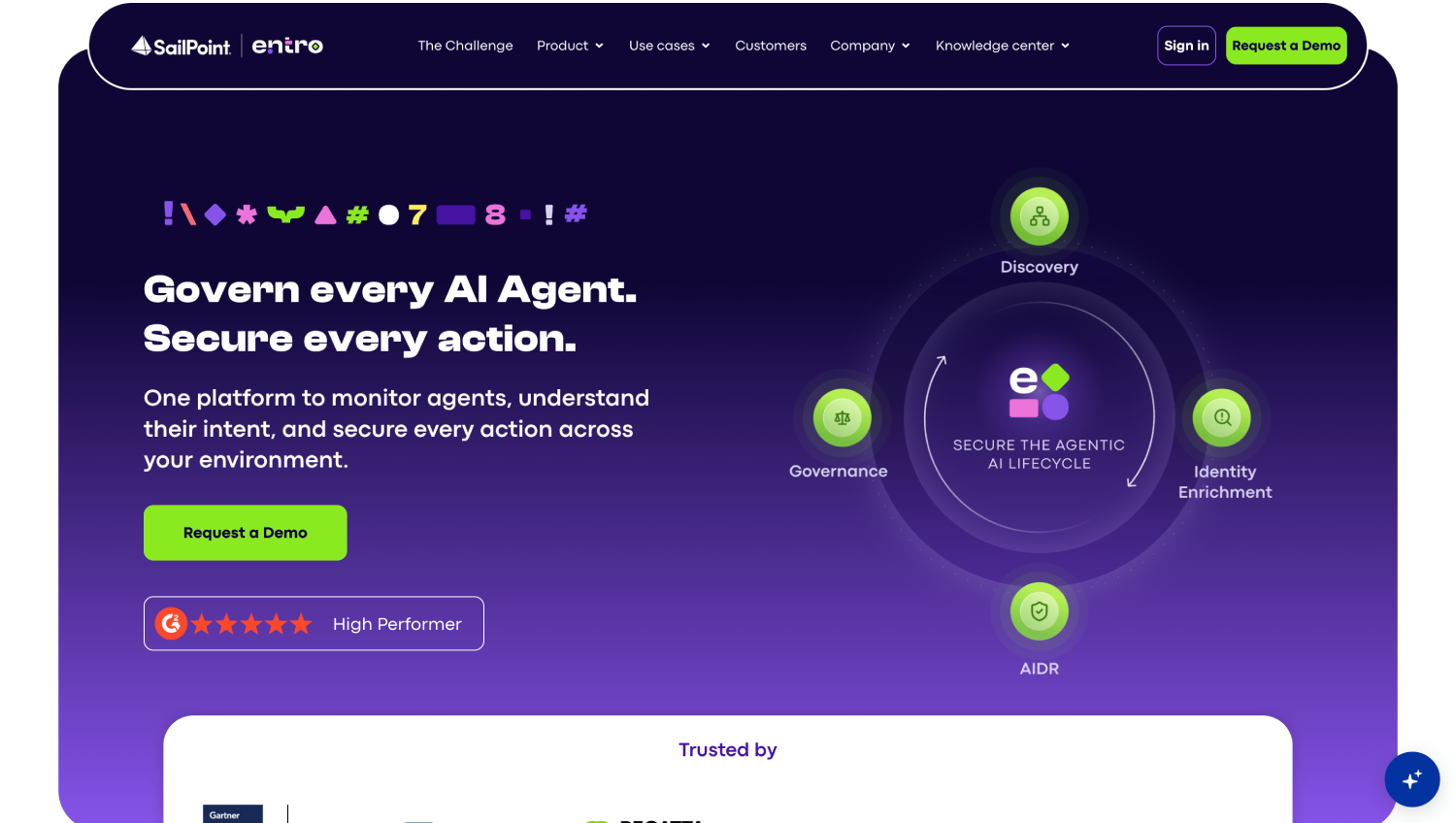
Entro Security builds its NHI inventory from secrets vaults first, then enriches it with cloud API data and SaaS API polling. The logic is that if a secret is managed in HashiCorp Vault, AWS Secrets Manager, or Azure Key Vault, enumerating the vault gives you a provenance record for that credential: when it was created, by whom, when it was last rotated, and where it is referenced. That provenance record is the foundation for ownership attribution.
Where Entro earns the top position in this list is the combination of vault-native discovery with SaaS API enumeration. Most tools do one or the other. Entro’s coverage of OAuth grants and SaaS-to-SaaS tokens is meaningful because it queries the SaaS platform directly rather than relying on a proxy source. For teams running AWS Secrets Manager or HashiCorp Vault alongside a heavy SaaS footprint, Entro is the closest match to a complete inventory.
A source page for Entro Security was not available for review, so pricing disclosure cannot be verified. Contact the vendor directly to determine whether list pricing is published or whether quotes are issued per environment.
2. Astrix Security
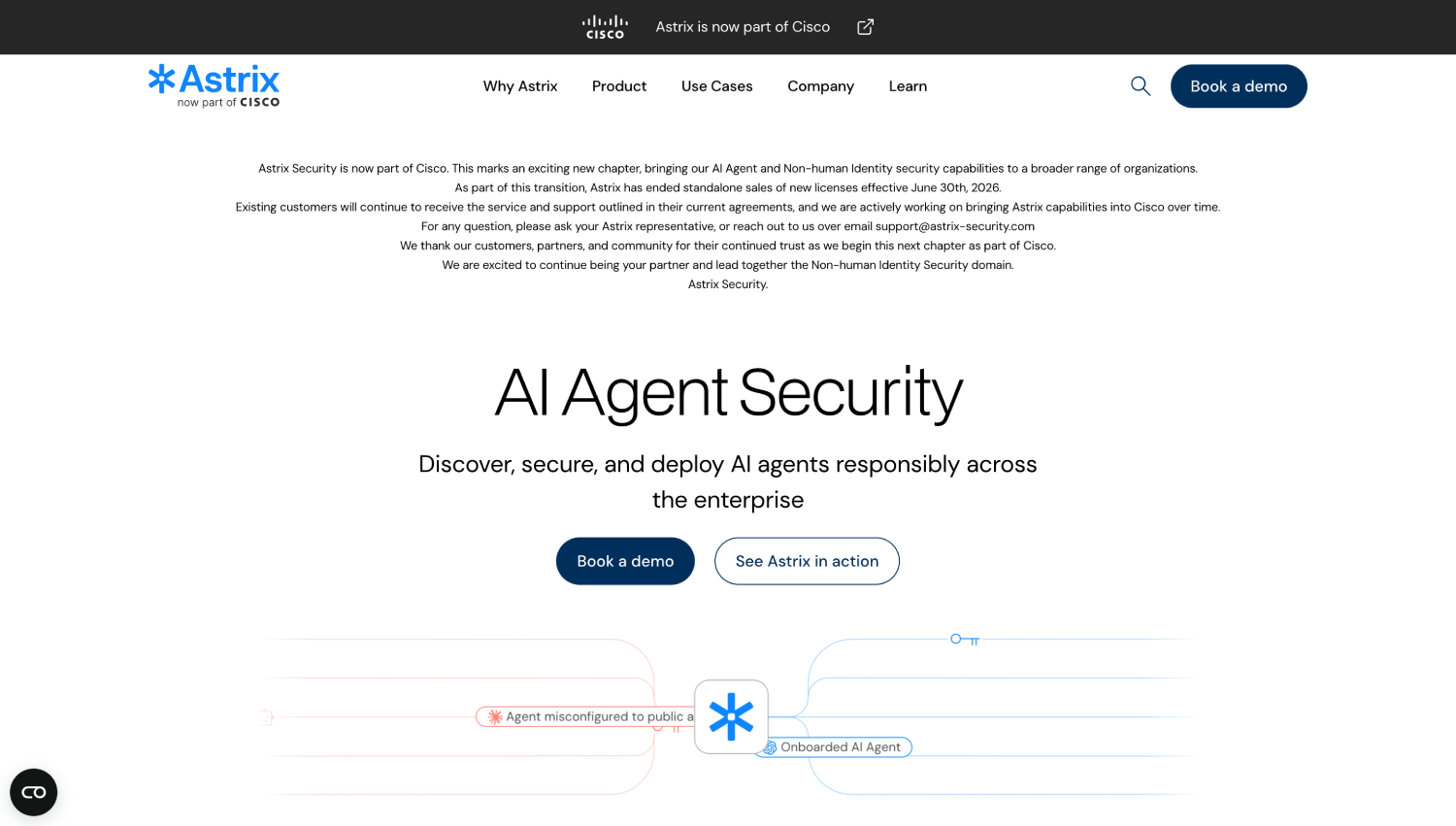
Astrix Security was acquired by Cisco, effective June 30, 2026, and ended standalone sales of new licenses as of that date. According to Astrix’s own site, the acquisition brings its AI agent and non-human identity security capabilities into Cisco’s portfolio. Organizations evaluating Astrix as a standalone product should confirm current availability and licensing terms directly with Cisco, as the pre-acquisition commercial model no longer applies.
As a product, Astrix was the most SaaS-focused tool in this category. Its discovery model started with the SaaS integration graph: polling each connected SaaS platform for authorized OAuth applications, API tokens, and service account grants, then mapping those identities back to the human user who originally authorized the connection. For organizations where the primary NHI exposure is SaaS-to-SaaS OAuth sprawl, the approach was well-suited to the problem. The ownership attribution method is operationally practical: if a Salesforce integration was authorized by a user account that no longer exists, the tool flags the grant as orphaned and surfaces the authorizing user’s last known manager as a suggested owner. The gap relative to other tools is code repositories and runtime cloud credentials, where coverage is shallow compared to vault-native or log-native tools. Buyers should confirm whether these capabilities carry forward under Cisco and under what licensing structure.
3. Veza
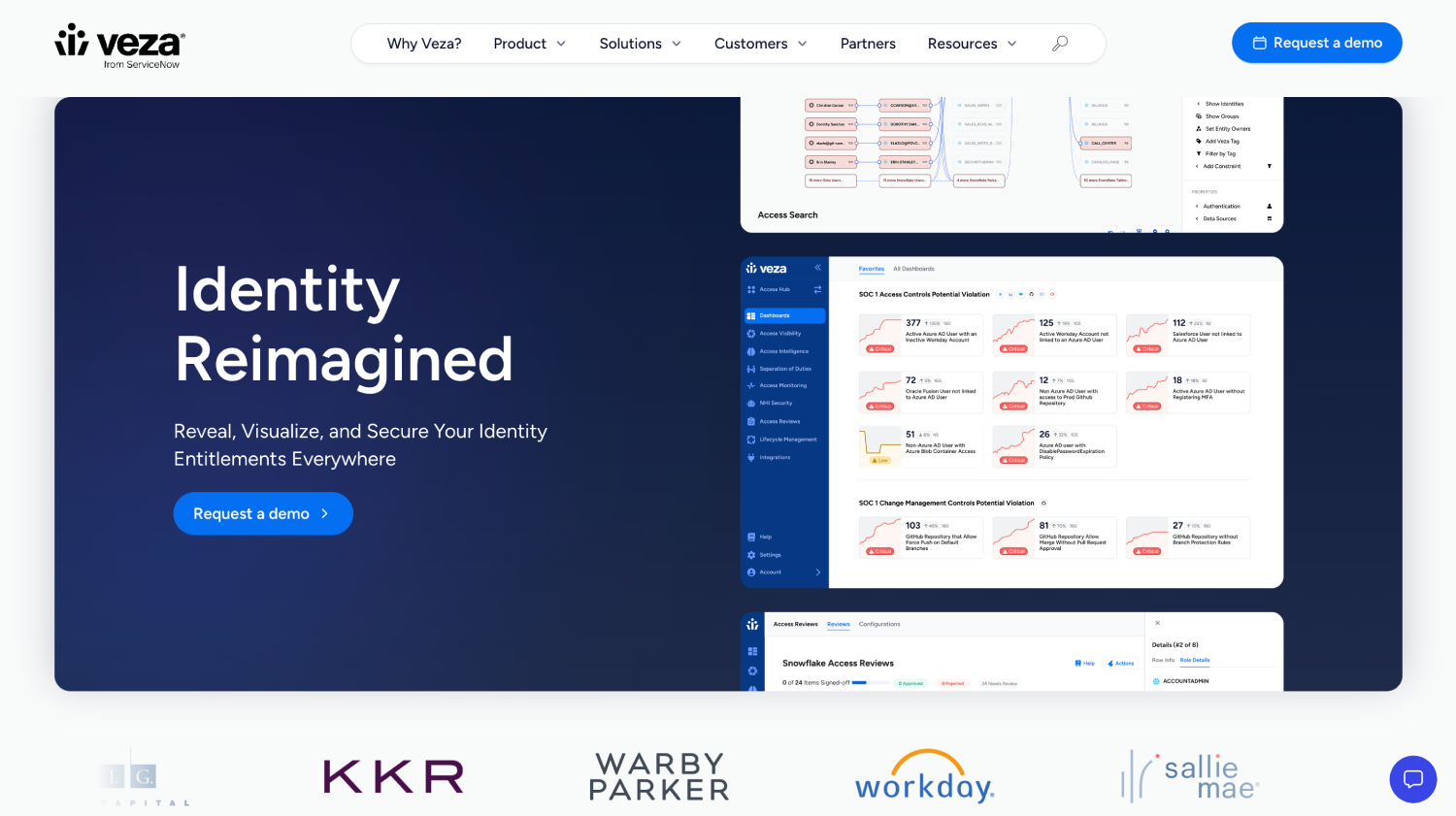
Veza approaches NHI discovery through an identity graph that maps what every identity (human and machine) can access across cloud providers, SaaS platforms, and data systems. It does not specialize in secrets or OAuth; it specializes in access relationships. The output is an answer to the question “this service account can read this S3 bucket” rather than “this credential was embedded in this repo three years ago.”
The practical consequence is that Veza is strongest for teams whose NHI problem is over-permissioned machine identities and access path risk, not for teams trying to find unknown credentials. If you already have a partial inventory and want to understand what blast radius looks like when one of those accounts is compromised, Veza’s graph model is the right tool. If your first goal is to discover NHIs you do not know exist, Veza’s discovery surface is narrower because it does not scan code or secrets vaults.
4. Saviynt
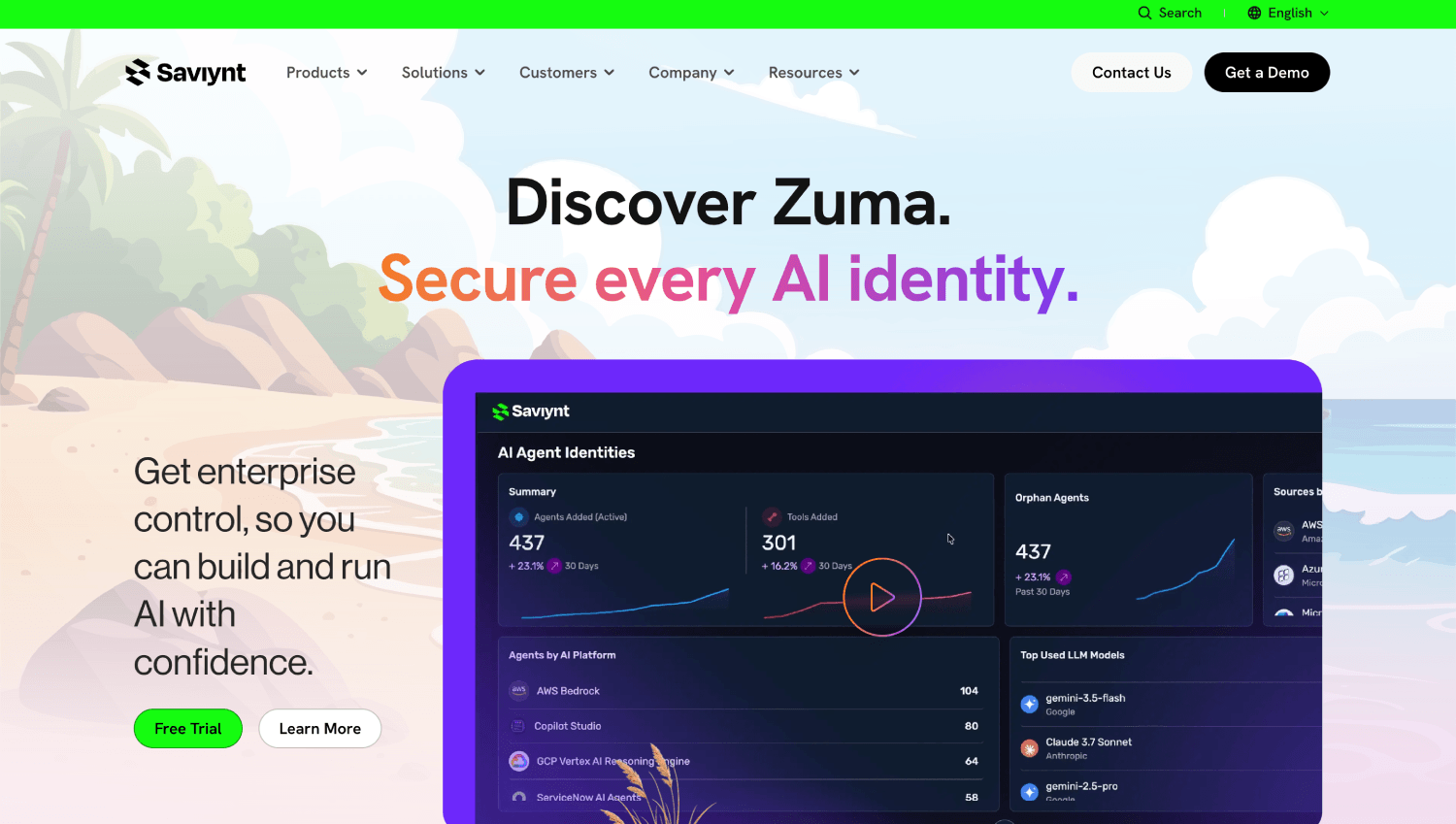
Saviynt is an identity governance and administration (IGA) platform that has extended to cover NHIs through connectors to cloud providers and SaaS applications. Its discovery mechanism is connector-driven: Saviynt pulls identity data from each connected system and aggregates it into a governance view. The ownership model is also connector-driven, relying on owner fields populated during provisioning or assigned during access certification campaigns.
The gap is the same as every IGA-native approach to NHI: the connectors enumerate what the directory knows. Identities created outside the provisioning workflow, which is most of the interesting NHI population, do not flow through the connector. Saviynt is a better fit for organizations that want to govern the NHIs they already know about than for organizations trying to discover the ones they do not.
5. Token Security
Token Security takes a runtime-first discovery approach, combining cloud provider log ingestion with code repository scanning. The distinctive piece is the attribution model for CI/CD-issued credentials: Token traces a runtime-issued token back to the pipeline run that created it, then to the repository and commit that triggered the run, then to the developer who made the commit. That chain of attribution is the most technically specific ownership assignment in this list for the CI/CD NHI category.
For engineering organizations where most NHIs are generated by CI/CD systems rather than by manual service account creation, Token’s attribution model cuts directly to the ownership question that costs teams the most remediation time. The trade-off is coverage of SaaS OAuth grants, which Token handles partially but not as completely as Astrix or Entro.
6. Palo Alto Networks Prisma Cloud

Palo Alto Networks Prisma Cloud discovers NHIs through its cloud security posture management (CSPM) layer: it reads cloud provider APIs to enumerate service accounts, roles, and machine identities, then applies identity posture analysis to flag overpermissioned accounts and inactive credentials. The NHI discovery capability is part of the broader CNAPP offering rather than a standalone product.
That positioning matters for buyers. If your organization is already running Prisma Cloud for cloud workload protection and CSPM, the NHI visibility layer costs nothing incremental to turn on, and the ownership attribution from cloud resource tagging is good enough for cloud-native service accounts. If your primary NHI problem is SaaS OAuth or embedded secrets in code, Prisma Cloud’s coverage gap will require a complementary tool. Palo Alto does not publicly disclose pricing, and Prisma Cloud licenses by resource or workload count rather than by identity count.
7. CyberArk
CyberArk has long been the market reference for privileged access management, and its NHI discovery capability flows from its vault-centric architecture. The discovery model enumerates machine identities that have credentials stored in the CyberArk vault, then extends outward through connectors to cloud providers and directories to find accounts not yet under vault management. The ownership model is folder and safe-based: whoever owns the safe owns the credential.
CyberArk’s strength in NHI discovery is depth for privileged credentials in on-premises and hybrid environments. Its relative weakness is the same as any vault-centric approach: identities that were never brought into the vault are structurally harder to discover. The product has expanded its cloud identity coverage significantly, but teams evaluating CyberArk specifically for SaaS OAuth or CI/CD token discovery should test that coverage against their actual environment before committing. CyberArk does not publish list pricing.
8. Britive
Britive approaches NHI management through just-in-time (JIT) privileged access provisioning. Its discovery method is different from every other tool in this list: rather than enumerating existing standing machine identities, Britive’s inventory is built from the record of what access was requested and provisioned through its JIT workflow. This gives it very precise ownership data for identities in scope, because every provisioned access record is tied to a requestor.
The limitation is scope: Britive discovers what flows through Britive. Pre-existing standing machine identities created outside its workflow are not natively enumerated. Teams using Britive for NHI inventory should plan to run a separate discovery pass for legacy service accounts and then migrate management of those accounts into the JIT model. It is better positioned as an NHI management and provisioning tool than as a discovery-first inventory tool.
9. Teleport
Teleport is an access infrastructure platform that manages access to servers, databases, Kubernetes clusters, and cloud consoles through short-lived certificates. Its NHI inventory comes from its audit log: every machine identity that authenticates through Teleport is recorded, attributed to a certificate subject, and stored. Ownership is clear because Teleport issued the certificate and knows who or what requested it.
Like Britive, Teleport’s discovery coverage is bounded by what goes through Teleport. It does not scan for NHIs in SaaS platforms, code repos, or cloud IAM outside its own proxy. For organizations that have adopted Teleport as their access layer for infrastructure, the NHI inventory for that scope is accurate and low-effort to maintain. For broader NHI discovery, it needs to be paired with a tool that covers the sources Teleport does not proxy.
How Do These Tools Find Identities That No Directory Lists?
The mechanisms vary by tool, but the underlying approaches fall into three patterns. First, some tools make direct API calls to systems that issued or stored the credential, such as a SaaS platform’s OAuth API or a secrets vault’s list endpoint. These calls enumerate credentials the system itself tracks, whether or not they appear in a directory. Second, some tools analyze behavioral telemetry: cloud audit logs reveal authentication events from identities that may not be in the directory because they were created programmatically and never registered there. Third, some tools scan source code and pipeline configs where credentials are embedded, finding NHIs that have never authenticated and therefore appear in no log.
The identities that no directory lists and no log records are the hardest: credentials that exist in a file, have never been used, and live in a private repository. Static code scanning is the only source that reaches them. This is why code repo scanning is a required capability for a complete NHI inventory, not an optional add-on.
How Do These Tools Determine Ownership of an Orphaned Credential?
Ownership attribution for orphaned NHIs is the operational problem that no vendor fully solves. The methods in practice, from strongest to most unreliable, are:
- Creator metadata with HR system correlation. If the credential was created by user ID X, and user ID X no longer appears in the HR system, the last-known manager of X is the suggested owner. Entro and Astrix both use this pattern for SaaS-originated credentials. It works when the creator account is still traceable. It breaks when the creator account was a shared service account, which is common.
- Commit history attribution. If the credential appears in a code repository, git blame and commit authorship can trace it to a developer. Token Security’s CI/CD attribution model does this well. It breaks when credentials are added in bulk migrations or by automated tooling.
- Access path tracing. Veza’s graph approach can trace a machine identity’s access path back to the human identity that provisioned it or that the machine identity is proxying for. This is useful for understanding blast radius but does not always resolve to a single responsible owner.
- Resource tagging inheritance. Cloud service accounts often inherit the owner tag of the resource they are attached to. This works when tagging discipline is good, which in most organizations it is not.
- Last accessor mapping. Who last used the credential? This is not the same as the owner, but in practice a team that recently used a service account is more likely to know whether it is still needed. Some tools surface this as a starting point for manual triage.
No tool eliminates the need for a manual ownership assignment process for truly orphaned credentials. What good tools do is reduce the percentage of credentials that arrive at triage with no attribution signal at all. Aim for a workflow where no more than 10 to 15 percent of discovered NHIs require fully manual owner assignment. If the number is higher, the tool’s attribution model is not matched to how your credentials were originally created.
The ownership attribution challenge mirrors the broader question of governing identities that span systems, which is also the central problem in non-human identity security platforms more broadly.
What Is the False-Positive Rate on Stale Identity Detection?
The honest answer is that “false positive” is the wrong frame for stale identity detection. A credential that has not authenticated in 90 days is not necessarily orphaned. It may belong to a disaster recovery script that has not run. It may be a break-glass account for a system that has not needed emergency access. It may be a batch job that runs quarterly. Tools that flag every credential inactive for more than N days as a violation produce alert fatigue, not remediation.
The tools that handle this well do two things: they distinguish between dormant and orphaned, and they let teams set context-specific thresholds. Dormant means no recent activity but a plausible legitimate use case. Orphaned means no recent activity, no known owner, and no legitimate use case that can be confirmed. Entro and Veza both expose enough contextual metadata, including access history, scope, and last-accessor identity, to support this distinction. Tools that only surface inactivity duration without context force analysts to make that judgment manually, which is where false-positive burden concentrates.
Setting a review cadence matters as much as the tool’s detection logic. A quarterly review of credentials inactive for 60 or more days, with a defined escalation path for credentials where the owner cannot be confirmed within two weeks, is a more operationally sound approach than chasing a zero-orphan target in real time.
Do These Tools Cover SaaS-to-SaaS Tokens and OAuth Grants?
Coverage varies significantly. Astrix and Entro are the strongest in this category, both designed to enumerate OAuth grants by polling SaaS platforms directly. Veza covers a broad set of SaaS platforms through its identity graph connectors. Saviynt covers select SaaS platforms through its IGA connectors but is not optimized for OAuth grant enumeration specifically.
Palo Alto Prisma Cloud, CyberArk, Britive, and Teleport have limited to no SaaS OAuth coverage as a discovery source. Teams for whom SaaS-to-SaaS tokens are a primary concern should not expect these tools to solve that problem without a purpose-built integration or a complementary tool in the stack.
The SaaS OAuth problem is also not static. New integrations get authorized continuously, often by developers or business users who do not go through a security review. Any inventory program needs to address the authorization governance problem, not just the discovery problem. Discovering existing grants is step one; preventing new unauthorized grants from creating ungoverned NHIs is step two. The intersection of NHI governance and broader application security posture is covered in SecurityOpsWire’s cloud-native application security tools comparison.
The SecurityOpsWire NHI Inventory Bootstrap Framework
Most teams do not need a perfect NHI inventory on day one. They need a first inventory that is good enough to act on, with a process to improve it. The following framework, which we call the Four-Pass NHI Bootstrap, gives security teams a structured sequence that produces output worth acting on without requiring a finished toolset.
Pass 1: Cloud-provider enumeration. Pull service accounts, roles, workload identity accounts, and managed identities from every cloud provider using native APIs or a CSPM tool. This is the fastest pass and covers the NHIs with the most blast radius. Tag each record with last authentication date.
Pass 2: Secrets vault and CI/CD pipeline scan. Enumerate every secret in your vaults (HashiCorp Vault, AWS Secrets Manager, Azure Key Vault, GCP Secret Manager) and every pipeline configuration in your CI/CD tools (GitHub Actions, GitLab CI, CircleCI, Jenkins). Cross-reference with the Pass 1 inventory. Credentials in vaults but not in cloud IAM are usually service account keys or third-party API tokens. Credentials in pipeline configs but not in vaults are the highest-risk population.
Pass 3: SaaS OAuth enumeration. Using a tool with SaaS API connectors (Astrix or Entro for depth, Veza for breadth across platforms), enumerate all OAuth grants and connected app authorizations across your core SaaS platforms. Flag any grant where the authorizing user account no longer exists.
Pass 4: Ownership assignment sprint. Run a two-week sprint where every NHI in the combined inventory gets an owner assigned or a disposition decision recorded. Owner can be a team, not just an individual. Disposition options are: active and owned, active and ungoverned (needs remediation), dormant and under review, or confirmed orphan pending deletion. Any credential with no disposition after the sprint defaults to freeze: permissions are revoked and the credential is rotated or deleted.
After the bootstrap, quarterly reviews of credentials inactive for 60 or more days, combined with real-time alerting on new ungoverned grants (SaaS OAuth is the highest-frequency source), maintains the inventory at a manageable quality level.
For teams tracking the growing population of AI agents that also generate machine identities, the overlap between NHI inventory and AI agent enumeration is addressed in SecurityOpsWire’s coverage of non-human identity security platforms and the broader machine identity management tool comparison.
How to Choose: Matching Tool to Environment
Three questions determine the right tool for a given environment. First, where do most of your NHIs live? If the answer is cloud provider service accounts and IAM roles, Prisma Cloud or Veza cover that well. If the answer is CI/CD tokens and embedded secrets, Token Security or Entro. If the answer is SaaS OAuth and integration tokens, Astrix or Entro.
Second, how mature is your existing IAM and secrets management infrastructure? Teams with CyberArk or a mature vault deployment already in place can extend NHI discovery from that foundation. Teams without a vault, where secrets are scattered across environment variables, pipeline configs, and hardcoded files, need a discovery tool that leads with code scanning rather than vault enumeration.
Third, what is the primary driver: discovery, governance, or access control? Discovery-first teams should evaluate Entro, Astrix, and Token. Governance-first teams (access certification, ownership attestation, policy enforcement) should look at Veza and Saviynt. Access-control-first teams (JIT, least privilege enforcement, session recording) should look at Britive and Teleport. CyberArk spans governance and access control for privileged credentials but is not a discovery-first product.
Frequently Asked Questions
What NHI types are most commonly missed by cloud IAM console inventory?
OAuth grants and connected app tokens issued by SaaS platforms are the most frequently missed category, because they are created and stored in the SaaS platform rather than in the cloud provider’s IAM service. Secrets embedded in CI/CD pipeline configuration files and environment variables are the second most common gap. Both categories require dedicated tooling or API-level enumeration from the issuing system, not just a cloud IAM API call.
Can a single tool provide complete NHI coverage across cloud, SaaS, and code?
No current tool provides complete coverage across all four discovery sources: cloud APIs, code repositories, SaaS APIs, and network telemetry. Entro and Astrix come closest by combining two or three sources. Most production NHI programs use a primary discovery tool for their highest-risk NHI category and supplement with a CSPM or IGA tool for cloud-native and directory-managed identities. Plan for two to three tools to achieve full coverage in a mature environment.
How do NHI discovery tools handle credentials that rotate frequently?
Tools that discover NHIs from vault metadata (Entro, CyberArk) handle rotation well because the vault record is the authoritative source regardless of the actual secret value. Tools that discover NHIs from code scanning or log analysis need to be careful about duplicate records when credentials rotate: the same logical identity may appear as multiple distinct secrets in a repo scan. Better tools deduplicate on identity behavior and access scope rather than on the literal credential value.
What does ownership attribution look like for a service account created by an automated deployment pipeline?
Attribution chains back through the pipeline run to the repository, then to the repository owner or the team that owns the pipeline. The most operationally useful ownership assignment is the team that owns the repository, not an individual, because individuals leave and pipelines persist. Tools like Token Security that trace the full CI/CD attribution chain make this assignment tractable. For pipelines owned by infrastructure teams rather than application teams, the infrastructure team is the correct default owner.
How should teams define “orphaned” versus “dormant” for NHI review purposes?
Orphaned means no confirmed owner and no confirmed active use case. Dormant means no recent authentication but a plausible legitimate use case exists, such as a DR script or a quarterly batch job. The operational difference matters: dormant credentials should trigger owner confirmation requests, not immediate revocation. Orphaned credentials should be rotated and permissions frozen pending a deletion decision. Set a time limit, typically two to four weeks, for owner confirmation before escalating dormant to orphaned status.
Do NHI discovery tools integrate with SIEM or SOAR platforms?
Most enterprise-focused tools in this list export findings to SIEM platforms via webhook, syslog, or a native connector. Entro, Veza, and CyberArk have documented integrations with common SIEM platforms including Splunk and Microsoft Sentinel. SOAR integration for automated remediation workflows, such as rotating a flagged credential or revoking an orphaned OAuth grant, is less consistent and should be confirmed during proof-of-concept. The integration depth required for a mature NHI response workflow is covered in SecurityOpsWire’s analysis of non-human identity security platforms.
Is NHI discovery covered under CIEM, CSPM, or CNAPP platforms?
Cloud infrastructure entitlement management (CIEM) tools and CNAPP platforms do cover the cloud-provider-managed subset of NHIs, specifically IAM roles, service accounts, and instance profiles. That coverage is real but partial. SaaS OAuth tokens, embedded secrets in code, and CI/CD-issued credentials are generally outside CIEM and CSPM scope. Purpose-built NHI discovery tools close the gap that CNAPP platforms leave open. Teams should not assume their CNAPP investment eliminates the need for NHI-specific tooling.
What is the right review cadence for a new NHI inventory program?
Start with a monthly review cadence for the first two quarters while establishing baseline noise levels and refining ownership assignment processes. Move to quarterly reviews once the inventory is stable and fewer than 5 percent of credentials arrive at review without an owner. Real-time alerting on new ungoverned grants (particularly SaaS OAuth and new secrets in code) should run continuously regardless of the review cadence, because new NHIs are created faster than any quarterly schedule can track.
The Inventory Is Not the Goal
A completed NHI inventory that sits in a spreadsheet or a dashboard changes nothing. The inventory’s value is entirely downstream: it feeds the ownership assignment process, which feeds the review cadence, which feeds remediation decisions. Teams that treat discovery as the endpoint and governance as a future phase will find themselves re-running discovery six months later against an inventory that has drifted back to baseline.
The most durable NHI programs are built around three operational commitments: a continuous discovery process that catches new NHIs as they are created (not quarterly), a defined owner for every credential in the inventory (a team is acceptable; “unknown” is not), and a freeze-and-rotate default for any credential that cannot be confirmed as active within a defined window. The tooling supports those commitments; it does not replace them.
The discovery method comparison in this article is the starting point, not the endpoint. Choosing the right tool matters, but the harder work is the process design that makes ownership attribution reliable enough to trust and the review cadence disciplined enough to catch drift. That process design is where most NHI programs succeed or fail, independent of which tool they chose.