
- Exposure management platforms do something vulnerability scanners cannot: they map which findings sit on paths an attacker can actually walk, then rank work by business impact rather than CVSS severity alone.
- Gartner’s Exposure Assessment Platform category formalizes a distinction that matters for buying decisions: some tools aggregate findings from your existing scanners, some replace them, and a few do both. Knowing which architecture fits your environment determines whether you consolidate or layer.
- The scoring model is the product. If a platform cannot explain why a medium-severity finding ranks above a critical one, and cannot let you weight asset criticality yourself, it is still vulnerability management with a new label.
- Pricing scales by asset count, data source connections, or both. For most enterprise environments, the operational cost of deployment and tuning outweighs license cost in year one.
- The shortlist decision comes down to one question: do you want to replace your scanners or get more from the findings they already produce?
The best exposure management platforms combine asset criticality, attack path analysis, and exploitability context to produce a ranked, defensible work list. The leading options in 2026 include Tenable One, Qualys ETM, Rapid7 Exposure Command, XM Cyber, CyCognito, Zafran, Nagomi, Balbix, Hive Pro, Armis, and Axonius. Choosing between them turns on whether your team needs a new scanning foundation or a correlation layer above what you already run.
What Is the Difference Between an Exposure Assessment Platform and a CTEM Platform?
Gartner introduced the Exposure Assessment Platform category to describe tools that unify visibility across an organization’s attack surface and produce prioritized exposure findings. The EAP label is Gartner’s taxonomy for the technical tooling layer. Continuous Threat Exposure Management, also coined by Gartner, is the program framework: a five-stage process of scoping, discovery, prioritization, validation, and mobilization that an organization runs. An EAP is one of the primary tools a security team uses to run a CTEM program. They are not synonyms, and no single product fully implements the entire CTEM process on its own.
The practical difference for a buyer: evaluating a CTEM program means asking whether your people, process, and tools together cover all five stages. Evaluating an EAP means asking whether a specific platform can ingest the asset and finding data your environment produces and surface what to fix first. Many platforms in this list position themselves as CTEM-enabling without Gartner having formally placed them in the EAP category. That positioning is a marketing choice, not a category designation. For a deeper look at the CTEM program layer, the best CTEM platforms comparison on SecurityOpsWire covers the program framework in detail.
Aggregators vs. Generators: Which Architecture Fits Your Environment?
Every platform in this list sits somewhere on a spectrum between two architectural poles. Generators run their own scanning and assessment engines. They produce first-party findings through agent-based sensors, agentless cloud connectors, or active network probing. Aggregators ingest findings from your existing scanners, CMDB, cloud security tools, and EDR platforms, then apply their prioritization model on top. Most platforms blend both, but understanding where a vendor started tells you where it performs best.
Generators suit teams that want to reduce the number of scanning tools they operate. They carry a higher deployment cost upfront but reduce the integration surface over time. Aggregators suit teams that already run Tenable, Qualys, or Rapid7 and want to get more signal out of those investments without ripping them out. The integration surface in an aggregator model is larger, which means ongoing maintenance when upstream tools change their APIs or finding schemas.
A useful test before any demo: ask the vendor what happens to your prioritization model when one of your upstream scanners goes offline. Aggregators that cannot degrade gracefully leave blind spots in ranked work lists without surfacing that the data is incomplete. That is an operational risk that rarely appears in feature documentation.
How Is Exposure Scored and Can the Scoring Model Be Tuned?
The gap between exposure management and legacy vulnerability management is almost entirely in the scoring model. CVSS severity scores findings in isolation. Exposure scoring adds at least three additional inputs: asset criticality, exploitability in context, and reachability from a realistic attacker starting point. The more sophisticated platforms also factor in compensating controls, such as a WAF rule or a network segment boundary that blocks a known exploitation path, so a critical CVSS finding behind a well-enforced control ranks lower than a medium-severity finding on an internet-facing asset with no compensating layer.
Tuning the model is where real operational value appears, and it is also where most evaluations reveal the platform’s actual depth. Ask three specific questions during a proof of concept. First: can you change the relative weight of asset criticality versus exploitability versus patch availability, and do those weights persist across the entire work list or only within a specific scope? Second: can you feed business context, such as which systems are in scope for a compliance audit or which assets are in a production environment versus a development environment, and does that context change rankings automatically? Third: when the vendor’s threat intelligence indicates a vulnerability is being actively exploited in the wild, does the platform surface that signal without manual configuration, and how quickly does the rank change after a new exploitation event?
The SecurityOpsWire Exposure Scoring Depth Test, applied across this list, uses those three questions as pass/fail criteria. Platforms that cannot tune weights or ingest business context fail the first gate. Platforms that require manual re-prioritization after a new exploitation event fail the second. What remains is a shorter list of tools that actually change operational output rather than relabeling a CVSS sort.
How Does Pricing Scale With Asset Count?
Most platforms in this category do not publish list pricing. The honest reason is that enterprise deals involve volume discounts, data source mix, and deployment scope that make list pricing meaningless for most buyers. What follows is the pricing model each vendor uses, not specific rates, because no verified public pricing page exists for most of them; all quotes are environment-specific.
| Platform | Primary Pricing Model | Public Pricing Available | Key Scaling Factor |
|---|---|---|---|
| Tenable One | Per asset, tiered by product bundle | No; quote-based | Asset count across all source types |
| Qualys ETM | Per asset; module-based add-ons | No; quote-based | Asset count, connector volume |
| Rapid7 Exposure Command | Per asset | No; quote-based | Asset count, cloud workload mix |
| XM Cyber | Per node; environment-based tiers | No; quote-based | Node count, AD/cloud scope |
| CyCognito | Per asset discovered | No; quote-based | External attack surface size |
| Zafran | Per asset, connector-based | No; quote-based | Asset count, security tool integrations |
| Nagomi | Quote-based | No; quote-based | Security tool coverage scope |
| Balbix | Per device/asset | No; quote-based | Asset count, data source breadth |
| Hive Pro | Quote-based | No; quote-based | Asset count, threat intelligence tier |
| Armis | Per device; module-based | No; quote-based | Device count, especially OT/IoT |
| Axonius | Per asset | No; quote-based | Asset count, adapter connections |
The operational cost question matters as much as license cost. Platforms that require dedicated engineering time to maintain connector mappings, schema normalizations, and scoring weight configurations carry a hidden headcount cost that does not appear in any quote. For a security team running lean, an aggregator with 40 connectors that each require quarterly maintenance is a different staffing decision than a generator with two native scanning engines.
The 11 Best Exposure Management Platforms Compared
Tenable One
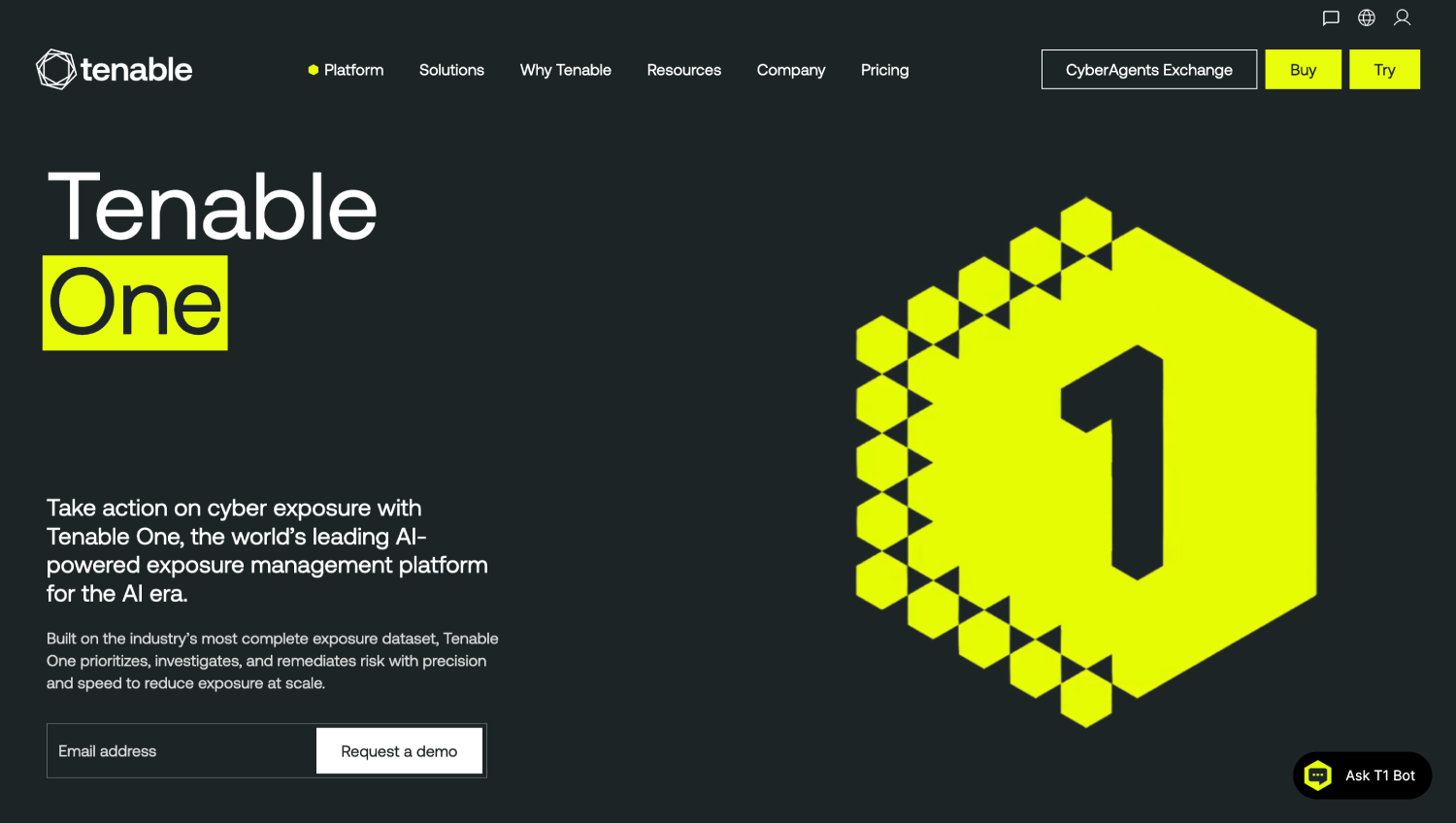
Tenable One is a unified exposure management platform built on top of Tenable’s scanning portfolio, which includes Tenable Nessus, Tenable.io, and Tenable.cs. The platform correlates findings across vulnerability management, cloud security, web application scanning, and identity into a single asset inventory and applies its Lumin exposure scoring model to produce ranked remediation lists. Asset exposure scores combine CVSS-based severity, asset criticality derived from the organization’s own tagging or network position, and threat intelligence on active exploitation.
For organizations already running Tenable’s scanning tools, Tenable One reduces data silo overhead significantly because the integration is native rather than connector-dependent. For organizations running competing scanners, the value proposition weakens: Tenable One can ingest third-party data, but the depth of the scoring model is highest when the underlying findings come from Tenable’s own engines. The platform suits large enterprises with hybrid environments who want a single vendor covering vulnerability management, cloud posture, and identity exposure. Teams without existing Tenable licensing face a larger upfront consolidation cost. Pricing is quote-based and scales by asset count.
Qualys Enterprise TruRisk Management
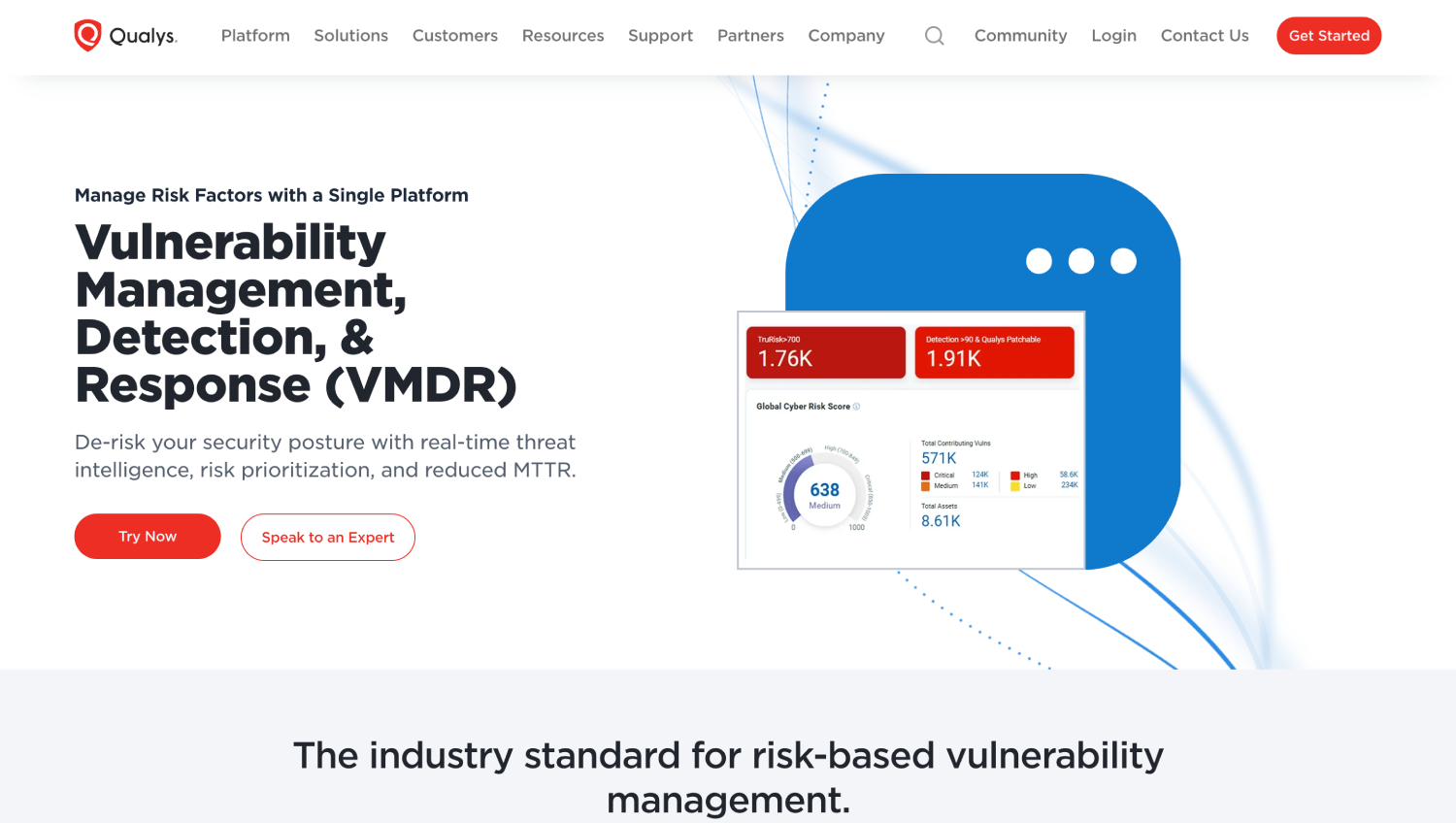
Qualys Enterprise TruRisk Management, often referenced as Qualys ETM, extends Qualys’s scanning platform with a risk quantification layer it calls TruRisk. The scoring model combines vulnerability severity, threat intelligence, asset business context, and estimated business impact into a numeric risk score that Qualys positions as comparable across different finding types, not just CVE-based vulnerabilities. The platform can aggregate findings from non-Qualys tools through its integration layer, though the native scoring depth is strongest for findings produced by Qualys’s own sensors and cloud agents.
Qualys ETM fits organizations that already run Qualys for vulnerability management and want to extend toward exposure management without switching vendors. The business impact quantification angle is useful for board-level reporting: TruRisk scores translate technical findings into a dollar-denominated risk estimate, which security leaders can use to defend remediation prioritization decisions. That quantification model is Qualys’s own; it is not independently audited. Buyers should probe the assumptions behind the dollar figures before using them in executive reporting.
Rapid7 Exposure Command
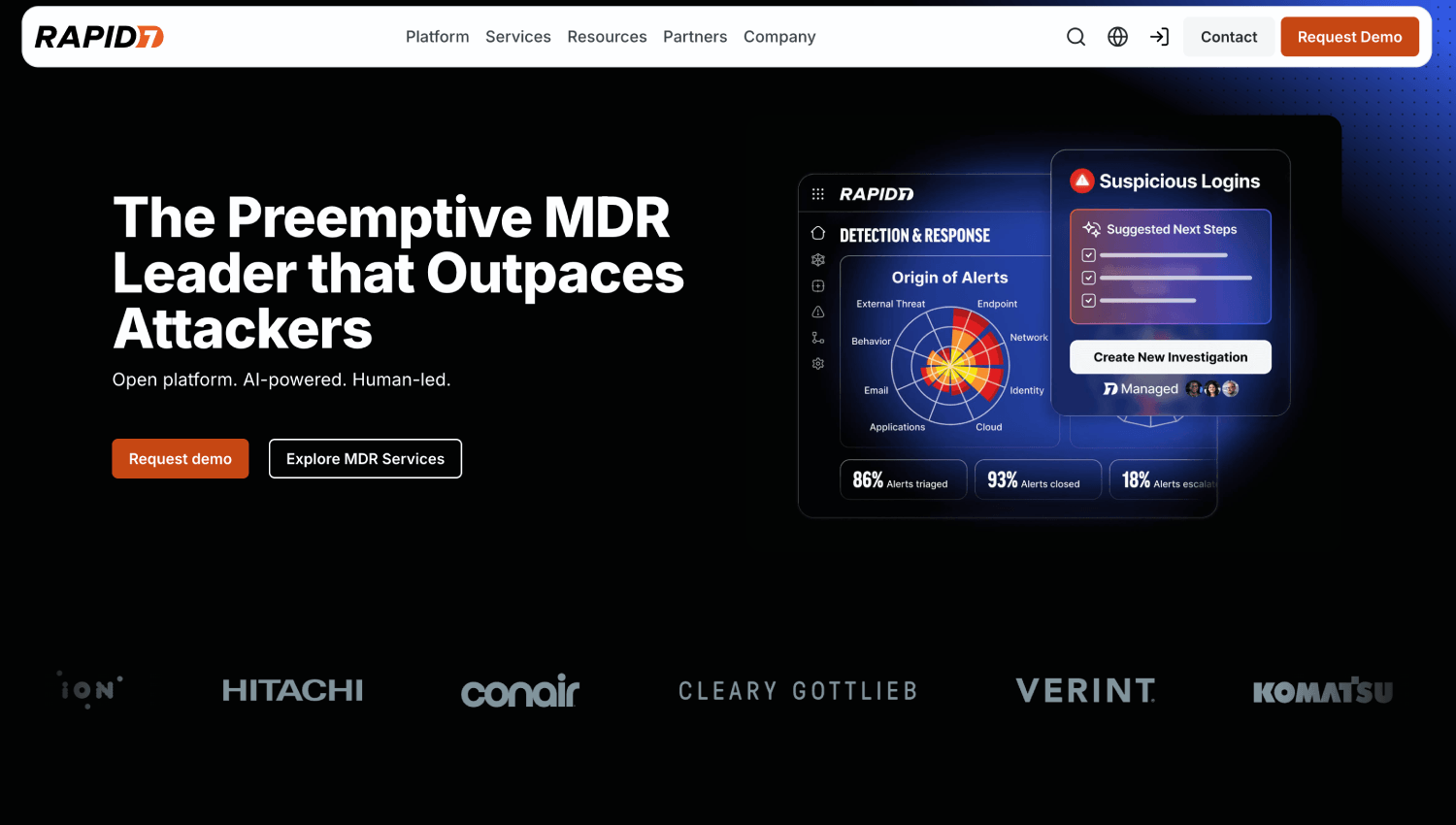
Rapid7 Exposure Command is the platform layer that sits above Rapid7’s InsightVM vulnerability management tool and integrates with its cloud security and application security products. The platform maps findings to attack paths and surfaces which exposures are reachable from the network perimeter or from a compromised internal asset. Rapid7 describes this as surface command combined with risk command, meaning the platform separates the discovery and the prioritization functions into distinct views.
Exposure Command works best for organizations already in the Rapid7 product suite. The attack path analysis draws heavily on the same agent telemetry that InsightVM and InsightIDR collect, so the richness of the path model depends on agent deployment coverage. Gaps in agent coverage create gaps in path analysis. For organizations with good Rapid7 agent coverage across endpoints and cloud workloads, the attack path visualization is a meaningful addition to standard severity ranking. Pricing is per asset and quote-based.
XM Cyber
XM Cyber started as an attack path simulation platform and expanded into exposure management from that foundation. The product continuously maps attack paths from any simulated attacker starting point to defined crown jewel assets, then ranks findings by their position on those paths rather than by CVSS score. A medium-severity misconfiguration that sits on ten attack paths to an Active Directory domain controller ranks higher than a critical-severity vulnerability on an isolated development server.
The AD-centric attack path model is XM Cyber’s clearest differentiator. Organizations with complex Active Directory and Azure AD environments will find the path visualization genuinely useful for prioritizing identity-adjacent exposures that vulnerability scanners miss entirely, such as delegation misconfigurations, excessive GPO permissions, and Kerberos attack vectors. The platform generates its own findings through agentless sensors rather than primarily aggregating from external scanners, which means it adds a new data source to an existing stack rather than replacing one. Pricing is per node.
CyCognito
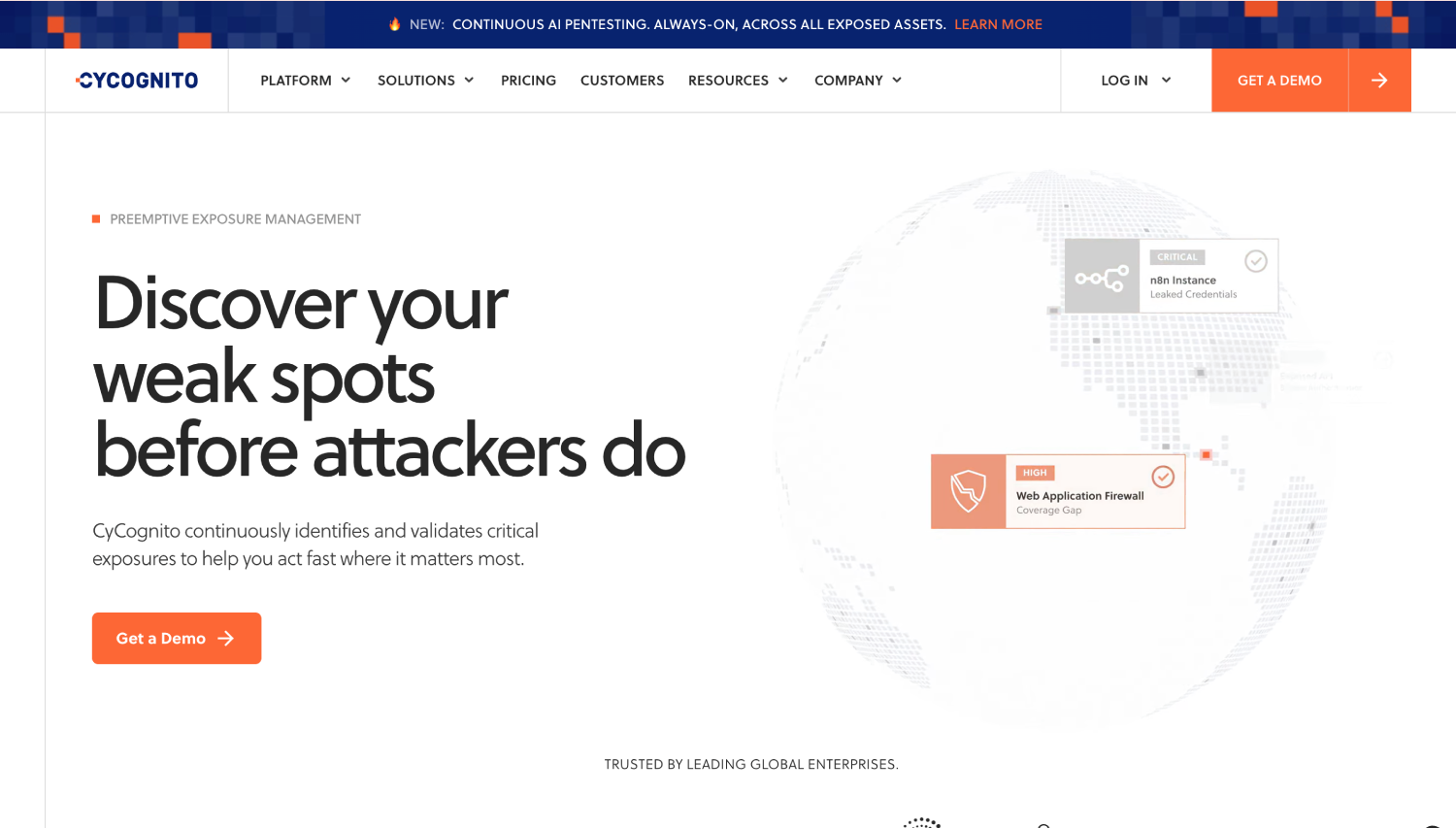
CyCognito focuses on external attack surface management and exposure assessment from an outside-in perspective. The platform discovers an organization’s internet-facing assets through the same reconnaissance methods an external attacker would use: certificate transparency logs, passive DNS, IP range enumeration, and content discovery. It then assesses discovered assets for vulnerabilities and misconfigurations without requiring internal agent deployment or CMDB input to start.
The outside-in approach is CyCognito’s primary value for organizations that do not have complete internal asset inventories, which is most mid-market and enterprise organizations that have grown through acquisition. The platform can surface assets the security team did not know existed before the scan. The trade-off is depth: without agent telemetry and internal network visibility, the attack path model is shallower than platforms with internal sensors. CyCognito is strongest as an external attack surface layer, either standalone or in combination with an internal-focused platform. Pricing scales by discovered asset count.
Zafran
Zafran takes a compensating controls approach to exposure prioritization. The platform ingests vulnerability findings from existing scanners and then cross-references each finding against the security controls already deployed in the environment, drawing data from EDR platforms, WAF configurations, firewall rules, and network segmentation data. If a compensating control demonstrably blocks the exploitation path for a given vulnerability, Zafran de-prioritizes that finding and surfaces the ones where no compensating control exists.
This approach directly addresses a common operational problem: CVSS-critical findings that have been effectively mitigated by an existing security tool remain on remediation queues indefinitely because no one connects the scanner output to the control layer. Zafran’s architecture is pure aggregator, which means it does not replace scanners but adds a control-awareness layer on top. For organizations running mature security stacks with good EDR and network control coverage, the signal-to-noise improvement is significant. For organizations with immature control coverage, the platform’s value is lower because there are fewer compensating controls to cross-reference. Pricing is asset-based and quote-driven.
Nagomi

Nagomi positions itself at the intersection of exposure management and security control validation. The platform maps an organization’s existing security tool coverage against the MITRE ATT&CK framework, identifies gaps between deployed controls and the threat techniques most relevant to the organization’s industry and threat profile, and then connects those control gaps to open exposures in the vulnerability and misconfiguration data. The output is a prioritized list of exposures weighted by whether the existing security stack can detect or block exploitation.
Nagomi is closer to an aggregator than a generator. It does not run its own scans. Its differentiation comes from the threat-profile-to-control-gap mapping, which answers a question that purely scanner-based exposure platforms do not: given the threats most likely to target your organization, which exposures matter because your controls cannot handle them? This is most useful for security leaders preparing board or executive reporting that needs to connect technical findings to specific threat actor TTPs. Pricing is quote-based.
Balbix

Balbix (acquired by SAFE) aggregates asset inventory and vulnerability data from a broad connector library and applies a machine-learning-based scoring model to produce risk rankings. The platform covers endpoints, cloud workloads, network infrastructure, applications, and identities in a single asset view. Its scoring model factors in CVSS, exploitability data, asset business criticality, and breach likelihood, which Balbix derives from its own threat intelligence and historical exploitation patterns.
The breadth of the asset model is Balbix’s primary strength: organizations looking for a single platform to produce a unified asset inventory with risk scoring across IT, cloud, and application layers will find it covers more asset types natively than some competitors. The depth of the scoring model for any individual asset type, such as Active Directory attack paths or cloud-specific misconfiguration chains, is shallower than specialist platforms. Balbix fits security leaders who need a board-ready risk dashboard above a heterogeneous tool stack without rearchitecting the underlying tooling. Pricing is per asset and quote-based.
Hive Pro
Hive Pro combines vulnerability management, threat intelligence, and exposure prioritization in a single platform, with particular emphasis on mapping open vulnerabilities to active threat actor campaigns. The platform ingests vulnerability scanner findings and correlates them against its threat intelligence database to surface which open CVEs in an organization’s environment are currently being exploited by named threat actors. The output is a remediation priority list that weights active exploitation by relevant threat groups above theoretical severity.
Hive Pro’s threat-actor-centric scoring model is most valuable for organizations in sectors with well-defined adversary profiles, such as financial services, healthcare, and critical infrastructure. When the threat intelligence accurately reflects the specific threat actors relevant to an industry, the prioritization model produces meaningfully different rankings than CVSS sorting. The platform operates in both aggregator and generator modes, accepting findings from external scanners while also running its own assessment capabilities. Pricing is quote-based.
Armis
Armis started as an agentless device visibility platform for OT, IoT, and medical device environments where traditional agent-based scanning cannot reach. The platform has expanded into exposure management through its Armis Centrix product, which adds vulnerability assessment, risk scoring, and remediation workflow capabilities on top of the device inventory foundation. The exposure model combines device criticality, network exposure, vulnerability data, and threat intelligence into a risk score that works across IT, OT, IoT, and cloud assets.
Armis is the correct choice when OT and unmanaged device coverage is a hard requirement. No other platform in this list has the same depth of passive asset identification for industrial control systems, building management systems, and medical devices. For pure IT environments without OT scope, Armis’s differentiation is lower and the per-device pricing model may be more expensive than alternatives. The platform is an aggregator for IT findings and a generator for OT and IoT findings through its passive sensing engine. For organizations with OT exposure requirements, this is worth a dedicated evaluation track. Understanding how identity and non-human assets intersect with OT exposure is increasingly relevant; SecurityOpsWire’s coverage of non-human identity security platforms addresses the adjacent problem of machine credentials in complex environments.
Axonius
Axonius is an asset inventory aggregation platform that expanded into exposure management by adding a vulnerability and risk correlation layer on top of its adapter-based asset data model. The platform connects to over 800 data sources, including IT management tools, security tools, cloud platforms, and SaaS applications, to produce a comprehensive asset inventory. The exposure management layer maps vulnerability findings from connected scanners to those assets and applies business context to rank findings.
Axonius’s value starts with the asset inventory problem. Organizations that cannot reliably answer “what assets do we have and who owns them” will find the adapter breadth useful before they reach the exposure scoring functionality. The exposure prioritization model is less mature than dedicated exposure platforms, but for organizations that need asset inventory solved first and exposure ranking second, the single platform approach reduces deployment complexity. The adapter maintenance burden is real: 800 adapters means 800 schemas to keep current as upstream tools update. That is a staffing consideration, not just a vendor concern. Axonius pricing is per asset and quote-based.
Which Platforms Generate Their Own Findings vs. Aggregate Third-Party Data?
| Platform | Primary Architecture | Own Scanner/Sensor | Third-Party Ingest | Best Fit |
|---|---|---|---|---|
| Tenable One | Generator + Aggregator | Yes (Nessus, cloud, web app) | Yes, limited depth | Existing Tenable shops |
| Qualys ETM | Generator + Aggregator | Yes (cloud agents, VMDR) | Yes, limited depth | Existing Qualys shops |
| Rapid7 Exposure Command | Generator + Aggregator | Yes (InsightVM agent) | Yes, via InsightConnect | Existing Rapid7 shops |
| XM Cyber | Generator | Yes (agentless path simulation) | Partial | AD-heavy hybrid environments |
| CyCognito | Generator | Yes (external ASM) | No primary ingest | External attack surface focus |
| Zafran | Aggregator | No | Yes (primary model) | Mature stacks with strong EDR/WAF |
| Nagomi | Aggregator | No | Yes (primary model) | Control gap and threat-profile mapping |
| Balbix | Aggregator | No | Yes (primary model) | Heterogeneous stacks, board reporting |
| Hive Pro | Generator + Aggregator | Yes (limited) | Yes | Threat-actor-prioritized remediation |
| Armis | Generator + Aggregator | Yes (passive OT/IoT) | Yes (IT layer) | OT, IoT, and unmanaged device fleets |
| Axonius | Aggregator | No | Yes (800+ adapters) | Asset inventory first, exposure second |
What Should a Proof of Concept Actually Test?
A proof of concept for an exposure management platform that tests only the dashboard and the finding count produces no useful information. The evaluation needs to stress three things: scoring model transparency, data freshness under real conditions, and remediation workflow integration.
Scoring model transparency means you can see why a specific finding ranked at position one rather than position two hundred. Platforms that cannot show the weighting inputs for an individual finding cannot be tuned and cannot be defended to a risk committee. Run at least five findings through a manual review where you ask the platform to explain its ranking. If the answer is “our proprietary algorithm,” end the evaluation.
Data freshness matters because exposure windows are short when active exploitation begins. Test how long it takes from a new vulnerability disclosure to a scoring update in the platform. Ask specifically how the platform handles a newly published exploitation event for a vulnerability that was already in the queue. If the ranking change requires a manual trigger or a scheduled rescan cycle, that latency has operational consequences during an active campaign.
Remediation workflow integration is where most platforms disappoint. The output of an exposure management platform needs to reach the team or the tool that owns the fix: a ServiceNow ticket, a Jira issue, a Slack notification to the asset owner. Test the bidirectional connection: does the platform mark a finding resolved when the upstream ticket closes, or does remediation status require manual update? One-way ticket creation is table stakes. Bidirectional status sync is the capability that keeps the work list accurate without analyst intervention. This connects directly to how SOC operations consume and act on prioritized findings; the best AI SOC platforms comparison covers the triage and response workflow side of that connection.
How Do These Platforms Handle Cloud-Native and Kubernetes Environments?
Cloud-native and container environments introduce exposure types that traditional scanner-based platforms handle poorly: short-lived workloads that appear and disappear faster than scan cycles, image-layer vulnerabilities that require different remediation owners than host-layer findings, and IAM misconfigurations that create exposure without a CVE. The platforms in this list handle these environments with varying depth.
Tenable One and Qualys ETM both have native cloud security modules that cover cloud posture management alongside vulnerability findings. They track IAM misconfigurations, storage exposure, and compute vulnerabilities under the same scoring model as endpoint findings. Rapid7 Exposure Command integrates with InsightCloudSec for cloud posture data. XM Cyber’s agentless approach extends into cloud environments and models attack paths that cross the cloud-on-premises boundary, which is where many real intrusions progress. For organizations running heavily containerized workloads, CyCognito surfaces externally-exposed container APIs and cloud storage but does not provide deep cluster-internal exposure mapping. The dedicated cloud security posture management platforms provide more depth on cloud-specific exposure; SecurityOpsWire’s coverage of cloud-native application security tools addresses that layer specifically.
Armis has limited Kubernetes-native coverage because its strength is the OT and unmanaged device layer. Axonius ingests cloud inventory data through adapters to major cloud providers but its exposure model for cloud-specific finding types depends on what the connected security tools report. Teams running significant Kubernetes workloads should test container image scanning integration explicitly during any proof of concept: ask which registries the platform monitors, how it handles ephemeral workloads, and whether it correlates image-layer CVEs with running container instances in real time.
A Decision Framework for Shortlisting
The SecurityOpsWire Exposure Platform Decision Matrix works across two axes. The first axis is scanner dependency: do you want the platform to generate its own findings, or do you want it to work with findings from your existing tools? The second axis is prioritization depth: do you need attack path analysis and control-aware scoring, or do you primarily need asset criticality and exploitability context applied to a large finding volume?
If your answer to the first axis is “replace or consolidate scanners,” start with Tenable One, Qualys ETM, or Rapid7 Exposure Command, depending on which scanning foundation you already run or are willing to adopt. If your answer is “work with what we have,” start with Zafran if your control stack is mature, Nagomi if your primary need is threat-profile-to-control-gap mapping, Balbix if you need a board-level risk dashboard across a heterogeneous stack, or Axonius if asset inventory accuracy is the foundational problem you need to solve before exposure scoring matters.
If attack path analysis is the primary requirement, XM Cyber is the specialist choice for AD-heavy environments. If external attack surface is the starting point, CyCognito fills that role without requiring internal agent deployment. If OT and unmanaged devices are in scope, Armis is the only platform in this list with genuine depth in that asset class. For threat-actor-centric prioritization, Hive Pro and Nagomi both address that framing from different angles. The application security exposure layer, where software supply chain findings and secrets exposure intersect with infrastructure vulnerabilities, connects to a different tooling category; SecurityOpsWire’s ASPM tools comparison for GitHub-centric teams covers that boundary.
Frequently Asked Questions
What is an Exposure Assessment Platform as defined by Gartner?
Gartner’s Exposure Assessment Platform category describes tools that provide unified visibility across an organization’s attack surface, aggregate or generate security findings, and apply prioritization logic that goes beyond CVSS severity. EAPs are positioned as the tooling foundation for running a Continuous Threat Exposure Management program. Gartner introduced the EAP category to separate the technical tooling layer from the broader CTEM program methodology. Not every vendor described as an exposure management platform has been formally placed in Gartner’s EAP category.
What is the difference between vulnerability management and exposure management?
Vulnerability management identifies and scores vulnerabilities, typically using CVSS, and produces a finding list ordered by severity. Exposure management adds asset criticality, attack path context, compensating control awareness, and active exploitability data to produce a ranked work list that reflects actual risk rather than theoretical severity. A critical-CVSS vulnerability on an isolated, non-production asset with compensating controls ranks below a medium-severity finding on an internet-exposed, business-critical system with no mitigating layer. That reranking is the functional difference.
Can exposure management platforms replace vulnerability scanners?
Generator-type platforms like Tenable One, Qualys ETM, and Rapid7 Exposure Command can replace standalone vulnerability scanners because they include native scanning engines. Aggregator-type platforms like Zafran, Nagomi, Balbix, and Axonius cannot replace scanners because they depend on scanner output as their primary input. For most enterprise environments, exposure management is an additional layer above existing scanners rather than a replacement, at least in the first deployment phase. Consolidation typically happens over 12 to 24 months as teams prove out the new platform’s coverage.
How do exposure management platforms score risk differently from CVSS?
CVSS scores the intrinsic severity of a vulnerability in isolation: exploit complexity, impact type, attack vector. Exposure scoring adds environmental and threat context: is the vulnerable asset reachable from the internet or from a compromised internal host? Does the organization’s deployed security stack have a compensating control for this exploitation path? Is this vulnerability currently being exploited in active campaigns targeting this industry? These inputs change the rank order of findings substantially. A finding at CVSS 9.8 that sits behind a network boundary with compensating controls may rank below a CVSS 6.5 finding on a directly internet-exposed critical asset.
Which exposure management platforms are best for organizations with OT environments?
Armis is the only platform in this list with purpose-built depth for OT, industrial control systems, building management systems, and medical devices. Its passive sensing engine identifies OT assets without active probing, which is important in environments where active scanning can disrupt operational technology. Claroty also addresses OT exposure, though it is not detailed in this list. Other platforms in this comparison either lack OT asset visibility or depend on third-party OT scanner integrations that add deployment complexity.
How does pricing typically scale for exposure management platforms?
Most platforms price by asset count, with tiers for endpoint assets, cloud workloads, and network devices. Some platforms, including XM Cyber and Armis, price per node or device with rates that vary by asset class. Aggregator platforms may add pricing tiers based on the number of upstream data source connectors or the volume of findings ingested. None of the platforms in this list publish list pricing; all require a quote based on environment size and scope. The operational cost of connector maintenance, tuning effort, and integration upkeep is typically not included in any quote.
What integrations should an exposure management platform support on day one?
The minimum viable integration set for most enterprise environments: at least one major vulnerability scanner, a CMDB or asset inventory source, a ticketing system for remediation workflow, and a SIEM or SOAR platform for alerting on newly ranked critical findings. Platforms that require extensive custom connector development to reach these four categories will consume security engineering time before they produce any prioritized output. Test all four integration paths during a proof of concept, not after contract signature.
What does risk-based exposure prioritization actually mean in practice?
Risk-based exposure prioritization means the platform reorders findings based on the combination of likelihood of exploitation, business impact of the affected asset, and the presence or absence of compensating controls, rather than ordering by CVSS score alone. In practice, a team applying risk-based prioritization to a queue of 10,000 findings will typically identify 150 to 300 findings that require immediate attention, with the remainder deprioritized until the high-risk set is addressed. The specific number depends on asset inventory size and scoring model calibration, but the reduction in active work list size is the measurable output that matters.
How to Build a Shortlist Without Wasting Six Months in Demos
The fastest shortlist process starts with two mandatory decisions made before any vendor contact. First, decide whether you are willing to change your scanning foundation or only willing to add a prioritization layer. That single decision eliminates half the platforms in this list from serious consideration. Second, decide which asset class is your hardest coverage problem: external attack surface, OT and unmanaged devices, Active Directory and identity exposure, or cloud infrastructure misconfiguration. Each of those maps directly to a platform category with genuine depth, rather than marginal coverage.
With those two decisions made, request a proof of concept against your actual environment data, not a vendor-provided demo environment. The scoring model behavior in a vendor demo is always favorable. The scoring model behavior against your real finding volume, your real asset criticality data, and your real control coverage tells you something different. Any vendor that declines a proof of concept against real environment data at the evaluation stage deserves significant skepticism. The technical depth required to evaluate these platforms connects to adjacent security program decisions around how vulnerability findings flow into broader security operations workflows, which the CTEM platforms comparison addresses from the program perspective.
The reader who started this article believing exposure management is vulnerability management with analyst rebranding will have found evidence that the scoring model difference is real. But the skepticism is still warranted in the opposite direction: not every platform in this category has actually built the attack path analysis, control-aware scoring, and tunable business context that separates exposure management from a severity sort. Ask for the scoring explanation on three specific findings during any evaluation. If the answer cannot be reproduced outside the vendor’s dashboard, you have found the boundary of the platform’s actual depth.