
- Most DSPM evaluations stall because teams measure coverage breadth and ignore classification accuracy. A tool that finds every S3 bucket but mislabels 30% of its contents is a data inventory project, not a security control.
- The tools that justify their budget close the loop: they discover data, classify it, map access, and push a remediation to the identity layer or storage policy, without requiring a separate change-management ticket to a different team.
- Agentless scanning dominates the market, but the trade-off is scan frequency. Agentless tools typically run scheduled sweeps, not continuous monitoring. If a bucket policy changes between sweeps, you have a blind spot.
- Scanning cost scales with data volume in ways vendor quotes rarely reflect. At 100TB, per-resource pricing and egress fees from cloud API calls become the dominant budget line, not the platform license.
- The right DSPM platform depends on three variables: where your data lives (cloud-native, SaaS, on-premises, or hybrid), whether your team has the capacity to act on findings, and whether you need remediation built in or can integrate with existing IAM and SIEM tooling.
The best DSPM tools in active enterprise use are Cyera, BigID, Varonis, Securiti, Sentra, Wiz DSPM, Palo Alto Prisma Cloud, Netskope, Zscaler DSPM, Concentric AI, Normalyze (now part of Proofpoint), Microsoft Purview, Symmetry Systems, Rubrik Data Security, and Flow Security. Each addresses a different combination of data-store coverage, classification depth, and remediation capability. No single platform dominates all three dimensions.
Why Most DSPM Deployments Produce Reports Instead of Controls
Teams buy a DSPM platform, run their first scan, receive a report with thousands of findings, and then spend three months figuring out who owns each data store well enough to act. The tool did its job. The workflow around it was not ready.
This is the operational failure mode that no vendor comparison page mentions. Discovery surfaces risk. Classification tells you what the risk is. Remediation changes the risk. A platform that handles only the first two steps hands off to a process that may not exist. When evaluating DSPM tools, the remediation question is not a checkbox. It is the question that determines whether the platform becomes a control or a dashboard.
The secondary failure is classification accuracy. Vendors report precision and recall against their internal benchmark datasets, which are almost never representative of the messy, business-specific data in a real environment. A field named “customer_reference” in one company’s schema contains PII. In another it contains order numbers. Pattern matching alone will not resolve that ambiguity. Tools that combine regex, ML classifiers, and metadata-aware context consistently outperform pure pattern-matching tools on enterprise data, but the improvement only shows up in a classification-accuracy test on your own data, not on a vendor demo dataset.
What Does a DSPM Tool Actually Do, and What Does “Posture” Mean?
Data Security Posture Management (DSPM) refers to the continuous process of discovering where sensitive data exists, classifying its sensitivity, mapping who and what has access to it, and identifying where the access or protection configuration violates policy. Gartner coined the category term, and vendors have since expanded its boundaries in different directions.
The core workflow is: connect to cloud APIs or storage endpoints, enumerate data stores (S3, BigQuery datasets, Snowflake schemas, RDS instances, SharePoint libraries, SaaS app data), sample or fully read content to classify sensitivity, compare the access policy on each store against the data sensitivity level found, and surface gaps as findings. Remediation is the fourth step that not all tools include natively.
“Posture” means the aggregate state of your data security controls at a point in time, similar to how AI Security Posture Management tools map the control state of AI deployments. A good posture score requires clean inventory, accurate classification, policy alignment, and a mechanism to correct drift.
Agentless, Agent-Based, or Hybrid: What Does Each Scanning Model Cost You?
Agentless scanning connects through cloud provider APIs (AWS S3 APIs, Azure Blob APIs, GCP Storage APIs) and reads data without installing software. Setup is fast, typically measured in hours for a single cloud account. The constraint is that API-based scanning introduces latency between a configuration change and detection. Most agentless tools run scheduled sweeps on a configurable interval, commonly 24 hours, which means a misconfigured bucket created today may not appear in findings until tomorrow.
Agent-based scanning installs a lightweight process in each data environment, enabling near-real-time visibility and the ability to observe data in motion, not just at rest. The trade-off is deployment friction. In a multi-account AWS organization with 40 accounts, deploying and maintaining agents across every account adds operational overhead that agentless deployment avoids. For on-premises databases and SaaS applications, agent-based or API-connector models are often the only viable path anyway.
Hybrid scanning, which most mature platforms now offer, uses agentless API access for cloud storage and API connectors for SaaS, then adds agents or proxy-based scanning for on-premises databases. Varonis and BigID both operate this way, covering cloud and on-premises within a single policy framework. The operational cost is managing two scanning architectures, which matters when your team is small.
How Scanning Cost Actually Scales With Data Volume
Most DSPM vendors quote pricing per data store, per resource, or per GB scanned. At small scale, those numbers look manageable. At 50TB of unstructured data spread across 800 S3 buckets, the math changes.
Consider a hypothetical enterprise with 60TB of data across AWS and Azure, 400 data stores, and a security team of six. A per-resource pricing model at a typical market rate generates a predictable license cost. The hidden cost is cloud egress and API request charges. When a DSPM tool samples content from S3 objects, AWS charges for the GET requests and, if the tool processes data outside the region, for egress. At 60TB with a 10% sampling rate, that egress bill is not trivial, and it does not appear in the DSPM vendor’s quote. Before signing, run the vendor’s scanner in a single account and check your AWS Cost Explorer the following week.
Vendors with in-cloud processing architectures, where the scan runs inside your own cloud account rather than routing data through the vendor’s infrastructure, avoid egress charges entirely. Cyera, Sentra, and Normalyze/Proofpoint all use in-cloud processing models. Confirm this in the architecture documentation before procurement, because it directly affects your cloud bill.
The SecurityOpsWire Classification Accuracy Test: How to Measure What Vendors Won’t
No vendor comparison page quantifies classification accuracy in a way that transfers to your environment. The SecurityOpsWire Classification Accuracy Test is a four-step methodology for measuring this before you commit.
Step 1: Build a labeled test dataset. Take a real S3 bucket or storage container from your environment. Manually label 500 to 1,000 objects by sensitivity level (public, internal, confidential, restricted or equivalent). Use objects that reflect your actual data: business documents, database exports, log files, code artifacts. Include edge cases: files with PII buried in otherwise non-sensitive documents, encrypted files that appear sensitive by name but contain no classified content.
Step 2: Run each candidate tool against the labeled dataset. Do not tell the vendor which objects are ground truth. Give them API access to the bucket and let them run their standard classification scan. Collect the tool’s output classifications.
Step 3: Score precision and recall per sensitivity tier. Precision measures how often the tool’s “confidential” label is actually confidential. Recall measures how much of your actual confidential content the tool found. A tool with 95% precision but 60% recall is missing 40% of your sensitive data. A tool with 95% recall but 60% precision will bury your security team in false positives. Your environment’s risk tolerance determines which failure mode is more acceptable.
Step 4: Test schema-aware classification. Add a database table export where the column name is ambiguous but the values contain clear PII. If the tool classifies based on column name patterns alone (“email” = PII), it will fail on columns with non-standard names containing the same data. Tools that inspect actual values as a fallback, not just schema metadata, score better on this sub-test. This is the single test that most separates tier-one DSPM platforms from the rest.
The 15 DSPM Platforms: Capabilities, Architecture, and Where Each Fits
1. Cyera
Cyera is an AI-native DSPM platform with classification, context-enrichment, and access-risk mapping capabilities across AWS, Azure, and GCP. Its architecture uses agentless, in-cloud scanning, and the platform surfaces access risk by correlating data sensitivity with the IAM effective-permissions graph.
Cyera’s remediation capability includes automated access right-sizing recommendations and policy change generation, though applying those changes requires approval workflows rather than autonomous execution. The platform suits cloud-first organizations with large volumes of unstructured data across multiple cloud accounts. Pricing is not publicly disclosed; Cyera quotes per environment.
2. BigID
BigID covers the broadest range of data stores in this list: structured databases, unstructured file stores, SaaS applications, data warehouses, and on-premises systems. It uses ML-based classification with a correlation engine that links identities across systems, which makes it well-suited for privacy compliance use cases (GDPR, CCPA) where you need to answer “where is this person’s data?” across all environments.
The platform is modular. Customers buy a base scanning capability and add modules for risk analysis, access governance, data retention, and remediation. This creates flexible pricing but also means the entry-level license does not include everything shown in demos. Operational overhead is moderate: BigID requires configuration of connectors per data source, and the number of supported connectors (over 100 by the vendor’s own documentation) means initial setup for a heterogeneous environment takes weeks, not days.
3. Varonis
Varonis approaches DSPM from the data access governance direction. Its strongest capability is not just discovering sensitive data but continuously monitoring who accesses it, generating a detailed access audit trail, and detecting anomalous access patterns. Varonis covers Microsoft 365, SharePoint, Exchange, Windows file shares, and cloud storage, with particularly deep coverage of Microsoft environments.
Varonis emphasizes automated least-privilege enforcement, including real-time access reduction and policy application within defined parameters, though the extent of autonomous versus approval-based execution should be confirmed in evaluation. For organizations primarily running Microsoft data infrastructure, Varonis often outperforms broader cloud-native tools on depth. For AWS-heavy or multi-cloud environments, its cloud coverage is more limited than Cyera, Sentra, or Wiz. Pricing is not publicly disclosed.
4. Securiti
Securiti focuses on the intersection of DSPM, privacy operations, and AI data governance. Its Data Command Center product connects data discovery to compliance workflows: finding sensitive data, mapping it to regulatory frameworks, and generating evidence for audits. The AI-specific layer, which maps training data and inference data to privacy controls, is relevant for organizations managing AI workloads, an area also addressed by AI agent security platforms from a different angle.
Securiti’s breadth is also its operational challenge. The platform covers privacy, security, and AI governance in a single interface, which suits organizations that want a unified compliance and security data layer. Security teams that want a pure DSPM without compliance workflow overhead will find the product surface larger than they need. Pricing is not publicly disclosed.
5. Sentra
Sentra uses an in-cloud scanning architecture and emphasizes data security posture from a risk-prioritization angle. Its data flow tracking maps how sensitive data moves between environments, identifying cases where data originally classified as confidential in production has been copied to a development environment with weaker access controls. This lateral data movement detection is a capability most other tools in this list surface only as a manual query, not an automatic finding.
Sentra’s cloud coverage spans AWS, Azure, GCP, and Snowflake. Its remediation capabilities focus on generating recommended IAM policy changes and integrating with Jira and ServiceNow for workflow routing, rather than executing changes autonomously. For cloud engineering teams that care specifically about data sprawl and shadow copies of sensitive data, Sentra’s data flow framing is more operationally useful than a generic sensitivity heatmap. Pricing is not publicly disclosed.
6. Wiz DSPM
Wiz DSPM offers DSPM capabilities integrated into the broader Wiz cloud security platform. If your organization already runs Wiz for CSPM and vulnerability management, adding DSPM overlays sensitive data findings onto existing cloud context: an S3 bucket with PII that is publicly exposed and connected to an EC2 instance with a critical vulnerability becomes a single prioritized finding, not three separate alerts from three separate tools.
That integration is the primary value proposition. Wiz DSPM is not the deepest standalone DSPM platform in terms of classification taxonomy depth or remediation automation. BigID, Varonis, and Cyera each go deeper on specific dimensions. But for a team already running Wiz that wants to add data risk context without deploying a separate platform, the integration density outweighs the feature gaps. Pricing is not publicly disclosed and is typically bundled with Wiz platform licensing.
7. Palo Alto Prisma Cloud
Prisma Cloud includes a DSPM layer within a broader CNAPP that also covers workload protection, CSPM, and container security. The integration logic is similar to Wiz: if your team already runs Prisma Cloud, adding data risk context to existing cloud findings reduces the number of platforms you manage.
Prisma Cloud’s DSPM capabilities include real-time data activity monitoring, detecting anomalous database access patterns as they happen rather than in a scheduled scan. For organizations evaluating Prisma Cloud as a platform consolidation play rather than a DSPM-first purchase, this is a reasonable path. As a standalone DSPM, its classification depth and SaaS coverage trail purpose-built DSPM vendors. Pricing is not publicly disclosed.
8. Netskope DSPM
Netskope reaches DSPM from the SSE (Security Service Edge) layer. Its DSPM capability connects to the same classification engine used by its CASB and DLP products, which means data classifications are consistent whether the discovery source is a cloud storage scan or a network proxy observation. For organizations running Netskope SSE, this consistency eliminates the mismatch that occurs when a DSPM tool and a DLP tool use different classification taxonomies and produce conflicting findings.
Netskope reaches DSPM from the SSE layer and connects to SaaS applications through integrations with its CASB and DLP products. Its IaaS cloud storage coverage (AWS S3, Azure Blob) is present but not as deep as purpose-built DSPM platforms. Pricing is not publicly disclosed.
9. Zscaler DSPM
Zscaler’s data security posture management capability sits inside its Zero Trust Exchange platform, adjacent to its DLP and CASB functions. Like Netskope, Zscaler’s DSPM is most valuable when your organization already routes traffic through Zscaler, because the inline visibility adds data-in-motion context to data-at-rest discovery. The combined view of what data exists in a cloud store and what data is being transferred out of it is operationally useful for detecting exfiltration risk.
As a standalone DSPM purchase without existing Zscaler infrastructure, the platform is harder to justify against purpose-built DSPM tools. Pricing is not publicly disclosed.
10. Concentric AI
Concentric AI differentiates on autonomous remediation. Its Semantic Intelligence platform uses AI-based classification and includes an autonomous remediation engine that can apply access changes and DLP policy updates without requiring human approval for each finding, within defined rule sets. For security teams that cannot staff a remediation workflow, autonomous remediation is operationally significant. The trade-off is risk: automated access changes applied at scale require careful rule definition to avoid breaking legitimate access.
Concentric AI operates primarily through API connectors for SaaS and cloud environments. On-premises file share coverage exists but is less complete than Varonis. Pricing is not publicly disclosed.
11. Normalyze (Proofpoint)

Normalyze is positioned as part of Proofpoint’s data security portfolio. Organizations evaluating this platform should clarify current product scope, packaging, and roadmap directly with Proofpoint. Normalyze’s original architecture used an in-cloud, agentless scanning model with a graph-based data risk engine that connected sensitive data findings to the attack path an external attacker would need to reach that data. That attack-path-to-data correlation was a genuine technical differentiator, and it is worth asking specifically how that capability is represented in current Proofpoint offerings during any evaluation conversation.
12. Microsoft Purview
Microsoft Purview covers data discovery and classification across Microsoft 365, Azure Storage, Azure SQL, and an expanding set of non-Microsoft data sources via connectors. For organizations with a Microsoft-heavy stack, Purview’s native integration with sensitivity labels, DLP policies, and conditional access policies creates a closed loop that no third-party DSPM can fully replicate: a sensitivity label applied by Purview triggers a DLP policy in Exchange, a Teams restriction, and an Azure Blob access control update through the same label taxonomy.
The limitation is coverage outside the Microsoft ecosystem. AWS S3, GCP, Snowflake, Salesforce, and non-Microsoft SaaS apps receive less depth than Microsoft data stores. Organizations running truly multi-cloud environments often pair Purview for Microsoft coverage with a second DSPM tool for cloud storage and non-Microsoft SaaS, which is a valid architecture but adds integration cost. Purview is included in Microsoft 365 E5 and available as a standalone add-on; Microsoft publishes current pricing at the Purview product page.
13. Symmetry Systems
Symmetry Systems builds its DSPM around a data object inventory and access graph, connecting data assets to the identity and permission model that governs them. Its DataGuard product is positioned toward organizations that need to answer access governance questions about cloud data at scale: which service accounts have read access to this RDS instance, and which of those service accounts are over-privileged relative to their actual usage pattern?
Symmetry covers AWS, Azure, and GCP cloud-native data services well. Its classification depth for unstructured data is more limited than BigID or Cyera. The platform fits security engineering teams that are strong on cloud IAM and want DSPM findings integrated into their existing identity governance workflow rather than a standalone data risk UI. Pricing is not publicly disclosed.
14. Rubrik Data Security
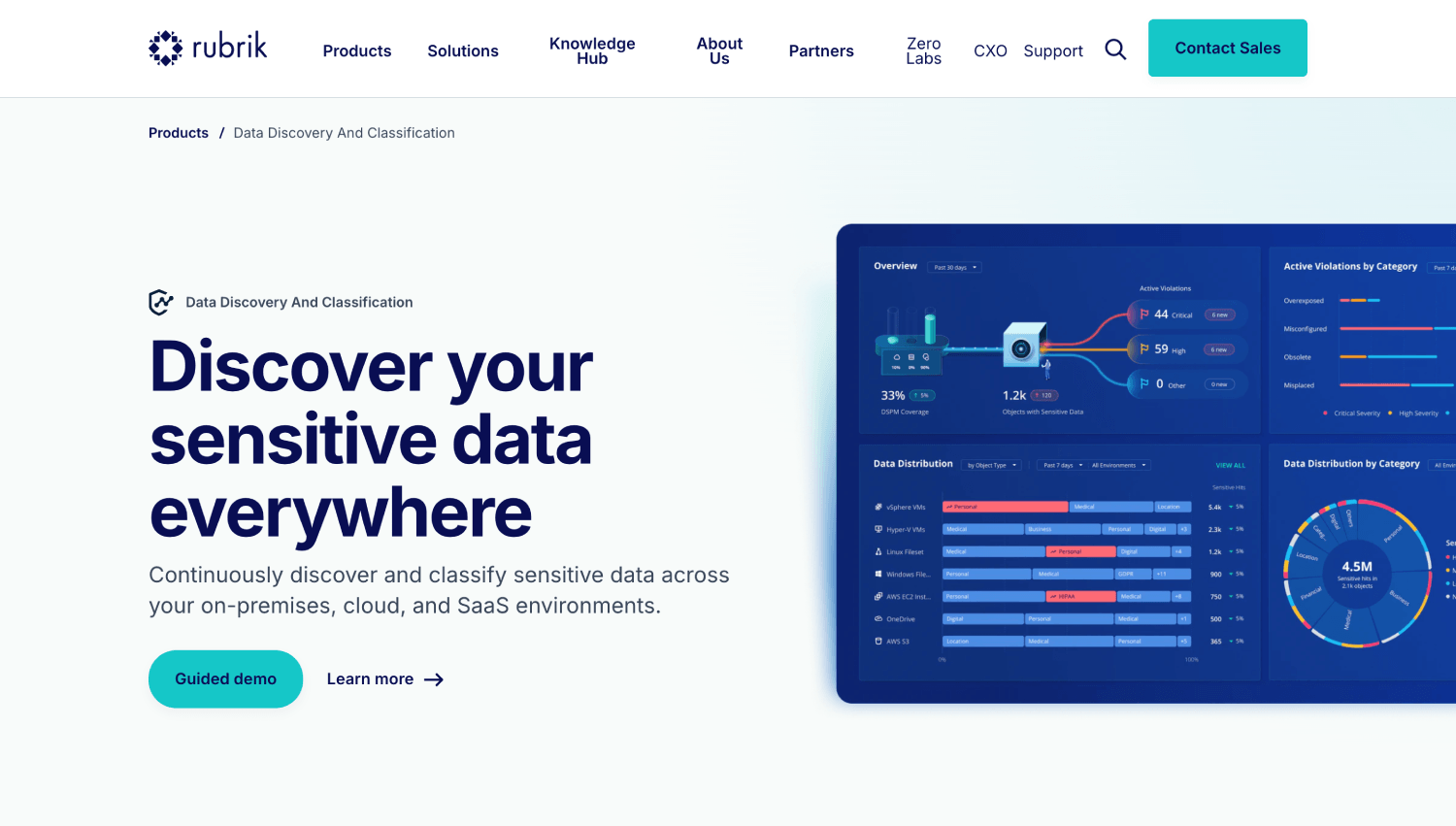
Rubrik Security Cloud includes DSPM capabilities with a focus on shadow data discovery: copies of production data in non-production environments, forgotten database snapshots, and data in cloud storage that predates current governance policies. The scanning approach is agentless and in-cloud.
The Rubrik platform connects DSPM findings to backup and recovery context. For a company whose sensitive data is also covered by Rubrik backups, the combined view of “this data is sensitive, it is exposed, and its backup state is X” is operationally useful for both security and resilience planning. Pricing is not publicly disclosed and is typically bundled with Rubrik Security Cloud licensing.
15. Flow Security
Flow Security focuses on data-in-motion monitoring alongside data-at-rest discovery. It maps how data flows between services, APIs, and external endpoints, which surfaces risks that a storage-scan-only approach misses: a microservice that reads sensitive data from a database and writes it to an unprotected API endpoint. That kind of data flow risk is invisible to agentless storage scanners.
Flow’s coverage of data-in-motion within cloud-native application architectures, including Kubernetes workloads and service meshes, is more depth than most DSPM platforms offer. For organizations building or running cloud-native applications where API data exposure is a primary concern, Flow addresses a gap the storage-scan-first tools do not. Pricing is not publicly disclosed.
How Do These Platforms Compare on the Dimensions That Matter?
| Platform | Primary Scanning Model | Cloud IaaS Coverage | SaaS Coverage | On-Premises Coverage | Remediation Capability | Best Fit |
|---|---|---|---|---|---|---|
| Cyera | Agentless, in-cloud | AWS, Azure, GCP | Limited | No | Recommendations + workflow | Cloud-first, large unstructured data |
| BigID | Hybrid (connectors + agents) | AWS, Azure, GCP | Broad (100+ connectors) | Yes | Modular (separate license) | Heterogeneous environments, privacy compliance |
| Varonis | Agent + API connectors | AWS, Azure | Microsoft 365, Salesforce | Yes (strong) | Automated least-privilege enforcement | Microsoft-centric environments |
| Securiti | Agentless + connectors | AWS, Azure, GCP | Yes | Limited | Workflow-driven | Privacy + AI governance combined |
| Sentra | Agentless, in-cloud | AWS, Azure, GCP | Snowflake | No | Recommendations + ticketing integration | Cloud data sprawl and shadow copies |
| Wiz DSPM | Agentless | AWS, Azure, GCP | Limited | No | Via Wiz remediation workflow | Existing Wiz customers |
| Palo Alto Prisma Cloud | Agentless + real-time monitoring | AWS, Azure, GCP | Limited | No | Via Prisma Cloud workflow | Existing Prisma Cloud customers |
| Netskope DSPM | API connectors | AWS, Azure | Strong (CASB-aligned) | No | Via SSE policy integration | SaaS-heavy orgs running Netskope SSE |
| Zscaler DSPM | Inline + API | AWS, Azure | Yes | No | Via Zero Trust Exchange policies | Existing Zscaler customers |
| Concentric AI | API connectors | Limited | Microsoft 365, Google Workspace, Box | Yes (file shares) | Autonomous (within rule sets) | Teams needing automated remediation |
| Normalyze/Proofpoint | Agentless, in-cloud | AWS, Azure, GCP | Limited | No | Attack-path prioritization | Verify current state with Proofpoint |
| Microsoft Purview | Native (Microsoft stack) | Azure (strong), AWS/GCP (limited) | Microsoft 365 (deep), others limited | Yes (limited) | Integrated (DLP + sensitivity labels) | Microsoft-centric organizations |
| Symmetry Systems | Agentless, API-based | AWS, Azure, GCP | Limited | No | IAM graph-based recommendations | Cloud IAM-focused security teams |
| Rubrik Data Security | Agentless, in-cloud | AWS, Azure, GCP | Limited | No | Findings integration with backup context | Existing Rubrik customers |
| Flow Security | Data-in-motion + API monitoring | AWS, Azure, GCP | Via API monitoring | No | Flow-level policy recommendations | Cloud-native apps with API exposure risk |
Which DSPM Tools Remediate Versus Only Report?
Remediation in DSPM exists on a spectrum. At one end, a platform generates a finding and stops. At the other, a platform executes the access change, applies the storage policy, and closes the finding automatically. Most tools sit somewhere in between, and understanding where a tool sits changes how much human capacity you need to operationalize it.
Finding-only tools include Wiz DSPM, Symmetry Systems, and Sentra in their base configurations. They surface the risk clearly and often integrate with ticketing systems to route findings to the right owner. Acting on those findings requires a human to review and execute the change. For teams with a mature IAM governance process and an active ticketing workflow, this is workable. For teams that are already underwater on remediation backlog, it adds volume without velocity.
Workflow-integrated tools like BigID, Cyera, and Securiti generate recommended remediations and push them to Jira, ServiceNow, or similar systems for approval and execution. The finding does not sit in a DSPM-only queue. This model suits organizations with existing change management workflows where security findings need to route through IT operations before execution.
Autonomous remediation tools like Concentric AI and Varonis execute access changes directly, within defined policy boundaries. Varonis applies least-privilege enforcement to sensitive files from accounts that have not used that access in a configurable window, within defined policy parameters. Concentric will apply DLP policies autonomously. Both require careful configuration of the autonomy boundaries to avoid breaking legitimate access patterns. The operational benefit is that remediation does not wait for a human queue to clear.
How Should You Shortlist DSPM Platforms by Data-Store Coverage?
Start by mapping your actual data stores before looking at a single vendor. A common mistake is selecting a DSPM platform based on its most prominently marketed integrations, then discovering three months into deployment that 40% of your actual sensitive data lives in a system the tool handles poorly.
Run this shortlisting exercise before vendor conversations. List every data store that might contain sensitive data: cloud object storage buckets, relational databases (managed and unmanaged), data warehouses, SaaS applications, file shares, messaging platforms, code repositories, and backup stores. Categorize each as cloud-native IaaS, SaaS, or on-premises. Then match your category profile to the coverage table above.
An organization running 70% of its sensitive data in Microsoft 365 and Azure SQL, with the remainder in AWS S3, should evaluate Microsoft Purview for Microsoft environments and pair it with a cloud-native DSPM for AWS coverage, before evaluating cloud-native-first tools like Cyera or Sentra. An organization running a cloud-native data stack in AWS with heavy Snowflake usage and minimal Microsoft exposure gets better value from Cyera, Sentra, or Wiz DSPM. A hybrid organization with significant on-premises database coverage and cloud growth should evaluate BigID, which consistently covers the most data-store types in this list.
The shortlisting logic also applies to AI infrastructure. As organizations deploy AI agents that read from and write to enterprise data stores, the data security posture of those stores becomes part of the broader AI security surface, an area covered separately in evaluations of AI agent discovery and monitoring tools.
What Should a DSPM Proof-of-Concept Actually Test?
A DSPM proof-of-concept that runs only against sanitized demo data tells you nothing about how the tool performs in your environment. Structure the POC around four verifiable outcomes.
- Classification accuracy on your own labeled data. Use the SecurityOpsWire Classification Accuracy Test methodology described above. Score precision and recall per sensitivity tier. Require each vendor to provide their methodology documentation so you can compare apples to apples.
- Data store coverage completeness. Before granting API access, document your expected data store inventory. After the scan, compare the tool’s discovered inventory to your known list. The gap between expected and discovered is your coverage gap.
- Time to first meaningful finding. Measure the elapsed time from API credential configuration to the first finding that is specific, accurate, and ready to act on. This measures both scan speed and false-positive rate on initial output.
- Remediation workflow exercise. Take one real finding (a non-critical one, or a test bucket with known exposure). Walk the remediation path end to end. For workflow-integrated tools, verify that the Jira ticket was created, contained the correct context, and routed to the right team. For autonomous tools, verify that the access change applied correctly and was logged. Discovery is table stakes. This step separates tools that generate controls from tools that generate reports.
Frequently Asked Questions About DSPM Tools
What is the difference between DSPM and DLP?
DLP (Data Loss Prevention) operates on data in motion, applying policies at the network, endpoint, or email gateway to prevent sensitive data from leaving an authorized environment. DSPM operates on data at rest, discovering where sensitive data exists in storage systems and identifying whether the access controls and configurations protecting it are correct. The two are complementary: DSPM tells you what exists and where, DLP tells you what is moving and whether it should be. Some platforms, including Netskope and Zscaler, integrate both in a unified policy engine.
How accurate is DSPM classification in practice, and how is that measured?
Vendor-reported classification accuracy figures typically come from benchmark datasets that do not represent your environment. Practically, tools that combine ML classification with content inspection (reading actual field values, not just column names or file names) outperform pure pattern-matching tools on enterprise data. Precision and recall, measured per sensitivity tier against a manually labeled sample of your own data, is the most reliable accuracy measure. Most vendors will participate in a classification accuracy POC if you structure the request with a labeled ground-truth dataset.
Do DSPM tools work on on-premises data, or only cloud?
Cloud coverage is stronger across all platforms in this list, because cloud API access is standardized and does not require network access to internal systems. On-premises coverage varies significantly: BigID and Varonis offer the deepest on-premises database and file share coverage. Most cloud-native DSPM vendors, including Cyera, Sentra, and Flow, focus on cloud and have limited or no on-premises capability. Organizations with significant on-premises data should prioritize this dimension in their evaluation and request a specific on-premises POC, not just a cloud demonstration.
How does DSPM integrate with SIEM and SOAR platforms?
Most DSPM platforms export findings through webhooks, API endpoints, or native connectors to SIEM systems such as Splunk, Microsoft Sentinel, and Google Chronicle. The quality of that integration varies by vendor. A finding that exports only a severity level and a resource name is difficult to operationalize in a SIEM. A finding that includes the data store ARN, the classification taxonomy, the identity that has access, and the policy violation type gives a detection engineer enough context to write a detection rule or trigger a SOAR playbook. Ask each vendor to show you a sample finding payload, not a feature description, and evaluate whether your SOC team can act on it. Security teams running automated response workflows will find this directly relevant to their AI agent security platform and SOAR integration decisions.
What does a DSPM deployment typically cost to operate?
Operational cost has three components: the platform license, the cloud infrastructure cost of running scans (API request charges, egress fees if the vendor processes data outside your cloud accounts), and the staff time required to triage and remediate findings. Vendors with in-cloud processing architectures (Cyera, Sentra, Normalyze/Proofpoint) eliminate egress costs. Finding volume directly drives staff cost: a platform with a high false-positive rate on initial deployment creates a remediation backlog that consumes analyst time before any real risk is reduced. Budget for a tuning period of four to eight weeks after initial deployment before expecting production-quality finding quality.
Which DSPM platforms are best for organizations subject to GDPR or CCPA?
BigID was built explicitly for data privacy compliance and offers the strongest coverage for DSR (Data Subject Request) workflows, retention policy mapping, and cross-system identity correlation. Microsoft Purview integrates directly with Microsoft’s compliance and information protection tooling, which suits Microsoft-centric organizations under GDPR. Securiti combines DSPM and privacy operations in a single platform, which reduces the integration work required to connect discovery findings to privacy team workflows. All three handle cross-border data flow mapping, which is frequently required for GDPR compliance documentation.
Is DSPM relevant for organizations using AI models that process sensitive data?
Yes, and this is an area where the DSPM category is evolving quickly. AI models trained on or given access to enterprise data stores inherit the data security posture of those stores. If a model has read access to a storage bucket containing sensitive customer data, the effective access risk of that model’s inference environment includes that data. DSPM platforms that map service account and API key access alongside human identity access (Cyera, Symmetry, Sentra) surface AI-related data access risk in the same findings view. The broader governance question of how AI systems access and handle data connects DSPM to the emerging category of AI Security Posture Management platforms.
Conclusion
The divide in this market is not between good platforms and bad ones. It is between platforms that complete the loop from discovery to remediation and platforms that surface risk and hand the problem to a process that may not exist. If your security team has a functioning remediation workflow and the capacity to triage findings, the discovery-and-classify tier of this market serves you adequately. If your team cannot absorb a finding queue of thousands of data risk alerts per week, the tool you need is one that closes its own loop, not one that generates the most comprehensive report.
Classification accuracy is the dimension where marketing claims and operational reality diverge most. Every vendor will demo classification on a clean dataset. The only way to know how a tool performs on your data is to run the SecurityOpsWire Classification Accuracy Test on a sample of your actual environment, with your actual schema ambiguities, your actual field naming conventions, and your actual mix of sensitivity levels. That test, run before a contract is signed, will eliminate at least two platforms from any shortlist.
For most mid-enterprise organizations running AWS or Azure as their primary cloud, with some Microsoft 365 and limited on-premises exposure, the practical shortlist is three platforms: one cloud-native DSPM with in-cloud processing (Cyera or Sentra), one platform that covers the Microsoft stack deeply (Varonis or Purview), and either Wiz or Palo Alto Prisma Cloud if you already run those platforms for CSPM. Three tools covering overlapping ground is redundancy you cannot afford. One tool with real remediation capability, covering your actual data stores, is a control.