
TLDR
- CSPM tells you a storage bucket is publicly accessible. DSPM tells you the bucket holds 40,000 Social Security numbers and three service accounts with write access can reach it. The severity difference between those two findings is the entire argument for buying both.
- Most CSPM platforms perform shallow content inspection at best. They flag misconfiguration at the infrastructure layer. They do not classify data, map effective access, or track whether sensitive files moved since last scan.
- CNAPP platforms that bundle “DSPM” capabilities vary widely in depth. Buying a CNAPP does not automatically mean data classification and effective-access analysis are covered at the level a privacy or data security program requires.
- Ownership is the operational problem teams avoid naming: CSPM findings route to cloud security engineers, while DSPM findings belong to a data security or privacy team. Sending both to the same queue creates backlog and missed prioritization.
- Duplicate scanning cost is real but manageable. The overlap is narrow: both tools touch object storage. The non-overlap is large: DSPM covers databases, SaaS repositories, and unstructured data that CSPM never reaches.
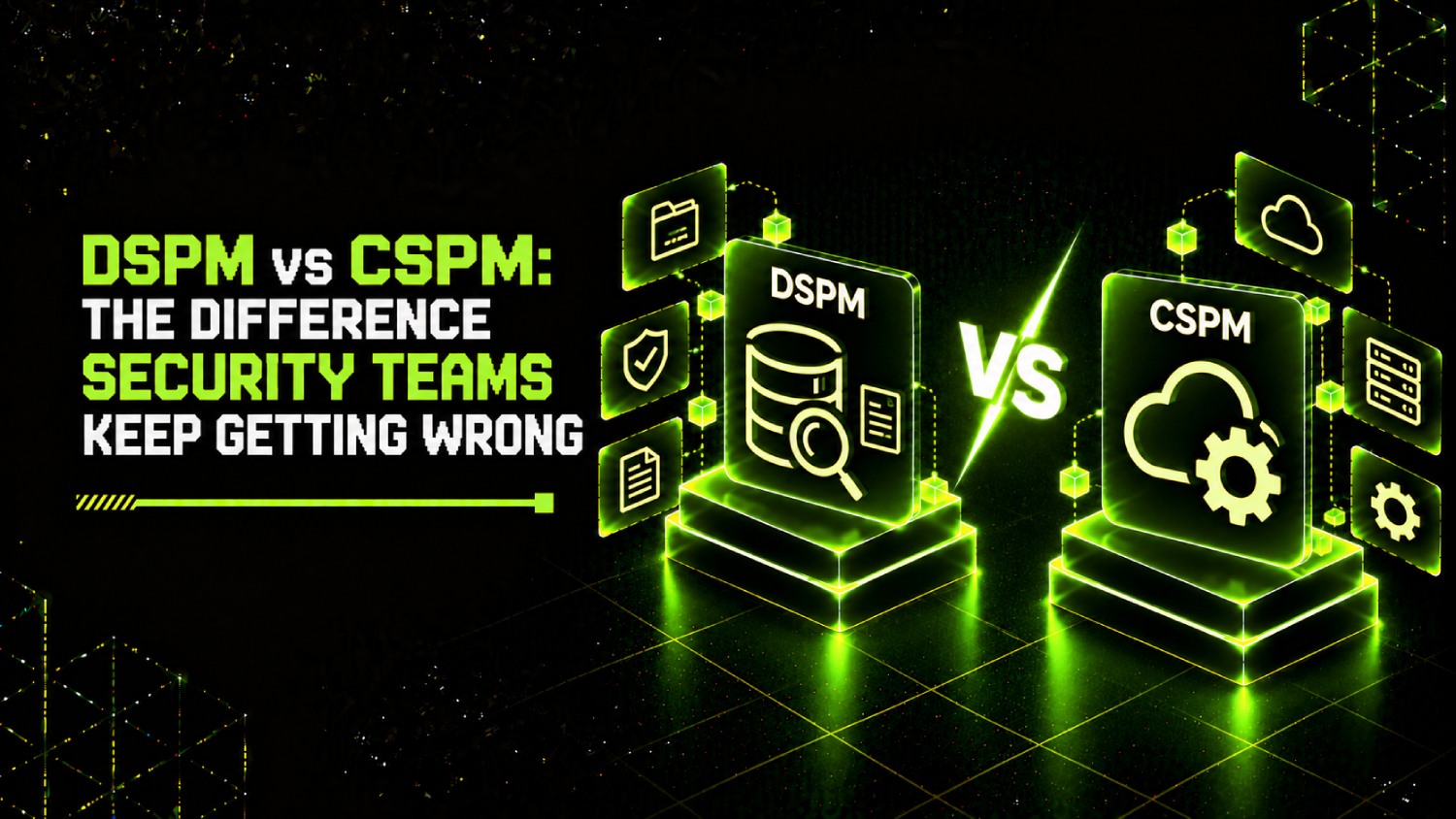
CSPM and DSPM answer different questions about the same cloud environment. CSPM asks whether the infrastructure is configured correctly. DSPM asks whether sensitive data is exposed, who can effectively reach it, and what the data actually is. A publicly accessible S3 bucket is a medium-severity CSPM finding. That same bucket containing regulated health records with three overprivileged identities that have accessed it in the past 30 days is a critical DSPM finding. The tools are not redundant. They are sequential.
Why CSPM Cannot See What DSPM Sees
Cloud security posture management tools work at the configuration layer. They query cloud provider APIs, compare the results against a rule set or benchmark, and surface deviations: open security groups, public buckets, missing encryption settings, IAM policies that grant overly broad access. That is genuinely useful work, and most mature cloud programs need it.
The gap is not a flaw in CSPM design. It is a scope boundary. CSPM tools are built to answer infrastructure questions, and they answer those questions well. What they do not do is inspect the contents of a bucket, classify a database column as containing personally identifiable information, or determine that a service account has the theoretical permissions to access a file share and has exercised those permissions recently.
Data security posture management operates below the configuration layer. A DSPM tool reads the data itself, typically through agentless scanning or API-based sampling, classifies it by sensitivity type (PII, PHI, payment card data, intellectual property, secrets), maps which identities have effective access (not just policy-level access, but access that could be exercised given the full chain of permissions), and tracks changes over time. That last capability matters operationally: DSPM can tell you when a new sensitive dataset appeared in an environment, when access patterns shifted, or when previously private data became reachable through a permission change you did not catch in the CSPM layer.
What Does CSPM Actually Miss About Data?
Three specific gaps define where CSPM stops and DSPM begins.
1. Content Blindness
CSPM flags that a bucket has public read access. It does not know whether the bucket contains configuration files, application logs, or a full export of a customer database. Those three scenarios have entirely different regulatory and business impacts, but from the CSPM perspective they generate the same finding with the same severity. A cloud security engineer triaging that alert has no way to know which scenario they are in without going and looking manually.
2. Effective Access Versus Policy Access
IAM policy analysis in CSPM platforms typically evaluates permissions as written in policies. Effective access is more complex. It factors in permission boundaries, service control policies in AWS Organizations, resource-based policies, and whether a given identity has been active recently. A DSPM tool that maps effective access to a sensitive dataset gives the triage team a materially different picture than a CSPM tool that reports “this role has S3:GetObject on *.”
3. Data Movement and Drift
CSPM operates on the current configuration state. It does not track whether data was copied from a compliant, properly configured bucket to a test environment bucket with looser controls, or whether a developer pulled production records into a development database last Tuesday. DSPM tracks data lineage and movement patterns. That capability is what compliance frameworks like HIPAA and GDPR actually require organizations to demonstrate, and CSPM alone cannot produce that evidence.
The Severity Gap: A Worked Scenario
Consider a financial services company running four AWS accounts. A routine CSPM scan flags an S3 bucket in the data-lake account as publicly accessible. No encryption in transit is enforced. The finding gets a high severity score based on configuration rules aligned to the CIS AWS Foundations Benchmark.
That finding enters the cloud security team’s backlog. There are 47 open findings ahead of it. The expected remediation time based on team capacity is three weeks.
Now run a DSPM scan against the same environment. The tool identifies 14 objects in that bucket, classifies them, and surfaces the following: 11 files are application logs with no sensitive content. Three files are quarterly reports containing account numbers and full names for approximately 8,200 customers, classified as non-public financial information under GLBA. Effective access analysis shows two service accounts and one IAM user with the ability to read and download those files. Activity logs show one of the service accounts accessed the bucket six times in the past 14 days.
The DSPM finding is critical. The three-week remediation timeline is no longer acceptable. The finding also now belongs to the data security team and the compliance function, not just the cloud security engineer queue.
Same infrastructure finding. Entirely different severity, ownership, and response timeline. This is not a theoretical difference in tooling philosophy. It is the difference between a finding that gets patched on a normal schedule and a finding that triggers an incident response process.
Do CNAPP Platforms Include Real DSPM?
This is where vendor claims require scrutiny. Several major CNAPP platforms have added data security capabilities over the past two years, and some market them as DSPM. The actual depth varies.
Platforms like Wiz, Palo Alto Networks Prisma Cloud, and CrowdStrike Falcon Cloud Security include data classification features that can identify sensitive data in cloud object storage and some database services. What those features typically do not match, compared to dedicated DSPM platforms like Varonis, BigID, or Rubrik Data Security, is coverage depth for structured databases, SaaS applications, and on-premises data stores, plus granular data lineage and movement tracking.
If your sensitive data lives primarily in AWS S3 and Azure Blob Storage and your CNAPP platform supports those services, the bundled capability may be sufficient. If your data environment includes Snowflake, Salesforce, on-premises SQL Server, SharePoint, and Google Drive, a dedicated DSPM platform will cover more ground. For teams evaluating data security tooling for cloud-hosted data, the SecurityOpsWire DSPM platform comparison covers major vendor options across deployment models and data store coverage.
The honest answer for most enterprise environments: CNAPP-bundled DSPM is a reasonable starting point and avoids adding another vendor. Dedicated DSPM is the right call when compliance obligations require comprehensive data discovery across hybrid and multi-cloud environments, or when the privacy and data governance team needs a tool they can operate independently of the cloud security function.
Which Team Owns CSPM Findings vs. DSPM Findings?
Ownership confusion is where the CSPM-DSPM gap becomes an operational problem. Most organizations route cloud security findings to a cloud security engineering team or a SOC team. That routing is correct for CSPM findings: misconfigured security groups, overly permissive IAM policies, and missing logging configurations are infrastructure problems with infrastructure remediation paths.
DSPM findings have a different ownership model. A finding that regulated data is overexposed belongs to at least three functions: the data security or privacy team (who owns the data classification and access governance), the compliance team (who owns the regulatory risk), and the application or business team that owns the data. Cloud security engineers can fix the infrastructure configuration. They cannot decide whether a particular dataset should be accessible to a particular service account, because they do not know what that data is used for or what the business justification for access was.
The SecurityOpsWire Alert Routing Matrix below maps finding types to the correct owning team. Security programs that route DSPM findings to the cloud security queue are not wrong about the technical remediation. They are wrong about who needs to be involved in the decision about whether and how fast to remediate, and who needs to be notified if the finding meets a regulatory disclosure threshold.
| Finding Type | Tool Layer | Primary Owner | Secondary Stakeholder | Response SLA Driver |
|---|---|---|---|---|
| Public storage bucket (no sensitive content confirmed) | CSPM | Cloud Security Engineering | None | Configuration benchmark |
| Public storage bucket with classified PII or PHI | DSPM | Data Security / Privacy | Cloud Security Engineering, Legal/Compliance | Regulatory exposure window |
| Overly broad IAM role (no data access confirmed) | CSPM | Cloud Security Engineering / IAM Team | None | Least-privilege policy |
| Service account with effective access to regulated dataset, recently active | DSPM | Data Security / Privacy | IAM Team, Application Owner | Incident response threshold |
| Missing encryption at rest on a storage resource | CSPM | Cloud Security Engineering | None | Configuration benchmark |
| Sensitive data discovered in a test environment | DSPM | Data Security / Privacy | Application Owner, Compliance | Data residency / compliance policy |
| Publicly exposed API endpoint | CSPM | Cloud Security Engineering | Application Security | Attack surface exposure |
| Sensitive data accessed by an anomalous identity | DSPM | SOC / Incident Response | Data Security, Legal | Potential breach trigger |
Where CSPM and DSPM Actually Overlap
The overlap is smaller than the vendor definition pages suggest. Both tools scan cloud object storage services. Both will surface a finding when an S3 bucket or Azure Blob container has public access configured. In that narrow zone, teams running both tools will see duplicate alerts, and they need a clear deduplication rule: CSPM owns the configuration finding, DSPM owns the data-layer finding, and both get closed when the infrastructure remediation is confirmed and a re-scan shows the data is no longer accessible.
Outside object storage, the overlap shrinks further. CSPM covers network configuration, compute security, container and Kubernetes posture, and cloud-native service configuration. DSPM covers structured and unstructured data wherever it lives, including SaaS platforms, collaboration tools, and data warehouses that CSPM never touches. Teams worried about scanning cost duplication are solving the wrong problem. The duplicate scan cost on object storage is real but typically small relative to the coverage each tool provides in its own domain.
For teams that have invested heavily in cloud infrastructure posture and are now considering data-layer coverage, the question of how AI data risk intersects with DSPM is worth examining before scoping a deployment , particularly if AI training pipelines or model serving infrastructure touch the same data stores. The SecurityOpsWire comparison of AI-SPM versus DSPM covers where those two disciplines diverge and where they share coverage obligations.
The CSPM-DSPM Coverage Matrix: What Each Tool Sees
| Coverage Area | CSPM | DSPM | Notes |
|---|---|---|---|
| Cloud infrastructure configuration | Yes | No | CSPM primary domain |
| IAM policy analysis (written permissions) | Yes | Partial | DSPM focuses on effective access to data, not all IAM coverage |
| Object storage content classification | No / Limited | Yes | Some CNAPPs have basic classification; DSPM is comprehensive |
| Database content classification | No | Yes | DSPM covers structured databases; CSPM only checks config |
| SaaS data repositories | No | Yes (in leading platforms) | Salesforce, Google Drive, SharePoint coverage varies by DSPM vendor |
| Data lineage and movement tracking | No | Yes | Compliance reporting use case exclusive to DSPM |
| Effective access to sensitive data | No | Yes | Critical for breach impact assessment |
| Network and compute misconfiguration | Yes | No | CSPM primary domain |
| Container and Kubernetes posture | Yes | No | Covered by CNAPP/CWPP layer |
| Regulatory evidence generation (data-specific) | No | Yes | GDPR, HIPAA, GLBA, CCPA data mapping requirements |
| Secrets in code or storage | Partial | Partial | Secrets management tools cover this more completely |
| Anomalous data access detection | No | Yes | Some DSPM platforms include behavioral analysis on data access |
Does Buying Both CSPM and DSPM Duplicate Scanning Cost?
Scanning overlap exists on object storage. Both tools will enumerate S3 buckets, Azure containers, and Google Cloud Storage. If your CSPM platform charges per resource or per cloud account, and your DSPM platform charges per data store scanned, you will pay twice to touch the same object storage resources. That is a real cost, and it is worth quantifying before you sign both contracts.
The duplication typically does not extend further. DSPM platforms charge based on data volume scanned, data stores covered, or a combination. They scan databases, SaaS systems, and data warehouses that a CSPM tool never queries. CSPM platforms charge based on cloud resources under management, which includes compute, network, and services that DSPM never touches. Most of the cost in each tool is paying for coverage the other tool does not provide.
Pricing for both categories is almost never published publicly. CSPM tools that are part of CNAPP platforms (Wiz, Prisma Cloud, CrowdStrike) do not disclose per-account or per-resource rates. Dedicated DSPM platforms like BigID, Varonis, and Rubrik quote per environment. The cost model matters more than the list price in both cases: CSPM costs scale with cloud resource count, while DSPM costs scale with data volume and store count. A large enterprise with a lean cloud footprint but large data stores will find DSPM more expensive relative to CSPM, and vice versa. Teams building the business case for both tools should model the overlap cost at roughly 10-20% of total scanning spend on object storage, though that estimate will vary based on your cloud-to-data-store ratio.
For teams evaluating DSPM in Microsoft Azure environments specifically, the SecurityOpsWire comparison of DSPM tools for Azure covers how major vendors scope and price for that cloud provider.
How to Decide Which to Buy First, or Whether to Buy Both
Buy CSPM first if your cloud security program is early-stage and your primary risk is infrastructure misconfiguration. Most teams are here. A public bucket matters even if you do not know what is in it. CSPM gives you continuous configuration monitoring, compliance benchmark alignment, and a remediation workflow that integrates with ticketing systems your engineering team already uses.
Add DSPM when any of these apply: your organization is subject to GDPR, HIPAA, GLBA, CCPA, or a comparable data protection regulation with specific data mapping and breach notification requirements; your cloud environment contains customer records, financial data, or health information; your incident response team cannot answer “what data was affected?” without a manual investigation that takes days; or your privacy or compliance function needs evidence of data access controls that a configuration tool cannot produce.
If you are running a CNAPP platform that includes bundled data classification, start by testing its depth against your actual data estate. Scan a representative sample of your most sensitive data stores and see what the platform classifies and misses. If coverage is adequate for your regulatory requirements, you may not need a dedicated DSPM platform immediately. If the classification is shallow or the SaaS and database coverage is absent, the gap between a bundled feature and a dedicated tool will be visible in that test.
For teams with significant Snowflake data infrastructure, the differences in DSPM coverage for that environment are substantial enough to warrant separate evaluation. The SecurityOpsWire comparison of DSPM platforms for Snowflake covers vendor-by-vendor depth across that specific environment.
Frequently Asked Questions
What is the core difference between CSPM and DSPM?
CSPM monitors cloud infrastructure configurations and flags deviations from security benchmarks: open ports, public storage, missing encryption settings, overly permissive IAM policies. DSPM scans the data itself, classifying it by sensitivity, mapping which identities have effective access, and tracking how data moves across environments. CSPM answers “is the bucket configured correctly?” DSPM answers “what is in the bucket, who can reach it, and does that exposure create regulatory risk?”
What is the difference between DSPM and CSPM for teams evaluating both?
The clearest way to frame the dspm vs cspm distinction for a buying decision is by data layer versus infrastructure layer. CSPM operates entirely at the infrastructure and configuration layer , it never reads data contents. DSPM operates at the data layer , it classifies what data exists, who has effective access to it, and whether that access creates regulatory or business risk. A team evaluating both should think of CSPM as covering the container and DSPM as covering what is inside it. The two tools share a narrow overlap on object storage findings, but diverge completely on databases, SaaS repositories, and compliance evidence generation.
Can CSPM replace DSPM, or do you need both?
CSPM cannot replace DSPM. The two tools operate at different layers. CSPM does not read data contents, classify information by type, or map effective access to specific datasets. For organizations subject to data protection regulations or for any environment holding customer records, health information, or financial data, CSPM alone leaves a material gap in risk visibility. A misconfiguration finding without data context cannot be accurately prioritized or properly escalated to the right team.
Do CNAPP platforms include real DSPM capability?
Major CNAPP platforms have added data classification features that cover cloud object storage. The depth varies. Coverage for structured databases, SaaS applications, collaboration platforms, and on-premises data stores is generally stronger in dedicated DSPM platforms than in CNAPP-bundled features. For organizations with complex, multi-environment data estates and regulatory compliance requirements, dedicated DSPM platforms typically provide more comprehensive classification, lineage tracking, and compliance reporting. Testing CNAPP-bundled features against your actual data environment is the most reliable way to evaluate whether the bundled capability is sufficient.
Which team should own DSPM alerts?
Data security, privacy, and compliance functions should own DSPM findings, not the cloud security engineering team. DSPM findings that involve regulated data require decisions about data ownership, regulatory notification thresholds, and access justification that cloud engineers are not positioned to make. Cloud security engineering stays in the remediation path for the infrastructure fix, but the escalation decision and regulatory impact assessment belong to the data security and compliance function. Routing DSPM alerts into the same queue as CSPM findings creates prioritization errors and delays the right stakeholders from seeing exposure.
How does DSPM handle sensitive data discovery across SaaS?
Leading DSPM platforms connect to SaaS applications through API integrations, scanning for sensitive data in Google Drive, Salesforce, Microsoft 365 SharePoint, Slack, and similar platforms. Coverage varies by vendor. Platforms like BigID and Varonis have broad SaaS connector libraries. CSPM tools do not cover SaaS data repositories at all, which is a significant blind spot for organizations where sensitive data lives in collaboration and productivity applications rather than purely in cloud infrastructure storage.
Is DSPM the same as DLP?
DSPM and DLP address different problems. DLP (data loss prevention) controls data movement in real time, blocking or alerting when sensitive data is transmitted outside approved channels. DSPM establishes a posture baseline, discovering where sensitive data exists, classifying it, and identifying where access controls are misconfigured or overly broad. DSPM tells you there is a problem with how data is stored and who can reach it. DLP tells you when data is actively moving somewhere it should not. The SecurityOpsWire comparison of DSPM versus DLP covers where each tool fits in a data security program.
Does running both CSPM and DSPM create duplicate alerts?
Yes, on a narrow set of findings. Both tools will flag publicly accessible cloud storage. The practical solution is a deduplication rule: CSPM owns the configuration finding, DSPM owns the data-layer finding, and remediation of the configuration finding closes both. Outside object storage, the alert overlap is minimal. DSPM surfaces findings in databases, SaaS systems, and data stores that CSPM does not scan. CSPM surfaces findings in compute, network, and cloud service configurations that DSPM does not evaluate.
The Posture Layer That Changes Everything
The enduring confusion about CSPM and DSPM comes from the word “posture” appearing in both names. Posture in cloud security means the current state of controls relative to a benchmark. CSPM measures the posture of infrastructure. DSPM measures the posture of data. They are not two versions of the same idea. They are two different answers to two different risk questions, and collapsing them into one category produces exactly the misconfiguration that lets a public bucket with regulated records sit in a backlog for three weeks.
Security programs that treat CSPM coverage as data security coverage are not making a theoretical error. They are making a prioritization error. The severity of a finding changes when you know what data it affects. The ownership changes. The regulatory clock changes. A program that cannot answer “what data was exposed?” in the first hour of an incident investigation is not a program that has its cloud security posture managed. It is a program that has its infrastructure configuration managed, which is a different and smaller thing.
The right mental model: CSPM is a prerequisite for cloud operations hygiene, and every cloud security program should have it. DSPM is a prerequisite for data governance and breach response, and every organization holding regulated data should have it too. They do not compete for the same budget line. They answer different questions for different teams, and the gap between what each tool sees is exactly where your highest-severity findings are hiding.