
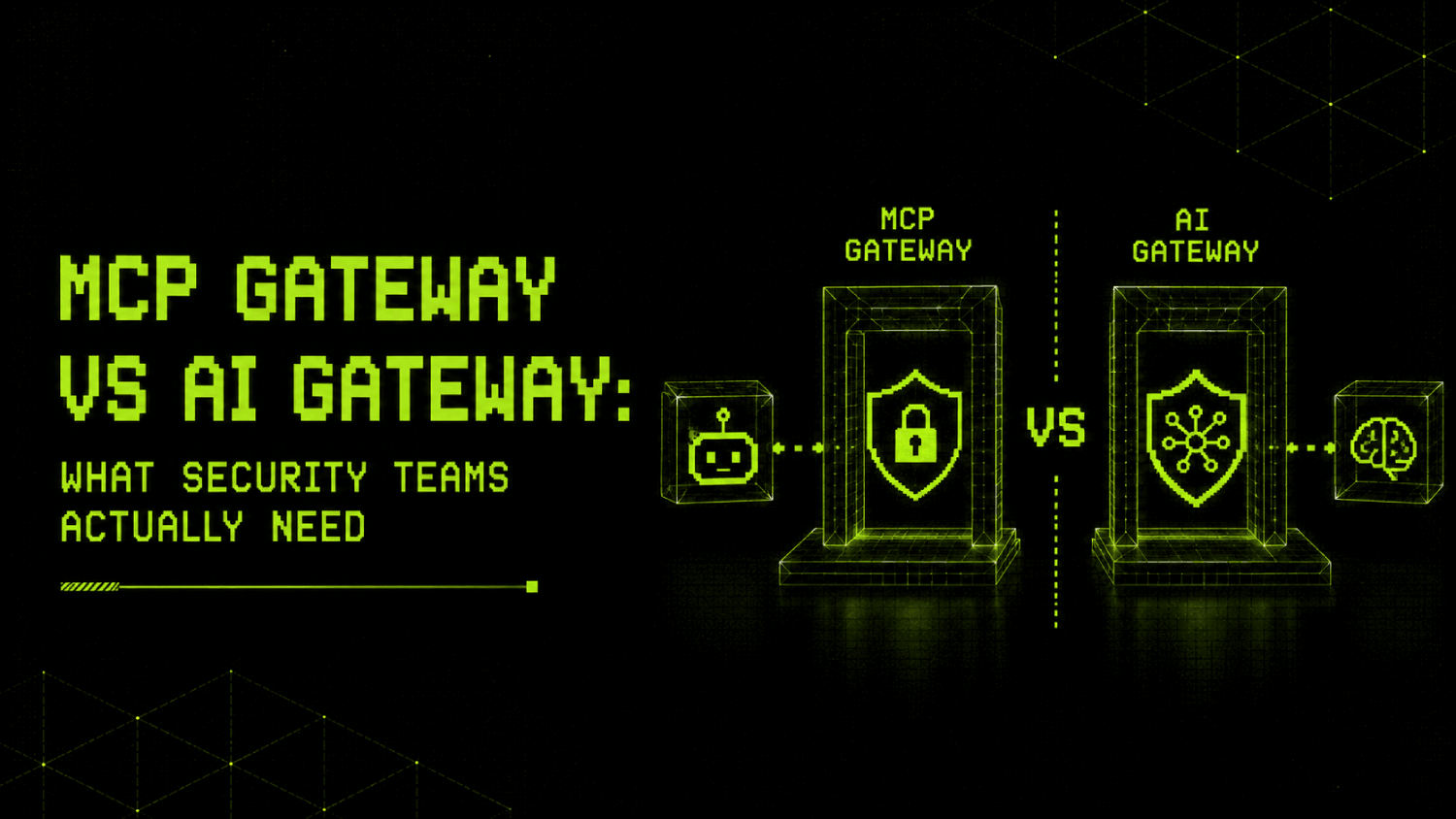
- An AI gateway (also called an LLM gateway) controls the traffic between your application and the model: prompt content, token spend, rate limits, and model routing. An MCP gateway controls what tools an agent is allowed to call after the model has already decided to act.
- These are two distinct control planes operating at different layers. Placing an AI gateway in front of model calls does not govern tool invocations at all. A misconfigured file-system tool or a database write exposed through an MCP server is invisible to the AI gateway.
- For most teams starting from zero: deploy the AI gateway first to get visibility into prompt traffic and control spend, then add the MCP gateway when you have autonomous agents invoking external tools in production.
- The operating cost difference matters more than the purchase price. An AI gateway adds latency primarily at the prompt/response layer; an MCP gateway adds latency at every tool call. In an agentic loop with many tool calls per task, that compounds quickly.
- Security teams should own the policy in both layers, not just the AI gateway. Tool permissions, scope restrictions, and tool-call audit logs belong in a security control, not a DevOps routing rule.
When evaluating mcp gateway vs ai gateway, the core distinction is this: these are not the same product aimed at the same traffic. An AI gateway sits between your application and the model provider, governing prompts, responses, token budgets, and model routing. An MCP gateway sits between an agent and the tools it can invoke via the Model Context Protocol, enforcing which tools exist, who may call them, under what conditions, and with what audit trail. Both are necessary in a mature agentic architecture; neither substitutes for the other.
What Is an AI Gateway and What Traffic Does It Actually Control?
An AI gateway (sometimes called an LLM gateway) is a proxy layer that intercepts calls between your application code and a model provider such as OpenAI, Anthropic, or a self-hosted model endpoint. The products that occupy this category include Cloudflare AI Gateway, Portkey (now PRISMA AIRS AI Gateway), LiteLLM, and infrastructure vendors like Kong AI Gateway and Traefik, which have extended their existing API proxy products to handle model traffic specifically.
What these products govern: prompt content (inspection, redaction, injection detection), model selection and routing, rate limits, token budgets, caching of repeated completions, and response filtering. Cloudflare AI Gateway’s documentation describes its role as an application control plane for AI calls. That framing is accurate as far as it goes. The product sees the request before it reaches the model and the response before it reaches your application.
What these products do not see: anything that happens after the model decides to act. When a model emits a tool call, the AI gateway’s job is already done. The agent runtime picks up the tool call and dispatches it to whatever server or API is registered for that tool. No AI gateway intercepts that dispatch, inspects the parameters, checks whether the agent has permission to write versus read, or logs the outcome.
What Is an MCP Gateway and Which Layer Does It Own?
The Model Context Protocol, published by Anthropic, defines a standard for connecting agents to external tools and data sources through a structured client-server interface. An MCP gateway is a reverse proxy and management layer that sits between MCP clients (agent runtimes) and MCP servers (the tools themselves). Products in this space include Solo.io and security-native platforms such as Lasso Security and Noma. IBM has also published work in this area under the name ContextForge, though that product’s current capabilities and positioning should be verified directly with IBM.
The MCP gateway inspects tool invocations before they execute. It enforces which tools an agent session is permitted to call, validates parameter inputs against a schema, checks the identity of the calling agent, applies rate limits per tool, and produces an audit log of every invocation and its result. This is the layer that can block a write operation when only read was authorized. It is also the layer that can detect an agent attempting to invoke a tool it was never shown in its system prompt, which is a common signal in prompt injection attacks that attempt to hijack an agent’s tool-use behavior.
The key architectural distinction: the AI gateway’s authority ends at the model boundary. The MCP gateway’s authority begins at the tool boundary. In an agentic system, these are not the same place, and the gap between them is where most novel agent security risks actually live.
Is MCP an AI Gateway? A Direct Answer
No. MCP (Model Context Protocol) is a protocol specification, not a gateway product. An MCP gateway is an infrastructure component that implements routing and policy enforcement for traffic conforming to that protocol, specifically the traffic between agents and tools. An AI gateway governs traffic between applications and language models. The two products operate at different layers of an agentic architecture, govern different traffic types, and apply different categories of policy. A product can implement both functions, but calling MCP itself an AI gateway conflates the protocol with the proxy, and conflates model traffic with tool traffic.
How the Two Control Planes Map to a Real Agentic Architecture
Consider a mid-market SaaS company running an internal support agent. The agent receives a user query, calls the language model to plan a response, then invokes three tools: a read from a knowledge base, a lookup in a CRM, and an optional ticket update. That single user interaction crosses both control planes.
The AI gateway intercepts the outbound prompt (the user query plus system context) and the inbound model response (the tool call plan). It can detect prompt injection in the user input, enforce a token limit, route to a cheaper model for classification tasks, and log the conversation for compliance. It has no visibility into what happens next.
The MCP gateway intercepts each of the three tool calls the agent emits. It checks whether the agent session is authorized to read the knowledge base (permitted), look up CRM records (permitted, read-only), and write a ticket update (permitted only if the user’s intent classification met a confidence threshold the security team configured). It logs each invocation with the agent identity, the parameters, and the result. If the agent tries to call a fourth tool it was not provisioned, the MCP gateway blocks it and raises an alert.
No single product today covers both planes with equal depth. Teams choosing a consolidated vendor should check which plane that vendor treats as primary and what they sacrifice on the other.
Which Vendors Cover Which Layer?
The table below reflects publicly documented product positioning. Entries for Lasso Security and Noma are based on each vendor’s published marketing and product pages; teams should verify current capabilities directly before purchasing. The IBM ContextForge entry is based on IBM’s published blog post; the product’s full feature set and current status should be confirmed with IBM directly.
| Vendor / Product | Primary Layer | AI Gateway (Prompt/Model) | MCP Gateway (Tool/Agent) | Security-Native or Infra-Native |
|---|---|---|---|---|
| Cloudflare AI Gateway | AI/LLM layer | Yes | No | Infra-native |
| Portkey (now PRISMA AIRS AI Gateway) | AI/LLM layer | Yes | Yes (authentication, access, and observability of MCP servers) | Infra-native |
| LiteLLM | AI/LLM layer | Yes | No | Infra-native |
| Kong AI Gateway | AI/LLM layer | Yes | Limited plugin support | Infra-native |
| Traefik | AI/LLM layer | Yes (via middleware) | No | Infra-native |
| Solo.io | MCP/tool layer | Partial | Yes | Infra-native |
| IBM ContextForge | MCP/tool layer | No | Yes (per IBM’s published blog; verify current status with IBM) | Infra-native |
| Lasso Security | MCP/tool layer | Partial (prompt inspection) | Yes (per vendor positioning; verify current capabilities directly) | Security-native |
| Noma | Both layers | Yes | Yes (per vendor positioning; verify current capabilities directly) | Security-native |
The infrastructure-native products (Kong, Traefik, Cloudflare, LiteLLM, Solo.io) are built by teams whose prior art is API proxying, load balancing, and routing. They bring strong operational tooling and existing integration with DevOps workflows. The security-native products (Lasso, Noma) are built by teams whose prior art is identity and access policy, threat detection, and audit logging. The security controls in infrastructure-native products are often thinner than their routing and reliability controls. That is not a criticism; it reflects what those teams were originally hired to solve.
For security teams who need to own policy and demonstrate it in an audit, the distinction matters. A routing rule in a Kong plugin is not the same as an access control policy with a versioned rule history and an attached RBAC model.
Which Layer Enforces Tool Permissions, and Why That Question Has a Specific Answer
Tool permissions belong at the MCP gateway, not the AI gateway. The reason is architectural, not philosophical. The AI gateway sees the model’s intent, expressed as a tool call in the model’s response. By the time the AI gateway sees that intent, the model has already decided what it wants to do. The AI gateway could theoretically block the dispatch based on the model’s stated tool name, but it does not have access to the runtime identity of the agent session, the parameter values being passed, or the current authorization state of the invoking agent.
The MCP gateway sees all of those things. It receives the actual tool invocation with parameters, it has the agent session context, and it sits in the execution path rather than the inference path. This is where least-privilege enforcement is operationally feasible. Writing a policy that says “agent sessions initiated by unauthenticated users may read but not write” is a sensible MCP gateway policy. Writing that same policy in an AI gateway requires the AI gateway to parse the model’s natural-language tool call output and infer intent, which is neither reliable nor auditable.
For teams building detection logic, the MCP gateway is also where the useful signals live. An agent calling an unexpected tool, calling a tool with parameters outside normal range, or calling a sequence of tools that matches a known exfiltration pattern: those detections are built on tool-call telemetry, not on prompt content. For a broader look at the tools that surface these signals, the MCP security tools coverage covers products purpose-built for this control plane.
What Does Each Layer Add in Latency and Operating Cost?
Both layers add latency. The question is where it accumulates and whether it compounds.
An AI gateway sitting in the request path between your application and the model provider adds latency once per model call: the cost of TLS termination, prompt inspection, and any synchronous policy check. For most prompt-response patterns, this is measured in single-digit to low-double-digit milliseconds depending on the depth of content inspection. Caching can offset some of this for repeated prompts.
An MCP gateway adds latency per tool call. In a simple agent that calls one tool per task, that is one additional hop. In an agentic loop where the model calls five tools to complete a task, the MCP gateway latency accumulates five times. If each tool call adds 20-30ms for inspection and policy evaluation, a five-tool task adds 100-150ms before the tool results even return. That number matters for synchronous user-facing agents. It is less significant for background automation tasks where wall-clock time is not the primary constraint.
Operating cost has a less-discussed dimension: tuning effort. An AI gateway with prompt injection detection requires someone to maintain the rule set and threshold configuration. False positives in prompt inspection block legitimate users. False negatives pass malicious inputs to the model. That tuning burden sits on the security team, not the platform team, because the security team owns the policy definition. The same dynamic applies to MCP gateway tool policies: every new tool added to the agent catalog requires a policy review and a permission definition. In a fast-moving engineering org, that review cadence becomes a bottleneck if the security team has not built a lightweight process for it.
Cloudflare does not publicly disclose pricing for its AI Gateway product beyond a free tier described on its pricing page; teams should contact Cloudflare directly for enterprise pricing. Kong, Portkey (now PRISMA AIRS AI Gateway), and LiteLLM all offer open-source versions with self-hosted deployment options, which shifts cost from licensing to infrastructure and operational overhead. Noma and Lasso do not publish list pricing; both quote per environment.
The SecurityOpsWire Gateway Sequencing Model: Which Layer to Deploy First
Most teams currently running AI applications in production have the AI gateway layer partially addressed, even informally. They have rate limits on their OpenAI API keys. They log prompt content to a SIEM. They have some form of output filtering. What they rarely have is any policy at the tool invocation layer, because most of their current AI applications are not agentic: they are single-turn prompt-response pipelines where no tool calling occurs.
The sequencing decision depends on what your AI estate actually looks like today. The SecurityOpsWire Gateway Sequencing Model frames it as three stages:
- Stage 1: Model traffic visibility. Deploy an AI gateway when you have prompt-response applications in production with no logging or spend controls. This is table stakes before any security program can function. You cannot detect anomalies in traffic you cannot see.
- Stage 2: Tool inventory before tool policy. Before deploying an MCP gateway, produce a complete inventory of every tool your agents can invoke, the identity of every agent that can invoke them, and the current scope of permissions each tool assumes. An MCP gateway without this inventory is a policy engine with no policy. This is the step most teams skip because it requires coordination between security and the teams building agents.
- Stage 3: MCP gateway with policy as code. Deploy the MCP gateway once the tool inventory exists. Write tool permissions as versioned policy, not as routing rules. Attach the tool-call audit log to your existing SIEM or XDR ingest pipeline. Treat MCP gateway alerts as first-class security events, not infrastructure noise.
Teams that jump to Stage 3 without completing Stage 2 end up with a gateway that passes all traffic because no one has defined what to block. That is not a security control; it is a logging appliance with extra steps.
Do Security Teams Actually Need Both, and in What Order?
Yes, eventually, but the timeline depends on your agent architecture. If your AI applications are still prompt-response pipelines with no autonomous tool use, the MCP gateway is premature. Invest in the AI gateway layer, get visibility into prompt traffic, and use that visibility to build baseline behavior models before your agents acquire tools.
If you already have agents invoking tools in production and no MCP gateway, that is the more urgent gap. An agent with write access to a production database and no tool-invocation audit trail is a risk that the AI gateway cannot compensate for, regardless of how sophisticated your prompt inspection is. The tools your agents can call represent the actual blast radius of a compromise. For teams already evaluating the broader platform decisions around agent security, the AI agent security platforms comparison covers products that address both layers and the identity controls underneath them.
The common failure mode is treating the AI gateway as sufficient because it is the layer the platform team already owns. Platform teams care about reliability, routing, and cost. Security teams care about permissions, audit trails, and anomaly detection. Those are different requirements, and they do not automatically get addressed when the platform team deploys a gateway for their own reasons.
What Is the Difference Between an LLM Gateway and an MCP Gateway?
An LLM gateway and an AI gateway are the same category under different names. Both refer to a proxy layer governing traffic between applications and language model APIs. The term “LLM gateway” was the earlier usage; “AI gateway” has become more common as vendors have broadened scope beyond pure text models to include multimodal and embedding endpoints.
An MCP gateway is categorically different. It governs traffic between agent runtimes and tool servers, using the Model Context Protocol as the transport. It does not interact with the language model directly at all. The confusion arises because both products sit “in front of” something in the agent architecture, but they sit in front of different things at different layers. The LLM gateway sits in front of the model. The MCP gateway sits in front of the tools.
What Is the Difference Between an MCP Proxy and an MCP Gateway?
An MCP proxy forwards tool-call traffic with minimal modification, primarily to handle connectivity, protocol translation, or load distribution across MCP servers. An MCP gateway adds a policy and control layer on top of that forwarding function: authentication of the calling agent, authorization checks against a policy store, parameter validation, rate limiting, and audit logging. All MCP gateways function as proxies; not all MCP proxies function as gateways. For security purposes, the proxy-only pattern is insufficient because it provides connectivity without access control.
Frequently Asked Questions
Is an MCP gateway just an AI gateway with tool routing added?
No. The two products govern different traffic at different architectural layers. An AI gateway intercepts calls between your application and a language model, handling prompts, responses, token limits, and model selection. An MCP gateway intercepts calls between an agent runtime and external tools, handling authentication, tool-level permissions, parameter validation, and audit logging. Adding tool routing to an AI gateway does not replicate the authorization model or the per-invocation audit trail that an MCP gateway provides.
Can one product cover both the AI gateway and MCP gateway functions?
Some vendors position their product across both layers. Noma addresses both prompt-layer and tool-layer governance in a single platform, per its published positioning. Most infrastructure-native products (Kong, Traefik, Cloudflare AI Gateway, LiteLLM) focus primarily on the model traffic layer and have limited or no native MCP gateway capability. Choosing a single product for both functions requires verifying that the security controls are equally deep at each layer, not just that the product has a checkbox in each category.
What is the right policy for tool permissions in an MCP gateway?
Tool permissions should follow least privilege: each agent session should be authorized to call only the tools it requires for its current task, with the minimum scope each tool supports (read before write, scoped resource identifiers rather than wildcard access). Policies should be versioned, attached to an agent identity rather than an IP address or API key, and reviewed whenever a new tool is added to the catalog. Write access to any external system should require explicit authorization, not a default permit.
What detection signals does an MCP gateway generate that an AI gateway does not?
An MCP gateway produces tool-invocation logs: which agent called which tool, with what parameters, at what time, and with what result. From that telemetry you can detect agents calling tools outside their provisioned set (a common signal in prompt injection attacks that attempt to redirect agent behavior), anomalous parameter values (such as an agent attempting to exfiltrate data by passing an unusually large query to a database tool), and unusual invocation sequences. An AI gateway’s telemetry covers the prompt and response content, not the downstream tool execution. These are complementary data sources, not substitutes.
What latency does an MCP gateway realistically add per tool call?
Latency depends on the depth of policy evaluation and whether the gateway performs synchronous external lookups (such as calling an identity provider for each invocation). A lightweight local policy check adds single-digit milliseconds per call. A synchronous call to an external authorization service can add 20-50ms or more per invocation. In an agentic loop with many tool calls per task, that per-call overhead accumulates. Teams should load-test their gateway configuration under realistic agent workloads before setting latency budgets for user-facing applications.
Does deploying an AI gateway reduce the need for an MCP gateway?
No. An AI gateway reduces prompt injection risk at the model input layer and provides spend control, but it has no mechanism to enforce what tools an agent may invoke or to audit tool-call parameters. If an attacker succeeds in redirecting an agent’s behavior through the model (bypassing or surviving prompt inspection), the MCP gateway is the remaining control that can block the resulting unauthorized tool call. The two layers compensate for each other’s blind spots; removing one does not strengthen the other.
Which teams should own MCP gateway policy: security or platform engineering?
Security should own the policy definitions: which tools are permitted for which agent identities, under what conditions, with what scope restrictions. Platform engineering should own the operational deployment and the integration with the agent runtime. In practice, most MCP gateway deployments today are owned entirely by platform teams because the security team was not involved when the gateway was selected. That creates a gap: the gateway is deployed but the security controls are either absent or configured to defaults that permit more than they should. Involving security in the tool inventory and policy definition before deployment is the step that changes this outcome.
The Control Plane That Most Teams Are Missing
The dominant mental model in enterprise AI security right now is that the AI gateway in front of the model covers the meaningful risk surface. It does not. It covers the risk surface that existed before agents had tools. The moment an agent can write to a database, send an email, execute code, or call an external API, the tool invocation layer becomes the primary blast radius. That layer has its own control plane, its own policy model, and its own telemetry requirements.
The gap is not ignorance of MCP gateways. The gap is that most security teams are learning about agent architectures at the same pace their engineering teams are deploying them, which means the security controls follow the architecture instead of preceding it. By the time the MCP gateway is on the roadmap, there are already agents in production with no tool-invocation audit trail and no least-privilege policy.
The practical framing is this: treat the AI gateway as the security perimeter for model interactions, and treat the MCP gateway as the security perimeter for agent actions. Both perimeters need to be owned by security teams, not inherited from platform defaults. A team that has both layers instrumented and policy-driven has a defensible architecture. A team that has only the AI gateway is watching the model but not watching what the model told the agent to do.