
- Most vendor demos for AI agent security platforms run against synthetic environments with controlled agent behavior. Your agents, your tool connections, and your LLM provider are what expose real gaps.
- Repositioned products are common in this market. A traditional API security tool or CASB with an “agentic AI” badge rarely covers runtime prompt injection or inter-agent trust chains. The right questions expose this in under ten minutes.
- Operating cost diverges sharply from purchase price. Platforms that charge per agent, per API call, or per LLM token can reach multiples of the quoted license fee within ninety days of a production rollout.
- The evaluation framework that matters is not a feature matrix. It is a staged proof of concept against your actual agent infrastructure, scored on detection fidelity, false-positive rate, and operator time-to-value.
- No analyst grid or vendor comparison listicle can substitute for a scoped POC. This guide gives you the structure to run one.
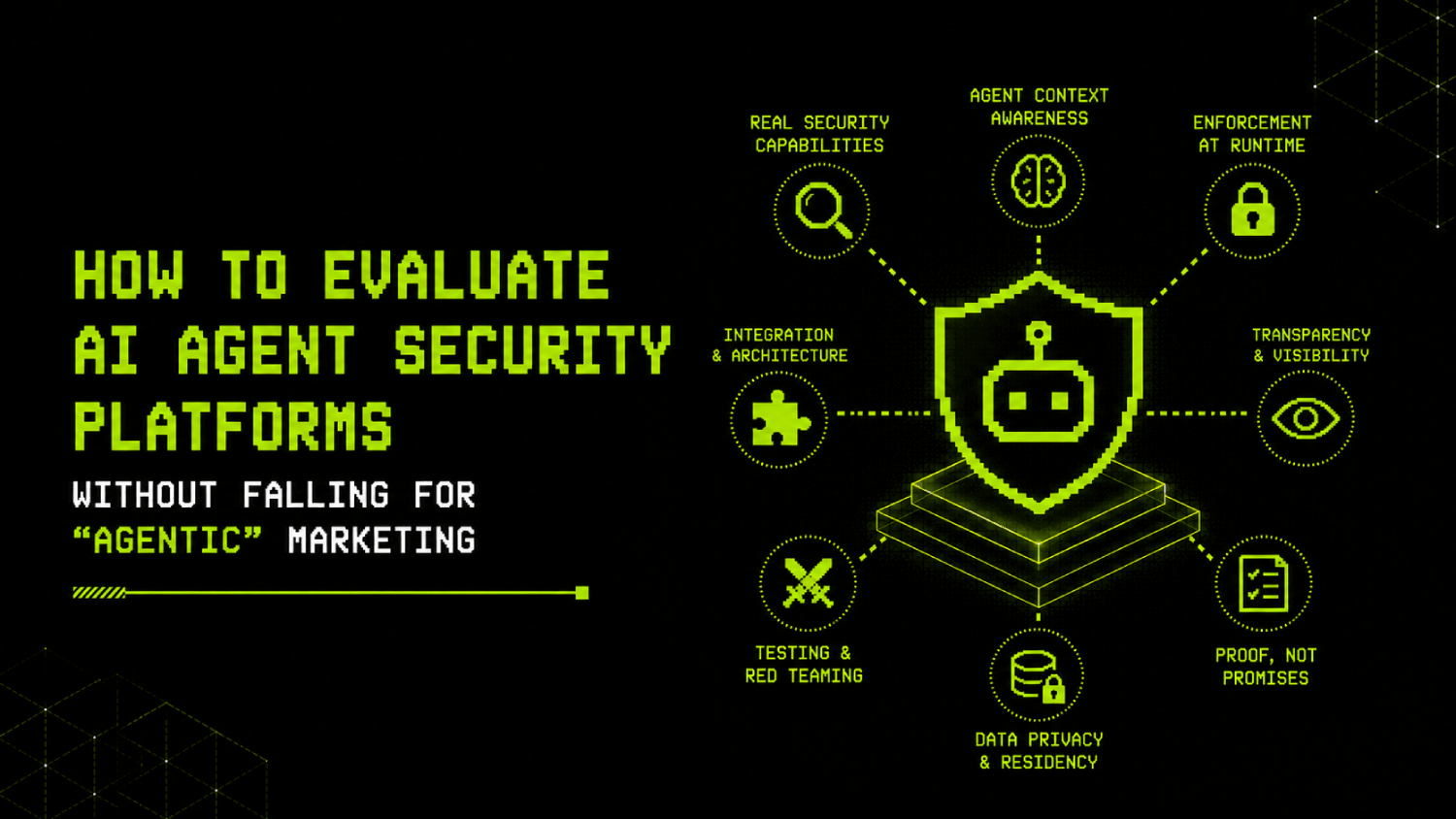
To evaluate AI agent security platforms without being misled by demos , and to understand how to evaluate AI agent security platforms in a way that produces a defensible purchase decision , run a staged proof of concept against your own agent infrastructure rather than accepting vendor-controlled test environments. The evaluation should test four things: whether the platform discovered agents you did not register manually, whether it detected policy violations during live agent execution, what the false-positive rate looked like over at least five business days, and what the total operating cost projects to at full agent inventory scale.
Why Feature Demos Cannot Tell These Platforms Apart
A vendor demo for an AI agent security platform is almost always run against a lab environment where every agent is pre-registered, every tool connection is documented, and the only traffic flowing is traffic the vendor chose. That is not what your environment looks like. Your environment has shadow agents spun up by a developer testing an automation, MCP connections that were approved for one use case and repurposed for three more, and LLM API keys that live in environment variables no one audited.
The demo will show you a clean dashboard with labeled agents, clean policy violations, and zero false positives. None of that is reproducible in production on day one. The differentiation between platforms only surfaces when you run your own agents through them.
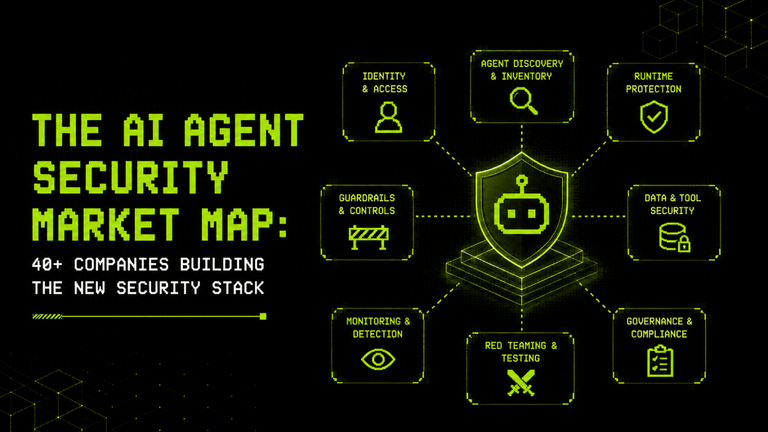
There is a second problem specific to this market. Many vendors in the AI agent security space are repositioned products from adjacent categories, specifically API security gateways, CASB platforms, and runtime application self-protection tools, that added an “agentic AI” label after the category started attracting budget. The feature gap between a genuine agent security platform and a repositioned product is significant, but it does not show up in a slide deck. For a broader view of what genuine AI agent security coverage actually spans, the AI agent security market map covering 40+ vendors lays out where different products actually sit.
The SecurityOpsWire Agent Security Evaluation Framework (ASEF)
The ASEF is a five-stage evaluation structure designed for security and IT leaders who need to move from vendor demo to a defensible purchase decision. It runs in sequence. Each stage is a gate. A vendor that cannot pass Stage 2 does not get to Stage 3.
Stage 1: Discovery Verification (Pre-POC, One Week)
Before you install anything, document every AI agent your team knows about. Registered agents, approved workflows, LLM API connections, and any MCP server configurations. This becomes your baseline inventory.
Then ask the vendor to deploy in passive discovery mode against your actual environment for five business days. At the end of that period, compare what the platform found against your documented baseline. Every agent the platform missed is a blind spot. Every false positive in the discovered inventory, meaning a process flagged as an agent that is not one, is tuning debt you will carry forever.
Score this stage on two numbers: discovery recall (agents found as a percentage of your known inventory) and false discovery rate (non-agents flagged as agents divided by total flagged). A platform that finds 70% of your known agents with a 5% false discovery rate is meaningfully different from one that finds 95% with a 20% false discovery rate. For teams building out an agent inventory from scratch, the comparison of AI agent discovery and monitoring tools covers the discovery-specific capabilities in this space.
Stage 2: The Repositioning Exposure Questions
Run these questions on the vendor call before any technical POC work. A genuinely built-for-purpose platform answers all five directly. A repositioned product will deflect, reframe, or give answers that only apply to API-level controls.
- How does your platform detect prompt injection attempts that occur mid-session, after initial authentication has already been granted? A repositioned API gateway has no answer to this. It inspects requests at the boundary, not mid-execution.
- When an agent delegates a subtask to another agent, how do you track and enforce the trust boundary between them? Inter-agent trust chains are an architectural problem. Most traditional tooling treats the delegating agent and the receiving agent as separate API calls with no chain context.
- Can your platform detect when an agent’s behavior deviates from its declared system prompt at runtime, without requiring me to log every token? Full token logging is expensive and often prohibited by data residency requirements. A platform that requires it is transferring an operational cost to you that the demo never mentioned.
- How do you handle an agent that is accessing tools through an MCP server that was not in my original deployment manifest? Shadow MCP connections are the agent-layer equivalent of shadow IT. If the platform cannot detect them, it cannot govern them.
- What is the blast radius if your runtime monitor goes down? Does agent execution pause, degrade, or continue unmonitored? This tells you whether the platform is fail-open or fail-closed, and whether the vendor has thought through the operational availability trade-off.
If the vendor cannot answer questions 2 and 4 with specifics about how their data model represents inter-agent relationships and tool access chains, you are looking at a repositioned product. Move on or deprioritize them in scoring. The adjacent question of how MCP connections should be governed at the gateway level is covered in the MCP gateway versus AI gateway analysis.
Stage 3: The POC Design
A well-designed AI security proof of concept takes ten to fifteen business days and requires three things from your side: a representative sample of your actual agents (not a sanitized subset), at least one scenario involving an agent-to-agent handoff, and a security engineer who can review alerts in near-real time rather than batch-reviewing at week’s end.
Structure the POC around five test scenarios. Run each one deliberately, document the expected outcome, and record what the platform actually detected.
| POC Test Scenario | What You Are Testing | Expected Platform Behavior | Pass Criteria |
|---|---|---|---|
| Inject adversarial content into an agent’s retrieval context (simulated RAG poisoning) | Runtime prompt injection detection | Alert on anomalous instruction content before tool execution | Alert fires before any downstream tool call completes |
| Have an agent request a permission scope it was not granted at registration | Least-privilege enforcement at runtime | Block or alert on the out-of-scope request | Request is blocked or flagged within one execution cycle |
| Spin up an unregistered agent using an existing API key | Shadow agent detection | Discovery alert within the monitoring window | Platform identifies the new agent within 30 minutes of first API call |
| Execute an agent-to-agent handoff where the receiving agent requests elevated tool access | Inter-agent trust chain enforcement | Privilege escalation alert tied to the originating agent’s context | Alert includes the full chain, not just the receiving agent’s action |
| Exfiltrate a small amount of synthetic PII through an approved tool channel (with legal and privacy sign-off) | Data exfiltration detection over trusted channels | Alert on anomalous data pattern even though the tool channel itself is whitelisted | Alert fires with the data classification and destination identified |
Every test scenario should be run twice: once in your primary cloud environment and once against any secondary environment where agents run, whether that is a different AWS account, a local development setup, or a SaaS platform with its own agent runtime. Coverage parity across environments is not guaranteed, and vendors will often demo only the environment where their integration is strongest.
Stage 4: Operating Cost Modeling
This is where evaluations consistently go wrong. Purchase price and operating cost are different numbers, and in AI agent security platforms the gap between them can be wide.
Consider a team running 200 production agents across three cloud accounts, each agent making an average of 150 tool calls per hour during business hours. Vendors in this category use different billing units: some charge per agent, some per API call inspected, some per LLM token logged, and some charge a flat platform fee while requiring a separate ingest contract for the SIEM integration that makes alerting useful. Vendors in this category do not publicly disclose pricing , you will need to request a detailed quote specifying the billing unit, the rate at that unit, any included volume, and the overage rate. Map your actual agent activity metrics against each vendor’s billing model before you sign anything.
Then model the quoted figures against your current agent count, your projected agent count at twelve months, and your projected agent count at twenty-four months. Agent deployments grow faster than most teams expect once a platform is approved for production use.
Beyond licensing, calculate the operational overhead. How many hours per week does your security engineer spend reviewing alerts from the platform? What is the tuning debt after the first 30 days? Does the platform require a dedicated integration engineer to maintain the SIEM connector, or does it push structured logs to your existing pipeline natively? A platform with a lower license fee that requires 10 hours per week of analyst time is more expensive than a higher-priced platform that runs with 2 hours per week. Model the headcount cost explicitly.
Stage 5: RFP Scoring
Use this scoring table to weight and compare platforms after the POC. The weights reflect what actually matters in a production deployment, not what looks good in a feature grid.
| Evaluation Criterion | Weight | How to Score (1-5) |
|---|---|---|
| Discovery recall against your actual agent inventory | 20% | 5 = 95%+ recall, under 5% false discovery rate. 1 = below 70% recall or above 20% false discovery rate. |
| Runtime detection fidelity across all five POC scenarios | 25% | 5 = all five scenarios detected with context-rich alerts. 1 = fewer than three detected, or alerts lacked chain context. |
| False-positive rate over the full POC window | 15% | 5 = fewer than 10 false positives per 1,000 agent actions. 1 = more than 50 per 1,000, or no false-positive reporting available. |
| Inter-agent and tool chain visibility | 15% | 5 = alerts include full execution chain with parent agent context. 1 = alerts are point-in-time with no chain lineage. |
| Projected 24-month total cost of ownership | 15% | 5 = lowest TCO in your comparison set. Scale inversely to the highest. |
| Integration with your existing SIEM or XDR pipeline | 10% | 5 = native structured log output, documented schema, tested integration. 1 = requires custom connector or professional services engagement. |
Multiply each score by its weight, sum the results, and rank vendors. Any vendor scoring below 3.0 on runtime detection fidelity should be eliminated regardless of total score. Detection is the core function. Everything else is table stakes or operational overhead.
Which Claims Cannot Be Verified Without a POC
Vendors make several claims in demos that are structurally unverifiable without running your own agents through the platform. Know these before your next vendor call.
“We cover all major LLM providers.” This usually means the vendor has tested against OpenAI and Anthropic. Whether they handle local model deployments, fine-tuned models, or LLMs accessed through a proxy layer depends on whether they inspect the protocol or the provider. Ask specifically about your LLM provider and request a documented integration spec, not a verbal confirmation.
“Our platform has no performance impact on agent execution.” This is almost always measured in a lab environment with low concurrency. In production, a synchronous policy check on every tool call adds latency. Some platforms are asynchronous and miss violations that happen faster than the check completes. Neither behavior is acceptable in all use cases. Ask for the architecture document showing where in the execution path the policy check occurs and whether it is blocking or non-blocking.
“We detect prompt injection.” Detection of prompt injection is not binary. There is a spectrum from simple keyword matching on known adversarial strings to semantic anomaly detection against an agent’s baseline behavior. Ask the vendor to show you, in your POC, a prompt injection attempt that uses no known adversarial keywords. If their detection fails on that scenario, they are matching signatures, not reasoning about intent.
“Our AI guardrail layer handles compliance requirements.” Guardrails and compliance are related but not equivalent. For a more precise look at what guardrail platforms actually cover versus what they leave to the security team, the comparison of AI guardrail platforms for production LLMs and agents draws that distinction in detail.
How Should Evaluation Weight Operating Cost Against Coverage?
The short answer: coverage floors first, then cost. A platform that misses a third of your agent inventory at a lower price is not a value proposition. It is a false sense of coverage that will surface during an incident review.
Set a minimum acceptable threshold for discovery recall and runtime detection before you score cost at all. A reasonable floor for a mature security program is 90% discovery recall and detection on at least four of your five POC scenarios. Any platform that does not clear that floor is out of the comparison, regardless of price.
Once you have a shortlist that clears the coverage floor, cost becomes a legitimate differentiator. At that point, weigh total cost of ownership, not license fee. A platform priced at the top of your range that requires one hour per week of analyst time competes differently against a lower-priced platform requiring eight hours per week when you account for analyst loaded cost. Most security leaders do not model this explicitly, and vendors know it.
Red-teaming is a related discipline that belongs in a mature AI agent security evaluation. Before a platform goes to production, understanding its detection gaps requires adversarial testing against your agents under realistic attack conditions. The review of AI agent red teaming platforms covers the tooling options for that specific exercise.
Questions That Expose RFP Responses Built Around Marketing Rather Than Architecture
Standard RFP questions get standard marketing answers. These questions get architecture answers, which is where the real differentiation lives.
Ask: “What is your data model for representing an agent’s declared intent versus its observed behavior?” A platform with genuine behavioral detection has an answer that involves a baseline, a deviation metric, and a sensitivity threshold. A repositioned product will redirect to its policy engine.
Ask: “How does your platform handle an agent that is accessing a tool through a chain of three intermediate agents, none of which are in my deployment manifest?” This tests whether inter-agent trust chain tracking extends to unregistered intermediaries. Most platforms only track registered agents. The unregistered chain is exactly where privilege escalation happens in practice.
Ask: “What does your platform do on day one of deployment before it has established any behavioral baselines?” Some platforms require two to four weeks of observation before they can detect behavioral anomalies. During that window, you have no runtime detection and you should know it. Ask what the platform can enforce in policy-only mode during the baseline period.
Ask: “Show me a false positive from a real customer deployment and how it was resolved.” Vendors who have production deployments will have false positive stories. Vendors who do not will deflect. The story matters less than the fact that they can tell one.
How AI-SPM Fits Into the Agent Security Evaluation
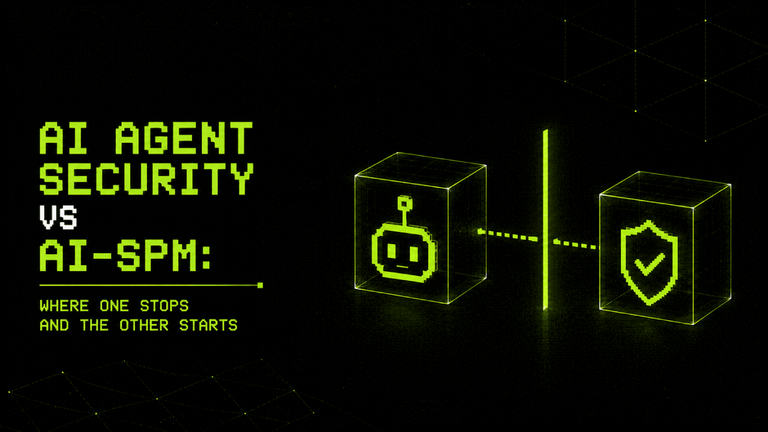
AI Security Posture Management is a related but distinct category that focuses on the configuration and risk posture of AI systems rather than their runtime behavior. Some vendors in this evaluation process will pitch AI-SPM capabilities alongside agent security controls, and it is worth being clear about which problem each solves before you consolidate them into a single score. The breakdown of AI-SPM versus AI agent security covers where the boundary sits and which team typically owns each function.
The short version for evaluation purposes: AI-SPM tells you whether your AI systems are configured correctly before they run. Agent security tells you whether they are behaving correctly while they run. You need both, but they are not the same product, and a platform that conflates them in a demo may be strong at one and weak at the other.
Frequently Asked Questions
How long should an AI agent security proof of concept run?
Ten to fifteen business days is the minimum for a meaningful POC. The first five days should run in passive discovery mode to establish a baseline and identify any shadow agents. The next five days should include deliberate test scenarios run by your team, not the vendor. A final two to three days of passive monitoring after the tests gives you a realistic view of the false-positive rate under normal operating conditions. Any POC shorter than ten days does not give you enough signal on behavioral baselines.
What questions expose a repositioned product during a vendor call?
Ask specifically about mid-session prompt injection detection, inter-agent trust chain enforcement, and shadow MCP connection discovery. A genuine AI agent security platform built for this category has architectural answers to all three. A repositioned API gateway or CASB will redirect to boundary-level controls and policy engines that operate on registered entities only. If the vendor cannot explain how their data model represents an agent execution chain with multiple handoffs, the product was not built for agent-layer security.
How should teams handle AI agent security for platforms where the agent runtime is controlled by a SaaS vendor, not their own infrastructure?
This is a real gap in most platforms. When the agent runtime is inside a SaaS vendor’s infrastructure, your visibility depends on what that vendor exposes via logs, APIs, or webhooks. Ask each platform you evaluate to show you specifically how they ingest and correlate agent behavior from SaaS-hosted runtimes like those in Microsoft Copilot Studio, Salesforce Agentforce, or similar products. If the integration requires a separate connector with a separate contract, model that cost explicitly.
What is a reasonable false-positive rate for an AI agent security platform in production?
There is no published industry standard for this category, given how new it is. A reasonable working threshold for production deployment is fewer than 10 false positives per 1,000 agent actions in steady state, after the initial tuning period. Above 30 per 1,000, analyst fatigue becomes a meaningful operational problem and teams start muting alert categories, which defeats the purpose. Measure the rate explicitly during your POC and project it against your production agent volume.
Should evaluation prioritize a single integrated platform or a best-of-breed stack?
For teams with fewer than three people in security engineering, integration overhead from a multi-vendor stack will consume more operational capacity than any individual best-of-breed advantage is worth. For teams with dedicated detection engineering capacity, best-of-breed is defensible if each product clearly outperforms the integrated alternative on its core function. The determining factor is not which approach is theoretically superior. It is how many hours per week your team can dedicate to maintaining integrations.
How do you evaluate AI agent security platforms when you do not yet have agents in production?
Run the POC against your development or staging agents, not against synthetic vendor demos. Development agents are real agents with real behavior patterns, even if their data access is constrained. They will expose discovery gaps, integration friction, and false-positive rates that a vendor demo environment never will. Use the POC period to also baseline the platform against what you expect production agents to look like, so you have a comparison point when you scale up.
What does total cost of ownership actually include for AI agent security platforms?
TCO for this category includes license fees scaled to your billing unit (per agent, per API call, or per token, depending on the vendor), integration engineering hours to connect the platform to your SIEM or alerting pipeline, analyst time for weekly alert triage and tuning, and any professional services required for initial deployment or quarterly reviews. Model all four components. License fee alone is the number vendors quote. TCO is the number that hits your budget twelve months in.
What the Evaluation Framework Gets You
Running the ASEF gives you something no analyst grid or vendor comparison listicle can produce: a ranked shortlist based on how each platform actually performed against your agents, your tool connections, and your team’s operational capacity. The vendors at the top of that list may not be the ones with the largest marketing presence or the most recent funding announcement. That is the point.
The AI agent security market is early enough that product quality varies more than in established categories like EDR or SIEM. Vendors with genuine architectural depth and vendors with repositioned legacy products can look identical in a demo and in an analyst grid. They do not look identical after a fifteen-day POC with deliberate test scenarios.
The single most important shift in how most teams approach this evaluation is moving the comparison point from the vendor’s environment to yours. Everything about the ASEF is designed to enforce that shift. A vendor that resists running a scoped POC against your actual agents, citing technical complexity or timeline constraints, is telling you something important about what their platform looks like outside a controlled demo. For a curated look at the platforms that hold up to this kind of scrutiny, the review of the best AI agent security platforms applies similar criteria across the major vendors in this space.