
- Model providers filter for hate speech and CSAM. They do not filter for prompt injection, data exfiltration through the output stream, or unsafe tool calls in an agentic pipeline. Those gaps belong to the application layer.
- The real selection criterion for any guardrail platform is not what it blocks but what it incorrectly blocks: false-positive rate at production token volume determines whether the system stays in enforcement mode or gets bypassed by developers inside two weeks.
- Open-source libraries (Guardrails AI, NeMo, LLM Guard) give you control over every rule and add zero per-token cost, but tuning debt accumulates fast on any team without a dedicated ML engineer.
- Managed platforms charge per token or per request and handle model updates for you, but pricing at scale can exceed the cost of the LLM itself if you are running a high-volume customer-facing application.
- Latency matters more than most teams budget for: a synchronous guardrail layer that adds 200ms to every call will surface as a product complaint before it surfaces as a security review.
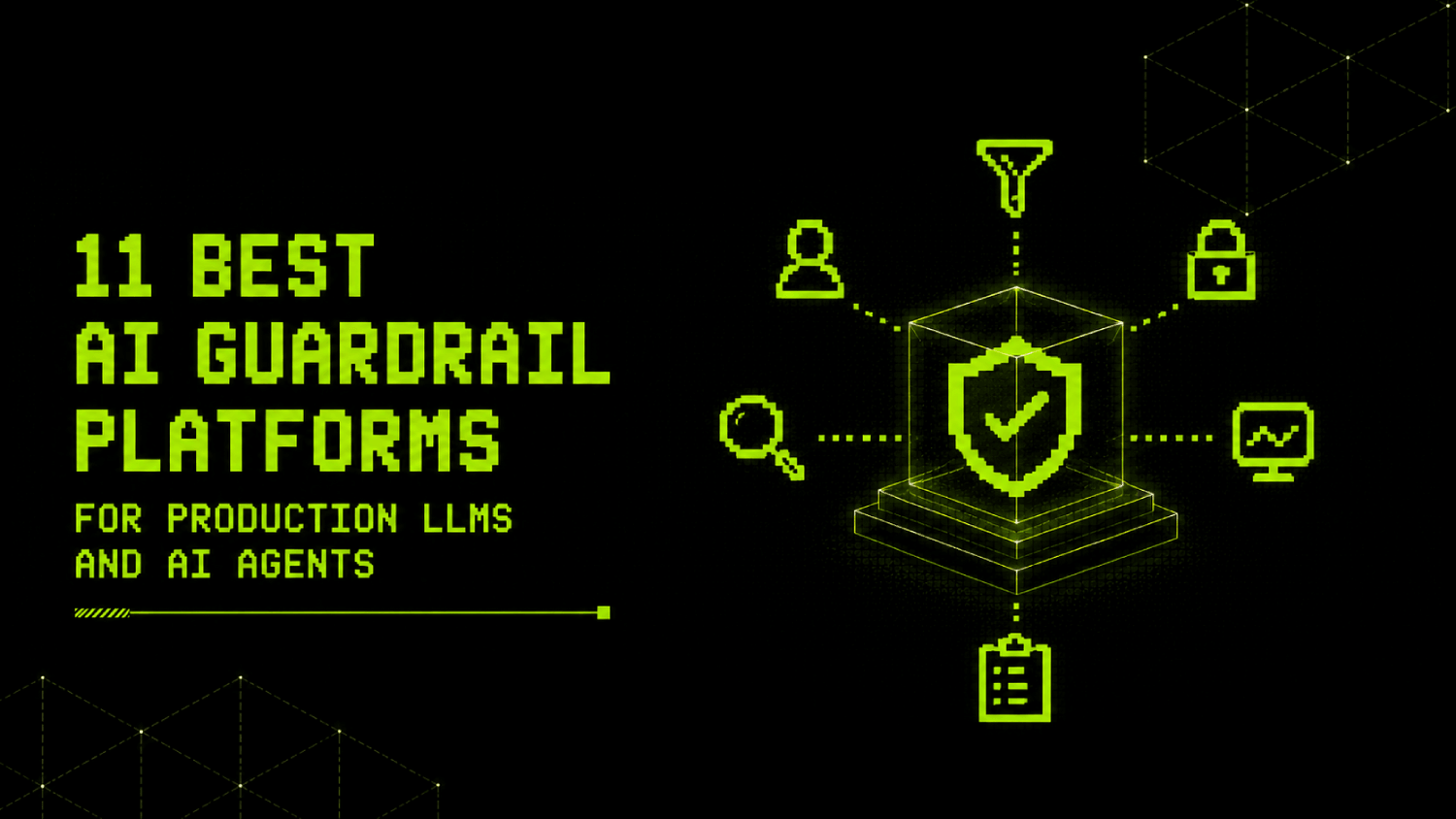
AI guardrail platforms are application-layer controls that sit between a client and an LLM to block prompt injection, detect sensitive data in outputs, and flag policy violations before they reach the user. They are distinct from model-level safety filters: model providers handle content moderation, but they do not inspect whether a retrieved document is being exfiltrated, whether a system prompt is being overridden, or whether an agent is about to call a destructive tool. The ten platforms below cover the full range from open-source libraries to fully managed cloud services, evaluated on false-positive behavior, latency profile, and pricing model.
What Do AI Guardrails Actually Block, and What Do They Miss?
The term “guardrails” covers at least four distinct control types, and most platforms only implement two or three of them well. Understanding the split determines which product fits your deployment.
Input validation covers prompt injection (where a user or a retrieved document attempts to override the system prompt), jailbreak detection, and topic restriction. This is the most mature control class, and every platform on this list handles it to some degree. Output validation covers sensitive data in the response stream: PII, secrets, proprietary code, or content that violates a defined policy. A smaller set of platforms handle output scanning at latency profiles suitable for real-time use. Semantic grounding checks whether a response stays anchored to a provided context document, which matters for RAG deployments where hallucination is a compliance risk. Agentic action control governs which tools an agent is permitted to call given the current context. This last category is increasingly bundled into guardrail products, but it is architecturally separate from input/output validation. For runtime agent action control, the platforms designed for autonomous agent security cover that layer in more depth.
What guardrails consistently miss: multi-turn injection that assembles a payload across several messages, indirect injection through RAG-retrieved documents that contain adversarial text, and latent data exfiltration where the model paraphrases sensitive information rather than quoting it directly. No platform on this list claims complete coverage of all three, and any vendor who claims otherwise should be pressed for their test methodology.
The SecurityOpsWire False-Positive Cost Model: One Framework for Comparing Guardrail Platforms
Every guardrail vendor leads with recall (what percentage of bad inputs it catches). Almost none lead with precision (what percentage of flagged inputs are actually bad). That asymmetry is intentional, because recall is easy to optimize by flagging everything. The operational cost is paid by whoever handles the false positives downstream.
The SecurityOpsWire False-Positive Cost Model breaks this into four factors worth pricing before you sign a contract:
- Block rate on benign production traffic. Run a sample of 1,000 real user queries through the platform in shadow mode before enabling enforcement. A block rate above 2% on benign traffic in a customer-facing application is typically unsustainable without a human review queue.
- Tuning surface. How granular is the threshold control? A platform that only lets you toggle categories on or off will create more false positives than one that lets you set per-detector confidence thresholds.
- Tuning debt accumulation rate. How often does the underlying detection model update? Managed platforms update their models without notice, which can shift your false-positive rate overnight. Open-source libraries do not update on their own, but they also do not regress on their own.
- Bypass response. When a guardrail fires on a legitimate request, what does the user experience? A hard block that returns an error is the worst case for product quality. A soft rejection that routes to a fallback response or a human queue is survivable. Platforms differ significantly here.
Consider a company running a customer-facing legal document assistant, processing 50,000 queries per day. At a 1% false-positive rate, 500 legitimate user requests are blocked daily. If each requires a support ticket, the false-positive tax accumulates quickly before anyone writes a line of tuning configuration , and that cost does not appear in any vendor’s pricing calculator.
What Latency and False-Positive Rate Should a Team Expect From a Production Guardrail Layer?
Synchronous guardrail evaluation adds latency to every request in the critical path. Asynchronous evaluation adds no latency to the user but cannot block a harmful response before delivery, which defeats the purpose for output controls. Most production deployments end up with synchronous input guards and asynchronous output logging, which is a reasonable compromise but means your output blocking is reactive, not preventive.
Latency figures vary by detector type. Regex-based PII detectors and keyword blocklists run in under 5ms. Transformer-based classifiers for jailbreak and injection detection typically add 30ms to 150ms depending on whether inference runs locally or hits an external API. Full LLM-as-judge evaluations, where a second model assesses the output, can add 500ms to 2,000ms. Teams that report guardrail latency as a problem are almost always running transformer or LLM-judge detectors synchronously in a path that was not budgeted for the overhead.
A reasonable baseline target: under 100ms p95 for synchronous input guards on a customer-facing product. Anything above 150ms should be evaluated against whether the control can move to async. These are not published industry standards; they are operational benchmarks based on user experience tolerances for chat-based products.
Open-Source Guardrail Library or Managed Platform: Which Fits Your Team?
The short answer: open-source if you have a Python engineer who can own the integration and tuning; managed platform if you are deploying a compliance control that someone will ask you to demonstrate in an audit.
Open-source libraries front-load engineering cost and eliminate per-token charges. At high token volumes, the per-request fees on managed guardrail platforms , vendors do not publicly list these rates, so exact figures require a vendor quote , can exceed the fully-loaded cost of a mid-level ML engineer in most markets. The case for self-hosting at volume is straightforward arithmetic once you have those quotes in hand. The risk is tuning debt: open-source detectors do not update automatically, so a new jailbreak technique that circulates on red-team forums in October may not have a community-contributed rule until December.
Managed platforms absorb tuning debt in exchange for a per-request fee and a loss of visibility into exactly what the detection model is doing. For security teams that need to demonstrate control effectiveness to an auditor, “the vendor’s model handles it” is a harder argument than a version-controlled ruleset in your own repository. For product teams that need to ship and cannot afford a dedicated guardrail engineer, managed platforms are the realistic choice.
11 AI Guardrail Platforms Compared: Features, False-Positive Behavior, and Pricing Models
| Platform | Deployment Model | Key Control Types | FP Tuning Surface | Latency Profile | Pricing Model |
|---|---|---|---|---|---|
| Guardrails AI | Open-source / Cloud | Input/output validators, schema enforcement | Per-validator threshold config | Varies by validator | Free OSS; Hub paid tiers not publicly listed |
| NVIDIA NeMo Guardrails | Open-source (self-hosted) | Topic rails, dialog policy, output filtering | Colang policy files | Adds LLM call overhead | Free OSS |
| Lakera Guard | Managed API | Prompt injection, PII, content policy | Category toggles, confidence thresholds | Low (optimized inference) | Per-API-call; not publicly listed |
| Aporia Guardrails | Managed / Self-hosted | Hallucination detection, PII, policy | Policy rules, per-detector weights | Synchronous, sub-100ms claimed | Not publicly listed |
| Protect AI / Palo Alto | Managed Platform | Model scanning, LLM firewall, supply chain | Rule-based with policy editor | Varies by deployment | Not publicly listed |
| Prompt Security | Managed API | Prompt injection, data leakage, shadow AI | Category and sensitivity controls | Low (API-native) | Not publicly listed |
| Robust Intelligence | Managed Platform | Red teaming, continuous testing, guardrails | Test-driven rule refinement | Primarily offline testing | Not publicly listed |
| Amazon Bedrock Guardrails | Managed (AWS-native) | Content filters, topic deny, PII, grounding | Filter strength sliders (0-high) | Adds per-call latency | Per 1,000 text units; see AWS pricing page |
| Azure AI Content Safety | Managed (Azure-native) | Content moderation, prompt shields, groundedness | Threshold configuration per category | Regional inference latency | Per 1,000 API calls; see Azure pricing page |
| Fiddler AI | Managed Platform | Monitoring, drift, safety scoring | Metric thresholds and alert rules | Async monitoring primary | Not publicly listed |
| LLM Guard (open-source) | Open-source (self-hosted) | PII, injection, toxicity, secrets | Per-scanner threshold config | Varies by scanner pipeline | Free OSS |
Guardrails AI
Guardrails AI is the most referenced open-source framework in this category, and its name dominates search results in a way that clouds evaluation. The framework works by wrapping LLM calls with validators that check structured output conformance, detect PII, enforce topic constraints, and flag injection attempts. Validators are composable Python classes, which means a team with Python engineers can write custom validators for domain-specific rules. False-positive behavior is controlled at the validator level: each validator exposes a threshold parameter, and you can override any validator’s pass/fail logic. The operational cost is ownership of that logic as the application evolves. The Hub (their hosted validator marketplace) adds cloud-managed validators, but enterprise pricing for Hub access is not publicly listed. Guardrails AI fits teams that want code-level control over every detection decision and have the engineering capacity to maintain it.
NVIDIA NeMo Guardrails
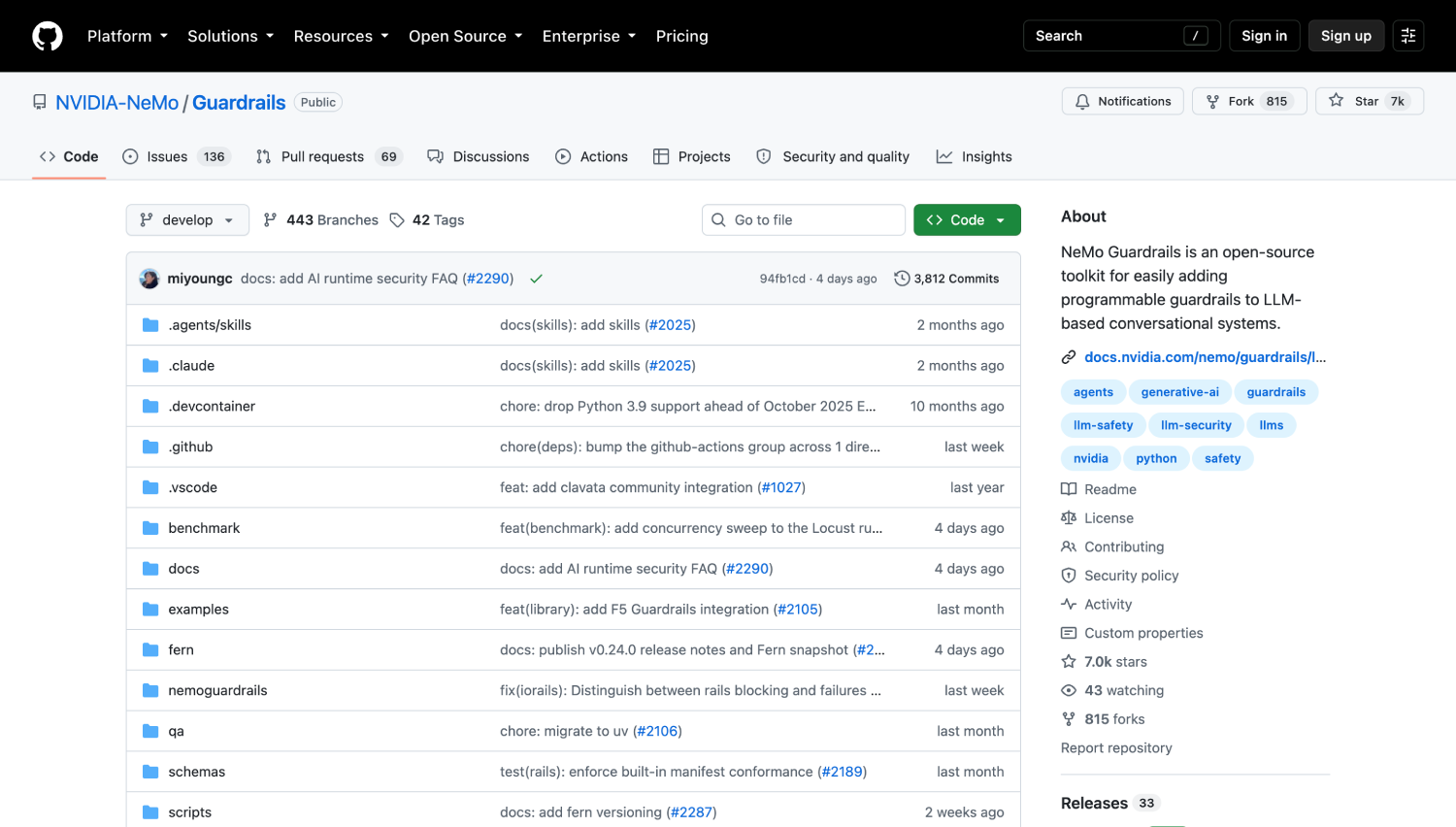
NVIDIA NeMo Guardrails takes a different architectural approach. Rather than wrapping API calls with validators, NeMo uses a domain-specific language called Colang to define dialog policies, topic rails, and output filters as explicit conversation flow rules. This makes it readable for non-engineers who can describe what the system should and should not discuss, but it means guardrail behavior is tied to a conversational model of the interaction. For RAG pipelines or non-conversational LLM tasks, the dialog-policy framing can be awkward to apply. False-positive tuning is done by editing Colang files: more specific policy definitions reduce over-blocking, but the cost is policy maintenance as the application scope changes. Because NeMo must invoke the LLM to evaluate certain rails, it adds a full LLM call to the latency budget for those checks. NeMo Guardrails is fully open-source, which means zero per-token cost at any volume.
Lakera Guard
Lakera Guard operates as a managed API that inspects every prompt and response before it reaches the model or the user. Their detector for prompt injection is built on a purpose-trained classifier rather than a general-purpose LLM, which keeps latency low relative to LLM-judge approaches. The tuning surface includes category-level toggles and confidence threshold adjustment per detector type, which gives more control than a simple on/off switch but less than per-rule threshold configuration in an open-source library. Lakera publishes a benchmark dataset called Gandalf that it uses for injection detection evaluation, which is useful context when assessing their recall claims. Pricing is per API call and is not publicly listed; teams evaluating Lakera should request a volume pricing proposal and model the cost against their expected daily request count before comparing against open-source alternatives.
Aporia Guardrails
Aporia started as an ML monitoring platform and extended into real-time guardrails for LLM applications. Their guardrail layer covers hallucination detection using a grounding check against the retrieved context, PII detection in outputs, and policy enforcement for topic and content restrictions. The hallucination detection via grounding is the capability that differentiates Aporia from simpler content-filter platforms: it compares the model’s response against the source documents in a RAG pipeline and flags responses that make unsupported claims. This is particularly relevant for compliance-sensitive use cases like legal, financial, or clinical documentation assistants. False-positive rate on hallucination detection depends heavily on how precisely the grounding threshold is set; Aporia exposes per-detector weight configuration for this. Aporia supports both managed and self-hosted deployment. Pricing is not publicly listed.
Protect AI and Palo Alto Networks
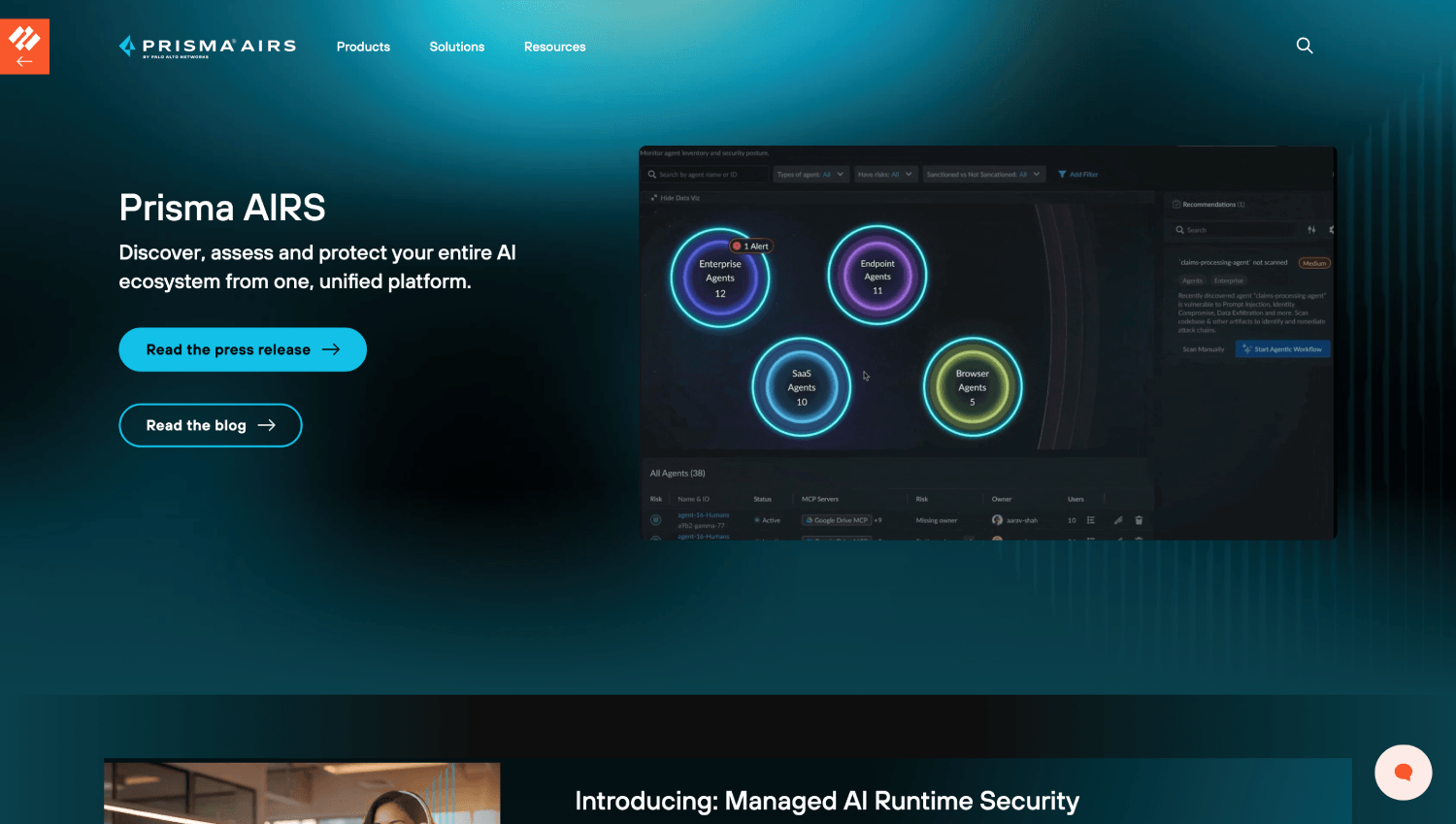
Protect AI‘s capabilities are now offered through Palo Alto Networks’ Prisma AIRS platform. The original Protect AI product suite included Guardian for model scanning and Rebuff for prompt injection detection, along with an LLM firewall. Buyers should verify current product availability and packaging directly with Palo Alto before committing to a procurement process, as the integration is ongoing. For teams already standardized on Palo Alto’s security platform, the integration path may justify the evaluation effort. For teams without an existing Palo Alto footprint, confirming the current product roadmap and support structure with the vendor directly is advisable before purchase.
Prompt Security
Prompt Security focuses specifically on enterprise AI governance: it inspects prompts sent to any LLM from any application or browser extension, covering both sanctioned and shadow AI usage. The shadow AI detection angle is differentiated. Most guardrail platforms sit in the path of a specific application you control; Prompt Security can proxy traffic from employees using ChatGPT directly or using browser-based AI tools, which surfaces a different threat model around data exfiltration. For organizations where employees are submitting sensitive documents to external LLM services outside IT visibility, Prompt Security addresses a gap that application-layer guardrails cannot. False-positive tuning is available through category and sensitivity controls. Pricing is not publicly listed.
Robust Intelligence
Robust Intelligence approaches the problem from continuous testing rather than real-time blocking. Their platform runs automated red-team scenarios against an LLM deployment to identify which inputs cause policy violations, and it generates guardrail rules derived from that testing. The product is more relevant as a pre-deployment validation and ongoing regression testing tool than as a real-time runtime control. This makes it complementary to runtime platforms rather than a direct replacement: use Robust Intelligence to discover where your guardrail configuration has gaps, then push those findings into a runtime platform. For teams building internal LLM applications where continuous testing can be part of the CI/CD pipeline, this is a strong fit. For teams that need a runtime block on live traffic, it is not a standalone solution. Pricing is not publicly listed. Buyers should verify the vendor’s current ownership and support structure directly before procurement.
Amazon Bedrock Guardrails
Amazon Bedrock Guardrails is the right choice for teams whose LLM workloads already run on AWS Bedrock and who do not want to manage a separate guardrail service. The controls include configurable content filters across hate, insults, sexual, and violence categories with four sensitivity settings, topic deny lists, PII detection and redaction in both inputs and outputs, and a grounding check for RAG outputs called Groundedness. AWS publishes per-unit pricing on their Bedrock pricing page, charged per 1,000 text units processed. Teams should model this cost against their expected token volume before assuming it is the cheapest path simply because it is native to their existing AWS deployment. The tuning surface for content filters uses a slider-style control for filter strength rather than per-rule threshold configuration, which limits precision tuning. Teams with highly domain-specific content policies may find this coarser than open-source alternatives.
Azure AI Content Safety
Azure AI Content Safety provides content moderation, prompt shield (their term for prompt injection detection), and a groundedness detection API for Azure-hosted deployments. It is the Microsoft-native equivalent of Bedrock Guardrails: best evaluated by teams already running Azure OpenAI Service or Azure AI Foundry. Microsoft’s published pricing is per 1,000 API calls per feature, with separate pricing for each service tier. The Prompt Shields feature specifically targets direct injection attacks and indirect injection in documents, which is architecturally relevant for document-processing pipelines. Threshold configuration per content category is exposed through the API, allowing per-deployment tuning. False-positive behavior is controlled by adjusting severity thresholds; the default thresholds are calibrated for general-purpose use and almost always require adjustment for enterprise domain-specific content.
Fiddler AI
Fiddler AI approaches LLM safety from the model observability direction rather than the blocking direction. Their platform monitors LLM outputs for safety scoring, toxicity, topic drift, and policy violations, primarily in async mode. This means Fiddler is a detection and alerting tool rather than a blocking control in the real-time path. For organizations that need audit trails of LLM output quality and safety metrics over time, Fiddler serves a compliance and monitoring role. For teams that need to prevent a harmful response from reaching the user in real time, Fiddler alone is not the answer. Where Fiddler fits well is alongside a blocking guardrail: the runtime platform blocks, and Fiddler provides the longitudinal dataset to tune thresholds and demonstrate control effectiveness to auditors. Pricing is not publicly listed.
LLM Guard (open-source)
LLM Guard is an open-source library that provides a scanner-based pipeline for both input and output validation. Scanners include PII detection, prompt injection detection, toxicity classification, secrets detection (credentials and API keys in outputs), and relevance checking. Each scanner runs as an independent component with a configurable threshold, which makes the tuning surface more granular than most managed platforms. The practical constraint is that running multiple transformer-based scanners in series adds latency multiplicatively: a pipeline with five active scanners, each adding 40ms, produces 200ms of overhead before the LLM call begins. Teams deploying LLM Guard in production need to profile their scanner pipeline under realistic traffic and disable any scanner whose latency cost exceeds its detection value for their use case. As an open-source project, its maintenance trajectory is worth monitoring before committing it as a long-term production dependency.
How Do Guardrails Price at Production Token Volume, and When Does Open-Source Win on Cost?
The volume-based pricing math is the single most important calculation teams skip during evaluation. Managed platforms that charge per API call or per text unit look inexpensive at pilot scale and expensive at production scale. The crossover point depends on your traffic volume and the fully-loaded cost of engineering time for self-hosting.
Amazon Bedrock Guardrails publishes its pricing at the Bedrock pricing page. Azure AI Content Safety publishes its pricing at the Azure pricing page. For all other managed platforms listed above, pricing requires a vendor conversation. Teams modeling costs should request per-request and per-token pricing tiers at their expected volume, not just the starting tier, because the gap between tiers can be significant.
For teams considering the MCP (Model Context Protocol) layer where agents interact with external tools, the input/output validation covered here is only part of the control picture. The access controls and permission scoping for agent-to-tool connections sit at a different layer and require separate tooling.
What Does Prompt Injection Defence Actually Look Like at the Application Layer?
Prompt injection is the attack class where an external input, either directly from a user or indirectly from a document retrieved during RAG, contains text that attempts to override the system prompt or redirect the model’s behavior. Detection approaches fall into three categories: string matching and regex (fast, brittle), transformer-based classifiers trained on injection examples (slower, more capable against known patterns, still evadable), and LLM-as-judge evaluation (slowest, most contextually aware, most expensive).
Most platforms combine classifier-based detection for speed with optional LLM-judge escalation for ambiguous cases. The split is the right architectural choice, but teams need to understand that the classifier tier will miss novel injection patterns that were not in the training set. No production guardrail platform provides complete injection coverage, and any vendor who claims otherwise should be asked for their evaluation methodology against indirect injection through RAG-retrieved content specifically, which is the harder and more operationally relevant case.
Detection signal for injection in your own stack: log all system-prompt-equivalent instructions and compare them against the model’s actual output behavior. A model that stops following system prompt constraints mid-session is a signal worth capturing in your observability layer regardless of which guardrail platform you deploy.
Frequently Asked Questions
What is an AI guardrail platform, and how is it different from a model provider’s built-in content filter?
A model provider’s content filter blocks predefined harmful content categories at the model level, typically hate speech, sexual content, and violence. An AI guardrail platform sits at the application layer and controls a broader set of risks: prompt injection attempts, PII in outputs, RAG grounding violations, topic policy enforcement, and data exfiltration through the response stream. The two layers are complementary. Disabling one does not replace the other. Most production LLM deployments that handle sensitive data need both.
What false-positive rate should a team expect from a production guardrail layer?
Out-of-the-box default configurations typically produce false-positive rates between 1% and 5% on general-purpose traffic, depending on the detector type and the specificity of the content domain. A customer-facing legal or medical assistant will have higher false-positive rates than a general chat application unless the guardrail thresholds are tuned to the domain. Teams should run at least 1,000 representative real-traffic samples through any guardrail platform in shadow mode before enabling enforcement, and target a block rate on benign traffic below 2% for customer-facing applications.
How much latency does a guardrail layer add to LLM requests?
Regex and keyword-based detectors add under 5ms. Transformer-based classifiers for injection and content policy add roughly 30ms to 150ms depending on whether inference is local or remote. LLM-as-judge evaluation adds 500ms to 2,000ms or more. Most production deployments combine fast classifiers for synchronous input blocking with async output monitoring for the heavier evaluation. Teams should budget latency by detector type and use async evaluation for any check where blocking before delivery is not strictly required.
When does building on an open-source guardrail library make more sense than buying a managed platform?
Open-source makes sense when token volume is high enough that per-request managed platform fees exceed the cost of engineering time to own the library, typically above a few million requests per day at market rates, or when your compliance posture requires version-controlled, auditable detection logic in your own environment. Managed platforms make more sense when the team lacks a dedicated ML or Python engineer for ongoing tuning, when rapid deployment matters more than cost optimization, or when a compliance requirement calls for an auditable vendor-backed control rather than internally maintained code.
Can AI guardrails prevent indirect prompt injection through RAG-retrieved documents?
Partially. Some platforms, including Azure AI Content Safety Prompt Shields and Lakera Guard, specifically target indirect injection in documents. However, detection coverage for indirect injection is less mature than for direct user-submitted injection. An attacker who controls a document that will be retrieved by your RAG pipeline can craft injection payloads that evade classifier-based detection by using paraphrasing, encoding, or context manipulation. Defense-in-depth for indirect injection requires both a guardrail layer and access controls over which document sources the retrieval step can query.
How does output validation for LLMs work in practice?
Output validation scans the model’s response before it reaches the user. Validators typically check for PII patterns (regex plus NER-based detection), secrets and credential strings, policy-violating content categories, and grounding violations in RAG contexts. The challenge is that output validation must run synchronously in the response path to block delivery, which adds latency. Async output scanning logs violations for review without blocking delivery, which is suitable for monitoring but not for prevention. Most teams run PII detection synchronously and reserve LLM-judge output evaluation for async audit logging.
What is the difference between a guardrail platform and an AI agent security platform?
Guardrail platforms handle input and output validation: what goes into the model and what comes out. AI agent security platforms handle runtime action control: which tools an agent is permitted to invoke, with what parameters, under what context constraints. A guardrail platform can flag that a response contains a dangerous tool call instruction; it does not enforce that the tool call does not execute. For teams running agentic pipelines, the controls for autonomous agent security are a separate layer that complements guardrail-based input/output validation.
The Decision That Actually Matters Before You Select a Platform
Most teams start a guardrail evaluation by asking which platform has the best injection detection recall. That is the wrong first question. Recall is easy to inflate, vendors know this, and the number is meaningless without the corresponding precision figure on your specific traffic. Start instead with your false-positive budget: how many blocked legitimate requests per day can your support process absorb, and what does each one cost in engineering or support time.
Once you have that number, run shadow-mode testing with at least two candidate platforms against a real sample of your traffic. The platform whose default configuration comes closest to your false-positive budget with acceptable recall, and whose tuning controls give you the knobs to close the remaining gap, is the right platform for your environment regardless of what the benchmark tables say.
The platforms that perform best in vendor-produced benchmarks are rarely the ones that perform best in a specific production environment. Domain-specific content, unusual user populations, and the specific injection patterns targeting your application are all factors that no generic benchmark captures. The only benchmark that matters is the one you run on your own traffic, with your own policy definitions, before you commit.