
- Most enterprise GenAI security programs treat prompt filtering as the finish line. It covers one of five distinct risk layers, and often not the most exploited one.
- The OWASP GenAI Top 10 provides the most operationally useful coverage grid available: map your current tooling against it and the gaps become immediate and specific.
- The 11 platforms below range from single-layer prompt gateways to multi-layer programs spanning data classification, model posture, and output validation. Knowing which layer you are buying matters more than knowing which vendor is trending.
- Pricing across this category is almost entirely undisclosed. Every vendor in this list quotes per environment. Budget conversations should start with prompt volume, model count, and data residency requirements before any vendor call.
- The least-covered layer in most enterprise deployments is model and supply chain integrity: the controls that verify what a model was trained on, whether its weights have been modified, and whether third-party model components introduced risk before a single prompt was ever sent.
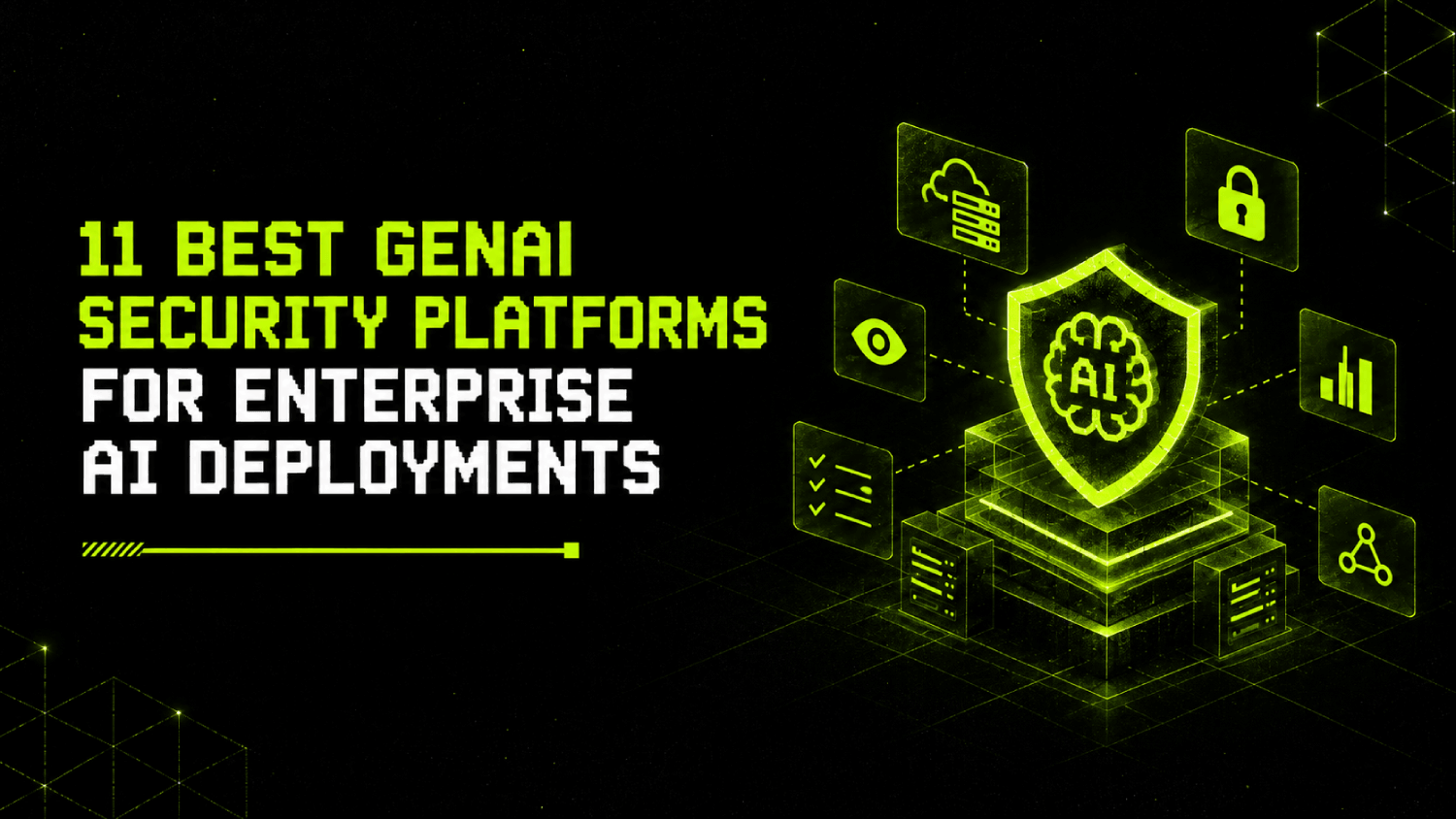
GenAI security platforms are purpose-built tools that protect enterprise AI deployments across data ingestion, model posture, prompt handling, output behavior, and application integration. The strongest platforms cover at least three of those five layers. Single-layer prompt filters are the most common entry point but leave data, model, and output exposure unaddressed. Eleven platforms currently offer meaningful enterprise coverage: Palo Alto AI Access Security, Netskope, Zscaler, Prompt Security, Lakera, Noma, WitnessAI, Robust Intelligence, Protect AI, Obsidian Security, and Microsoft Purview.
What Layers Does a GenAI Security Platform Actually Cover?
The vendor conversation almost always starts with prompt injection and data loss prevention. Those are real problems, but they represent roughly two items on the OWASP LLM Top 10 list, which currently identifies ten distinct risk classes for LLM applications. A platform that addresses only prompt-layer controls leaves eight categories of risk with no coverage at all.
For evaluation purposes, SecurityOpsWire maps GenAI security tooling against five operational layers derived from the OWASP GenAI project:
- Data layer: What data reaches the model during training, fine-tuning, and retrieval-augmented generation (RAG). Controls here include data classification, exfiltration prevention, and sensitive data detection before ingestion.
- Model layer: The integrity and provenance of model weights, third-party model components, and the supply chain between model source and deployment. This maps directly to OWASP LLM03 (supply chain vulnerabilities) and LLM04 (data and model poisoning).
- Prompt layer: Real-time inspection of inputs, including direct prompt injection attempts, indirect injection through retrieved documents, and sensitive data in user-submitted prompts. This is where most current tooling concentrates.
- Output layer: Validation of model responses for hallucination, sensitive data disclosure, insecure code generation, and policy violations before the response reaches the end user or downstream application.
- Application and integration layer: How the LLM application connects to other systems, including plugin abuse, excessive agency granted to model calls, and access controls on LLM-integrated APIs and tools.
A prompt filter lives entirely in layer three. Most enterprise GenAI deployments, as of this writing, have partial coverage of layers one and three, thin or no coverage of layer two, and almost nothing on layers four and five beyond whatever the model provider’s own guardrails offer. That is the gap this article is designed to make visible.
If your program extends into autonomous AI agents rather than just LLM applications, the application and integration layer expands significantly. The coverage considerations for agentic systems are covered separately in the SecurityOpsWire review of AI agent security platforms.
The SecurityOpsWire GenAI Coverage Grid: How to Score Your Current Stack
Before evaluating any of the 11 platforms below, run this five-question audit against your current tooling. Score each layer: full coverage, partial coverage, or no coverage. Most teams will find full coverage only in layer three, partial coverage in layer one, and gaps in layers two, four, and five.
| Layer | OWASP GenAI Top 10 Mapping | What “Full Coverage” Requires | What Most Teams Actually Have |
|---|---|---|---|
| Data | LLM02 (Sensitive Information Disclosure), LLM06 (Excessive Agency via data access) | Classification of training data and RAG sources, DLP on data ingested into model context | Partial: DLP policies that predate LLM use cases, not tuned for prompt context |
| Model | LLM03 (Supply Chain), LLM04 (Data and Model Poisoning) | Model provenance tracking, weight integrity verification, third-party component scanning | None or minimal: most orgs consume models from provider APIs and do not inspect them |
| Prompt | LLM01 (Prompt Injection), LLM02 (Sensitive Information Disclosure in prompts) | Real-time prompt inspection, indirect injection detection, sensitive data redaction | Most common coverage area; still frequently limited to keyword matching |
| Output | LLM02 (disclosure in responses), LLM09 (Misinformation/Hallucination), LLM10 (Unbounded Consumption) | Response scanning before delivery, hallucination flagging, insecure code output detection | Rare outside platforms that own the full request-response cycle |
| Application/Integration | LLM05 (Improper Output Handling), LLM06 (Excessive Agency), LLM07 (System Prompt Leakage) | API access controls, plugin and tool permission scoping, system prompt protection | Usually addressed by app developers, not security tooling |
This grid is the extractable diagnostic asset. Print it, run it against your current stack, and the conversation with any vendor in this list becomes more productive immediately.
11 GenAI Security Platforms Compared: Coverage, Positioning, and Operational Reality
1. Palo Alto Networks AI Access Security
Palo Alto AI Access Security sits inside the Prisma SASE architecture and approaches GenAI risk from a network access control angle. The platform provides visibility into which AI applications employees are accessing, enforces access policies by application and user group, and applies data loss prevention to traffic flowing to external AI services. Its native strength is shadow AI discovery: identifying unsanctioned GenAI tool usage that bypasses IT-approved channels.
Coverage is strongest in layers one and three. The DLP integration inherits from Prisma’s existing data classification engine, which means teams already running Palo Alto SSE have lower deployment friction. Output-layer coverage and model provenance are not primary use cases here. This platform fits organizations whose primary GenAI risk is employees moving sensitive data into consumer AI tools, not teams building internal LLM applications.
Pricing is not publicly disclosed. Palo Alto quotes AI Access Security as part of Prisma SASE licensing, with terms tied to seat count and existing platform entitlements.
2. Netskope
Netskope covers GenAI security through its SSE platform, with purpose-built policy controls for AI application categories. Its inline inspection approach means it can classify and block data moving to any GenAI service in real time, including prompts containing PII, source code, or financial data. Netskope’s application catalog covers a large number of AI services, which gives security teams a faster path to visibility than building custom detection for each new tool.
The platform’s GenAI posture features extend to coaching users in real-time when they attempt to paste sensitive data into an AI prompt, rather than silently blocking and generating a ticket. That behavior reduces repeat violations without requiring a separate awareness program. Coverage remains concentrated in layers one and three. Pricing is not publicly disclosed.
3. Zscaler
Zscaler’s AI Security offering applies the same inline proxy architecture used for web and SaaS traffic to GenAI applications. Policy enforcement, data inspection, and access control operate at the network layer, which means coverage extends to all AI traffic passing through the Zscaler cloud regardless of the endpoint application used. The approach gives broad coverage for shadow AI without requiring endpoint agents.
Zscaler has added AI application risk scoring to its catalog, rating AI services by data practices, training data policies, and regional compliance considerations. That risk scoring makes it faster to build a tiered access policy: allow low-risk applications, require authentication for medium-risk, and block high-risk tools by default. Like Palo Alto and Netskope, Zscaler is primarily a layers-one-and-three platform. Teams building custom LLM applications on-premises or in private cloud will find limited coverage for the application integration layer. Pricing is not publicly disclosed.
4. Prompt Security
Prompt Security, now part of SentinelOne, is purpose-built for GenAI deployments rather than adapted from an SSE or CASB product. The platform sits between the application and the LLM, inspecting both prompts and responses in the request-response cycle. That bidirectional position gives it coverage across layers three and four: prompt injection detection on the way in, sensitive data or policy-violating content detection on the way out.
The platform’s detection engine covers indirect prompt injection, where malicious instructions are embedded in retrieved documents or tool outputs rather than user input directly. That is a meaningful differentiator from keyword-based DLP approaches. Prompt Security integrates with common LLM providers via API proxy, which keeps deployment relatively lightweight. Coverage of the data layer (training data, RAG source classification) and model supply chain is limited. Pricing is not publicly disclosed.
5. Lakera
Lakera focuses specifically on prompt injection defense and LLM application security. Its Gandalf product line is the most publicly known component, used primarily for developer education, but its enterprise platform provides real-time guardrails that can be integrated into LLM application pipelines via API. The detection logic is trained specifically on adversarial prompt patterns, which gives it meaningful coverage of OWASP LLM01 (prompt injection) beyond what general-purpose DLP achieves.
Lakera’s enterprise offering covers the prompt layer and partial output layer. It does not address model supply chain, training data, or application integration controls. The deployment model is API-based, which suits teams building custom LLM applications more than those primarily managing employee access to third-party AI tools. For teams who want to explore how AI guardrail platforms compare across production LLM deployments, Lakera is a primary reference point in that market. Pricing is not publicly disclosed.
6. Noma Security
Noma takes a broader scope than most prompt-focused vendors. The platform provides AI security posture management (AI-SPM), covering the inventory of AI models in use, the data pipelines feeding them, and the access controls governing who can interact with them. That posture management framing puts Noma across layers one, two, and five more than it does layers three and four.
Noma’s model inventory capability is one of the few in this list that addresses the model supply chain directly: tracking which models are deployed, their source, and whether they carry known vulnerabilities or have been modified from their declared state. For teams that have moved from consuming AI via SaaS to building and deploying their own models, that inventory function fills a gap the SSE-based platforms do not address. The platform’s positioning relative to other AI agent security vendors is covered in detail in the comparison of Noma Security alternatives for enterprise AI agent protection. Pricing is not publicly disclosed.
7. WitnessAI
WitnessAI emphasizes governance and auditability alongside technical controls. The platform logs AI interactions at the prompt and response level, creating an audit trail that security and compliance teams can query. That logging capability matters for regulated industries where demonstrating what was sent to an AI model and what it returned is a compliance requirement, not just an operational preference.
WitnessAI’s access control model allows policy enforcement at the user, group, and application level, with different policies applicable to different AI tools or internal deployments. Coverage sits primarily in layers three and five. The platform’s logging infrastructure is more mature than its detection engine for adversarial prompts, which means it fits well in organizations whose primary concern is auditability and acceptable use policy enforcement rather than active attack detection. Pricing is not publicly disclosed.
8. Robust Intelligence
Robust Intelligence built its platform around AI model testing, red-teaming, and runtime guardrails, covering layers two, three, and four more comprehensively than most vendors in this list. Its model evaluation capabilities predate the current GenAI security market: the platform was built for finding failure modes in production models, including adversarial robustness, data poisoning susceptibility, and bias-related failure patterns. The model-layer coverage remains a genuine differentiator.
Buyers evaluating Robust Intelligence should confirm current product packaging, ownership status, and roadmap directly with the vendor, as corporate status information was not available in the sources reviewed for this article. Pricing is not publicly disclosed and should be obtained directly from the vendor.
9. Protect AI
Protect AI concentrates on ML model security and the AI/ML supply chain, which puts it squarely in layer two. The platform scans models for malicious code embedded in serialized model files (a real attack vector for models shared via open repositories), tracks model provenance, and monitors model deployments for behavioral drift that could indicate tampering or poisoning. Its Guardian product specifically addresses the risk of loading model artifacts from sources like Hugging Face without inspection.
For teams building internal AI applications on open-source or fine-tuned models rather than consuming closed API services, Protect AI addresses risks that no other platform in this list covers as directly. It does not provide prompt-layer or output-layer controls in the same depth as Lakera or Prompt Security. Think of it as the SBOM and software composition analysis (SCA) equivalent for the model layer. Pricing is not publicly disclosed.
10. Obsidian Security
Obsidian Security approaches GenAI risk from an identity and SaaS security posture angle. The platform monitors how identities, including service accounts and OAuth-connected applications, interact with AI services. Its core capability is detecting anomalous access patterns: an account that suddenly begins exporting large volumes of data through a connected AI integration, or a service account with excessive permissions to an LLM-connected pipeline.
Obsidian covers layer five (application and integration controls) and contributes to layer one (data access governance) through its identity-centric lens. It does not provide prompt inspection or model supply chain coverage. The platform is strongest for organizations whose GenAI risk is primarily about how existing identities and SaaS integrations are being used to access or exfiltrate data through AI-connected systems, rather than adversarial prompt attacks. Pricing is not publicly disclosed.
11. Microsoft Purview
Microsoft Purview provides GenAI security controls for organizations already in the Microsoft 365 and Azure ecosystem, primarily through its AI Hub capabilities that cover Copilot for Microsoft 365 and Azure OpenAI deployments. The data governance controls extend native Microsoft Information Protection labels into AI interactions, preventing labeled sensitive data from being included in prompts sent to Copilot or from appearing in AI-generated responses.
Coverage depth depends heavily on how much of the Microsoft stack a given organization uses. For a fully Microsoft-native environment, Purview provides meaningful coverage across layers one, three, and five without additional vendor integration. For hybrid environments with non-Microsoft AI deployments, coverage drops sharply. The platform’s licensing is tied to Microsoft 365 E3/E5 and Purview compliance plans. Microsoft does not display pricing on its Purview AI documentation pages; exact GenAI Hub feature availability by tier and current pricing should be confirmed directly with Microsoft or through a Microsoft licensing agreement.
Which Platforms Cover Which OWASP GenAI Top 10 Risks?
| Platform | LLM01 Prompt Injection | LLM02 Sensitive Disclosure | LLM03 Supply Chain | LLM04 Data/Model Poisoning | LLM05 Output Handling | LLM06 Excessive Agency | LLM07 System Prompt Leakage |
|---|---|---|---|---|---|---|---|
| Palo Alto AI Access | Partial | Yes | No | No | No | No | No |
| Netskope | Partial | Yes | No | No | No | No | No |
| Zscaler | Partial | Yes | No | No | No | No | No |
| Prompt Security | Yes | Yes | No | No | Yes | Partial | Partial |
| Lakera | Yes | Partial | No | No | Partial | No | No |
| Noma | No | Yes | Yes | Partial | No | Yes | No |
| WitnessAI | No | Yes | No | No | No | Partial | No |
| Robust Intelligence | Yes | Partial | Yes | Yes | Yes | No | No |
| Protect AI | No | No | Yes | Yes | No | No | No |
| Obsidian Security | No | Partial | No | No | No | Yes | No |
| Microsoft Purview | Partial | Yes | No | No | Partial | Partial | No |
This table is built from public documentation and product positioning, not hands-on testing. “Partial” means the platform addresses the risk class in some configurations or for some deployment scenarios but does not provide comprehensive coverage. Individual deployments may vary. Treat this as a starting framework for vendor conversations, not a final procurement scorecard.
Prompt-Layer Products Versus Full-Lifecycle Platforms: What Is the Difference?
Prompt-layer products are tools that sit between the user and the model, inspecting inputs and sometimes outputs. They provide fast time-to-value and low deployment friction. Lakera, Prompt Security, and the SSE-based offerings from Palo Alto, Netskope, and Zscaler all operate primarily at this layer.
Full-lifecycle platforms attempt to cover data governance before the model sees anything, model integrity and supply chain risk, prompt-layer controls, output validation, and application integration security. No single vendor in this list covers all five layers comprehensively. Robust Intelligence comes closest for the middle three layers. Noma comes closest for layers one, two, and five. A team that needs genuine multi-layer coverage will need at least two of these platforms, integrated.
The operational cost of running two platforms is real. Prompt inspection products generate policy alerts that need triage. Posture management platforms generate findings that need remediation workflows. For a security team of four people also covering cloud and application security, adding two GenAI-specific tools means adding tuning debt. That is the honest calculation most vendor evaluations skip.
Consider a hypothetical: a 2,000-person financial services firm with 40 internal LLM applications, all running on Azure OpenAI Service, with a four-person AppSec team. That team has Microsoft Purview already in place for data governance, which gives them reasonable layer-one and partial layer-three coverage at no additional licensing cost. Adding Prompt Security or Lakera at the application layer covers LLM01 and LLM02 more precisely. Adding Protect AI for model scanning covers LLM03 and LLM04, which are currently blind spots for almost every financial services team building on fine-tuned models. Three products, three distinct layers, and a realistic triage workflow that the existing AppSec team can absorb without a new hire. That is a more defensible architecture than a single platform claiming to do everything.
What Is the Running Cost at Enterprise Prompt Volume?
Every vendor in this category prices by private quote. None publish list rates. That fact alone is instructive: pricing in this market is highly sensitive to prompt volume, model count, deployment model, and whether the customer is consuming the platform as an API proxy or as an agent installed in infrastructure. The variables are too numerous for a published price sheet to be meaningful.
What buyers should prepare before entering vendor negotiations: monthly active prompt volume (or a reasonable estimate), number of distinct AI applications or models in scope, data residency requirements (on-premises processing versus cloud-routed inspection changes the architecture and the cost), and whether the requirement is primarily DLP-style policy enforcement or active detection of adversarial inputs.
API-proxy-based platforms (Prompt Security, Lakera, Robust Intelligence) typically price on some combination of requests processed and data volume. SSE-integrated platforms (Palo Alto, Netskope, Zscaler) add GenAI controls to existing seat-based licenses, so the incremental cost depends on whether a team is already paying for those base platforms. Posture-management platforms (Noma, Protect AI, Obsidian) typically price on the number of models, applications, or identities under management rather than prompt volume.
The model-count pricing model is worth understanding carefully. At an early stage, a team may have ten internal AI applications. Twelve months later, after developer productivity tools, HR chatbots, and customer-facing AI features are all deployed, that number may be forty or sixty. Vendors who price on model or application count will see your costs grow proportionally. Vendors who price on prompt volume will grow with usage intensity instead. Neither is inherently better, but the growth curve is different, and it matters for multi-year budgeting.
Which Single Layer Is Least Covered in Most Enterprise Deployments Today?
Model supply chain integrity is where enterprise GenAI security programs have the least coverage and the most exposure. The prompt layer receives the most tooling investment. The data layer benefits from existing DLP infrastructure, even if imperfectly adapted. The model layer has almost nothing in most enterprise environments.
Most organizations consume models through API services from OpenAI, Anthropic, Google, or Azure, and have no visibility into the training data provenance, the fine-tuning processes applied, or whether model weights have been modified between versions. When organizations move to open-source or fine-tuned models, the attack surface expands: malicious code can be serialized inside model files, training datasets can be poisoned, and third-party model components can introduce risks that no prompt filter will ever catch because the vulnerability is baked in before a prompt is ever sent.
Protect AI is the most direct address to this gap among the eleven platforms. Noma covers it in the context of AI-SPM. Robust Intelligence addressed it with its original model testing and red-teaming capabilities. Outside of those three, this layer is effectively unmanaged in most enterprise GenAI programs. That is the finding that should drive the next budget conversation for any team that has moved beyond consuming AI from vendor APIs into building and deploying their own models.
The question of how to govern AI systems that act autonomously, beyond the application deployments covered here, is a separate program with its own tooling requirements. The distinction between AI-SPM and AI agent security is worth understanding before that program expands into agent workflows.
Frequently Asked Questions
What is a GenAI security platform?
A GenAI security platform is a tool or set of tools designed to protect enterprise generative AI deployments from risks specific to large language models and AI applications. These risks include prompt injection, sensitive data disclosure in prompts or responses, model supply chain tampering, and excessive permissions granted to AI-connected systems. The category spans products from inline proxy-based DLP tools to AI security posture management platforms, and no single product currently covers all risk layers comprehensively.
How do GenAI security tools map to the OWASP GenAI Top 10?
The OWASP LLM Top 10 identifies risk classes including prompt injection (LLM01), sensitive information disclosure (LLM02), supply chain vulnerabilities (LLM03), data and model poisoning (LLM04), improper output handling (LLM05), excessive agency (LLM06), and system prompt leakage (LLM07), among others. Most current GenAI security tools address LLM01 and LLM02 through prompt inspection. LLM03 and LLM04 have the least tooling coverage in enterprise deployments. Mapping your current stack against the full list of ten risk classes is the most efficient way to find gaps.
What is the difference between a prompt filter and a full GenAI security platform?
A prompt filter inspects inputs before they reach a model and may also scan outputs before they reach the user. It addresses prompt injection and data disclosure risks at the request-response level. A full GenAI security platform extends that coverage to include data governance for training and retrieval sources, model provenance and supply chain integrity, and access controls on AI-connected applications and integrations. The difference in scope is significant. A prompt filter typically reaches two of the five operational risk layers; a multi-layer platform attempts three or more.
Which enterprises need a GenAI security platform versus native controls?
Organizations that consume AI exclusively through standard SaaS applications from major providers can often extend existing DLP, SSE, and CASB controls with minimal additional tooling. Organizations building custom LLM applications, deploying open-source or fine-tuned models, or integrating AI into business-critical workflows with access to sensitive data need purpose-built controls that existing security infrastructure was not designed to provide. The more an organization moves from consuming AI to building with AI, the stronger the case for dedicated GenAI security tooling.
What should security teams ask vendors about pricing for GenAI security platforms?
No vendor in the current GenAI security market publicly discloses pricing. Before a vendor call, prepare your monthly prompt volume estimate, the number of distinct AI models or applications you need to cover, your data residency requirements, and whether you need on-premises processing or can accept cloud-routed inspection. Ask specifically whether the pricing model is per prompt, per model, per seat, or per data volume processed, and ask how that model scales at two times and five times your current AI deployment size. The growth curve often matters more than the starting rate.
How do GenAI security platforms handle indirect prompt injection?
Indirect prompt injection is when malicious instructions are embedded in content retrieved by the model, such as documents in a RAG pipeline or outputs from a connected tool, rather than typed directly by a user. Standard keyword-based DLP does not catch this because the injected instruction looks like normal text until the model processes it. Platforms with purpose-built LLM inspection engines, including Prompt Security and Lakera, train detection logic specifically on indirect injection patterns. SSE-based platforms from Palo Alto, Netskope, and Zscaler provide partial coverage at best for this attack class.
What is AI-SPM and how does it relate to GenAI security?
AI security posture management (AI-SPM) is a category focused on inventorying AI models and applications, assessing their configuration and access controls, and identifying misconfigurations or excessive permissions before they are exploited. It is a posture and governance function, not a real-time detection function. Noma is the primary AI-SPM vendor in this list. AI-SPM complements prompt-layer and model-layer security tools but does not replace them. Teams that need both runtime protection and posture visibility should expect to run at least two distinct tools.
How to Select a GenAI Security Platform for Your Deployment Type
The right starting point depends on what your AI deployment actually looks like, not on which vendor has the best analyst coverage. Three profiles cover most enterprise situations.
If your primary risk is employees using consumer AI tools with company data, start with an SSE platform that already has AI application visibility: Palo Alto AI Access Security, Netskope, or Zscaler. They provide the fastest time-to-control and use infrastructure you may already own. Add Microsoft Purview if your data is predominantly in the Microsoft 365 ecosystem.
If you are building custom LLM applications internally, the prompt-layer and output-layer controls from Prompt Security or Lakera give you the most precise coverage of LLM01 through LLM05. Pair one of those with Protect AI if you are deploying open-source or fine-tuned models and need supply chain integrity controls at the model layer. That two-tool combination covers four of five risk layers for most internal application deployments.
If your program includes AI agents with access to production systems and data, the application integration layer becomes the primary risk surface. Noma’s AI-SPM capabilities and Obsidian’s identity-centric monitoring both address that layer. For the agentic security program more broadly, the evaluation criteria differ from what applies to LLM application security, and the tooling for AI agent discovery and monitoring deserves a separate evaluation track.
Red-teaming your GenAI applications before and after deploying controls is worth treating as a standing practice rather than a one-time exercise. The attack surface shifts every time a new model version is deployed or a new data source is connected to a RAG pipeline. The platforms designed for AI application red teaming operate in a distinct product category from the runtime controls described here and address a different part of the security lifecycle.
The single most durable insight from evaluating this market is that GenAI security is not a product category with a clear winner. It is a set of distinct risk layers, and the vendors who are honest about which layers they cover and which they do not are the ones worth building a longer conversation with. Any vendor who claims to address all five layers with equal depth in a single platform is describing a roadmap, not a product.