
- Noma Security and Lasso Security are not interchangeable. Noma leads with AI-SPM posture and governance across the model and data pipeline lifecycle; Lasso leads with runtime enforcement and gateway-level controls at the point of inference.
- If your primary gap is visibility , you do not know what models, agents, or data connections exist in your environment , Noma fits that problem first. If your gap is control , you know what is running but cannot enforce policy at inference time , Lasso fits that problem first.
- Neither vendor publishes list pricing. Both quote per environment. Treating price as the deciding variable before scoping the architectural fit will produce a PoC that tests the wrong layer.
- The honest weakness in Noma is runtime depth at the inference layer. The honest weakness in Lasso is posture coverage across the upstream pipeline, where models are built and data is sourced.
- This analysis is based entirely on public documentation, vendor websites, AWS Marketplace listings, and SERP-visible positioning. No hands-on testing was conducted.
Comparing Noma Security vs Lasso Security requires mapping each platform to a specific layer of the AI stack before evaluating features. Noma Security fits security teams whose AI risk is concentrated in the development and deployment pipeline , model inventory, data pipeline exposure, agent-to-tool access, and governance posture. Lasso Security fits teams whose AI risk is concentrated at the inference layer , prompt injection, harmful content, runtime policy violation, and employee-facing GenAI usage. The platforms overlap in agent security coverage, but they approach it from opposite ends of the stack.
Why Most Teams Treat This Choice as a Tie Before They Have Scoped the Problem
Security leaders comparing Noma and Lasso usually arrive at the decision after seeing both names on the same listicle and assuming the gap between them is mostly marketing. That assumption is understandable. Both companies were founded to address generative AI risk, both name prompt injection and agent security in their positioning, and both sit in a category , AI security platforms , that did not meaningfully exist before 2023.
The framing that creates the problem is treating AI security as a single layer when it is actually three: the development and data pipeline layer, the model and agent deployment layer, and the inference and runtime layer. A tool strong at one layer is often shallow at another. Noma and Lasso have made different bets about which layer matters most, and evaluating them without naming that layer first is the fastest way to run a PoC that answers the wrong question.
For a broader map of what the full category covers, the SecurityOpsWire comparison of AI-SPM versus AI agent security explains where posture management ends and agent runtime control begins , a distinction that is directly relevant to how these two platforms divide the problem.
What Does Noma Security Actually Do, and Where Does It Focus?
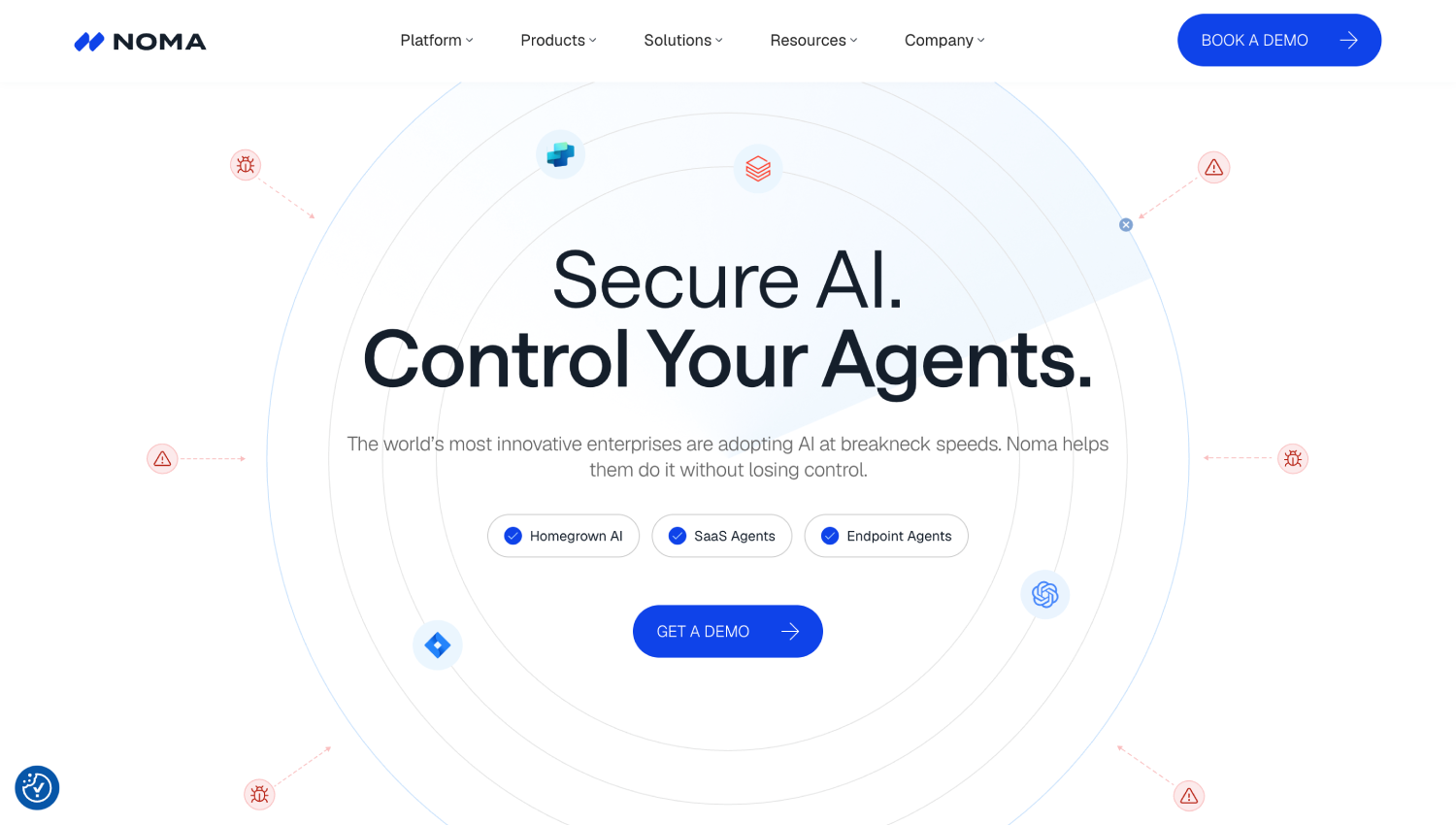
Noma Security positions itself as an AI security platform covering the full lifecycle from model development through production deployment. Its public documentation emphasizes AI asset inventory, AI-SPM posture management, data pipeline security, RAG security, and agent and MCP access control. The company’s AWS Marketplace listing and public resources frame the core problem as AI risk management in the context of business priorities , meaning Noma wants to sit upstream, helping security teams understand what AI assets exist and what risk they carry before they generate an incident.
Noma’s posture-first architecture reflects a view that most enterprise AI risk today is invisible: security teams do not have an accurate inventory of which models are deployed, which data sources feed which RAG pipelines, which agents have access to which tools, and which of those connections carry credential exposure or over-permissioned access. Noma targets that visibility gap directly.
Where Noma’s Public Documentation Is Specific
Noma’s public-facing content explicitly names AI asset discovery, model inventory, AI security posture management, data pipeline risk, RAG pipeline security, and agent and MCP access governance as coverage areas. The company’s documentation on controlling agent and MCP access has been indexed and surfaced in search results, which suggests that agentic access control is a first-class product surface rather than a marketing claim layered over a simpler gateway.
For teams concerned about Model Context Protocol exposure specifically, that MCP access control layer is worth examining directly in a PoC, since MCP is an attack surface that most AI security platforms name but few have instrumented deeply. The SecurityOpsWire review of MCP security tools covers how different platforms approach agent-to-tool access control, including what enforcement actually looks like at the protocol level.
Noma’s Honest Weakness
Noma’s runtime enforcement at the inference layer , blocking or modifying a prompt or response in real time as it transits between a user and a model , is not the center of the product, based on the company’s own public documentation and positioning. Noma describes runtime capabilities, but the dominant framing is posture, inventory, and governance rather than inline enforcement. For a team running a customer-facing LLM application that needs sub-100ms policy decisions at inference time, that architectural emphasis is a real constraint worth surfacing in scoping conversations before a PoC begins.
What Does Lasso Security Actually Do, and Where Does It Focus?
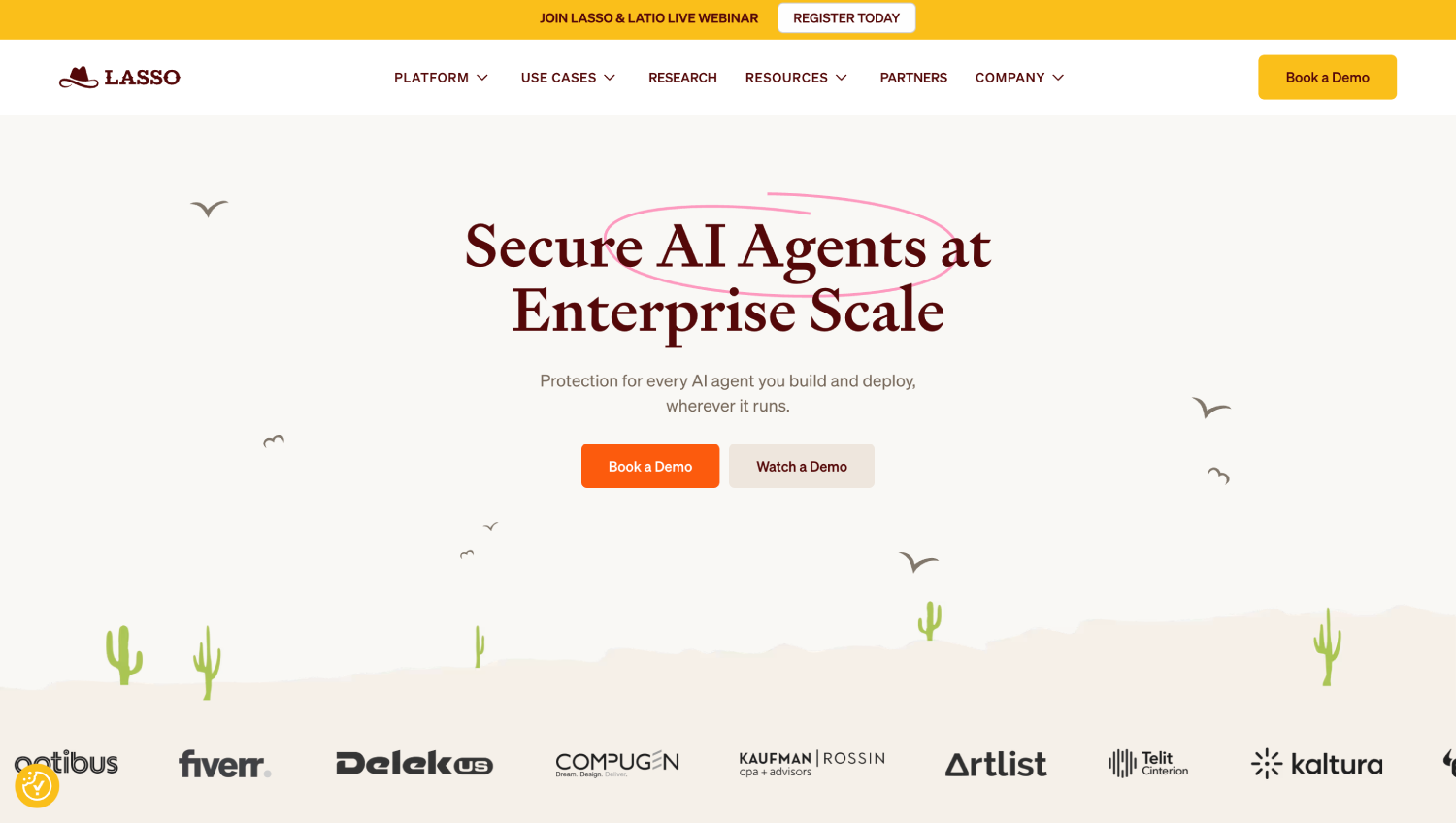
Lasso Security positions itself as a GenAI-first security platform built for the agentic era. Its public-facing documentation consistently leads with runtime protection: prompt injection defense, harmful content prevention, policy enforcement at the inference layer, and discovery and monitoring of GenAI usage across the enterprise. The company’s SERP-visible framing describes a platform that connects discovery, AI risk management, automated red teaming, and runtime protection , but the runtime protection piece appears to be the product’s center of gravity, not a secondary feature.
Lasso’s “Lasso for Employees” product on AWS Marketplace signals a specific use case: employees using sanctioned and unsanctioned GenAI tools. That employee-facing coverage implies a gateway or proxy architecture capable of intercepting and evaluating requests, which is a different deployment model than a posture scanner or inventory agent.
Where Lasso’s Public Documentation Is Specific
Lasso’s public site explicitly names prompt injection attack protection, harmful content generation prevention, and runtime threat coverage as primary capabilities. The company’s resources section references the agentic era and frames discovery and red teaming as inputs to the runtime protection layer, rather than standalone products. That sequencing matters: if discovery feeds enforcement, the architecture is control-first. If discovery is the primary output, the architecture is visibility-first. Lasso appears to be the former.
Teams evaluating runtime protection capabilities should also assess what complementary controls exist at the guardrail layer. The SecurityOpsWire comparison of AI guardrail platforms for production LLMs and agents covers how inline enforcement differs from posture-based controls, which is directly relevant when assessing whether Lasso’s runtime layer replaces or supplements a guardrail solution.
Lasso’s Honest Weakness
Lasso’s public positioning is thinner on upstream pipeline coverage , the security of model training data, fine-tuning pipelines, model registries, RAG data source permissions, and the governance layer that tracks which teams own which models. A team whose AI security program needs to answer the question “what AI assets do we have and what is the posture of each?” will find Lasso’s documentation less specific on that half of the problem. That is not a fatal gap for all buyers, but it is a real one for security teams in regulated industries where AI governance documentation is a compliance input.
How Does Each Platform Handle Runtime Enforcement Versus Posture Management?
This is the most important architectural question in the comparison, and the answer explains why both vendors can use identical category language while serving different primary buyers.
| Capability Area | Noma Security | Lasso Security |
|---|---|---|
| AI asset inventory and discovery | Core product surface, explicitly documented | Present, positioned as input to runtime controls |
| AI-SPM posture management | Core product surface | Not a primary positioning claim |
| RAG and data pipeline security | Explicitly named in public documentation | Not prominently featured |
| Model and MCP access governance | Explicitly documented (agent and MCP access control) | Present under agentic era framing |
| Runtime prompt injection defense | Referenced but not the dominant framing | Primary product claim, explicitly documented |
| Harmful content prevention at inference | Not a primary positioning claim | Explicitly named as core capability |
| Employee GenAI usage protection | Not prominently positioned | AWS Marketplace product exists for this use case |
| Automated red teaming | Not a primary positioning claim | Referenced in public resources framing |
| AI governance reporting | Explicitly tied to business priority context | Not a primary positioning claim |
The table above reflects public documentation and positioning only. Both vendors may have capabilities beyond what their current public documentation describes. The right scoping question is not whether a capability appears in the documentation but whether it is instrumented well enough to generate reliable signal in your specific environment.
What Integration Work Does Each Platform Actually Require?
Both platforms need to discover your AI environment before they can do anything useful, and the integration burden is where PoC timelines and ongoing operational costs diverge.
Noma’s posture-oriented architecture implies a read-access integration model in its early layers: connecting to cloud accounts, model registries, data pipelines, and agent frameworks to build the inventory. That kind of integration is closer in pattern to a CSPM onboarding than to deploying an agent or gateway. For teams with multiple cloud accounts and fragmented AI tooling, the catalog completeness of that initial discovery phase is the primary success metric in week one of a PoC.
Lasso’s runtime and gateway-oriented architecture implies a different integration path: traffic must transit through or be intercepted by the platform to generate runtime enforcement. Deploying a gateway or proxy into an application’s inference path requires coordination with the team that owns the application, which is not always the security team. In organizations where AI applications are owned by product or engineering, that coordination is an organizational dependency, not just a technical one. Factor that into PoC scoping.
Neither vendor publishes integration requirements at the level of detail needed to estimate deployment effort from the outside. Both conversations should include questions about API-based versus agent-based data collection, whether gateway deployment requires changes to application code, and what the blast radius is if the gateway has an outage during inference.
How Do Noma and Lasso Price, and What Drives the Bill Upward?
Neither Noma Security nor Lasso Security publishes list pricing. Both require direct engagement for a quote. This is consistent with nearly every AI security platform in this category, where deal sizes, deployment scope, and integration complexity vary enough that a published price list would be misleading.
What matters more than the number is the pricing model, because the model determines what drives your bill upward as usage grows. For posture-oriented platforms like Noma, the most common pricing drivers in this category are number of AI assets under management, number of cloud accounts or environments, and the volume of pipeline connections being monitored. For runtime-oriented platforms like Lasso, the common pricing drivers are inference request volume, number of applications protected, and the number of users covered under an employee-facing product tier.
A company scaling its AI application portfolio should model both scenarios: a posture platform whose cost scales with asset count grows linearly as you add models and agents; a runtime platform whose cost scales with inference volume grows faster if your applications are high-traffic. Both are defensible models, but they produce different cost curves at scale. Ask each vendor explicitly how the contract is structured and what triggers an overage conversation.
The SecurityOpsWire AI Security Layer Test: Four Questions Before You Start a PoC
Most AI security PoCs fail not because the tool is wrong but because the success criteria were written before the team identified which layer of the AI stack had the primary gap. The following four-question framework, developed from the structural analysis in this article, is designed to be asked before scoping begins.
- Where is your primary AI risk today: in what is built and deployed, or in what is running? If you cannot answer this from existing telemetry, you need a discovery and inventory tool first, which points toward Noma’s architecture. If you already know what is running and need to control it, Lasso’s architecture is the closer fit.
- Who owns your AI applications: security, or product and engineering? A runtime gateway that requires application-level integration demands cooperation from teams outside security. If that cooperation is difficult in your organization, a posture platform that uses read-only cloud integrations is operationally easier to deploy.
- Does your compliance or governance program need AI asset documentation? Governance documentation , model inventories, data lineage, access logs for AI systems , is increasingly a regulatory expectation in financial services, healthcare, and EU AI Act-adjacent programs. A posture platform generates that documentation structurally; a runtime platform does not, by default.
- What is your inference volume, and is it growing? Runtime protection platforms price on inference traffic. If your AI application layer is high-traffic or growing rapidly, the cost model of a runtime-first platform needs to be modeled at 12 and 24 months, not at current volume.
Which Teams and Environments Does Each Platform Fit?
Noma fits security teams at mid-market to enterprise companies that are in the AI inventory and governance phase of their security program. The classic buyer profile is a security engineering team that has received a mandate , from the board, from a regulator, or from a post-incident review , to produce an accurate inventory of AI assets and their associated risks. These teams often lack visibility into which models are in use, which data sources feed them, and which agents have been granted access to sensitive tools. Noma’s architecture is built to answer those questions first.
Lasso fits security teams at companies where AI applications are already in production and the gap is enforcement at the inference layer. The classic buyer profile is a team responsible for a customer-facing or employee-facing LLM application that has identified prompt injection, jailbreak attempts, or policy violations in existing logs and needs a platform that can classify and block those requests in real time. The employee-facing product tier makes Lasso specifically relevant for companies managing shadow AI usage , employees submitting sensitive data to public LLM services without sanctioned controls in place.
Both platforms are relevant to teams building out a full AI agent security program. For a broader evaluation of the category that includes platforms beyond these two, the SecurityOpsWire roundup of AI agent security platforms covers the full competitive set with architecture-level analysis.
Where Do the Two Platforms Genuinely Compete for the Same Buyer?
The overlap zone is mid-market companies that are simultaneously building their AI inventory practice and deploying production LLM applications. These teams are doing both things at once and do not have the budget or headcount for two separate platforms. For that buyer, the decision comes down to which layer is on fire right now.
If the immediate threat is a known runtime exposure , a customer-facing chatbot that has been manipulated in testing or a red team exercise that surfaced prompt injection , Lasso’s runtime enforcement closes that gap faster. If the immediate threat is a governance gap , an audit or a board-level question about AI risk that security cannot answer with current tooling , Noma’s inventory and posture layer answers that question faster.
Teams in that overlap zone should also examine whether either platform integrates cleanly with their existing detection and response stack. For context on how AI agent monitoring tools differ from runtime enforcement platforms, the SecurityOpsWire analysis of AI agent discovery and monitoring tools covers the distinction between passive discovery and active control.
Frequently Asked Questions
What is the pricing for Noma Security?
Noma Security does not publish list pricing. The company quotes per environment based on scope, which typically includes the number of AI assets, cloud accounts, and data pipeline connections being monitored. Any figure circulating in listicles or comparison sites without a direct link to a current Noma pricing page should be treated as unverified. Contact Noma directly for a scoped quote, and ask explicitly what drives overages at growth.
What does Noma Security do?
Noma Security is an AI security platform focused on AI asset inventory, AI-SPM posture management, RAG and data pipeline security, and agent and MCP access governance. Its architecture is designed to give security teams visibility into what AI models and agents exist in an environment, what risks they carry, and how access is controlled across the AI stack. Noma positions governance and business-priority context as core outputs alongside technical controls.
What is Lasso Security and how does it differ from Noma?
Lasso Security is a GenAI-first security platform focused on runtime protection at the inference layer: prompt injection defense, harmful content prevention, and policy enforcement for LLM applications. It also covers employee GenAI usage via a dedicated product tier. The key difference from Noma is architectural emphasis. Lasso leads with enforcement at the point where a model generates a response; Noma leads with posture and visibility across the upstream pipeline where models and agents are built and deployed.
Which platform covers the full model-to-agent lifecycle?
Noma’s public documentation covers more of the development-to-deployment portion of the lifecycle, including model inventory, data pipelines, RAG security, and agent access governance. Lasso covers more of the inference and runtime portion. No single platform in this category has demonstrated equally deep coverage across all lifecycle stages in public documentation. A PoC should define which lifecycle stages are in scope and evaluate depth at each stage explicitly rather than accepting lifecycle marketing claims at face value.
Do either Noma or Lasso require changes to application code for deployment?
Noma’s posture-oriented integration model, as described in the company’s public documentation, appears to rely on cloud integrations and API connections rather than inline application instrumentation for its core inventory and posture capabilities. Lasso’s runtime enforcement model implies that application traffic must transit through or interact with the platform, which may require application-level configuration, based on how Lasso describes its gateway architecture on its public site. Neither vendor has published detailed deployment architecture documentation that would allow a definitive answer. This should be a first-day question in any vendor conversation.
How should a security team structure a PoC to choose between these two?
Define the primary gap first using the four questions in this article. Set success criteria before the PoC starts, not after. For a posture platform like Noma, the primary success criterion is inventory completeness: what percentage of known AI assets does the platform discover without manual input? For a runtime platform like Lasso, the primary success criterion is enforcement accuracy: what is the false-positive rate on legitimate traffic during a week of inline policy enforcement? A PoC that does not predefine these metrics will produce a vendor demo, not a decision.
Is either platform better for regulated industries?
Noma’s emphasis on AI governance documentation, asset inventory, and business-priority risk context makes it a closer architectural fit for regulated industries where auditors expect structured AI asset management. Financial services, healthcare, and companies building toward EU AI Act compliance need artifact-generating posture tools, not just runtime controls. Lasso’s runtime protection is relevant in regulated industries for specific use cases , particularly protecting customer-facing applications from manipulation , but it does not by default generate the governance documentation that compliance teams need.
The Clearest Way to Frame the Final Decision
Security programs address two fundamentally different problems: they either lack visibility into a risk, or they lack control over a risk they can already see. Most AI security programs right now have both problems, but they have them in different proportions depending on how mature the AI application portfolio is and how early the security team was involved in its deployment.
Noma is the right starting point when the visibility problem dominates. If a security team cannot produce an accurate list of which models, agents, data connections, and MCP integrations exist in the environment, runtime enforcement is premature because it is guarding doors the team has not yet mapped. The SecurityOpsWire analysis of AI agent red teaming platforms is worth reading alongside this comparison, because red teaming presupposes an inventory of attack surfaces that posture management should produce first.
Lasso is the right starting point when the control problem dominates. If a team already has inventory and posture data, has identified production LLM applications with runtime exposure, and needs a platform that can classify and block malicious or policy-violating inference traffic at scale, Lasso’s architecture addresses that gap directly. A PoC in that scenario should be measured on enforcement precision, not discovery completeness, and should include a week of traffic with real user patterns before any go/no-go decision is made. The two platforms are not competitors for the same dollar in most environments. They are sequential investments in a maturing AI security program, and the order of investment should follow the order of the gaps.