
- Noma Security does not publish pricing, does not offer self-hosted deployment, and is positioned as a SaaS-only platform , those three facts alone account for most of the switching conversations happening in enterprise security teams right now.
- The alternatives in this list are organized by the reason teams leave Noma, not by arbitrary ranking: deployment model, coverage depth, integration breadth, and budget.
- Several tools in this space have been absorbed into larger platform vendors, which changes the procurement path and the roadmap risk calculation significantly.
- For regulated environments requiring air-gapped or on-premises deployment, the realistic shortlist is short: Lakera with private cloud options, WitnessAI with on-premises support, and the Palo Alto AIRS portfolio for customers with existing Palo Alto agreements.
- Expect at least two to three months of tuning debt when switching mid-contract, regardless of which alternative you choose , the detection models and policy baselines do not transfer.
The best Noma Security alternatives for enterprise AI agent protection are Lasso Security, Zenity, Straiker, Prompt Security, WitnessAI, Lakera, Obsidian Security, and Protect AI. Each addresses a distinct gap: Zenity for Microsoft Copilot and low-code agent coverage, Lakera for prompt injection at inference time, Protect AI for teams that need MLOps-layer security, and Obsidian for SaaS-native identity and access control around AI applications.
Why Do Security Teams Look Past Noma Security?
Noma Security is positioned as an AI security lifecycle platform: it covers model inventory, data pipeline security, runtime protection for LLM-based applications, and agent behavior monitoring. The platform is SaaS-only, and Noma does not publicly disclose pricing. Both facts create friction in specific procurement contexts.
Regulated industries , financial services, defense contractors, healthcare systems operating under strict data residency rules , cannot send inference telemetry to a third-party SaaS platform without a data processing agreement that survives a compliance audit. That eliminates Noma before the technical evaluation even begins. A separate set of teams rules it out on coverage: Noma’s strongest position is in LLM application security and agent lifecycle management, but teams running Microsoft 365 Copilot, Power Automate flows, or ServiceNow AI configurations find that coverage thin. A third category of teams , typically security-mature enterprises that already run a SIEM and an XDR , find Noma’s alert output hard to route into their existing detection pipeline without additional integration work.
The switching cost question matters more than most buyers initially estimate. Moving from one AI security platform to another mid-contract means rebuilding policy baselines, retraining your team on a different alert taxonomy, and accepting a temporary regression in detection coverage while the new platform learns your environment. Budget three months minimum for that transition. The sections below flag which platforms have migration tooling and which require a clean-slate implementation.
How to Use This List Without Wasting Five Vendor Calls
The SecurityOpsWire Switching Constraint Filter works like this: before reading each entry, identify your primary reason for looking past Noma. Deployment model (need on-prem or private cloud)? Coverage gap (Microsoft Copilot, low-code, MLOps)? Integration fit (SIEM routing, XDR correlation)? Budget ceiling (need public pricing before procurement will approve an evaluation)? Each entry below leads with the fit condition, then the weakness. Skip entries that do not match your constraint , they are not your shortlist.
For a broader view of the platform category before you read individual entries, the full comparison of AI agent security platforms on SecurityOpsWire covers evaluation criteria that apply regardless of which vendor you land on.
Which Noma Alternatives Fit Each Switching Reason?
| Vendor | Primary Fit Condition | Deployment Model | Pricing Public? | Noted Weakness |
|---|---|---|---|---|
| Lasso Security | LLM app and agent runtime monitoring | SaaS | No | Limited MLOps-layer coverage |
| Zenity | Microsoft Copilot and low-code agents | SaaS | No | Narrow outside Microsoft environments |
| Straiker | AI application red teaming plus runtime | SaaS | No | Early-stage; limited enterprise references |
| Prompt Security | Prompt injection and data leakage prevention | SaaS; private cloud option | No | Coverage thins outside major LLM providers |
| WitnessAI | AI usage governance and policy enforcement | On-premises / private cloud | No | Less runtime agent behavior depth |
| Lakera | Prompt injection at inference; model safety | SaaS; private deployment option | No | Weak on agent-to-agent behavior monitoring |
| Obsidian Security | SaaS identity and access control around AI apps | SaaS | No | Not an AI-native security platform |
| Protect AI | MLOps and model supply chain security | SaaS | No | Runtime agent monitoring less mature than lifecycle coverage |
Lasso Security: Closest Like-for-Like Replacement on Agent Runtime
Lasso Security covers LLM application monitoring and AI agent runtime behavior , the layer Noma is best known for. Teams that run custom-built agents on top of OpenAI, Anthropic, or Azure OpenAI APIs, and that are leaving Noma primarily because of pricing opacity rather than a coverage gap, will find Lasso the lowest-friction migration path. The detection model is built around prompt injection, sensitive data exposure in model outputs, and unexpected agent action sequences.
The weakness is depth on the MLOps side. Lasso does not provide the model supply chain visibility , training data lineage, model registry monitoring, dependency scanning for ML packages , that teams protecting the full AI development lifecycle need. If your use case stops at inference and agent behavior, that gap does not matter. Pricing is not publicly disclosed; Lasso quotes per environment.
Zenity: The Only Realistic Option for Microsoft Copilot and Power Platform Agents
Zenity solves a problem the rest of this list mostly ignores: security visibility into Microsoft 365 Copilot, Power Automate, Power Apps, and low-code agents built by business users rather than engineering teams. Most enterprise AI security platforms instrument developer-built LLM applications through an API or SDK. They have no visibility into a Power Automate flow that a finance analyst built last Tuesday and connected to SharePoint and a payment system.
If Microsoft’s low-code and Copilot environment is where your highest-volume agent deployment is happening , which it is for most large enterprises running Microsoft 365 , Zenity is not an alternative to Noma so much as a complement to whatever runtime monitoring tool you already have. Outside the Microsoft environment, Zenity’s coverage is narrow. Teams running Google Workspace AI features, Salesforce Einstein agents, or custom agents on non-Microsoft infrastructure will find limited value. Pricing is not publicly disclosed.
For teams managing the intersection of agent-to-tool access controls and low-code environments, the MCP security tools comparison covers the protocol-layer controls that Zenity does not address.
Straiker: Red Teaming Plus Runtime in One Platform
Straiker combines AI application red teaming with runtime monitoring, which is a different architectural bet than Noma makes. Noma leans into posture management and lifecycle visibility; Straiker leans into continuous adversarial testing as the primary signal for runtime risk. The practical difference is that Straiker surfaces exploitability rather than configuration state , it tells you whether a prompt injection path is reachable and weaponizable in your specific deployment, not just whether your model is connected to a sensitive data source.
The weakness is enterprise maturity. Straiker is earlier-stage than Noma, and teams that need a vendor with a dense reference list in their industry or a well-staffed enterprise support organization should factor that in. Pricing is not publicly disclosed. For teams specifically evaluating adversarial testing coverage, the AI agent red teaming platforms comparison covers this layer in depth.
Prompt Security: Inline Inspection for Prompt Injection and Data Leakage
Prompt Security sits inline between your application and the LLM API, inspecting every prompt and completion for injection attempts, sensitive data patterns, and policy violations before they reach the model or leave it. The architecture is different from Noma’s: where Noma instruments at the agent and application lifecycle level, Prompt Security operates at the request level. That makes it faster to deploy in many environments , there is no agent to install, and the integration is an API proxy , but it also means it has no visibility into what happens inside an agent’s reasoning loop between API calls.
A private cloud deployment option makes Prompt Security viable for some regulated environments where SaaS-only platforms fail compliance review. Coverage thins outside major LLM providers; teams using fine-tuned models hosted on private infrastructure or open-source models on their own compute may find detection accuracy drops. Pricing is not publicly disclosed.
WitnessAI: The On-Premises Option for Air-Gapped and Strict Data Residency Environments
WitnessAI is one of the few platforms in this space that supports on-premises and private cloud deployment as a first-class option rather than a custom enterprise add-on. For defense contractors, government agencies, and financial institutions with data residency requirements that prohibit telemetry leaving a controlled environment, WitnessAI is one of the shortest shortlists available.
The platform focuses on AI usage governance: who is using which AI tools, what data is flowing through them, and whether that usage complies with internal policy. That is a different center of gravity than Noma’s agent behavior monitoring and LLM application security. Teams that need runtime agent behavior depth , detecting when an agent takes an unexpected action sequence, for example , will find WitnessAI less complete in that layer. Pricing is not publicly disclosed. The vendor quotes per deployment.
Lakera: Prompt Injection Specialist With Private Deployment Options
Lakera built Gandalf , a public prompt injection challenge , and then productized the underlying detection capability into Lakera Guard, which runs as an inline API layer intercepting prompts and completions. The detection models are trained specifically on prompt injection patterns, jailbreak attempts, and sensitive data leakage in LLM outputs. For teams whose primary concern is adversarial input to production LLMs, Lakera’s detection accuracy in that specific scenario is the strongest argument for it.
The weakness is agent-to-agent behavior monitoring. Lakera watches what goes into and comes out of an LLM API call. It does not watch how an agent sequences tool calls, whether an agent is acquiring capabilities outside its defined scope, or whether an agent-to-agent communication chain is drifting from expected behavior. Teams that have already solved for prompt injection and need monitoring of complex agentic pipelines will outgrow Lakera’s current coverage. Private deployment options exist for regulated environments. Pricing is not publicly disclosed. For teams evaluating broader guardrail capabilities beyond injection detection, the AI guardrail platforms comparison covers this layer across multiple vendors.
Obsidian Security: Identity-First Approach to AI Application Risk
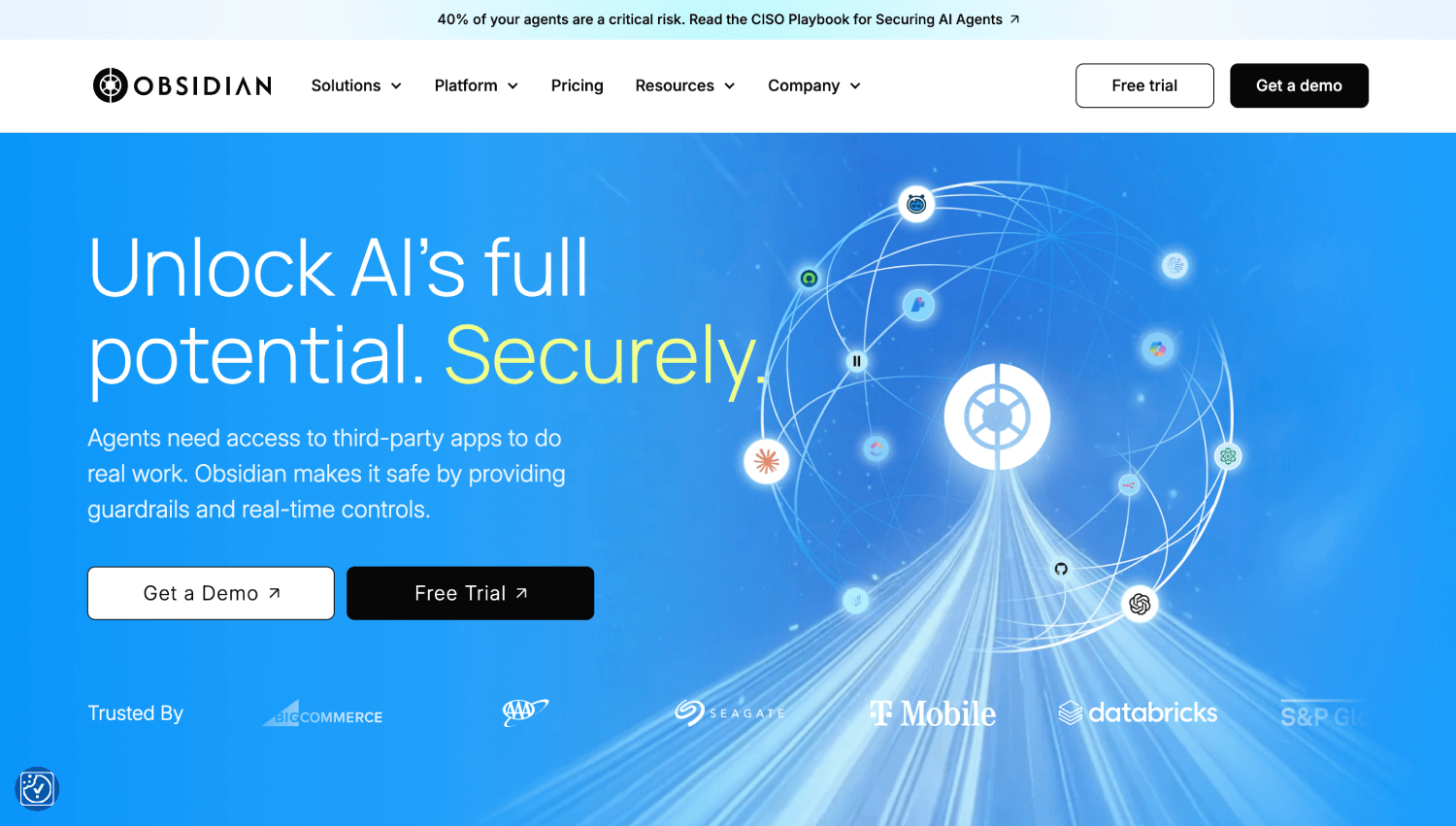
Obsidian Security is not an AI-native security platform. It is a SaaS security and identity threat detection platform that has extended its coverage to AI applications , specifically, monitoring OAuth permissions granted to AI tools, detecting overprivileged service accounts connected to LLM applications, and flagging abnormal data access patterns through AI-connected integrations.
The fit condition is specific: teams whose primary AI security concern is identity and access sprawl around AI applications, rather than the behavior of the agents themselves, will find Obsidian more operationally relevant than platforms focused on prompt injection or agent action monitoring. If your highest-risk scenario is an employee granting a third-party AI tool excessive OAuth permissions to Google Drive or Salesforce, Obsidian’s detection coverage maps directly to that threat. If your concern is what the agent does after it has access, Obsidian does not answer that question. Pricing is not publicly disclosed.
Protect AI: MLOps and Model Supply Chain Security
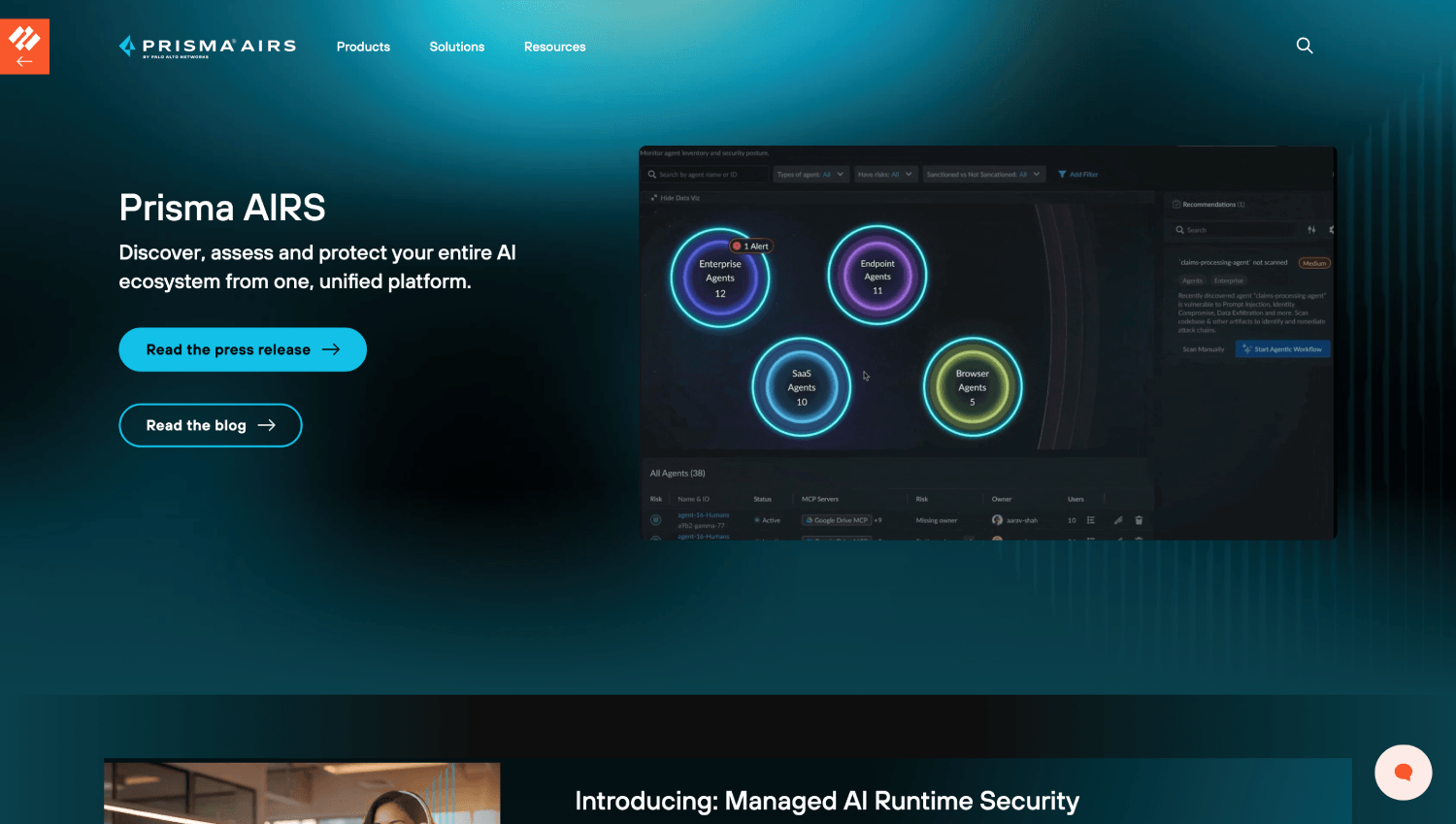
Protect AI focuses on the model development and supply chain layer rather than runtime agent behavior. Its product line , including Recon for ML model scanning, Guardian for model registry security, and the open-source Huntr bug bounty program for AI and ML vulnerabilities , targets the model artifacts, training pipelines, and ML package dependencies before a model ever reaches production. That makes Protect AI the right answer for a specific and frequently underserved use case: securing the ML supply chain from training through deployment.
Teams running internal ML engineering teams, fine-tuning models on proprietary data, or managing a model registry with third-party model artifacts have exposure that most AI security platforms do not address. Protect AI does. Runtime agent behavior monitoring is less mature than the lifecycle and supply chain coverage. Pricing is not publicly disclosed; the vendor quotes per environment through its sales process.
For teams specifically concerned with the discovery and ongoing monitoring of agent deployments across their environment, the AI agent discovery and monitoring tools breakdown covers that layer across multiple vendors in this space.
What Switching Costs Should a Team Expect Mid-Contract?
The honest answer is three to six months of reduced detection coverage and elevated tuning debt, depending on how deeply your security operations team has integrated the outgoing platform. AI security platforms build their detection value from behavioral baselines specific to your environment: the normal prompt patterns, the expected agent action sequences, the typical data access volumes for your LLM applications. None of that transfers to a new platform. You rebuild it from zero.
Consider a hypothetical scenario that illustrates the switching cost arithmetic. A 1,200-person financial services company running a custom AI agent on Azure OpenAI, a Microsoft 365 Copilot deployment for 400 users, and three internal LLM-powered applications. They have run Noma for eight months. In that time, they have tuned out roughly 60 to 80 percent of initial false positives and built alert routing into their SIEM. Switching to any alternative means re-establishing those baselines, renegotiating the alert schema with the SIEM team, and accepting that the first 90 days of the new platform will generate elevated noise. The procurement team should factor that operational cost , measured in analyst hours, not just license fees , into the total cost comparison. A platform that costs 20 percent less but requires an additional 200 analyst hours to tune in year one is not necessarily the cheaper option.
The platforms with the most structured onboarding and baseline-building tooling in this list are Lakera (because its detection scope is narrower and therefore faster to calibrate) and vendors with enterprise customer success resources behind them. The platforms with the most tuning debt risk are the earlier-stage vendors , Straiker and Lasso , where the detection models have been validated across a smaller range of enterprise environments and deployment patterns.
Which Alternatives Support Self-Hosting or Air-Gapped Deployment?
WitnessAI is the clearest answer for teams that need on-premises deployment as a non-negotiable. Prompt Security and Lakera both offer private cloud deployment options, though the details of those configurations vary by contract and are not publicly documented on their sites.
Based on the source pages available for the platforms in this list, none publish a documented air-gap installation guide as publicly available documentation. Teams in defense or intelligence contexts should treat every vendor conversation as a custom scoping exercise, and should require a reference customer in a comparable regulatory environment before signing. The absence of a public self-hosting guide does not mean the capability does not exist , it often means the vendor’s sales process gates that information , but it does mean you cannot verify the capability before the call.
Frequently Asked Questions
What is Noma Security and what does it actually do?
Noma Security is an AI security platform that covers the full AI application lifecycle: model and agent inventory, data pipeline security, runtime monitoring for LLM-based applications, and agent behavior detection. It is positioned as a SaaS-only platform. Noma does not publicly disclose pricing. The platform’s strongest coverage is in LLM application security and agent lifecycle management, with weaker coverage for low-code agents and Microsoft Copilot environments.
Does Noma Security offer on-premises or self-hosted deployment?
Noma Security does not publicly document an on-premises or self-hosted deployment option. The platform is presented as SaaS-only. Teams with data residency requirements that prohibit telemetry leaving a controlled environment should evaluate WitnessAI, which supports on-premises deployment, or Lakera and Prompt Security, which offer private cloud options.
What is Noma Security’s pricing?
Noma Security does not publish pricing on its website. The vendor quotes per environment through its sales process. This is typical for the AI security platform category , none of the alternatives in this article publish list pricing either. Budget estimates from the sales conversation should be validated against the operational costs of implementation, tuning, and integration before comparing to an alternative’s quoted price.
How does Zenity differ from other Noma alternatives?
Zenity is specifically built for Microsoft 365 Copilot, Power Automate, Power Apps, and other low-code agent environments. Other Noma alternatives focus on developer-built LLM applications instrumented through an API or SDK. Zenity provides security visibility into agents created by business users without engineering involvement, which is a coverage layer most AI security platforms do not address. Outside the Microsoft environment, Zenity’s coverage is limited.
Is Protect AI still an independent company?
Protect AI is an AI and ML security company focused on model supply chain security. For the most current information on its corporate status and any acquisition or ownership changes, check the vendor’s official site directly, as corporate status in this space changes frequently.
Which AI security platform alternative is best for detecting prompt injection attacks?
Lakera is the most focused option for prompt injection detection at inference time. Its detection models are trained specifically on prompt injection patterns and jailbreak attempts, and it operates as an inline API proxy. Prompt Security also addresses prompt injection with an inline inspection architecture. Both offer private deployment options for regulated environments. Neither provides deep visibility into agent-to-agent behavior or agentic pipeline sequencing.
What switching costs should I expect when moving from Noma to an alternative?
Expect three to six months of elevated tuning debt and reduced detection signal quality while the new platform establishes behavioral baselines for your environment. Alert routing to existing SIEM or XDR tooling will need to be reconfigured for the new platform’s alert schema. Analyst hours spent on initial tuning are a real cost that should be included in total cost comparisons alongside license fees. Platforms with narrower detection scope, like Lakera, typically reach stable baseline faster than broader platforms.
How do I narrow my shortlist to two alternatives without five vendor demos?
Use your primary switching constraint as the filter. If deployment model is the constraint (need on-prem or private cloud), your realistic shortlist is WitnessAI and, for teams with appropriate agreements, vendors that offer private cloud configurations like Lakera or Prompt Security. If the constraint is Microsoft Copilot and low-code agent coverage, Zenity is the primary choice and you need a second platform for custom LLM application monitoring. If the constraint is MLOps and model supply chain security, Protect AI is the answer. Matching constraint to primary fit condition before requesting demos eliminates three to four conversations immediately.
The Single Most Important Insight Before You Shortlist
Most AI security platform evaluations fail at the coverage mapping step. Teams define their use case as “AI security” and evaluate platforms against a generic feature matrix. The actual risk exposure is specific: it lives in the intersection of which AI tools are deployed, how they are built, where they run, and what data they can reach. Noma’s coverage model matches some of those intersections well and others poorly. The same is true of every platform in this list.
The right evaluation sequence is to map your deployed AI surface first , custom LLM applications, vendor AI tools like Copilot or Salesforce Einstein, low-code agents, and internal MLOps pipelines , and then match platform coverage to that specific map. A platform that covers 90 percent of a surface you do not have is worth less than one that covers 60 percent of the surface you actually run.
Switching cost is real and chronically underweighted in procurement decisions. The license price comparison is the easy part. The tuning debt, the alert schema migration, the analyst hours, and the temporary detection regression are where the actual cost lives. Factor them in before you sign a new contract, not after you have already cancelled the old one.