
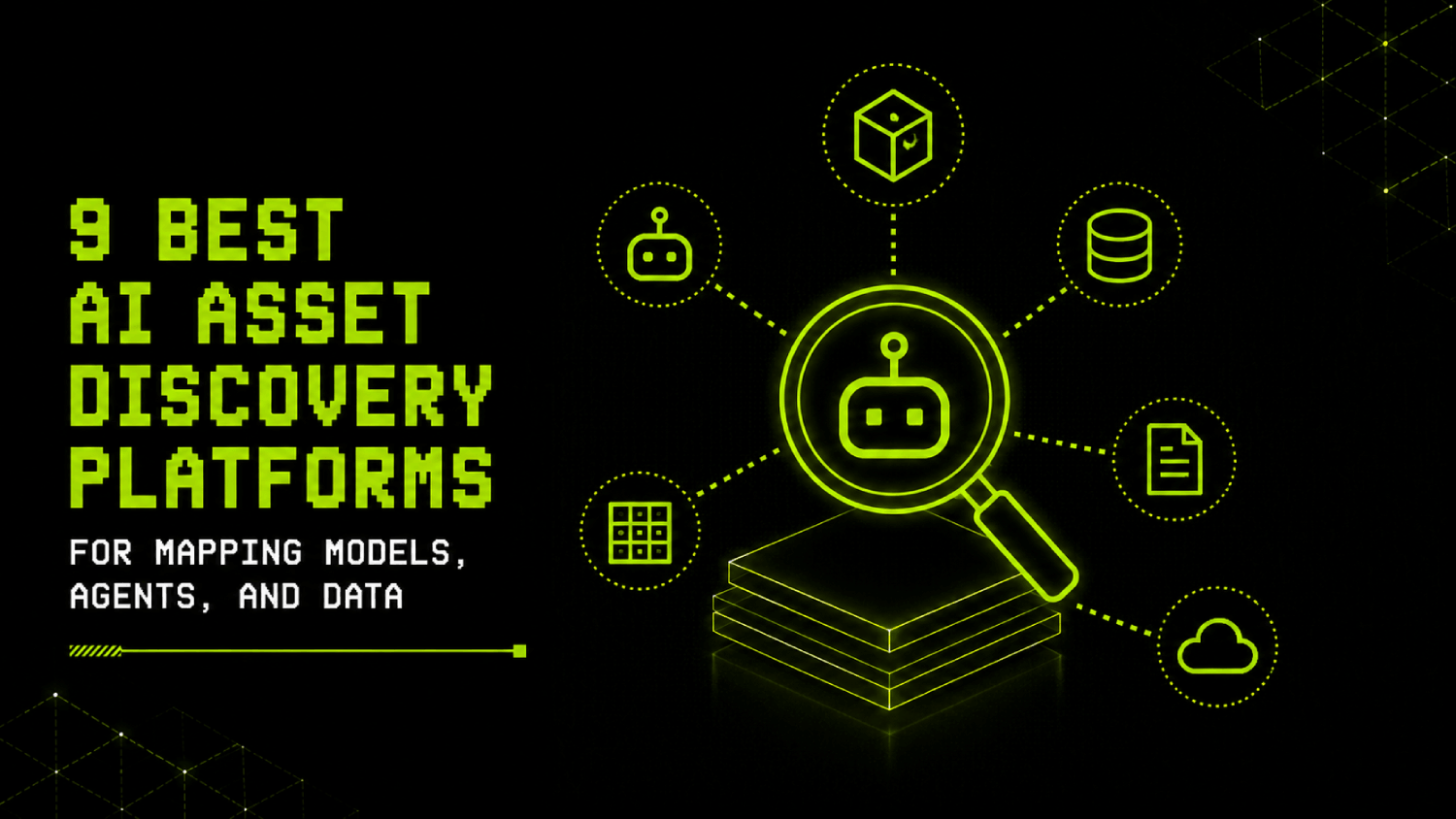
- A spreadsheet of AI models maintained by the ML platform team is stale before the next sprint ends. Self-hosted models, fine-tuned checkpoints, agent pipelines, and third-party API integrations appear and disappear faster than any manual process can track.
- AI asset inventory is not IT asset management. Tools like Lansweaver, runZero, and SolarWinds find devices and services. AI inventory tools find models, datasets, embeddings, training pipelines, prompts, and the data flows connecting them.
- The platforms worth evaluating fall into three architectural families: cloud security platforms that added AI-BOM capabilities (Wiz, Orca, Palo Alto), data governance platforms that extended to AI (BigID, Cyera, Securiti), and purpose-built AI security platforms (Noma, Zenity, Credo AI, Microsoft Purview).
- An inventory without access context, data lineage, and ownership attribution is a list. An inventory with those three dimensions is governance evidence.
- Air-gapped and on-premises environments expose the most significant gaps across nearly every platform reviewed here.
AI asset inventory tools discover, catalog, and continuously monitor the AI components inside an organization: trained models, fine-tuned checkpoints, embedding stores, datasets, inference endpoints, agent pipelines, prompt templates, and third-party model API connections. The strongest platforms attach access context, data lineage, and ownership metadata to each discovered asset, making the inventory usable as governance evidence rather than a simple list. No tool reviewed here handles fully air-gapped environments without significant configuration work.
What Counts as an AI Asset, and Why the Definition Matters for Tooling
The scope of “AI asset” determines which tool fits your environment. A narrow definition covers only deployed model endpoints. A complete definition, and the one regulators are beginning to require, covers the full chain from training data to inference output.
A complete AI asset inventory should account for at least seven asset classes. First, foundation models and fine-tuned variants, whether self-hosted on GPU infrastructure or accessed via API. Second, training and validation datasets, including any datasets ingested from third parties. Third, embedding stores and vector databases, which often hold sensitive document representations. Fourth, AI agents and the workflows connecting them to tools and data sources. Fifth, prompt templates stored in code repositories or configuration management systems. Sixth, model serving infrastructure, including inference endpoints, model registries, and orchestration layers. Seventh, notebooks and experiment artifacts in platforms like MLflow, Weights and Biases, or SageMaker Experiments, which often contain intermediate model checkpoints that never get formally registered.
That last category is where most spreadsheet-based inventories fall short. A notebook run on a Friday afternoon that produces a fine-tuned model checkpoint is not going to appear in any registry unless someone manually adds it. Discovery tools that integrate with the underlying compute and storage layers catch these artifacts automatically.
This Is Not IT Asset Management: Why ITAM Tools Return the Wrong Results
Search for “AI asset discovery tools” and you will find results for Lansweaver, runZero, SolarWinds, and Freshservice. Those are IT asset management and network discovery tools. They find devices, operating systems, software installations, and open ports. They do not find a fine-tuned LLaMA checkpoint stored in an S3 bucket, a LangChain agent pipeline defined in a Python file, or a vector database instance that only accepts connections from a specific service account.
The difference is architectural. ITAM tools scan networks and query software inventories. AI inventory tools read model registry APIs, crawl object storage for model artifacts, parse infrastructure-as-code for AI service configurations, and monitor API gateway logs for outbound calls to external model providers. The data model is also different: an AI inventory needs to store not just “what exists” but “what data trained it, who owns it, what systems it can reach, and what data it can return.”
For security teams evaluating AI-SPM capabilities alongside inventory, the distinction between AI-SPM and AI agent security matters here too. Inventory is the prerequisite for both, but the tooling that handles inventory well does not always handle runtime agent monitoring well, and vice versa.
The SecurityOpsWire AI Inventory Depth Model: Four Layers That Separate Useful Tools from Lists
Before comparing specific platforms, a consistent evaluation framework helps. Most vendor comparisons stop at “what can it discover.” The more operationally relevant question is what context the tool attaches to each discovered asset. The SecurityOpsWire AI Inventory Depth Model organizes this into four layers.
Layer 1: Discovery coverage. Which asset classes does the tool find, and through what mechanism (API integration, network scan, agent, or policy scan of IaC)? A tool that only reads from registered model registries misses shadow models. A tool that only scans cloud provider APIs misses on-premises deployments.
Layer 2: Access and permission context. Which identities, service accounts, and human users can reach each AI asset? What data sources can the asset access at inference time? Without this layer, you cannot assess blast radius.
Layer 3: Data lineage. What data trained the model? Does the training data contain regulated categories like PII, PHI, or financial records? Which external datasets or third-party model weights were included? This layer is what regulators, auditors, and EU AI Act compliance workflows actually need.
Layer 4: Ownership and change tracking. Who is responsible for each asset? When was it last updated, and what changed? This layer converts an inventory into a living document rather than a point-in-time snapshot.
Tools that reach Layer 4 can feed governance workflows. Tools that stop at Layer 1 or 2 are useful for visibility but require significant manual enrichment before they generate any governance value.
9 AI Asset Inventory Tools Evaluated: Coverage, Depth, and Trade-offs
1. Wiz (AI-BOM)
Wiz added AI Security Posture Management capabilities including an AI Bill of Materials feature to its cloud security platform. The AI-BOM component discovers AI assets by reading cloud provider APIs across AWS, Azure, and GCP, identifying managed AI services (SageMaker, Azure OpenAI, Vertex AI), model artifacts in object storage, and container images running inference workloads.
The integration with Wiz’s existing cloud graph is the primary advantage. Because Wiz already maps the relationships between identities, data stores, and compute across your cloud environment, the AI inventory inherits that relational context. A discovered SageMaker endpoint automatically shows which IAM roles can invoke it and which S3 buckets contain its training data, assuming those buckets are also in your Wiz scope.
The limitation is that Wiz’s AI discovery is tied to its agentless cloud scanning architecture. Self-hosted models running on bare-metal GPU servers outside a monitored cloud account, or models running inside Kubernetes clusters not configured for Wiz integration, may not surface. Wiz does not publish pricing and quotes per environment.
2. Palo Alto Networks (AI-SPM within Prisma Cloud)
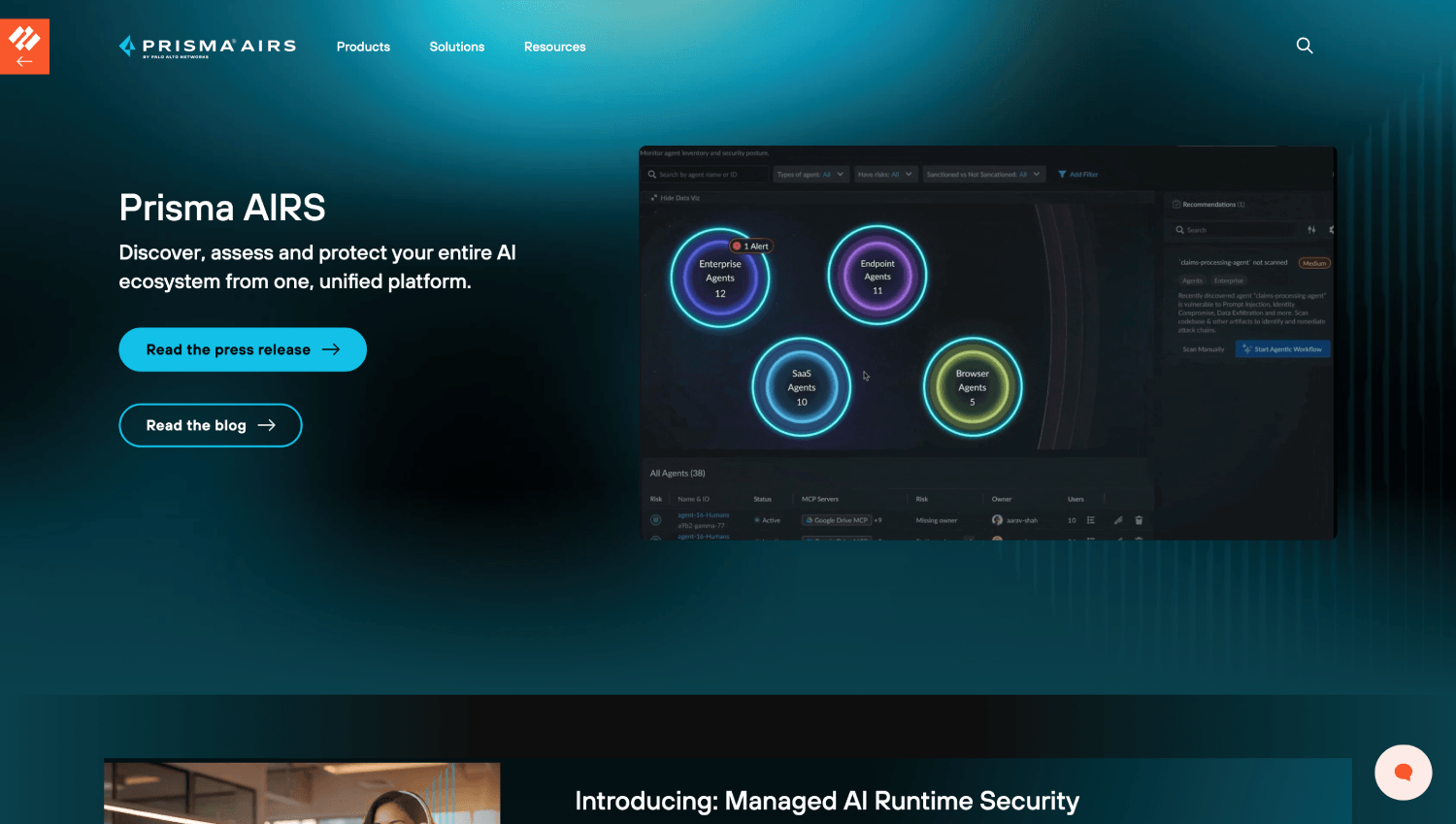
Prisma Cloud includes AI Security Posture Management as part of its CNAPP offering, providing discovery of AI services across cloud environments. The discovery mechanism follows a similar cloud-API-first approach to Wiz, reading managed AI service configurations and flagging misconfigured or overly permissive AI endpoints.
Prisma Cloud’s breadth across the CNAPP feature set (CSPM, CWPP, CIEM, and AI-SPM in a single platform) suits organizations that want to consolidate AI inventory into an existing security platform investment rather than deploy a new tool. The trade-off is depth: purpose-built AI security platforms tend to have more granular AI asset classification and richer lineage tracking. Palo Alto does not publish per-environment pricing for Prisma Cloud.
3. Orca Security
Orca Security takes an agentless approach to cloud security that extends to AI asset discovery. Orca’s SideScanning technology reads cloud workload data out-of-band from cloud provider APIs and storage snapshots rather than deploying agents to individual workloads. For AI inventory purposes, this means Orca can identify model artifacts, configuration files, and AI-related packages inside workloads without requiring instrumentation of each endpoint.
Orca surfaces AI-related findings within its broader risk prioritization engine, which considers asset exposure, data sensitivity, and reachability in combination. The inventory capabilities are solid for cloud-native environments but share the same on-premises gap as Wiz and Prisma Cloud. Pricing is not publicly disclosed.
4. Cyera
Cyera describes itself as an AI Security Platform built to protect data and secure AI, with products spanning data protection, access governance, and AI agent security. Its Agent Guardian capability is designed to secure what AI agents can see and do, Access Trail provides visibility into data access by both humans and AI, and the platform’s DSPM capabilities address data classification and sensitive data exposure across cloud environments.
For teams whose primary governance concern is training data composition and inference-time data exposure, Cyera addresses that slice of the AI-BOM problem through its data classification and lineage capabilities. Agent Guardian and Access Trail extend coverage to the access and agent dimensions that pure DSPM tools omit. Teams that also need model artifact discovery, MLOps pipeline mapping, or prompt template tracking will need a complementary tool for those functions. Cyera does not publish pricing.
5. BigID
BigID is a data intelligence platform with AI discovery capabilities oriented around data governance and compliance. BigID scans data sources to identify AI training datasets, flag regulated data categories, and map data flows into AI systems. Its AI inventory features are strongest when the primary use case is demonstrating compliance with data-related AI regulations, specifically understanding what sensitive data entered which AI systems.
BigID integrates with a broad range of data sources, including on-premises databases, making it more viable in hybrid and on-premises environments than cloud-native CNAPP tools. That said, BigID’s model artifact and agent pipeline discovery is more limited than platforms built with model-centric discovery as the primary use case. Pricing is not publicly disclosed.
6. Securiti
Securiti positions its AI governance suite around data security, privacy, and AI risk in a combined platform. The AI inventory component discovers AI systems, catalogs associated data assets, and maps data flows, with compliance workflow integrations built around frameworks like GDPR, CCPA, and emerging AI regulation.
Securiti’s strength is the integration between data inventory, consent management, and AI governance workflows. For organizations with a data privacy function that needs to extend into AI oversight, this integration reduces duplicate work. Security teams primarily focused on model security posture or agent runtime risk may find the platform’s security depth less mature than CNAPP-native options. Pricing is not publicly disclosed.
7. Noma Security
Noma Security is a purpose-built AI application security platform with AI asset discovery as a core capability. Noma integrates with model registries, MLOps pipelines, code repositories, and AI orchestration frameworks to build an inventory that spans the full AI development and deployment lifecycle, from experiment notebooks to production inference endpoints.
The MLOps integration depth is Noma’s differentiator. Noma connects to MLflow, SageMaker, Vertex AI, Azure ML, and notebook environments to discover assets at the point of creation, not just after deployment. This catches the fine-tuned checkpoint and the experiment artifact that never made it into a formal registry. Noma also inventories AI agents and their tool connections, which matters as agentic architectures proliferate. For teams assessing how Noma compares to alternatives in the AI security space, the Noma Security alternatives comparison on SecurityOpsWire covers that ground. Pricing is not publicly disclosed.
8. Zenity
Zenity focuses specifically on AI agent and copilot security, with inventory capabilities oriented toward discovering autonomous agents, low-code AI workflows, and copilot extensions deployed across enterprise platforms including Microsoft 365 Copilot, Power Platform, and Salesforce Einstein.
Zenity fills a gap that CNAPP-native tools largely miss: AI assets created by business users in low-code or no-code environments rather than by engineering teams. An employee who builds a Power Automate flow connected to a GPT model is creating an AI asset with potential data exposure, but that asset will not appear in any model registry or cloud API scan. Zenity discovers these by integrating with platform APIs for the specific productivity and business application environments it supports. Coverage is deep within those platforms and limited outside them. For broader AI agent security capabilities beyond inventory, the AI agent security platform comparison covers the fuller market.
9. Credo AI
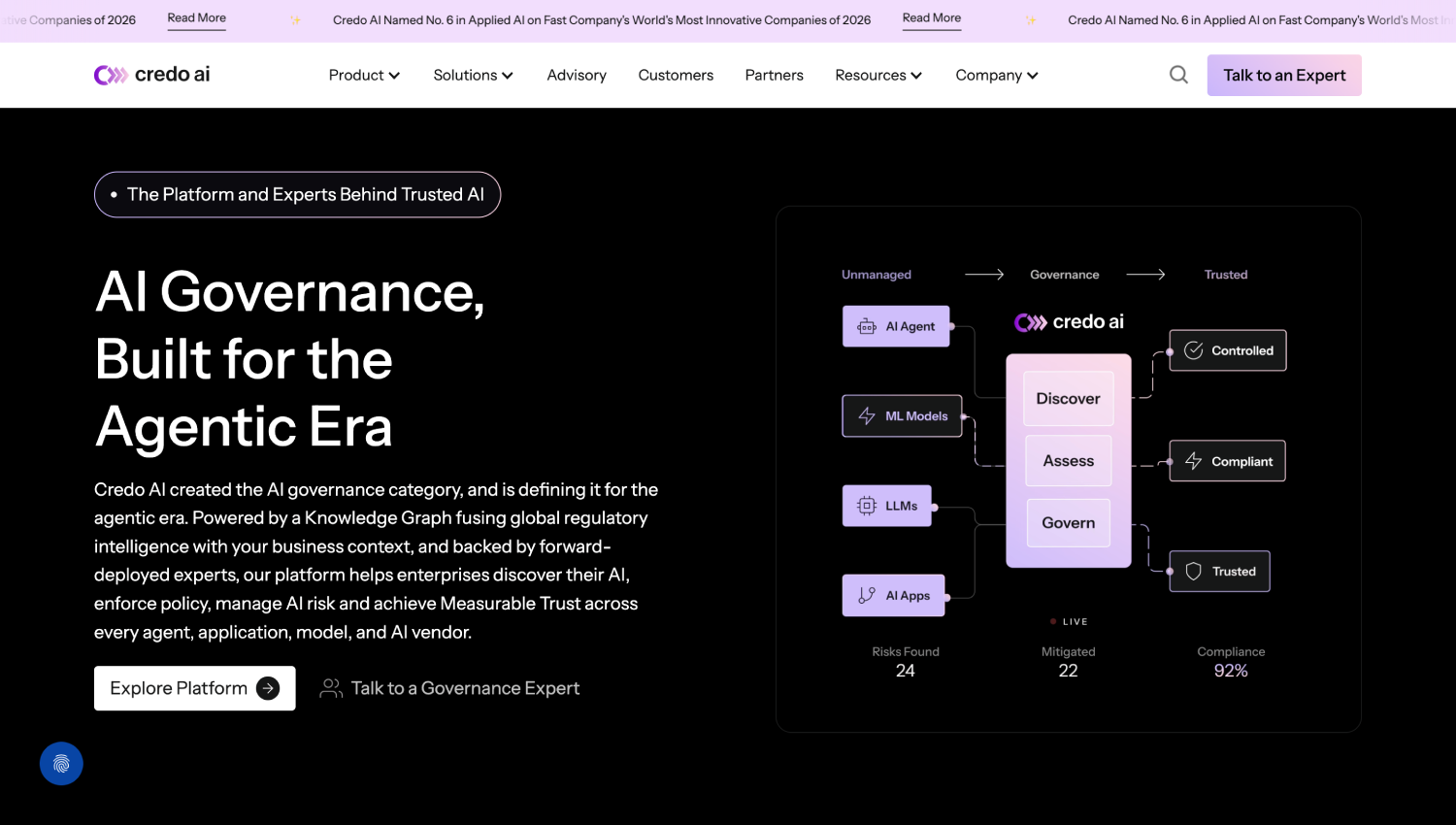
Credo AI approaches AI inventory from a governance and AI risk management direction. The platform builds an AI system registry, tracks model versions, associates governance documentation, and generates evidence for compliance with AI policies and regulations.
Credo AI is most useful as the governance layer above a technical inventory. It relies on teams to register AI systems rather than automatically discovering them from infrastructure, which means it works best when paired with a discovery-capable tool that feeds asset data into its registry. For organizations whose primary AI inventory driver is regulatory compliance and board-level reporting rather than technical security posture, Credo AI’s reporting and evidence workflows are mature. For runtime security and technical discovery, it is not a standalone answer. Pricing is not publicly disclosed.
10. Microsoft Purview

Microsoft Purview includes AI hub capabilities that discover and catalog AI applications across a Microsoft-centric environment, including Microsoft 365 Copilot deployments, Azure OpenAI Service usage, and AI interactions with data in Microsoft 365. Purview logs AI interactions and can flag when sensitive data is accessed by AI applications within its scope.
The strong case for Purview is organizations already deeply invested in the Microsoft stack. The AI inventory capabilities are tightly integrated with data classification labels, Microsoft Entra identity context, and compliance workflows. The coverage is effectively limited to the Microsoft environment, and discovery of third-party or self-hosted models outside Azure requires additional configuration or separate tooling. Microsoft does not separately price Purview’s AI hub features; they are available as part of specific Purview and Microsoft 365 licensing tiers.
Side-by-Side Coverage Comparison
| Platform | Cloud AI Services | Self-hosted / On-prem Models | AI Agents and Pipelines | Training Data Lineage | Low-code / Business User AI | Primary Architecture |
|---|---|---|---|---|---|---|
| Wiz AI-BOM | Strong | Limited | Partial | Via cloud data graph | No | Agentless cloud scan |
| Palo Alto Prisma Cloud | Strong | Limited | Partial | Via CSPM data | No | Agentless cloud scan |
| Orca Security | Strong | Limited | Partial | Via workload data | No | Agentless SideScanning |
| Cyera | Moderate | Partial | No | Strong | No | Data-centric cloud scan |
| BigID | Moderate | Moderate | No | Strong | No | Data intelligence platform |
| Securiti | Moderate | Partial | No | Strong | No | Data and privacy platform |
| Noma Security | Strong | Strong | Strong | Strong | Partial | MLOps-integrated |
| Zenity | Partial | No | Strong | No | Strong | Platform API integration |
| Credo AI | Partial (registry-based) | Partial (registry-based) | No | Moderate | No | Governance layer / GRC |
| Microsoft Purview | Strong (Microsoft) | No | Partial (Microsoft) | Moderate | Partial (Microsoft) | Microsoft ecosystem |
How Do These Tools Discover Self-hosted and Fine-tuned Models?
Self-hosted models are the hardest discovery target. A fine-tuned checkpoint sitting in a network-attached storage volume inside an on-premises Kubernetes cluster does not appear in any cloud provider API. The tools that find these assets do so through one of three mechanisms.
The first mechanism is MLOps platform integration. Noma and similar purpose-built platforms integrate directly with model tracking systems like MLflow and Weights and Biases. Every experiment tracked in those systems, including intermediate checkpoints, becomes visible in the inventory. This works well when teams actually use the tracking systems consistently, which is more common in mature ML engineering organizations than in research or prototype environments.
The second mechanism is storage crawling. Some platforms scan object storage and file systems for common model artifact formats, such as ONNX files, PyTorch checkpoint files, TensorFlow SavedModel directories, and Hugging Face model card formats. This catches artifacts that were never registered but produces a higher rate of ambiguous findings that need human review to classify.
The third mechanism is network traffic analysis. By monitoring API calls and internal network traffic for patterns consistent with model serving frameworks (Triton Inference Server, TorchServe, vLLM, and similar), some platforms can infer the existence of inference endpoints even without direct access to the underlying storage. This is the most useful technique for finding endpoints that someone actively tried to hide or simply forgot to register.
Air-gapped environments defeat all three mechanisms unless the tool can deploy a local agent with access to those environments. No platform in this review handles air-gapped environments without significant manual configuration; all require deliberate setup, and several require agent deployment that may conflict with the security requirements of the air-gapped environment itself.
Can an AI Inventory Feed Governance Evidence? What Auditors Actually Need
AI governance frameworks including the EU AI Act, NIST AI RMF, and emerging ISO 42001 require organizations to demonstrate ongoing knowledge of their AI systems, the data those systems use, and the controls governing them. A spreadsheet snapshot satisfies none of these requirements adequately because it cannot demonstrate continuity or change tracking.
A continuously updated inventory with timestamps, change history, and data lineage can feed governance workflows directly. Specifically, auditors and compliance teams need four things from an AI inventory: a record of which AI systems exist and their purpose, the data categories used to train them, the access controls governing who can query or modify them, and a log of changes over time.
Tools that reach Layer 4 of the SecurityOpsWire AI Inventory Depth Model, meaning they track ownership and change history alongside discovery, can export this evidence. Credo AI is the most explicitly governance-oriented tool in this review. Securiti and BigID have mature compliance reporting frameworks. Wiz, Noma, and Orca can contribute technical inventory data that feeds into a governance workflow, but they require integration with a GRC or governance platform to produce auditor-ready reporting.
The operational implication is that most organizations will need at minimum two components: a discovery-capable tool for technical inventory, and a governance or GRC layer for evidence management. Treating these as a single-tool problem is how security and compliance teams end up with a discovery tool that no one actually reads for governance purposes.
What Does the Inventory Miss in Air-gapped and On-premises Environments?
The honest answer is: a lot. Every cloud-native platform in this review builds its discovery mechanism on cloud provider APIs. Remove cloud connectivity and you remove the primary discovery path.
Consider the following illustrative scenario. A financial services firm runs its production LLM inference cluster in an on-premises data center with no outbound internet access. Models are fine-tuned on a private compute cluster, versioned in a local MLflow instance, and served via a private vLLM deployment behind an internal API gateway. None of this infrastructure has any cloud provider API representation. A cloud-agentless tool like Wiz or Orca discovers zero assets in this environment without explicit on-premises agent deployment and configuration.
BigID has broader on-premises connectivity through its connector architecture. Noma’s MLOps integrations can connect to a self-hosted MLflow instance if network access permits. But even these tools require deliberate configuration to reach on-premises deployments, and they cannot discover assets in truly air-gapped segments without a local collector that can operate offline and sync results when a connection window is available.
Teams with significant on-premises AI infrastructure should treat the vendor’s on-premises coverage claims with particular scrutiny during proof-of-concept testing. Ask specifically: what happens when the collector loses connectivity to the control plane? Does discovery pause, or does the collector buffer locally and sync on reconnection? The answer to that question separates operational tools from tools that require network conditions the air-gapped environment cannot provide.
Which Tool Fits Which Environment?
The right tool is determined by three variables: where your AI assets live, what your primary governance driver is, and whether you have a dedicated ML engineering team with mature MLOps tooling.
For cloud-native organizations running AI primarily on managed cloud services, Wiz or Orca provides solid inventory coverage as an extension of an existing CNAPP investment. Adding a new platform for AI inventory alone is hard to justify if a CNAPP is already deployed and already covering the cloud environment.
For organizations with a mix of cloud and self-hosted models, and a mature MLOps practice with MLflow or a similar tracker, Noma is the most complete discovery option because it reads from the source of truth that ML engineers actually use. An inventory built from MLflow is more accurate and more current than one built from scanning infrastructure artifacts.
For organizations whose primary AI inventory driver is regulatory compliance and data governance rather than security posture, BigID or Securiti provide a better foundation because their data classification and compliance reporting capabilities are more mature than what you get from security-first platforms.
For Microsoft-centric organizations where the primary AI deployment is through Microsoft 365 Copilot and Azure OpenAI, Purview plus Zenity covers the two main asset classes: managed AI services and the low-code agent workflows that employees build on top of them.
No single tool covers all asset classes across all environments. That is not a failing of any individual vendor; it reflects that AI infrastructure spans a wider range of deployment patterns than any previous technology category that security teams have had to inventory. Selecting a primary discovery tool and being explicit about its blind spots is a more defensible posture than assuming one tool has everything.
For teams assessing which agent-specific discovery capabilities matter beyond static inventory, the AI agent discovery and monitoring tools comparison covers the runtime visibility side of that question. For teams building out broader AI security controls beyond inventory, the AI agent security market map provides context on where inventory tools fit within the broader vendor categories.
Frequently Asked Questions
What is an AI model inventory and how is it different from a model catalog?
A model catalog is a curated list of approved or available models that teams can deploy, maintained by a platform or ML team as a selection resource. An AI model inventory is a security and governance record of every model actually deployed or accessible in an environment, including unapproved, shadow, or deprecated models. The catalog is a menu. The inventory is a factual accounting of what exists, regardless of whether it was supposed to be there.
What is an AI-BOM and how does it relate to a software BOM?
An AI Bill of Materials (AI-BOM) is a structured record of the components that make up an AI system: the base model or weights, fine-tuning datasets, third-party model dependencies, inference infrastructure, and associated software libraries. It extends the software bill of materials concept to cover AI-specific components that a standard SBOM would not capture, particularly training data provenance and model weight lineage. Several cloud security vendors have begun using “AI-BOM” as a product feature name for their AI asset discovery outputs.
How do AI inventory tools find shadow AI assets that were never officially registered?
The most effective techniques are storage crawling (scanning object storage and file systems for model artifact file formats), network traffic analysis (monitoring internal API calls for patterns consistent with model serving frameworks), and MLOps platform integration (reading experiment tracking systems like MLflow). No technique catches everything. Storage crawling produces false positives from archived or test artifacts. Network analysis requires sufficient visibility into internal traffic. MLOps integration only works if engineers use the tracking system consistently.
Can an AI asset inventory feed EU AI Act compliance documentation?
A continuously updated inventory with data lineage, ownership attribution, and change history can contribute to EU AI Act compliance documentation, particularly for the technical documentation requirements for high-risk AI systems. A static spreadsheet cannot. The governance-oriented platforms in this review (Credo AI, Securiti, BigID) have more mature compliance documentation and reporting than the security-first platforms, though the security platforms tend to have better technical discovery depth.
What is the biggest gap in current AI asset inventory tools?
On-premises and air-gapped environments. Nearly every platform reviewed here builds its discovery on cloud provider APIs. Self-hosted models in private data centers, air-gapped inference clusters, and on-premises MLOps environments require agent-based discovery or manual configuration that most teams have not yet built out. Organizations running significant AI infrastructure outside cloud environments should treat any cloud-native tool’s on-premises claims as requiring hands-on validation before they rely on the inventory for governance purposes.
Do AI inventory tools track AI agents separately from models?
Most tools do not. CNAPP-derived platforms (Wiz, Orca, Palo Alto) primarily discover model artifacts and endpoints. Zenity and Noma are the strongest options for agent-specific inventory, with Zenity focused on low-code agent workflows in business platforms and Noma covering developer-built agent pipelines in MLOps environments. For teams where agent inventory is a primary concern, the tool selection logic differs meaningfully from teams focused on model artifact tracking.
How often should an AI inventory be refreshed?
Continuous discovery is the baseline requirement for any inventory that will be used for governance purposes. A weekly batch scan misses models deployed and deprecated within a single sprint cycle. The platforms that integrate directly with CI/CD pipelines, model registries, and MLOps tracking systems can update inventory in near-real time as new assets are created. Platforms that rely on scheduled cloud API scans operate on polling intervals that may be configurable down to hours. Ask vendors specifically what triggers an inventory update, not just how frequently the scan runs.
The Inventory Is the Prerequisite, Not the Destination
Every security program for AI-based systems starts with knowing what AI systems exist. Without a current inventory, you cannot conduct meaningful risk assessment, apply access controls consistently, scope red team exercises accurately, or produce compliance evidence. But the inventory is infrastructure, not an outcome. A discovered list of model endpoints with no access context, no data lineage, and no ownership attribution is not materially better than a spreadsheet for the governance use cases that actually drive executive and board-level interest in AI security.
The framing that tends to produce better outcomes is treating AI inventory as a shared data source that multiple teams consume rather than a tool owned by one team. Security uses it for posture assessment and access control review. The ML platform team uses it to track deployed versions and deprecate old checkpoints. Compliance uses it as evidence for regulatory reporting. Legal uses it for AI system disclosure. When the inventory is maintained as a shared source of truth with clear ownership for each asset class, it stays current because multiple teams have reasons to keep it current. When it is owned exclusively by one team as a compliance artifact, it drifts.
The platform-level question worth asking at the start of a vendor evaluation is not “which tool discovers the most assets.” The more important question is “which tool produces an inventory that the teams who need to act on it will actually use.” Discovery coverage matters, but an inventory that sits in a dashboard no one opens during an incident has the same operational value as the spreadsheet it replaced. For teams building out the full AI security program beyond inventory, the controls covered in AI guardrail platforms for production LLMs and AI agent red teaming platforms depend directly on having an accurate inventory to scope against.