
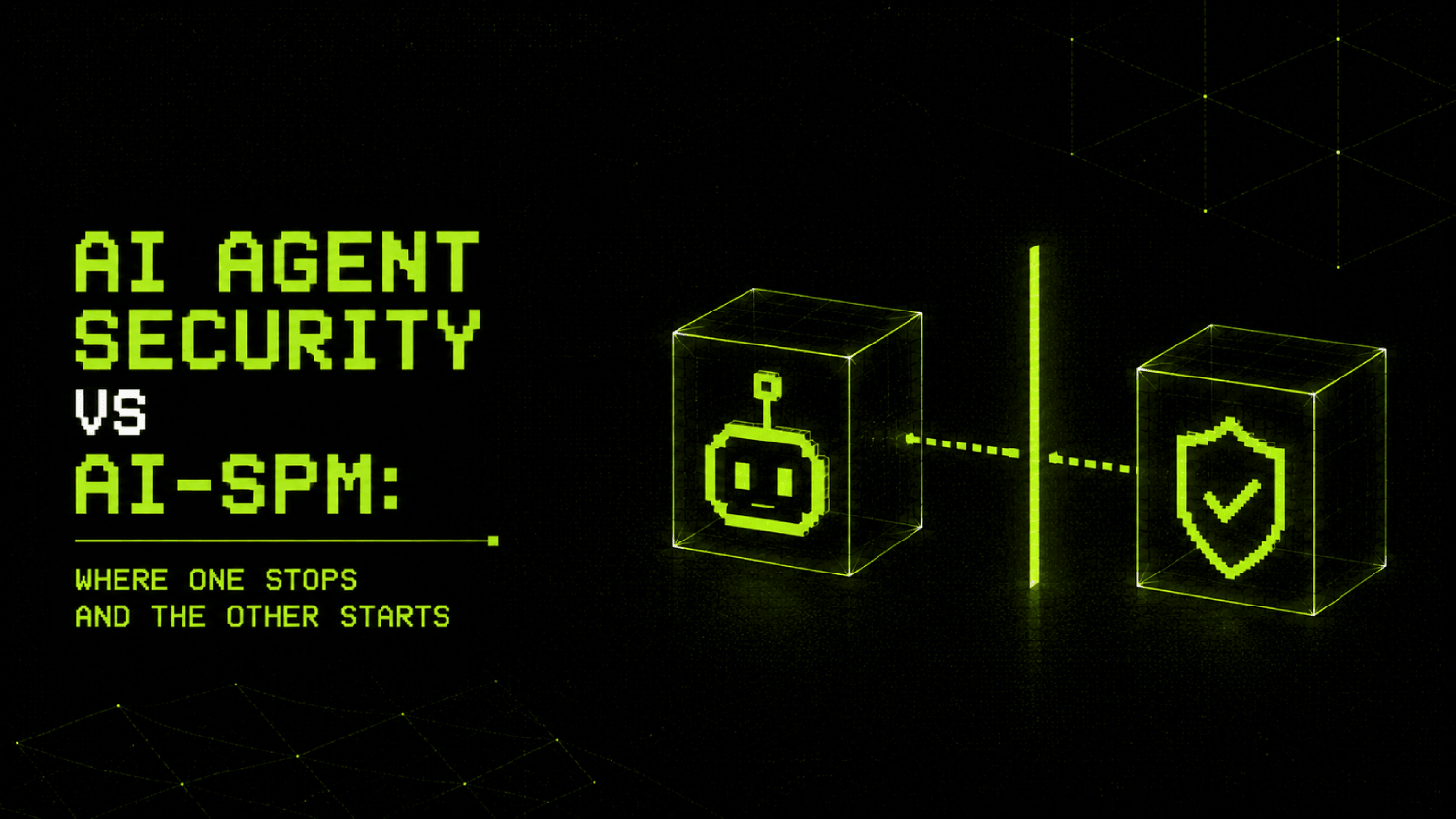
- AI-SPM and AI agent security address different points in the AI risk surface: posture management covers what you have and how it is configured, while agent security governs what an autonomous agent does while it is running.
- Buying AI-SPM and assuming runtime agent behavior is covered leaves a real gap. A misconfiguration finding does not stop an agent from exfiltrating data through a tool call it was never intended to make.
- The two categories share some inventory functions, but their control planes are fundamentally different: one is pre-execution, the other is in-line at execution time.
- Vendors including Wiz, Noma, Zenity, and Palo Alto Networks are converging on both categories, but no single product covers the full boundary today without trade-offs.
- Most teams should buy AI-SPM first, but only if they have already inventoried their AI assets. Teams deploying autonomous agents into production workflows need runtime agent security before posture work delivers meaningful risk reduction.
AI-SPM discovers, inventories, and assesses the configuration of AI assets: models, training pipelines, inference endpoints, and data stores. AI agent security enforces policy at runtime, controlling what an autonomous agent can access, call, and do during execution. The two disciplines overlap in asset discovery but diverge sharply in control mechanism. AI-SPM is a pre-execution posture discipline. Agent security is an in-line runtime control plane. Buying one does not substitute for the other.
Why Most Teams Conflate These Two Categories
The confusion is understandable. Both categories emerged in the same 18-month window, both claim to “secure AI,” and several vendors are deliberately blurring the line in their marketing to capture both budget lines. SERP results for “AI agent security vs AI-SPM” return almost exclusively vendor glossary pages that define AI-SPM and mention agents in passing, which compounds the problem for anyone doing independent research.
The deeper issue is that security teams have a familiar mental model for posture management. CSPM told them where their S3 buckets were misconfigured. They assume AI-SPM does the same job for AI infrastructure, and that covering AI infrastructure covers AI behavior. That assumption breaks the moment an agent starts making autonomous decisions.
An agent operating within a perfectly configured AI environment can still cause serious harm. It can call external APIs it was not intended to reach, chain tool invocations in ways the original developer did not anticipate, accept injected instructions from upstream content, or exfiltrate data through a legitimate MCP connection. None of those behaviors appear in a posture scan. They require runtime observation and enforcement.
What AI-SPM Actually Controls
AI Security Posture Management is a pre-execution discipline. Its job is to answer three questions before an AI workload runs: what AI assets exist in the environment, how are they configured, and what risk does that configuration introduce?
In practice, AI-SPM scanners inventory model registries, training data stores, vector databases, inference endpoints, fine-tuning pipelines, and AI service integrations such as API connections to foundation model providers. They assess those assets for misconfigurations like unauthenticated inference endpoints, overpermissioned service accounts attached to ML pipelines, training data stored in publicly accessible buckets, and models deployed without version control or lineage tracking.
Vendors such as Wiz’s AI-SPM and Orca’s AI-SPM approach this as an extension of their existing cloud posture graph. They connect AI asset inventory to cloud configuration context, which is genuinely useful: knowing that a model endpoint is public-facing and the underlying compute has a path to a sensitive data store is a meaningful finding. That is posture reasoning, and it is the right tool for it.
What AI-SPM does not touch is execution. It does not sit in the path of a live agent conversation. It does not observe tool calls, validate prompt content, or enforce what an agent is allowed to do when a user asks it something unexpected. The scan finishes, the report lands in a dashboard, and then the agent runs on its own.
What AI Agent Security Actually Controls
Agent security operates at runtime. Its control plane intercepts or monitors the execution flow of an autonomous agent: the prompts that go in, the tool calls that result, the data retrieved from memory or external sources, and the actions taken in downstream systems.
The risks agent security is designed to catch include prompt injection, where malicious content in a document or web page redirects an agent’s behavior; tool misuse, where an agent calls a permitted tool in a way that exceeds the intent of its permission; data exfiltration through legitimate channels, where an agent summarizes sensitive context into an output that leaves the system; and privilege escalation through chained tool calls, where an agent acquires access it was not directly granted by invoking a sequence of individually-permitted operations.
Platforms in this space, including Zenity and Noma, focus on instrumenting the agent’s execution layer rather than the infrastructure it runs on. Detection signals come from tool call logs, memory access patterns, output content inspection, and behavioral baselines built from normal agent operation. Enforcement happens in-line or near-real-time, not after a scheduled scan cycle.
For teams thinking about the MCP (Model Context Protocol) layer specifically, the security controls required at the agent-to-tool boundary are a good illustration of why posture scanning alone is insufficient. A well-configured MCP server with correct permissions still exposes a runtime attack surface. The controls needed to lock down agent-to-tool access via MCP operate at a different layer than anything a posture scanner touches.
The Control-Plane Diagram: Where Each Category Owns the Risk
Think of the AI risk surface in four layers, from design through execution:
| Layer | What Happens Here | Primary Control Owner | Secondary Control Owner |
|---|---|---|---|
| AI Infrastructure | Model storage, training pipelines, vector databases, inference endpoints, cloud service integrations | AI-SPM | CSPM / CNAPP |
| AI Configuration | System prompts, tool permission grants, memory scope, output filtering rules, access control on AI services | AI-SPM (partial) / Agent security (partial) | Secrets management, IAM |
| Agent Execution | Live prompt processing, tool call dispatch, memory reads and writes, multi-agent orchestration | Agent security | None today in most orgs |
| Agent Output and Action | Data sent to external systems, files written, APIs called, downstream workflows triggered | Agent security | DLP (limited coverage) |
The gap in most current deployments sits at the execution and output layers. AI-SPM ownership ends at the configuration layer, and it only partially covers configuration because dynamic configuration changes made by an orchestration framework between scan cycles are invisible to a static posture tool. Agent security owns layers three and four, and most organizations have nothing there yet.
The SecurityOpsWire Boundary Test: Four Questions That Reveal Which Gap You Actually Have
Before buying either category, a security team should answer four questions. The answers determine which gap is real and which product closes it. This is the SecurityOpsWire Boundary Test for AI security coverage.
- Can you produce an inventory of every AI model, endpoint, and training pipeline in your environment right now? If no, AI-SPM is the first purchase. You cannot govern what you cannot see.
- Do any of those AI systems operate as autonomous agents, taking actions in external systems without human approval for each action? If yes, you have a runtime risk that AI-SPM does not address.
- Do your agents have access to sensitive data, production systems, or external APIs? If yes, the blast radius of a prompt injection or tool misuse event is significant enough to justify runtime controls before posture work is complete.
- Is your agent configuration static, or does it change at runtime through orchestration frameworks, dynamic tool registration, or user-supplied context? If configuration changes at runtime, a scan-cycle posture tool will always be partially blind.
Teams that answer yes to question one only should start with AI-SPM. Teams that answer yes to questions two and three should evaluate agent security in parallel with or before posture tooling, because a runtime event does not wait for the posture program to mature. Teams that answer yes to all four are running the most complex variant of this problem and need both, with clear ownership at each layer.
Where Vendors Are Converging and What That Means for Buyers
Several vendors are building toward coverage across both layers, and the honest read is that none of them own both ends cleanly today.
Wiz extended its cloud security graph into AI asset inventory and misconfiguration detection, which is a natural adjacency from its CSPM and CNAPP roots. Its strength is connecting AI findings to cloud infrastructure context. Its coverage of runtime agent behavior is not where its graph model was designed to operate, and the product reflects that priority.
Noma describes itself as an AI security platform for LLMs, RAG pipelines, and AI agents, with a focus on discovering, governing, testing, and protecting AI systems from development through production. Its differentiation is in covering AI from development through production rather than bolting onto an existing cloud security graph. For teams evaluating purpose-built agent security platforms, a broader comparison is available in the SecurityOpsWire review of AI agent security platforms.
Zenity focuses on the agentic layer specifically, with particular emphasis on Microsoft Copilot and low-code AI agent platforms. Its control plane is closer to the runtime end of the spectrum, which makes it more relevant for organizations deploying agents through Microsoft’s platform offerings. Its posture coverage is narrower by design.
Palo Alto Networks has been building AI security capabilities into its platform. Its product page notes that Prisma AIRS AI Gateway is now generally available, part of a broader push to extend its cloud security platform into AI workload protection. As with Wiz, the starting point is the cloud security graph, with AI-specific coverage added on top; runtime agent enforcement is the layer most platform vendors are still building toward.
The practical implication for buyers: vendor convergence is real but incomplete. A platform that claims to cover both AI-SPM and agent security should be evaluated on the runtime enforcement question specifically. Ask whether the product can detect and block a prompt injection event in a live agent session, and ask what the latency impact of that enforcement is. The answers reveal which layer the product actually owns.
Can One Platform Do Both Well Right Now?
Not yet, with one important caveat. For organizations running agents exclusively through a specific orchestration platform or SaaS environment, a purpose-built vendor for that environment may cover both layers adequately. Zenity’s coverage of Microsoft Copilot agents is the clearest example: posture and runtime in one place, for one platform.
For organizations running multi-framework agentic workloads across cloud infrastructure, the answer is no. The posture scanning of infrastructure and the runtime enforcement of agent behavior require different instrumentation, different detection logic, and different response capabilities. Treating them as one purchasing decision means accepting that one of the two will be underserved.
Teams evaluating the broader agent security market should look at how different platforms approach the execution layer specifically. A detailed comparison of AI agent security platforms and how they actually control autonomous agents is a useful parallel read for that evaluation.
Do Overlapping Tools Double the Ingest and Tuning Cost?
This is where buyers often get surprised. If both an AI-SPM tool and an agent security platform instrument the same AI environment, there is real overlap in asset discovery data, and potentially in log ingestion if both ship findings to a SIEM.
The tuning cost question is different for each category. AI-SPM tools generate misconfiguration findings similar to CSPM findings: relatively low false-positive rates for clear violations like unauthenticated endpoints, higher noise for contextual findings like “this model has access to sensitive data” where sensitivity classification is ambiguous. The tuning burden is manageable and front-loaded.
Agent security tools generate behavioral signals, which are noisier by nature. Baselining normal agent behavior takes time, and during that window, false-positive rates for anomalous tool call patterns can be significant. A team running an agent that legitimately calls 40 different tools in a session will need to invest in behavioral baselines before the runtime alert queue produces findings worth acting on. That tuning cost is ongoing, not front-loaded, and it is proportional to the complexity of the agent’s permitted behavior.
Say a company runs a customer support AI agent with access to a CRM, a ticketing system, and a knowledge base. The agent handles several thousand sessions daily. An AI-SPM scan takes an hour per cycle and produces a handful of posture findings per week. An agent security platform monitoring that same agent generates tool call telemetry for every session. At several thousand sessions daily, even a one-percent false-positive rate on anomaly detection produces dozens of alerts per day that require triage. The operational cost of runtime enforcement scales with agent usage volume in a way that posture scanning does not. That is worth building into the budget conversation before signing.
Which Should a Team Buy First?
The answer depends on where in the AI adoption curve the organization sits, and it is not the same answer for every team.
| Organization Profile | First Purchase | Reasoning |
|---|---|---|
| Using AI-powered SaaS tools, no custom agents in production | AI-SPM | Shadow AI discovery and misconfiguration of AI service integrations are the primary risk surface. No runtime agent behavior to govern yet. |
| Building custom agents, not yet in production | AI-SPM first, agent security before go-live | Posture work during development, runtime controls as a go-live requirement. Treat agent security as part of the production readiness checklist. |
| Agents already in production with access to sensitive systems | Agent security immediately | Runtime risk exists today. Posture scanning does not reduce it. Inventory the environment in parallel using the agent security platform’s discovery features if AI-SPM is not yet in place. |
| Enterprise with multiple agent frameworks across cloud and SaaS | Both, with clear ownership per layer | Platform convergence is not yet mature enough to rely on a single vendor. Assign posture ownership to the cloud security platform and runtime ownership to a purpose-built agent security tool. |
Frequently Asked Questions
What is the difference between AI-SPM and AI agent security?
AI-SPM is a pre-execution posture discipline that inventories and assesses the configuration of AI assets: models, training pipelines, inference endpoints, and AI service integrations. AI agent security is a runtime discipline that monitors and enforces what an autonomous agent does during execution, including prompt handling, tool call behavior, memory access, and output content. The two categories share some asset discovery functions but operate at different points in the AI risk surface and use fundamentally different control mechanisms.
Does AI-SPM cover autonomous agent behavior at runtime?
No. AI-SPM tools scan configuration and assess posture before or between execution cycles. They do not sit in the path of a live agent session and cannot detect or block events like prompt injection, unauthorized tool calls, or data exfiltration through a legitimate MCP connection. Runtime agent behavior requires a separate control plane that operates at execution time, not on a scan schedule.
Which vendors offer both AI-SPM and agent security in a single product?
Wiz, Noma, Zenity, and Palo Alto Networks all offer capabilities spanning parts of both categories, but no single platform covers the full boundary cleanly today. Zenity’s coverage of Microsoft Copilot agents comes closest to unified posture and runtime control within a specific platform environment. For multi-framework agentic environments, most organizations need separate tooling at the posture and runtime layers, with deliberate ownership assigned at each.
What is the scope of AI-SPM?
AI-SPM scope covers the discovery and assessment of AI-specific infrastructure assets: model registries and stored models, training data stores, vector databases, inference endpoints, fine-tuning pipelines, and integrations with external AI services. It also covers the configuration of those assets, including access controls, authentication requirements, and data handling policies. AI-SPM does not govern agent behavior, prompt content, or tool call execution during live sessions.
What detection signals does agent security use that AI-SPM cannot generate?
Agent security platforms generate signals from tool call logs, prompt content inspection, memory access sequences, multi-agent communication patterns, and output content analysis. These are behavioral signals that only exist during execution. AI-SPM produces configuration findings from static or scheduled assessment of infrastructure state. A prompt injection attempt, a tool call chain that escalates privilege, or an agent summarizing sensitive data into an output are all invisible to a posture scan because they do not exist until the agent runs.
Are there cases where AI-SPM findings reduce agent security risk?
Yes, and this is where the two categories genuinely complement each other rather than substitute. An AI-SPM finding that an agent’s service account has write access to a production database is directly relevant to the blast radius of a runtime agent security event. Posture work that removes standing privilege from agent identities, tightens tool permission scope, and enforces least-privilege on AI service accounts directly reduces the damage a runtime compromise can cause. The categories do not replace each other, but posture hardening reduces the stakes of runtime failures.
How does agentic AI security differ from traditional application security?
Traditional application security assumes a relatively deterministic execution path that developers can analyze statically or test dynamically before deployment. Agentic AI systems make decisions at runtime based on context, user input, retrieved data, and tool availability. The execution path is not fully deterministic, which makes pre-deployment testing insufficient as the primary control. Runtime enforcement is required because the agent’s behavior under unexpected inputs or adversarial conditions cannot be fully predicted in advance.
Where This Leaves Security Leaders
The practical risk of conflating these two categories is not conceptual. A team that buys AI-SPM, hardens its model infrastructure, and then deploys autonomous agents into production workflows has addressed the configuration surface and left the execution surface entirely unmonitored. The agent runs with clean posture findings and unlimited runtime latitude. That is the gap this category boundary is meant to close.
The vendor convergence trend is real and worth watching. Within 18 to 24 months, the leading platforms in both categories will likely offer meaningful coverage across the posture and runtime layers. Buyers who wait for convergence to complete before purchasing anything accept real risk exposure in the interim. Buyers who purchase a converging platform today and assume the runtime layer is already production-ready should pressure-test that assumption with specific scenario-based evaluation: run a simulated prompt injection in a test environment and verify the platform catches it. The answer will reveal which layer the product actually owns.
The mental model that holds up across every deployment scenario: posture management is what you do to an AI environment before it runs. Agent security is what you enforce while it runs. Treating them as the same budget line, the same tool, or the same team’s responsibility creates a boundary dispute that attackers will resolve before the organization does.