
TLDR
- Entro Security is secrets-and-cloud-first: it maps the full lifecycle of secrets, API keys, and cloud credentials, tracing them from code repositories through CI/CD pipelines into runtime environments.
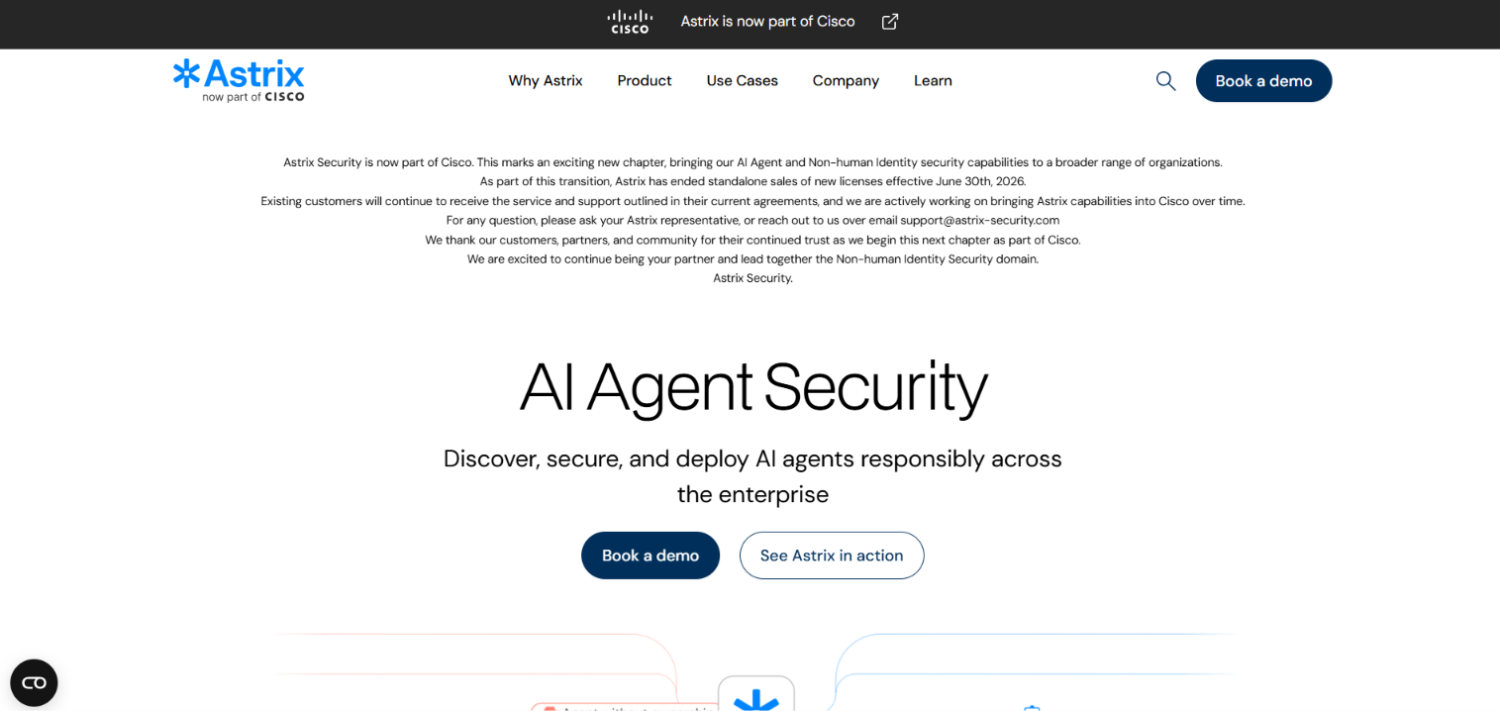
- Astrix Security is SaaS-integration-and-agent-first: it discovers OAuth grants, third-party app connections, and AI agent credentials that NHIs hold inside SaaS platforms. According to the Astrix Security website, “Astrix Security is now part of Cisco,” and standalone sales of new licenses ended June 30th, 2026.
- Neither platform is a true replacement for the other at full feature depth. The right choice follows where your unknown identities actually live, not which vendor has better slides.
- Neither Entro nor Astrix publishes list pricing. Both quote per-environment, and cost behavior at scale is a conversation, not a published rate card.
- The honest weakness for Entro is SaaS integration breadth. The honest weakness for Astrix is secrets lifecycle depth across cloud workloads.
When comparing Entro Security vs Astrix Security for non-human identity protection, the decision ultimately turns on where your unmonitored identities live. Entro Security fits organizations whose NHI risk concentrates in secrets sprawl across cloud infrastructure and developer toolchains. Astrix Security fits organizations whose NHI risk concentrates in SaaS OAuth proliferation and AI agent credentials , though buyers should note that, per the Astrix website, standalone sales of new Astrix licenses ended June 30th, 2026, following the company’s acquisition by Cisco. If your team does not yet know which problem is larger, the discovery pilot should answer that question before any contract is signed.
Why Teams Treating This as a Pricing Exercise Get It Wrong
Most teams land on this comparison after a vulnerability assessment surfaces an uncomfortable number of service accounts, API keys, or OAuth grants that nobody owns. The instinct is to treat Entro and Astrix as functionally identical tools competing on price. That framing misses the point entirely.
The two platforms emerged from different threat models. Entro Security was built around the observation that secrets sprawl across code, CI/CD, cloud providers, and secrets vaults in ways that no single vault or scanner fully captures. Astrix Security was built around the observation that SaaS platforms accumulate third-party app connections and OAuth grants at a rate that IAM teams never see, because those grants bypass traditional provisioning workflows entirely.
Those two starting points produce meaningfully different architectures, different integrations, and different discovery blind spots. The right evaluation question is not which tool costs less per identity. It is which tool finds the identities your team does not already know about.
What Does Each Platform Actually Do?
Entro Security: secrets lifecycle and NHI lineage
Entro‘s core capability is discovering and contextualizing secrets across the places they actually live: source code repositories, CI/CD pipelines, cloud provider secret stores, and infrastructure-as-code. It maps the lineage of a secret from the moment it is created through every system that holds a copy, flags rotation gaps, and identifies secrets that are active in runtime but forgotten in old repository branches.
The platform also covers cloud NHIs directly: IAM roles, service accounts, workload identities, and the permissions attached to them. Entro’s approach to risk prioritization weights by the blast radius of a given secret or identity rather than treating all credentials as equal-severity findings. A long-lived, overprivileged AWS IAM role with cross-account access scores differently than a read-only API token scoped to a single service.
Entro integrates with secrets managers including HashiCorp Vault, AWS Secrets Manager, Azure Key Vault, and GCP Secret Manager, as well as developer toolchains like GitHub, GitLab, and Jira. The agentless deployment model means onboarding does not require changes to workload configurations, which matters when the engineering team’s buy-in for security tooling is limited.
Astrix Security: SaaS graph and AI agent credentials
Astrix maps the connections between your core SaaS platforms and every third-party application that has been granted access via OAuth, API key, or service account. The discovery scope includes not just what a human user authorized, but what an AI agent, automation, or CI/CD integration authorized on behalf of that user or on behalf of a service identity.
The platform builds what it describes as an identity graph: a representation of which NHIs hold access to which SaaS resources, with what permissions, last-used timestamps, and risk signals attached. Astrix flags excessive scopes, dormant connections, connections made by identities that are no longer provisioned in the IdP, and connections from applications with no clear business owner.
According to the Astrix Security website, “Astrix Security is now part of Cisco,” constituting a public confirmation of acquisition. The site further states that “Astrix has ended standalone sales of new licenses effective June 30th, 2026” and that “Existing customers will continue to receive the service and support outlined in their current agreements.” Buyers considering Astrix should engage Cisco directly to understand current product availability and roadmap.
Astrix’s AI agent credential coverage is increasingly relevant. As organizations deploy autonomous agents that authenticate to SaaS APIs, those agents accumulate standing OAuth grants and API keys that sit outside the traditional PAM or secrets management perimeter. That gap is covered in more depth in SecurityOpsWire’s analysis of the broader non-human identity security platform market.
How Does Each Platform Approach Discovery Across a Mixed Cloud and SaaS Estate?
Discovery scope is where the architectural difference becomes operational. The table below maps each platform against the identity types most commonly found in a mixed AWS, Azure, and SaaS environment.
| Identity Type | Entro Coverage | Astrix Coverage |
|---|---|---|
| Secrets in code repositories | Strong: scans git history and open branches | Limited: not the core discovery surface |
| Secrets in CI/CD pipelines | Strong: native integrations with GitHub Actions, GitLab CI, Jenkins | Limited: indirect via OAuth grants to CI tools |
| Cloud IAM roles and service accounts | Strong: AWS, Azure, GCP with permission analysis | Moderate: covered as NHIs but less depth on permission lineage |
| Secrets vault inventory | Strong: multi-vault normalization and rotation tracking | Not a primary capability |
| SaaS OAuth grants | Moderate: covered but not the primary surface | Strong: deep OAuth graph across Salesforce, Slack, Google Workspace, Microsoft 365 |
| Third-party SaaS app connections | Limited | Strong: discovery plus risk scoring by scope and activity |
| AI agent credentials | Moderate: captures secrets agents use; less agent-specific context | Strong: dedicated agent identity graph with scope analysis |
| Kubernetes service accounts | Moderate: covered within cloud IAM scope | Limited |
The pattern holds consistently: Entro’s discovery depth runs along the code-to-cloud axis. Astrix’s discovery depth runs along the SaaS-to-agent axis. A team running three AWS accounts, a self-hosted GitLab instance, and 12 SaaS applications with active OAuth integrations has meaningful blind spots on both axes. That team needs to know which axis is currently unmonitored before picking a platform.
The SecurityOpsWire NHI Pilot Calibration: A Framework for Scoping Your Discovery Run
Before a pilot can be meaningful, the team needs to calibrate where its unknown identities are most likely to live. The SecurityOpsWire NHI Pilot Calibration is a four-question pre-pilot exercise designed to make that determination concrete before vendor demos start.
Question 1: What percentage of your secrets live outside a managed vault? Run a quick scan of your main code repositories using a free tool like TruffleHog. If the result surprises you, Entro’s discovery surface will produce the higher information gain in a pilot.
Question 2: How many distinct OAuth applications are connected to your Google Workspace or Microsoft 365 tenant? Pull the admin console report. If you do not have a current number or the number is larger than expected given your application catalog, Astrix’s discovery surface will produce the higher information gain.
Question 3: Do you have active AI agents authenticating to SaaS APIs? If yes, Astrix’s agent credential graph is the less-covered surface. This matters especially for teams deploying autonomous workflows via tools that authenticate to Salesforce, Slack, or similar platforms. SecurityOpsWire covers the broader implications of this credential gap in the context of AI agent security platforms.
Question 4: Can your current PAM or secrets management tooling tell you which secrets were created more than 90 days ago and have never been rotated? If the answer is no or takes manual effort, Entro’s rotation and lifecycle tracking will surface something your existing tools are missing.
Score two or more “yes” answers in Questions 1 and 4: pilot Entro first. Score two or more “yes” answers in Questions 2 and 3: pilot Astrix first. Score evenly across all four: pilot both simultaneously with a defined scope, measuring identities found that the team did not have in any existing CMDB, vault, or IdP record.
How Do Entro and Astrix Each Handle Secrets vs. SaaS Integrations?
The architectural split between the two platforms is sharpest here, and it has direct operational consequences for remediation workflows.
Entro’s remediation path for a discovered secret is tied to its vault integrations. When Entro finds a long-lived API key in a GitHub repository, it can trace whether that key exists in a managed vault, flag it for rotation, and in some configurations initiate the rotation workflow directly through the vault API. The remediation loop stays within the secrets management paradigm that security and platform engineering teams already operate.
Astrix’s remediation path for a discovered OAuth grant is different in kind. Revoking an OAuth connection requires action in the SaaS platform that issued the grant, not in a vault. Astrix surfaces the revocation workflow and, for supported SaaS platforms, can initiate revocation. The operational question is whether your SaaS administrators are in the loop on the remediation process, because revoking an active OAuth grant can break integrations that business units depend on. That coordination burden is real and should be factored into pilot planning.
The relationship between NHI platforms and traditional secrets management tooling is covered in more depth in SecurityOpsWire’s breakdown of NHI security versus secrets management, which is useful context before a pilot conversation with either vendor.
What Integration Effort Does Each Platform Actually Require?
Both platforms advertise agentless deployment, but the integrations each requires are different in character and carry different organizational dependencies.
Entro integration profile
Entro’s integrations are primarily read-access API connections to cloud provider IAM, secrets vaults, and code repository platforms. A single engineer with read-only IAM access to AWS, Azure, or GCP, combined with a GitHub or GitLab API token, can complete the initial connection in a few hours. The initial scan surfaces results quickly because the data is already structured in the APIs Entro queries.
The higher-effort integrations are the ones that make remediation possible: writing vault policies, configuring rotation automation, and integrating with ticketing systems for workflow. Those are not required for discovery, which means a pilot can be scoped entirely to read-only access and still produce high-value findings.
Astrix integration profile
Astrix’s integrations are primarily read-access connections to SaaS admin APIs: Google Workspace admin SDK, Microsoft 365 admin APIs, Salesforce connected apps, and similar. An administrator with org-level read access to your SaaS platforms can complete the initial connection in comparable time.
The organizational dependency that catches teams off-guard is that SaaS admin access is often held outside the security team, in IT operations or in individual business unit administrators. Getting the necessary API tokens or admin consents may require cross-functional coordination that adds calendar time to the pilot even when the technical setup is straightforward.
How Does Each Platform Price as Identity Count Grows?
Neither Entro nor Astrix publishes list pricing. Both vendors quote per-environment, and the pricing model appears to scale with identity count, connected integration count, or a combination of the two. Any figure appearing on third-party comparison sites without a linked vendor source or a dated quote should be treated as unreliable.
The pricing behavior to probe in a vendor conversation follows a predictable pattern for NHI platforms. Ask these questions before a contract discussion: Does the price scale per discovered identity or per connected integration? Is there a difference in price between monitored identities and remediated identities? What happens to contract cost when a discovery run finds 40 percent more identities than the initial estimate? That last question matters because NHI discovery at organizations with legacy SaaS estates routinely surfaces more identities than expected, and a per-identity pricing model that seemed reasonable at scoping can shift significantly at first scan.
For teams evaluating broader identity security spending alongside NHI tooling, the relationship between NHI platforms and PAM is worth understanding before budget conversations. SecurityOpsWire’s comparison of NHI security versus PAM covers where the two categories overlap and where they do not.
Honest Weaknesses: What Each Platform Gets Wrong
Where Entro falls short
Entro’s SaaS OAuth coverage is not its primary surface, and organizations with complex SaaS estates will find gaps that Astrix covers more thoroughly. A company running 80 SaaS applications with active API integrations between them will not get full visibility from Entro alone. Entro’s strength is the code-to-cloud axis; anything primarily living in SaaS-to-SaaS integration graphs is underserved.
Entro also requires a meaningful number of vault integrations to deliver its full lifecycle tracking value. An organization that has not yet consolidated secrets into managed vaults will get discovery value but limited lifecycle management value. The platform is most powerful when there is already some secrets management discipline to build on.
Where Astrix falls short
Astrix’s depth on secrets lifecycle management across cloud workloads is thinner than Entro’s. An organization with a large Kubernetes footprint and dozens of workload identities spread across namespaces will find Astrix’s cloud IAM coverage less complete than its SaaS coverage. The platform was not designed to replace a dedicated secrets management workflow.
Astrix’s remediation workflows also carry more coordination overhead than Entro’s, because SaaS administrators outside the security team are typically in the loop on any revocation action. That is not a product failure; it reflects the reality of SaaS access governance. But teams with limited cross-functional security influence should plan for that friction. Buyers should also factor in that, per the Astrix website, standalone new license sales ended June 30th, 2026 , any Astrix procurement now routes through Cisco.
Which Environment Fits Each Platform?
| Environment Characteristic | Better Fit | Reason |
|---|---|---|
| Heavy AWS/Azure/GCP footprint, moderate SaaS | Entro | Cloud IAM and secrets lifecycle depth |
| SaaS-first org, light cloud IaaS | Astrix | OAuth graph and SaaS integration discovery |
| Active AI agent deployments authenticating to SaaS | Astrix | Agent credential graph is a primary capability |
| Secrets sprawl in code repos and CI/CD pipelines | Entro | Git history scanning and pipeline secret discovery |
| Multi-vault environment needing rotation governance | Entro | Cross-vault normalization and rotation workflow |
| Large SaaS estate with unknown third-party app connections | Astrix | Third-party app connection discovery is the core product |
| Kubernetes-heavy workload identity management | Entro | Broader cloud workload identity coverage |
| Security team with limited SaaS admin access | Entro | Integration dependencies are within security team’s control |
Frequently Asked Questions
Who acquired Astrix Security?
According to the Astrix Security website, “Astrix Security is now part of Cisco.” The site further states that standalone sales of new Astrix licenses ended June 30th, 2026, and that existing customers will continue to receive service and support under their current agreements. Buyers interested in Astrix capabilities should engage Cisco directly for current product availability and roadmap details.
What does Astrix Security do?
Astrix Security discovers and monitors non-human identities, with primary focus on OAuth grants, API keys, and service account connections between SaaS platforms and third-party applications. It builds an identity graph showing which NHIs hold access to which SaaS resources, with what permissions and risk signals. A growing capability is discovery and monitoring of AI agent credentials that authenticate to SaaS APIs. Astrix does not publish list pricing and quotes per environment. As noted above, the product is now part of Cisco following acquisition, and new standalone license sales ended June 30th, 2026.
What is the core difference between Entro and Astrix in an NHI platform comparison?
Entro Security prioritizes secrets lifecycle management across code repositories, CI/CD pipelines, cloud vaults, and cloud IAM. Astrix Security prioritizes SaaS OAuth graph discovery and AI agent credential monitoring. The two platforms have meaningful coverage overlap in cloud IAM and API key discovery, but each has a distinct primary surface. Choosing between them should follow where your organization’s unmonitored identities most likely live, not vendor preference or price alone.
Is either platform a replacement for a dedicated secrets manager like HashiCorp Vault?
Neither platform replaces a secrets manager. Entro integrates with secrets managers to provide lifecycle visibility and rotation governance across multiple vaults, but it does not store or serve secrets. Astrix does not position itself as a secrets management platform at all. Both are discovery and risk management layers that operate above existing vault infrastructure, not substitutes for it. Teams without a managed vault should address that gap separately.
How does each platform handle service account discovery across Active Directory or Entra ID?
Both platforms cover service accounts in cloud identity providers as part of their NHI discovery. Entro’s coverage extends to cloud IAM service accounts with permission analysis. Astrix’s coverage includes service accounts that hold active SaaS connections. Neither platform is purpose-built for on-premises Active Directory service account management at the depth of a dedicated PAM or service account governance tool. For that gap, a dedicated service account management platform should be evaluated separately.
Can either platform discover NHIs associated with AI agents?
Astrix has dedicated AI agent credential discovery as a named capability, mapping the OAuth grants and API keys that autonomous agents hold in SaaS platforms. Entro captures secrets that agents use within cloud infrastructure and CI/CD pipelines, but its framing is less agent-specific. For teams running agentic AI workflows at scale, Astrix’s agent identity graph covers a surface that Entro does not prioritize. The broader challenge of AI agent discovery and monitoring involves additional tooling beyond either NHI platform.
What should a pilot measure to make a meaningful comparison between Entro and Astrix?
The most defensible pilot metric is identities found that the team did not have in any existing CMDB, vault, or IdP record. Count them by type: secrets in code, cloud IAM entities, SaaS OAuth grants, and third-party app connections. A platform that finds 200 previously unknown identities in your primary risk surface is more valuable than one that finds 400 identities you already knew about. Define the baseline before the pilot starts, not after.
Conclusion
The teams that get the most value from an NHI platform pilot are the ones that resist the instinct to let the vendor define the scope. Entro and Astrix will each find something real in any sufficiently complex environment. The question is whether what each finds is new information that changes your risk posture, or a recount of identities you already manage. Defining that boundary before procurement conversations start is the work that separates a useful pilot from a vendor-driven evaluation theater.
Both platforms are credible tools for distinct problems. Entro is the better starting point if your engineering org has accumulated years of secrets across repositories, pipelines, and cloud providers without a systematic rotation or lifecycle program. Astrix is the better starting point if your SaaS estate has grown faster than your IAM team’s visibility into what is connected to it, particularly if autonomous agents are authenticating to those SaaS APIs , though any Astrix procurement now routes through Cisco following the acquisition confirmed on the Astrix website. Running the four-question NHI Pilot Calibration before scheduling demos will make that call concrete rather than intuitive.
For organizations whose unknown identities span both surfaces, the honest answer is that neither platform fully covers the other’s primary terrain. Buying both is a real option for mature security programs with the budget and operational capacity to run them. But for most mid-market teams, the right first move is a time-boxed, well-scoped discovery pilot measured on net-new identity findings, with the platform selection following the data rather than preceding it.