
- AI security investigation platforms automate the mechanical work of evidence gathering: querying EDR telemetry, identity logs, and cloud activity in parallel, then assembling a timeline a human analyst would otherwise spend hours building manually.
- The auditable evidence trail is the most underrated evaluation criterion. If a platform cannot show exactly which queries it ran, which data sources it queried, and what it concluded from each, the output is not defensible in a post-incident review.
- Cross-source querying has a hidden cost most vendors do not surface: SIEM egress fees, third-party API call volume, and data retention tier conflicts that can spike per-investigation costs in production environments.
- The judgment that stays human is scoping and containment. Evidence gathering across EDR, identity, and cloud logs is correlation work that follows deterministic logic. A machine executing that logic is faster and more consistent than a tired analyst at hour six of an investigation.
- Not every platform on this list qualifies as a true investigation platform. Several are triage tools with investigation-adjacent features. The distinction matters for procurement.
AI security investigation platforms automate cross-source evidence gathering after an alert clears triage. They query EDR, identity, network, and cloud telemetry in parallel, correlate findings into a structured timeline, and surface a defensible evidence package. The best ones do this with a full audit log of every query and every inference, making post-incident review and regulatory response tractable. The weakest ones produce narrative summaries with no traceable sourcing, which are useful for writing ticket comments but not for reconstructing an intrusion.
What Is an AI Security Investigation Platform, and How Is It Different From a SIEM or SOAR?
A SIEM stores and queries log data. A SOAR executes predefined playbooks against alerts. An AI security investigation platform sits after triage and before containment: it takes a confirmed or suspected incident and autonomously gathers the evidence needed to understand what happened, how far it spread, and what needs to be contained.
The category is genuinely new, and vendors have not converged on a name. You will see it called agentic investigation, automated incident investigation, AI-assisted investigation, and security investigation automation, depending on who is talking. The architectural requirement that separates this category from both SIEM and SOAR is cross-source correlation without a human writing queries. The platform must be able to decide which sources to query, pull the relevant records, and reason about the relationships between them.
A SOAR can do this if someone has already written the playbook. An AI investigation platform is supposed to do it with no predefined playbook, because most real incidents do not fit the playbook the team wrote six months ago.
What Does an Auditable Evidence Trail Actually Require?
This is the central question for any post-incident review, compliance audit, or legal hold. An auditable evidence trail in an investigation platform means four things: a log of every query the system executed, the data source each query targeted, the records returned, and the inference or conclusion drawn from those records. Without all four, the platform has produced a narrative, not a reconstruction.
Teams that have been through a regulatory examination or litigation hold understand why this matters. An investigator who says “our AI platform determined the attacker moved laterally to the finance file server” will be asked to show the evidence. “The platform summarized it” is not an answer. The underlying query results, timestamped and source-attributed, are the evidence.
When evaluating any platform on this list, run a closed test on a known historical incident and ask two questions. First, can you trace every conclusion in the investigation report back to a specific log entry from a specific source? Second, is that trace exportable in a format your legal or compliance team can actually use? If a vendor cannot answer yes to both, rank them lower regardless of how their interface looks.
The SecurityOpsWire Evidence Chain Test , a SecurityOpsWire evaluation construct, not an industry-standard framework , formalizes this into four checks: (1) Query Log completeness, meaning every query the platform ran is visible to the analyst; (2) Source Attribution, meaning each finding names the data source and record that produced it; (3) Inference Transparency, meaning reasoning steps between evidence and conclusion are visible, not just the conclusion; and (4) Export Fidelity, meaning the full chain exports to a format usable outside the platform. Run all four on any platform before you sign a contract.
What Does Cross-Source Querying Actually Cost in SIEM Egress and API Fees?
Most vendors describe cross-source correlation as a feature. Few describe what it costs to run in production. The cost structure has three components that compound in large environments.
First, SIEM egress. Platforms that query your existing SIEM for historical logs will either use an API or a direct connector. Some SIEMs charge for API calls or data export above a volume threshold. If your investigation platform is triggering hundreds of historical queries per incident, and you have ten incidents per week, the API call volume adds up quickly. Splunk, for example, has historically charged for compute used by search workloads. Microsoft Sentinel charges for data ingestion and, depending on your commitment tier, for queries against certain data tiers. Ask your SIEM vendor explicitly whether your AI investigation platform’s query pattern will trigger additional charges.
Second, data retention tier conflicts. Most SIEMs offer hot, warm, and cold storage tiers at different price points. An AI investigation platform that needs thirty days of process execution logs to reconstruct lateral movement may hit a retention boundary if your SOC has priced its retention aggressively. The investigation platform’s query will either fail silently, return incomplete results, or trigger a data rehydration charge depending on your SIEM’s behavior.
Third, third-party API call volume. Platforms that enrich investigation findings by querying threat intelligence sources, identity providers, or cloud management APIs are making API calls on every investigation. Investigate the rate limits and per-call costs for every enrichment source the platform touches. Some enrichment integrations are included in the platform license. Others are pass-through costs that land on your budget without an obvious line item.
Say a mid-market company runs a 500-seat environment with Sentinel as its SIEM, Okta for identity, CrowdStrike Falcon as its EDR, and AWS as its primary cloud. An AI investigation platform investigating a single credential abuse incident might run twelve to thirty Sentinel queries for authentication and process logs, five to ten Okta API calls for session history and device trust, eight to fifteen CrowdStrike queries for endpoint telemetry, and four to eight AWS CloudTrail lookups. Sentinel’s Basic Logs tier, for example, applies a per-query charge on top of ingestion costs rather than covering queries within the ingestion fee , a distinction Microsoft’s Basic Logs documentation describes explicitly. Multiply that by investigation volume and enrichment sources and the underlying data costs become material well before the platform license does. No vendor publishes this math. You have to model it yourself against your actual environment.
10 Best AI Security Investigation Platforms
1. Dropzone AI
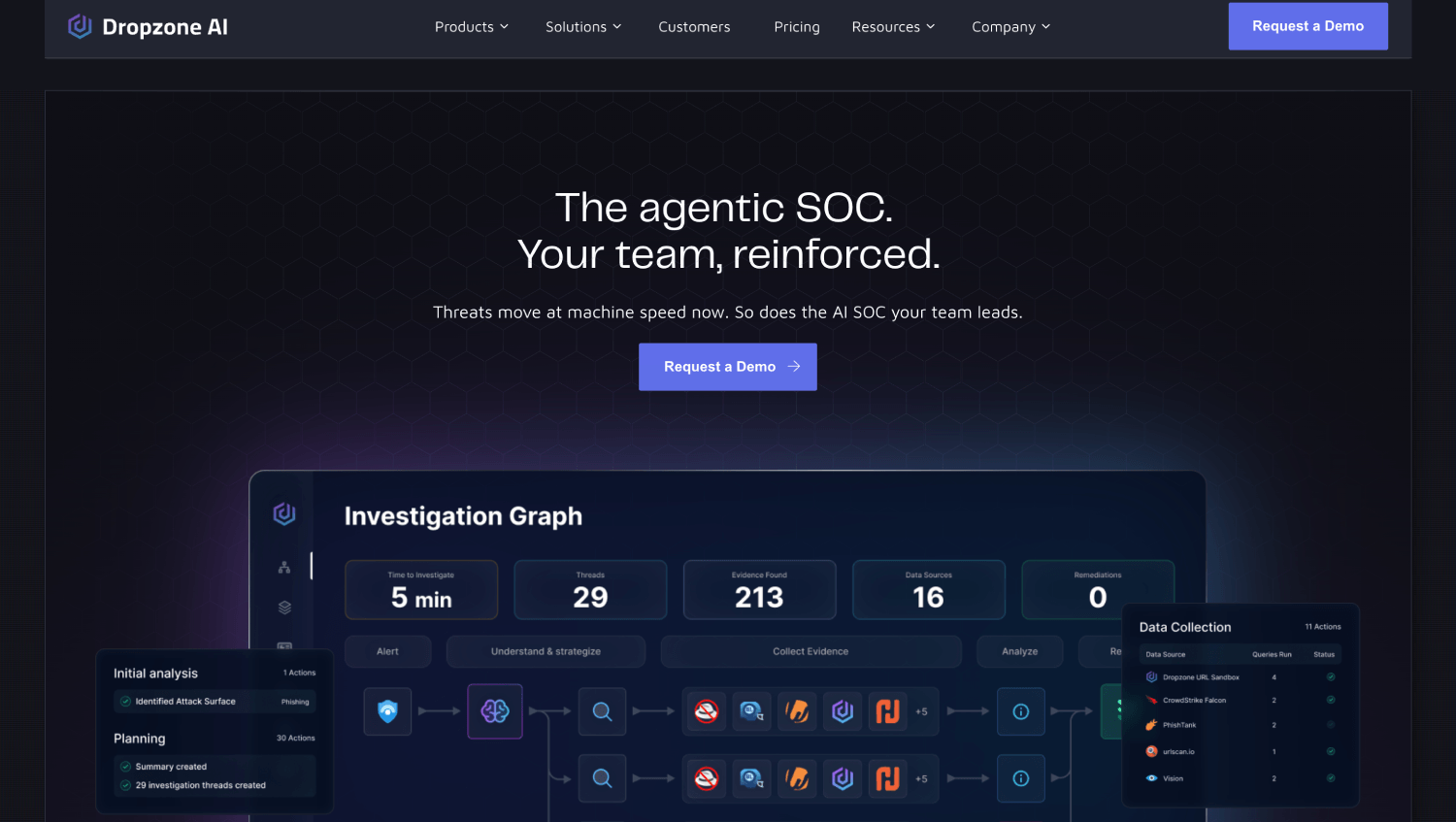
Dropzone AI is purpose-built for post-triage investigation. The platform deploys as an autonomous SOC analyst that takes a triaged alert and runs a full investigation without analyst prompting: querying EDR, SIEM, identity, and cloud sources, then producing a structured investigation report with evidence citations. The architecture is explicitly agentic, meaning the platform decides which queries to run based on what each prior query returns.
The evidence trail is Dropzone’s clearest differentiator against other tools in this list. Each investigation report includes a sourced finding section that ties every conclusion to the specific data source and record that produced it. This satisfies the Source Attribution and Inference Transparency checks in the Evidence Chain Test above. Export is available in formats that work for post-incident review, though teams should confirm export fidelity for their specific regulatory requirements.
Dropzone does not publicly disclose pricing. Quotes are per environment and depend on alert volume and integration count. The egress cost question is real here: because Dropzone queries your existing data sources rather than ingesting everything into its own data plane, the query volume it generates against your SIEM and EDR is your responsibility to model. Ask during the sales process for a query volume estimate against your projected alert load.
Best fit: teams that have triage handled and need the investigation layer automated. Not the right choice if your triage process is still noisy, because the platform will investigate false positives at the same depth as real incidents.
2. Google Security Operations
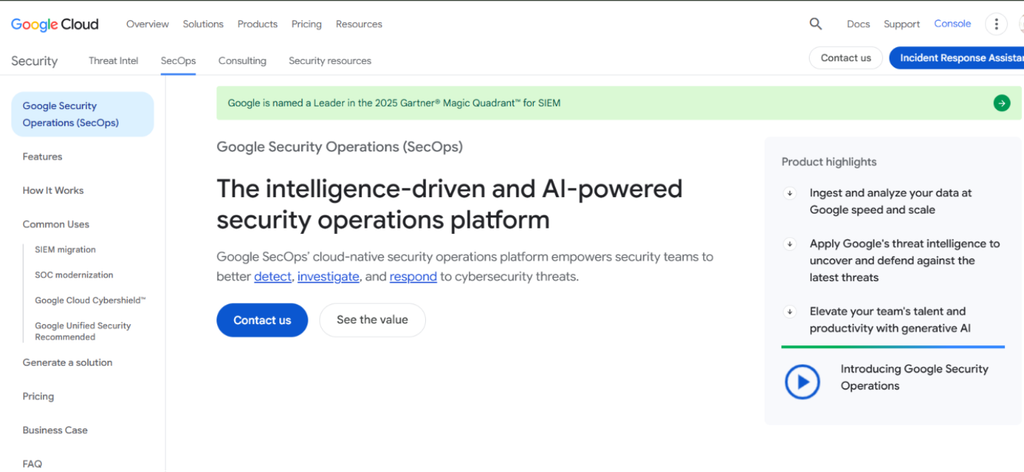
Google Security Operations integrates SIEM, SOAR, and AI-assisted investigation into a single surface. The investigation capability comes from Gemini integration, which allows analysts to query the data store in natural language and receive structured results. The platform’s data model is designed to hold years of telemetry at a flat per-seat or capacity price, which changes the egress cost conversation: if your data is already in Google Security Operations, querying it for investigation does not generate a separate egress charge.
The investigation workflow in Google Security Operations is more analyst-assisted than autonomous. The AI surfaces relevant entities, timelines, and related alerts, but a human analyst drives the investigation rather than the platform running it end-to-end. For teams that want to keep humans in the loop at the investigation step, this is a feature. For teams trying to reduce MTTR by removing human bottlenecks from evidence gathering, it is a limitation.
Google Security Operations does not publish per-unit pricing. Google positions it on a capacity and commitment model. Egress costs within the platform are lower than a federated query architecture because data is consolidated. The tradeoff is the commitment required to achieve that consolidation.
Best fit: organizations already on Google Cloud with a preference for a single vendor data plane and analysts who want to augment rather than eliminate their investigation involvement.
3. Microsoft Sentinel with Copilot for Security
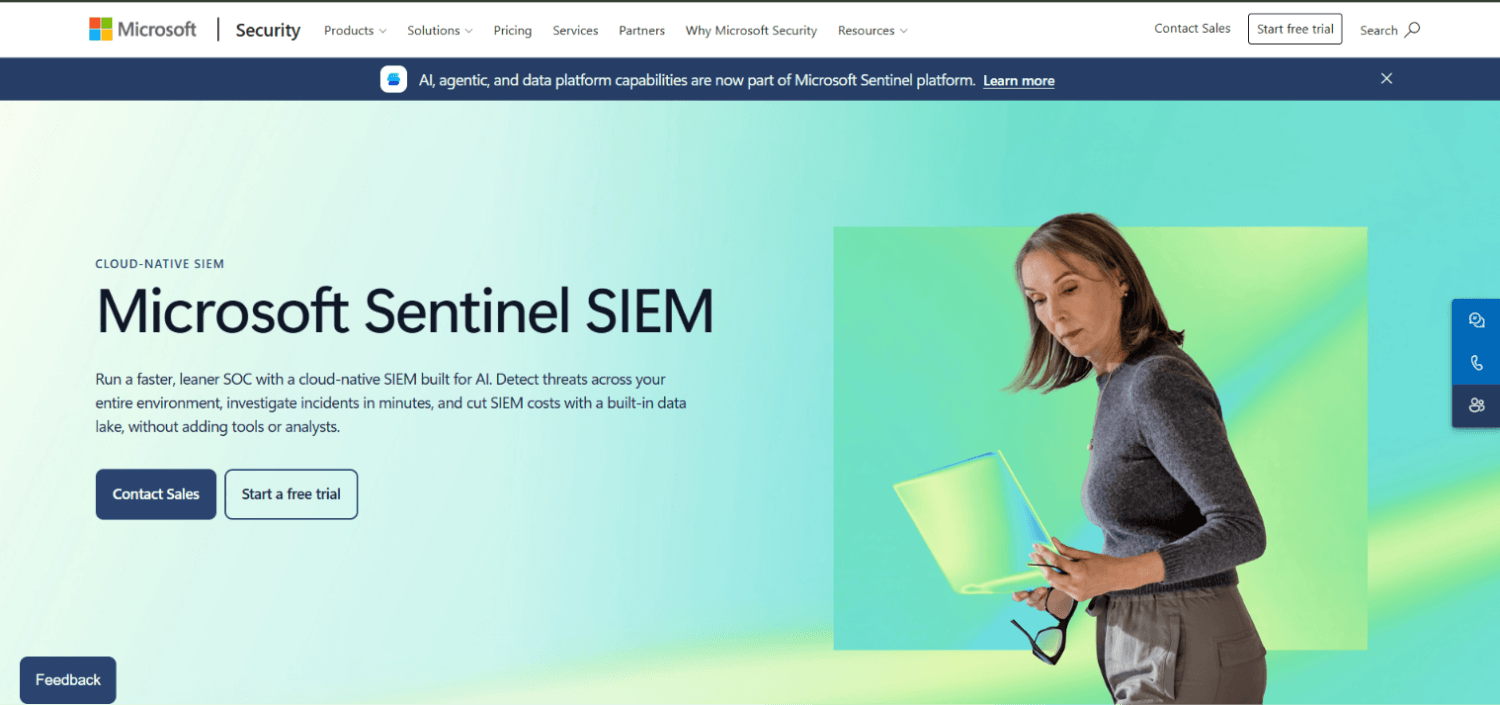
Microsoft Sentinel combined with Copilot for Security gives Sentinel customers an AI investigation layer on top of an existing SIEM investment. Copilot for Security can query Sentinel, Defender XDR, Entra ID, and Intune data, and it can produce investigation summaries, script analyses, and indicator pivots across those sources.
The pricing model here requires attention. Copilot for Security is billed separately from Sentinel, on a Security Compute Unit model. As of mid-2025, Microsoft introduced a pay-as-you-go option alongside provisioned SCU pricing. Sentinel itself charges for data ingestion, and different data tiers carry different per-GB costs. An investigation that pulls from the Basic Logs tier in Sentinel triggers a per-query charge rather than being covered by ingestion costs , meaning high investigation volumes against Basic Logs data will accumulate query charges separately from your ingestion bill. Microsoft’s documentation on Basic Logs querying describes this pricing behavior explicitly. Teams running heavy investigation workloads against Basic Logs data should model this per-query cost against their anticipated investigation volume before committing to the Sentinel + Copilot combination.
According to Microsoft’s Sentinel product page, Copilot for Security used within Sentinel reduces mean time to respond by approximately 30% , a figure specific to the Sentinel and Copilot for Security combination, not a general claim about either product in isolation.
The evidence trail in Copilot for Security is partial. The platform shows what it queried and summarizes results, but the underlying query logs are in Sentinel’s audit trail, not in the Copilot investigation report itself. Teams that need a self-contained exportable evidence package will need to build that from multiple sources.
Best fit: organizations already deeply invested in the Microsoft security stack where investigation happens primarily across Microsoft data sources. Cross-vendor investigation (querying non-Microsoft EDR or non-Azure cloud logs) requires additional connector work.
4. CrowdStrike Charlotte AI (within Falcon)
CrowdStrike Charlotte AI is the investigation and query interface embedded in the Falcon platform. It allows analysts to query Falcon’s threat graph in natural language and produces investigation summaries from endpoint telemetry. Because Falcon’s data plane is CrowdStrike’s own, the egress cost structure is contained: queries against Falcon data do not generate external SIEM egress charges.
The limitation is coverage. Charlotte AI’s investigation capability is strongest within the Falcon platform. Cross-source investigation that requires identity logs from a non-CrowdStrike identity provider, or cloud audit logs from a CSPM that is not Falcon Cloud Security, requires either connector work or accepting that the investigation is partial. CrowdStrike’s Falcon for IT and its third-party integrations extend coverage, but the depth of investigation across non-Falcon sources is narrower than the depth within Falcon data.
CrowdStrike does not publish per-seat pricing for Charlotte AI capabilities. Falcon platform pricing varies by module and commitment. Charlotte AI is included in certain Falcon bundles rather than priced separately, but confirmation of which bundles and at what tier requires a sales conversation.
Best fit: organizations where CrowdStrike Falcon is the primary detection and response platform and endpoint investigation represents the majority of post-triage work. Less suited for teams where cloud or identity investigation volume exceeds endpoint investigation volume.
5. Palo Alto Networks Cortex XSIAM
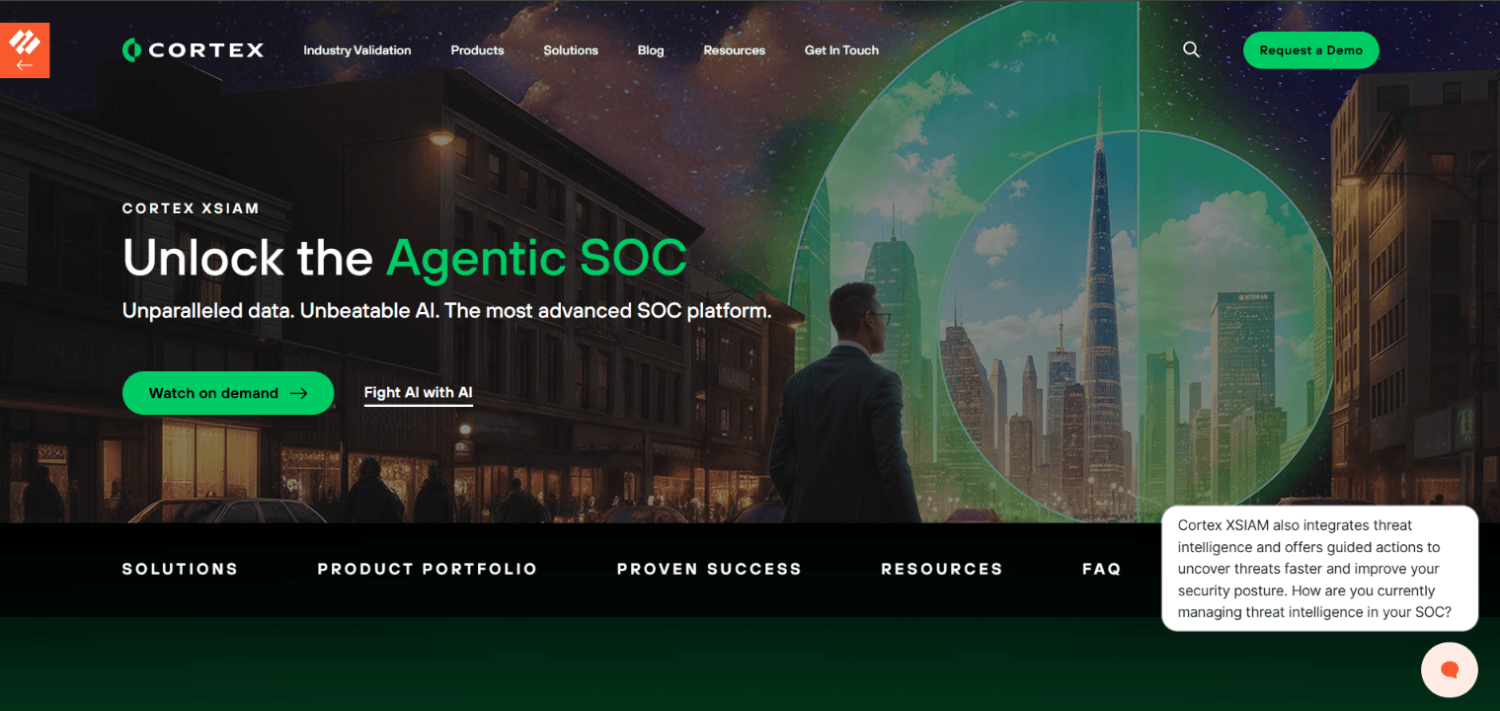
Palo Alto Networks Cortex XSIAM combines SIEM, XDR, SOAR, and AI-assisted investigation into a platform designed to consolidate the SOC toolchain. The investigation capability includes AI-driven alert correlation, automated root cause analysis, and an analyst co-pilot for query assistance. XSIAM ingests telemetry across endpoint, network, identity, and cloud sources into a unified data lake, which means cross-source investigation queries against data within the XSIAM data plane do not generate external egress charges.
The evidence trail in XSIAM is structured around its incident model: alerts are automatically correlated into incidents, and the investigation timeline is built on top of that incident object. Each incident carries the contributing alerts, associated assets, and AI-generated analysis. The depth of the audit trail for the AI reasoning steps is an area to validate in a proof of concept, particularly for regulatory environments that require documented inference chains.
Cortex XSIAM pricing is not publicly disclosed. The platform is positioned as a consolidation play, and Palo Alto quotes based on environment size, ingestion volume, and the modules required. Total cost of ownership calculations should account for the displacement of existing tools, not just the XSIAM license. Palo Alto’s sales team will model this displacement value, but teams should build an independent model as well.
Best fit: large enterprise environments with a genuine consolidation objective and existing Palo Alto footprint. The consolidation thesis only holds if the team is willing to displace incumbent tools, which carries migration cost and operational risk during transition.
6. Elastic Security with AI Assistant
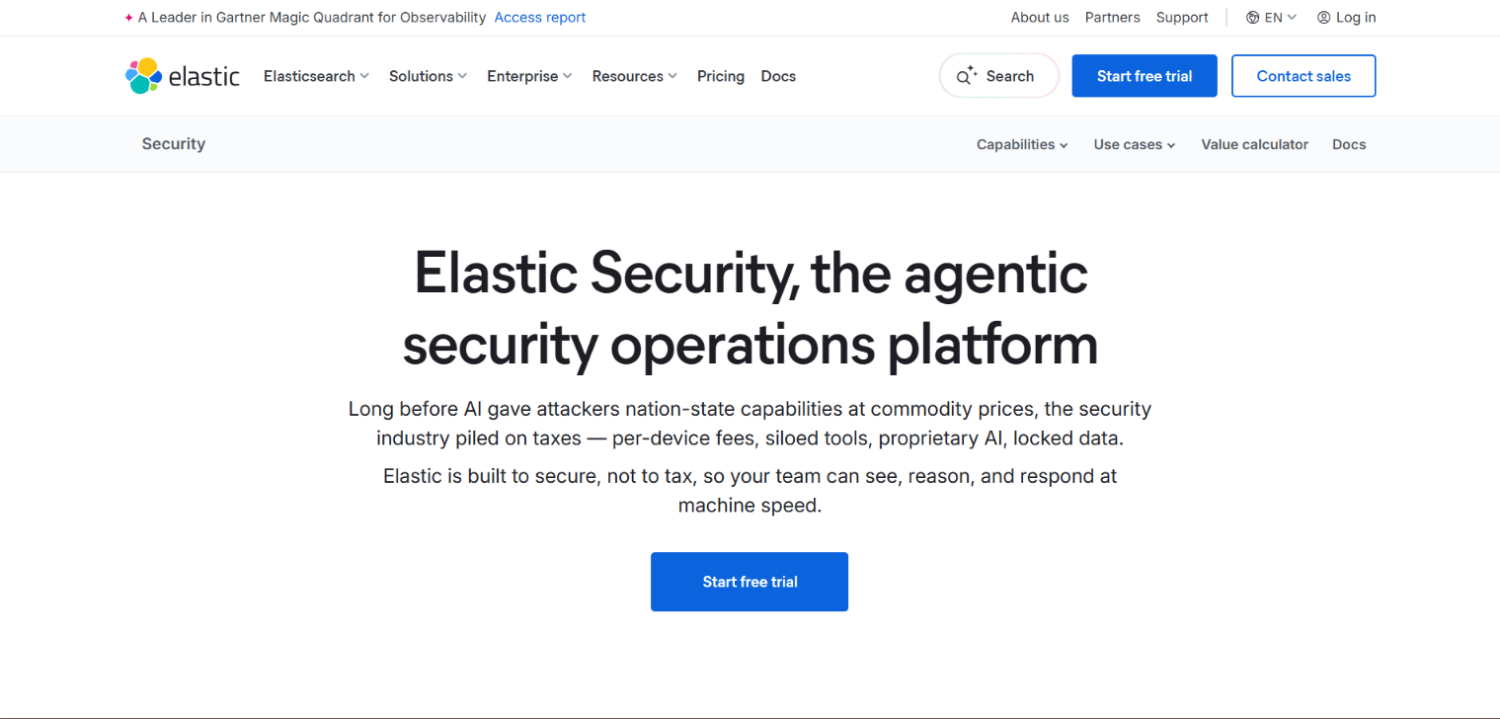
Elastic Security with its AI Assistant provides investigation capabilities built on the Elasticsearch data platform. Because Elastic is a data platform first, it handles cross-source investigation by ingesting telemetry from diverse sources into Elasticsearch indices and then querying across them. The AI Assistant can help analysts construct queries, interpret results, and correlate findings across data sources.
Elastic’s open model has a pricing implication worth understanding. Self-managed Elastic deployments give teams full control over data retention and query costs because there is no per-query charge from a cloud vendor. Elastic Cloud deployments on managed tiers follow a consumption model based on data ingest and compute. Teams managing investigation query volume in Elastic Cloud should monitor compute consumption during heavy investigation workloads.
The investigation workflow is more analyst-driven than autonomous. The AI Assistant accelerates query construction and interpretation but does not run end-to-end investigations autonomously. For teams with strong detection engineering capability who want AI to augment their analysts rather than replace investigation steps, Elastic fits well. The evidence trail is as complete as the underlying data because Elastic’s data model is transparent and queryable.
Best fit: organizations with strong internal Elastic expertise, a preference for open-source foundations, and analysts who want AI-assisted rather than AI-autonomous investigation.
7. Anomali ThreatStream and Copilot
Anomali positions its platform around threat intelligence-led investigation. The Anomali Copilot capability allows analysts to query the Anomali data store, correlate indicators across intelligence sources, and generate investigation narratives. The platform’s strength is the intelligence context it brings to investigation: when a host or IP appears in an investigation, Anomali’s intelligence layer can contextualize it against historical threat data. Specific capability details and current product positioning should be confirmed against Anomali’s current product pages, as the platform’s feature set evolves.
Anomali’s investigation capability is intelligence-forward rather than telemetry-forward. This means it is stronger in scenarios where indicator correlation matters and weaker in scenarios where raw endpoint or identity telemetry correlation is the primary investigation need. Teams doing threat hunting against intelligence-driven hypotheses will find Anomali’s architecture well matched. Teams doing alert-driven investigation of credential abuse or lateral movement within their own environment will find the platform less suited to that workflow.
Anomali does not publish pricing publicly. The evidence trail includes indicator provenance and intelligence source attribution, which is strong for intelligence-led use cases and less comprehensive for pure endpoint or identity investigation.
Best fit: teams where threat intelligence correlation is the primary investigation driver, or where investigations frequently require intelligence context to determine whether an indicator is genuine or benign.
8. SentinelOne Purple AI
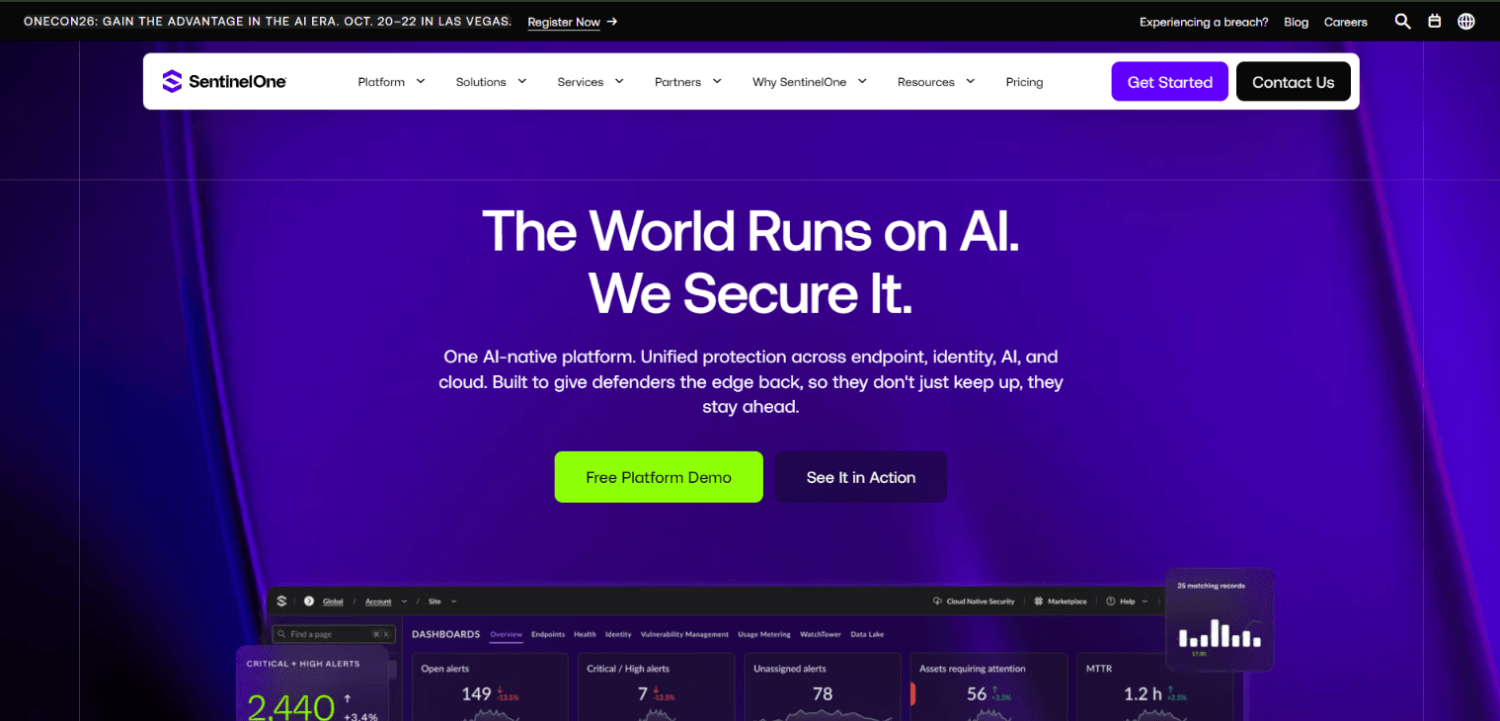
SentinelOne Purple AI is the AI investigation layer within the Singularity platform. According to SentinelOne’s product documentation, it allows analysts to query Singularity’s data store in natural language, generate hunting queries, and produce investigation timelines from endpoint and cloud telemetry. The platform can run autonomous investigations on certain alert types, producing a structured report with findings and recommended response actions. Teams should verify current capability scope directly with SentinelOne, as feature availability varies by Singularity tier.
SentinelOne’s data model is relevant to the egress cost question. Singularity Data Lake ingests endpoint, cloud, identity, and third-party log data. Investigation queries against data in Singularity Data Lake do not generate external SIEM egress charges. The question for teams with existing SIEM investments is whether to consolidate into Singularity Data Lake or maintain dual data stores. Maintaining dual stores means some investigation queries will cross platform boundaries, reintroducing the egress cost problem.
Purple AI includes an explanation layer that shows the queries it ran and the results it used to produce findings. This satisfies Query Log completeness and Source Attribution in the Evidence Chain Test. Inference Transparency is partial: the platform explains what it found but the reasoning chain between finding and recommendation is summarized rather than fully explicit. SentinelOne does not publish per-seat pricing for Purple AI. It is available on upper-tier Singularity packages.
Best fit: organizations running SentinelOne as their primary EDR who want AI investigation within the existing data plane. Cross-source investigation depth depends on what telemetry has been consolidated into Singularity Data Lake.
9. Vectra AI
Vectra AI focuses on network detection and identity threat detection, and its investigation capability reflects that focus. According to Vectra’s product pages, the platform’s Attack Signal Intelligence approach correlates network, identity, and cloud signals to surface attacker behavior patterns. Investigation in Vectra is built around entity-centric timelines: a compromised account or host becomes the pivot point, and Vectra assembles the associated detections, network flows, and identity events around it. Teams evaluating Vectra should confirm current capability scope and data model details directly with Vectra, as positioning in this category continues to evolve.
The investigation approach is well suited to lateral movement and identity abuse scenarios because those are the signal types Vectra’s detection models are trained against. For endpoint forensics or detailed process-level investigation, Vectra is weaker because it is not an EDR and its data model does not include process execution telemetry by default. Teams that need endpoint forensic depth will need to pair Vectra with an EDR and potentially a separate investigation workflow for those cases.
Vectra does not publish pricing. The evidence trail includes detection provenance and the signals that contributed to each detection score. For compliance-driven post-incident review, teams should evaluate whether Vectra’s exported investigation data meets their documentation requirements.
Best fit: organizations where identity and lateral movement investigation is the primary use case, particularly in hybrid environments with substantial Active Directory and Azure AD footprint.
10. Stellar Cyber Open XDR
Stellar Cyber Open XDR positions itself as an open platform that ingests telemetry from existing tools rather than requiring sensor replacement. The investigation capability includes automated correlation across ingested sources and AI-generated investigation summaries. Because Stellar Cyber operates as a data aggregation layer over existing tools, it can span EDR, identity, network, and cloud telemetry without requiring the organization to replace any existing sensors.
The egress cost question applies differently here. Stellar Cyber’s model involves ingesting data into its own data platform. The cost is in ingest volume, not in per-query egress. Teams with high log volumes should model Stellar Cyber’s ingest pricing against their data volumes carefully before committing, as the ingest cost can scale materially in log-heavy environments. Stellar Cyber does not publish pricing publicly.
The evidence trail includes the correlated alert data and the sources that contributed to each investigation finding. The depth of the audit trail for AI reasoning steps should be validated in a proof of concept. Stellar Cyber is particularly well positioned for MSSPs and mid-market teams that want broad coverage without replacing existing tooling.
Best fit: mid-market organizations or MSSPs that have heterogeneous tool environments and want investigation coverage across all of them without a rip-and-replace. Less suited for large enterprises that have already consolidated into a single-vendor data plane.
How Do These Platforms Compare on the Evidence Chain Test?
| Platform | Query Log Completeness | Source Attribution | Inference Transparency | Export Fidelity | Autonomous Investigation | Cross-Source Coverage |
|---|---|---|---|---|---|---|
| Dropzone AI | Strong | Strong | Strong | Verify in POC | Yes (end-to-end) | Federated (your sources) |
| Google Security Operations | Moderate | Strong | Moderate | Moderate | Analyst-assisted | Strong within Google stack |
| Microsoft Sentinel + Copilot | Split across tools | Moderate | Moderate | Multi-step export | Analyst-assisted | Strong within Microsoft stack |
| CrowdStrike Charlotte AI | Moderate | Strong (Falcon data) | Moderate | Verify in POC | Partial | Deep for endpoint, limited cross-vendor |
| Palo Alto Cortex XSIAM | Moderate | Strong | Verify in POC | Verify in POC | Partial | Strong with XSIAM data plane |
| Elastic Security | Strong (transparent data) | Strong | Analyst-driven | Strong | Analyst-assisted | Strong (ingest-based) |
| Anomali | Moderate | Strong (TI sources) | Moderate | Moderate | Analyst-assisted | Intelligence-centric |
| SentinelOne Purple AI | Moderate | Strong | Partial | Verify in POC | Partial | Strong within Singularity Data Lake |
| Vectra AI | Moderate | Moderate | Moderate | Verify in POC | Partial | Strong for identity and network |
| Stellar Cyber Open XDR | Moderate | Moderate | Verify in POC | Verify in POC | Partial | Broad (heterogeneous ingest) |
“Verify in POC” means the capability is claimed but not independently confirmed here. Treat those cells as open questions for your evaluation, not as positive or negative signals.
How Do AI Investigation Platforms Integrate with Existing SOC Workflows Without Duplicating Work?
The integration question is where most deployments stumble. Teams add an AI investigation platform expecting it to slot neatly into the existing SIEM-to-ticketing workflow, and then discover that the platform wants to own the alert queue, conflict with SOAR playbooks already in production, or duplicate enrichment steps the team already runs. Avoiding this requires mapping your current investigation workflow before selecting a platform.
Map four handoff points: where alerts enter the investigation queue, where investigators access data sources, where findings are documented, and where containment actions are authorized. An AI investigation platform needs to hook into the first two handoff points cleanly. If it tries to own the third and fourth, it will conflict with your case management and incident commander processes.
Platforms like Dropzone AI are designed to operate as an autonomous investigator that returns a finding to an existing case management system, leaving documentation and containment authorization in human hands. Platforms like XSIAM and Google Security Operations are designed to consolidate the entire workflow including case management, which means adoption requires process change as well as tool change. Neither model is wrong. The mismatch between what the platform assumes and what the team actually does is where deployments fail.
For teams evaluating how autonomous SOC capabilities fit into broader detection and response programs, the autonomous SOC platform evaluation on SecurityOpsWire covers the organizational prerequisites that determine whether autonomy is an asset or a liability at a given team maturity level.
Which Investigation Platform Fits Which Team Size and Architecture?
| Scenario | Best Fit Platform(s) | Reasoning |
|---|---|---|
| Two-person security team, mixed cloud and on-prem | Dropzone AI, Stellar Cyber | Autonomous investigation reduces analyst time per incident. Stellar Cyber covers heterogeneous environments without sensor replacement. |
| Enterprise SOC, Microsoft-first stack | Sentinel + Copilot for Security | Data already in Microsoft plane, unified licensing conversation, native identity investigation via Entra ID. |
| Enterprise SOC, Google Cloud-first | Google Security Operations | Flat-rate data retention eliminates retention tier conflicts in investigation, Gemini integration native. |
| CrowdStrike-heavy endpoint environment | Charlotte AI within Falcon | Deepest endpoint forensic investigation depth where Falcon is already deployed across the fleet. |
| Consolidation-focused enterprise | Palo Alto Cortex XSIAM | Best case for XSIAM is displacement of SIEM, XDR, and SOAR simultaneously. Partial consolidation weakens the ROI case. |
| MSSP or multi-tenant environment | Stellar Cyber Open XDR | Multi-tenant architecture designed for MSSP use. Broad ingest model covers diverse customer environments. |
| Identity and lateral movement focus | Vectra AI | Detection models and investigation workflows built specifically for identity abuse and lateral movement patterns. |
| Intelligence-led investigation | Anomali | Indicator enrichment and threat intelligence correlation is the core capability, not telemetry-level forensics. |
What Does Automated Investigation Add After Triage That a SOAR Playbook Does Not?
A SOAR playbook is deterministic. It runs the steps someone defined in advance, in the order they were defined, against the data sources the author thought to include. When the incident matches the playbook scenario, SOAR automation is fast and consistent. When the incident deviates from the playbook, an analyst has to pick up from wherever the playbook ran out of coverage.
AI investigation platforms are probabilistic and adaptive. They decide which data sources to query based on what prior queries returned. A credential abuse alert that reveals lateral movement to a cloud resource triggers queries against cloud audit logs that no SOAR playbook would have included, because the playbook author was thinking about Active Directory lateral movement, not AWS role assumption. The AI investigation platform follows the evidence rather than following a script.
The gap this closes is dwell time on novel or hybrid incidents. Incidents that cross tool and telemetry boundaries, which most real intrusions do, are the ones that take analysts the longest to reconstruct. A SOAR playbook handles the known incident type at machine speed. An AI investigation platform handles the unknown incident type at something faster than purely manual speed.
Teams building out AI-assisted SOC capabilities should think about triage and investigation as separate automation layers. For a clear framing of the triage layer specifically, the AI alert triage tool comparison on SecurityOpsWire addresses the triage-side architecture decisions that set up the investigation layer to succeed.
How Should Teams Evaluate These Platforms Without Falling for the Agentic Investigation Marketing?
“Agentic” is a marketing term right now more than a technical one. Vendors apply it to anything from fully autonomous multi-step investigation to a chatbot that helps analysts write KQL queries. Before accepting an agentic claim, ask three concrete questions.
First, what decisions does the platform make autonomously? Specifically, which data sources does it choose to query, and how does it decide? If the answer is “it follows a predefined list of integrations in a fixed order,” that is a SOAR playbook with a better interface, not agentic investigation.
Second, what happens when a query returns unexpected results? A genuinely agentic platform changes its subsequent query plan based on what it finds. If the platform proceeds to the next predefined step regardless of what the previous step returned, the agentic label is aspirational.
Third, how does it handle data sources it was not explicitly configured to query? Real investigations require pivoting to data sources the analyst did not anticipate. If the platform can only query the integrations a human configured in advance and cannot discover or add new query targets mid-investigation, its autonomy is bounded in ways the vendor’s marketing will not emphasize.
For teams navigating the broader challenge of evaluating AI security tools without being captured by vendor framing, the SecurityOpsWire guide on evaluating AI agent security platforms applies the same skeptical framework to the adjacent agentic security category.
Frequently Asked Questions
What is an AI security investigation platform?
An AI security investigation platform automates post-triage evidence gathering by querying multiple data sources, including EDR, identity logs, SIEM data, and cloud audit trails, in parallel and correlating the results into a structured investigation timeline. The core function is cross-source correlation without requiring a human analyst to write each query. The platform takes a triaged alert or confirmed incident and returns an evidence-backed reconstruction of what happened and how far the activity spread.
How does automated incident investigation reduce MTTR?
Manual investigation is slow primarily because analysts query one data source at a time, wait for results, then decide what to query next. AI investigation platforms run parallel queries across sources simultaneously and chain follow-on queries automatically. The time saved is the accumulation of query-wait-decide cycles that a human analyst runs sequentially. For incidents requiring correlation across four or more data sources, the time difference between manual and automated investigation is measured in hours, not minutes.
Is the evidence trail from AI investigation platforms usable for compliance audits or legal holds?
It depends on the platform’s audit log structure. Platforms that log every query executed, the data source queried, and the records returned produce evidence trails suitable for post-incident review and regulatory documentation. Platforms that produce narrative summaries without traceable source queries are not adequate for compliance or legal purposes without supplementation from underlying tool logs. Evaluate this with the SecurityOpsWire Evidence Chain Test before relying on any platform for compliance-driven investigations.
What are the hidden costs of cross-source querying in AI investigation platforms?
Three cost categories appear consistently. First, SIEM egress or compute charges triggered when the investigation platform queries historical log data at high volume. Second, data retention tier conflicts where investigation queries need data that has aged into cold storage, triggering rehydration charges or incomplete results. Third, third-party API call volume for enrichment sources such as threat intelligence feeds, identity providers, and cloud management APIs. None of these costs appear in the investigation platform’s license fee, and few vendors surface them proactively during the sales process.
How does an AI investigation platform differ from a SOAR?
SOAR platforms execute predefined playbooks in a fixed sequence against predetermined data sources. AI investigation platforms decide which data sources to query and what to query next based on what prior queries return. The practical difference appears on incidents that deviate from known playbook scenarios: SOAR coverage ends where the playbook ends, while an AI investigation platform continues following the evidence. Most real intrusions involve some deviation from the expected pattern.
Which AI investigation platforms publish pricing?
None of the platforms on this list publish list pricing. All quote per environment based on alert volume, data source count, seat count, or some combination. This is consistent across the enterprise security market for platforms of this complexity. When evaluating total cost, model the platform license, the underlying data costs from SIEM egress and API call volume, and the operational cost of maintaining integrations separately. The platform license is often the smallest of the three in large environments.
Can these platforms investigate incidents that span endpoint, identity, and cloud sources simultaneously?
Yes, but the depth varies significantly. Platforms built on consolidated data planes, such as Google Security Operations, XSIAM, and Singularity Data Lake, achieve cross-source correlation with lower latency because all the data is in one place. Platforms that federate queries to external tools, such as Dropzone AI, achieve cross-source correlation by querying each source directly at investigation time. The federated approach preserves your existing data investments but introduces the egress cost considerations described above. The consolidated approach eliminates egress costs but requires data migration commitment.
What should a closed test on a historical incident evaluate?
Run the platform against an incident your team has already fully investigated manually. Compare four outputs: the completeness of the evidence gathered (did the platform find the same artifacts your team found?), the accuracy of the timeline reconstruction, the traceability of each conclusion to a specific source record, and the format and completeness of the exported evidence package. Time how long the platform took versus how long your team’s manual investigation took for the same incident. That comparison is more informative than any vendor benchmark.
The Judgment That Stays Human
The institutional knowledge argument against automating investigation is half right. Knowing which data sources exist, what each one contains, and how to write queries against them is institutional knowledge, and it is the kind that accumulates slowly and walks out the door when analysts leave. That part can and should be encoded into a platform.
The judgment that does not encode well is the containment decision. An AI investigation platform can tell you that a service account queried a credential store, moved laterally to a production database, and staged data in an S3 bucket. The decision about whether to isolate that account immediately, notify the business owner, or preserve the access for threat actor tracking requires understanding the business context, the legal considerations, and the operational consequences that the platform cannot weigh. That decision is where human judgment is genuinely irreplaceable, and it is also the decision that benefits from arriving at it faster.
The case for AI investigation platforms is not that they replace analysts. It is that they give analysts an evidence package in fifteen minutes instead of four hours, and that the evidence package is more complete because the platform queried sources the analyst would have gotten to eventually but not quickly. The teams that will get the most out of these platforms are the ones that already have a rigorous triage process, clear containment authorization structures, and analysts who are currently bottlenecked on evidence gathering rather than on judgment. Teams still working out their triage process should address that first. The AI SOC platform comparison on SecurityOpsWire covers the full SOC automation stack including where investigation fits relative to triage and response automation.