
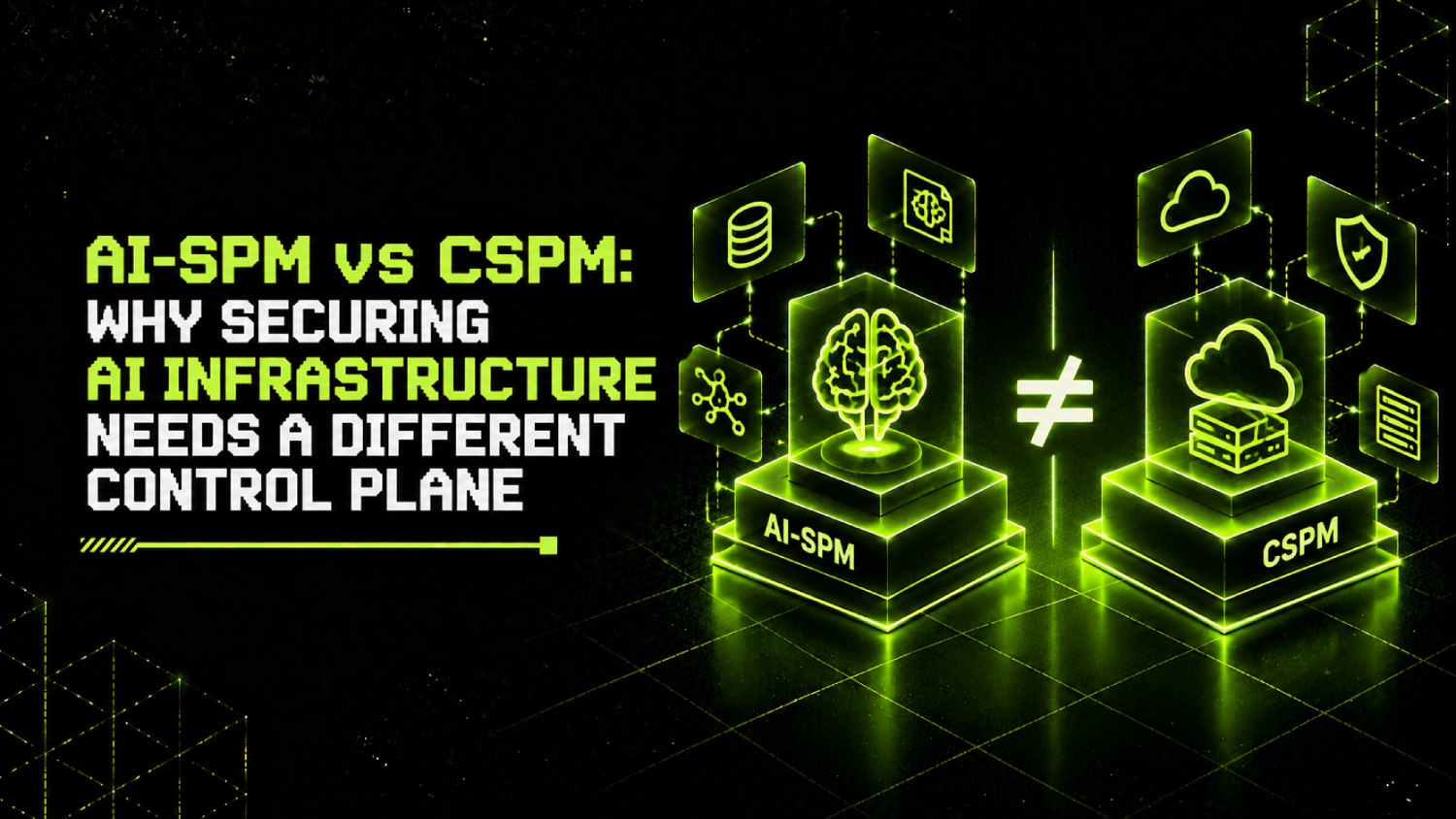
- CSPM inventories cloud resources and checks their configurations against known-good baselines. It was not built to model training pipelines, inference endpoints, or the access graph between a model and the data it reads at runtime.
- AI-SPM tracks a fundamentally different asset graph: foundation models, fine-tuned weights, vector databases, prompt templates, and the identities that call each one. That graph does not map cleanly onto the buckets, VMs, and IAM policies that CSPM was designed to reason about.
- Extending a CSPM with AI-specific rules closes some gaps, but it misses the behavioral layer: model output monitoring, prompt injection signals, and data lineage between training corpus and deployed model.
- Ownership typically splits along existing team lines, which is a practical reason to treat each as a separate control plane rather than collapsing them.
- Running both tools does not necessarily double ingest cost, because they pull from different data sources. The overlap is smaller than most procurement teams assume.
CSPM and AI-SPM solve different graph problems. CSPM models cloud infrastructure resources and their configurations. AI-SPM models the training and inference chain, including model identity, prompt flow, data lineage, and API access between components. They share some underlying cloud telemetry, but the asset types, risk signals, and remediation paths are distinct enough that extending a CSPM with policy rules cannot replicate what a dedicated AI posture tool does at the model layer.
Why Security Teams Assume CSPM Will Cover AI Workloads
The assumption is reasonable on the surface. AI workloads run on cloud infrastructure. CSPM already covers that infrastructure. An S3 bucket holding training data is still an S3 bucket. A misconfigured GPU instance in EC2 is still a misconfigured EC2 instance.
Most CSPM vendors have reinforced this belief by adding “AI security” modules to their platforms. Wiz has announced AI-SPM capabilities that surface AI-specific findings inside its existing graph, though the company does not publicly document when specific features were introduced. Microsoft Defender for Cloud includes AI workload protections that can detect overprivileged service principals accessing Azure OpenAI resources. These additions are real, and they cover real attack surface.
The deeper issue is that infrastructure misconfiguration is only one slice of the AI risk surface, and it happens to be the slice CSPM was already good at. The rest of the slice , model behavior, prompt handling, training data integrity, and inference access control , requires a different data model entirely.
What Does CSPM Actually Inventory and Check?
A CSPM connects to cloud provider APIs and pulls a snapshot of your resource configurations. It checks those configurations against a policy library derived from frameworks like the CIS Benchmarks, NIST CSF, and provider-specific best practices. Findings are typically expressed as: resource X has property Y, which violates rule Z.
The asset types CSPM reasons about are cloud-native primitives: compute instances, storage objects, managed databases, networking configurations, IAM roles and policies, container registries, and Kubernetes clusters. CSPM is very good at answering questions like “which S3 buckets are publicly accessible” or “which EC2 instances have no IMDSv2 enforcement.” It does not naturally answer “which model has access to production customer data through its RAG retrieval pipeline.”
That second question requires the tool to understand what a model is, what retrieval-augmented generation means architecturally, and how to trace a data path from a vector store through an inference endpoint to an output. CSPM has no native concept for any of those things.
What Does AI-SPM Actually Inventory and Check?
AI-SPM, as a category, is still being defined. Vendors including Wiz, Lacework, Noma Security, and Protect AI have each positioned their platforms around AI security posture, with meaningfully different scopes , visit each vendor’s site directly for current product scope, as positioning in this category shifts frequently. The core asset graph that distinguishes AI-SPM from CSPM includes:
- Foundation models and fine-tuned model versions, including third-party models accessed via API
- Model registries and artifact stores
- Training datasets, validation sets, and their lineage
- Vector databases and embedding stores
- Prompt templates and system prompts
- Inference endpoints and their callers
- AI pipelines: orchestration frameworks like LangChain or LlamaIndex, and the data flows they create
- Model access identities: service accounts, API keys, and non-human identities with permission to query a model
The risk checks AI-SPM runs against this graph are also different. Training data poisoning, prompt injection exposure, model output logging gaps, overprivileged inference identities, and shadow AI deployments are all AI-SPM findings. None of them surface naturally in a CSPM tool, even a well-tuned one, because the signals come from different sources than cloud API configurations.
The AI-SPM vs CSPM Asset Coverage Gap
The table below maps specific asset types and risk signals to each control plane. It is not exhaustive, but it shows where the structural gaps are.
| Asset or Risk Signal | CSPM Coverage | AI-SPM Coverage |
|---|---|---|
| Cloud storage buckets (configuration) | Yes, primary use case | Partial (as data store for AI assets) |
| IAM roles and policies | Yes, primary use case | Partial (model access identities only) |
| Kubernetes workload configuration | Yes | Limited |
| GPU instances and compute | Yes (config only) | Yes (training job context) |
| Foundation model inventory | No | Yes, primary use case |
| Fine-tuned model versions | No | Yes |
| Model registry access controls | Partial (if cloud-native) | Yes |
| Training dataset lineage | No | Yes |
| Vector database contents | No | Yes |
| Prompt template inventory | No | Yes |
| Inference endpoint exposure | Partial (network config) | Yes (caller identity + output) |
| Prompt injection signals | No | Yes |
| Training data poisoning indicators | No | Yes |
| Shadow AI app discovery | No | Yes |
| Third-party model API risk | No | Yes |
| Compliance drift (SOC 2 Type II, ISO 27001) | Yes (infra controls) | Emerging (AI-specific controls) |
The “partial” entries in the CSPM column deserve a note. CSPM can see that an S3 bucket holding a training dataset is publicly accessible. It cannot tell you that the bucket contains a training dataset for your customer churn model, nor can it tell you whether the dataset includes PII that should have been excluded before training. That distinction matters for regulatory exposure, and it is a good illustration of why data security posture management tools exist as a third category alongside CSPM and AI-SPM.
What Does CSPM Structurally Miss About AI Assets?
The deepest structural gap is the behavioral layer. CSPM is a configuration scanner. It checks the state of a resource at a point in time against a known-good definition. AI risk is often not a configuration problem. It is a behavioral problem.
A model that is correctly configured at the infrastructure level can still be manipulated through prompt injection. An inference endpoint with the right network policies can still return sensitive data if the system prompt was poorly scoped. A training job running in a properly locked-down VPC can still ingest poisoned data from an upstream dataset that looks clean to a storage scanner.
CSPM has no representation of “what does this model do at runtime.” It cannot model the relationship between a user query, a retrieved document, and a model output. That entire inference chain, which is where most AI-specific attacks manifest, is invisible to a CSPM.
The second gap is identity scope. CSPM tracks human and service identities as they relate to cloud resources. AI workloads introduce a new identity surface: the model itself as a calling entity, API keys embedded in inference pipelines, and non-human identities with access to multiple models and data stores simultaneously. Teams managing non-human identity security at scale are already finding that their IAM tooling cannot express these relationships without custom work.
Can a CSPM Be Extended to Cover AI Models?
Partially, and the extension is worth doing. Adding AI-specific policy rules to an existing CSPM closes the infrastructure configuration gap for AI workloads: exposed model endpoints, over-permissive service accounts with access to model registries, training storage buckets with public read access, missing logging on inference APIs. These are real risks and a CSPM with good custom policy support can catch them.
What the extension cannot do is build the AI asset graph. A CSPM extended with custom rules still has no concept of a model as a first-class entity. It cannot version-track model artifacts, cannot correlate a training dataset to the models trained on it, and cannot follow the prompt path through an orchestration layer to flag where sensitive data might leak. The graph is the product. Custom rules on top of a configuration scanner do not produce a graph.
Consider a concrete scenario. Say a security team at a mid-size financial services company has deployed a CSPM with 200 custom AI policies across three AWS accounts and an Azure tenant. They can reliably detect misconfigured SageMaker endpoints and find service accounts with overly broad Bedrock permissions. They cannot detect that a new internal LLM application connected to their customer support vector database last week, that the application uses a system prompt that has not been reviewed, or that it is accessible to employees without a data access agreement on file for that dataset. Those gaps require a tool that understands the AI asset graph, not a richer configuration policy library.
Which Teams Own Each Control Plane?
In most organizations today, CSPM is owned by the cloud security team or the security engineering team. Findings feed into a vulnerability management program, and remediation is typically routed to cloud platform engineers. The operational model is established and understood.
AI-SPM ownership is less settled. The logical candidates are the team that owns AI/ML platform security, which in many companies does not yet formally exist, the application security team that owns the pipelines feeding models, and the data security team that governs training data. In practice, findings from AI-SPM tools often fall between all three.
This is an argument for deciding ownership before you buy the tool, because a posture management tool with no clear remediation owner produces findings that age in a queue. The boundary between AI-SPM and AI agent security further complicates the ownership question for teams running autonomous agents, since agent behavior monitoring has its own operational requirements distinct from static posture checks.
The SecurityOpsWire AI Control Plane Test: Four Questions Before You Extend or Buy
The following four questions represent SecurityOpsWire’s own evaluative framework, developed to help security leaders structure the extend-vs-buy decision rather than treat it as a vendor selection exercise. They are not drawn from an external standard. Run through them before deciding whether to extend your CSPM or procure a dedicated AI-SPM tool.
- Can you enumerate your AI asset inventory today? If you cannot list your deployed models, their versions, their training data sources, and which applications call each one, a CSPM extension cannot solve that problem. You need a tool that builds the graph first.
- Is your AI risk primarily infrastructure misconfiguration, or does it include model behavior and data lineage? A team running a handful of managed AI APIs from a major cloud provider, with no internal training, may find that CSPM coverage is sufficient for their current exposure. A team running internal fine-tuning jobs against customer data almost certainly needs the deeper model-layer coverage.
- Do you have a team that will act on AI-specific findings? A tool without a remediation owner is a reporting cost, not a security control. Map findings to owners before you evaluate vendors.
- What does your AI pipeline look like in 18 months? If your engineering team is moving toward internal model training, RAG pipelines, or autonomous agents, buying a CSPM extension now and replacing it later costs more than starting with a dedicated tool. If your AI footprint is stable and cloud-provider-managed, extending the CSPM is the lower-friction path.
Does Running Both Tools Double Your Ingest Cost?
The short answer is no, and the reason is that the two tools pull from largely different data sources. CSPM ingests cloud provider API telemetry: configuration snapshots, resource metadata, and CloudTrail or equivalent audit logs. AI-SPM ingests model registry APIs, ML pipeline metadata, inference logs, and training job records. The overlap sits primarily in IAM and storage configuration, which is a relatively small slice of what either tool processes.
In practice, the additional cost of running an AI-SPM tool is driven by the pricing model of the specific vendor, not by duplicated log ingestion. Some AI-SPM vendors price by the number of AI assets inventoried, others by the number of models or inference endpoints monitored. Major vendors in this category do not publish list pricing , confirmed by checking representative vendor sites including Wiz’s contact page , so every procurement conversation starts with a custom quote based on environment size. The right cost question to ask a vendor is: does your per-unit pricing include historical model versions and inactive endpoints, or only active deployments? That distinction can move a quote significantly.
Teams already running a CSPM at enterprise scale should also ask whether the incumbent CSPM’s AI module is included in their existing license or priced as an add-on. Wiz does not publicly disclose pricing or licensing details for its AI security capabilities; the specific terms require direct engagement with the vendor. That kind of bundling, where it exists, can change the procurement math considerably if the AI-SPM requirements stay within the infrastructure configuration scope.
Extractable Answer: What Is the Difference Between CSPM and DSPM?
CSPM (cloud security posture management) checks the configuration of cloud infrastructure resources against security policies. It answers whether a resource is misconfigured. DSPM (data security posture management) identifies where sensitive data lives, classifies it, and monitors how it is accessed and shared. It answers what data you have and whether it is exposed. CSPM sees the bucket; DSPM sees what is in the bucket and whether those contents are sensitive. The two tools address different questions and use different data sources, though both can flag a publicly accessible storage resource for different underlying reasons. For a deeper comparison of data-focused tooling, the DSPM tools built specifically for AI data security are a separate evaluation category from general DSPM.
Where AI-SPM Connects to Broader AI Security Programs
AI-SPM is one layer in what is becoming a multi-tool AI security stack. Posture management tells you what AI assets exist and whether they are configured correctly. It does not test whether a model can be manipulated, and it does not block malicious inputs at runtime.
Red teaming fills the testing gap. Teams evaluating AI agent red teaming platforms use adversarial probing to surface prompt injection vulnerabilities, jailbreak exposures, and data extraction paths that static posture checks will never find. Runtime guardrails fill the blocking gap. The relationship between posture management, red teaming, and runtime controls is the same relationship that exists between CSPM, penetration testing, and WAF, but applied to the model layer.
The asset discovery question is also worth separating from posture management. Knowing that a model exists and knowing whether it is configured correctly are related but distinct problems. AI asset discovery platforms focus specifically on finding models, agents, and data flows that security teams do not know about, which is a prerequisite for any posture program.
Frequently Asked Questions
What is AI-SPM?
AI security posture management (AI-SPM) is a category of tools that inventories AI assets, including models, training datasets, inference endpoints, and orchestration pipelines, and checks them against security policies. It identifies risks like overprivileged model access, exposed inference APIs, missing output logging, and training data without proper access controls. AI-SPM builds an asset graph that covers the training and inference chain, not just the cloud infrastructure those workloads run on.
What does CSPM miss about AI workloads specifically?
CSPM misses the behavioral and model-layer surface entirely. It can detect a misconfigured storage bucket holding training data, but it cannot model the training data’s lineage, track model versions, detect prompt injection exposure, or map which applications and identities call a specific inference endpoint. CSPM also has no native concept for AI-specific asset types like vector databases, prompt templates, or fine-tuned model weights. These gaps cannot be closed with custom policy rules alone.
Can CSPM vendors extend their platforms to replace AI-SPM?
CSPM vendors can add AI-specific policy rules that close the infrastructure configuration gap for AI workloads. What they cannot replicate through policy extension is the AI asset graph itself. A CSPM with AI rules can flag a misconfigured SageMaker endpoint, but it cannot version-track models, correlate training datasets to deployed models, or follow a prompt path through an orchestration layer. Teams with more than basic managed AI API usage will find these gaps matter operationally.
Which team should own AI-SPM findings?
Ownership depends on your org structure, but the most functional pattern assigns AI-SPM findings to three owners: infrastructure findings (misconfigured endpoints, overprivileged service accounts) to the cloud security team, data lineage and training data findings to the data security or data governance team, and model behavior findings to the application security or AI platform team. Define these routes before deploying the tool. Unowned findings do not get remediated regardless of how good the detection is.
Does running CSPM and AI-SPM simultaneously significantly increase log ingest costs?
Overlap in data sources is smaller than most procurement teams expect. CSPM primarily pulls cloud configuration snapshots and audit logs. AI-SPM pulls from model registries, ML pipeline metadata, and inference logs. The IAM and storage layers overlap, but they represent a small share of what each tool processes. The cost question to focus on is how each vendor prices its AI-SPM tier and whether your CSPM vendor includes AI coverage in your existing license rather than as a separate purchase.
How does AI-SPM relate to DSPM for AI data security?
AI-SPM and DSPM overlap at the training data layer but address it from different angles. DSPM classifies sensitive data and monitors access to it, including data sitting in training datasets. AI-SPM cares about training data specifically because of its relationship to a model: whether the dataset influenced a deployed model, whether it contained data it should not have, and whether access to it was controlled appropriately through the training lifecycle. For teams with both a DSPM and AI-SPM requirement, those tools are complementary rather than redundant.
What is a good starting point for AI asset discovery before deploying AI-SPM?
A common pattern observed among security teams beginning this work: start with your cloud provider’s native AI service APIs and your internal model registry. Pull a list of every model artifact, every inference endpoint, and every service account or API key with permissions to call a model API. This manual inventory is almost always smaller than the actual AI footprint because it misses shadow AI , applications that developers spun up using external model APIs without security review. Dedicated AI agent discovery and monitoring tools address that gap before a formal AI-SPM deployment.
The Control Plane Decision in Practice
Most security teams evaluating this decision have a working CSPM. Whether to wait for the incumbent to build adequate AI coverage or procure a dedicated tool now comes down to where your AI program sits today. If your organization is actively training models on internal data, running RAG pipelines against sensitive datastores, or deploying autonomous agents, the CSPM’s AI module will not cover your actual risk surface for at least the next several product cycles. The asset graph problem is architecturally hard, and the major CSPM vendors are building toward it, not at it.
If your AI footprint is primarily third-party managed APIs (OpenAI, Anthropic, Azure OpenAI, Bedrock) without internal fine-tuning, the CSPM extension is a reasonable interim position. The exposure is real but it is mostly an infrastructure and identity access problem, which is exactly the problem CSPM was built to solve. At that scale, deploying a dedicated AI-SPM tool before your internal AI program matures may produce more findings than your team can act on.
CSPM and AI-SPM are not competing tools any more than SIEM and EDR are competing tools. They see different telemetry and produce different findings. The consolidation pressure that drove CNAPP was about reducing agent sprawl on hosts and normalizing cloud findings into one graph. AI-SPM represents a new graph, covering a new asset class, and the organizational question is whether your AI program is mature enough that the graph is worth building and maintaining. For teams scaling into internal model development, the answer is almost certainly yes, and waiting for the CSPM vendor’s roadmap is a coverage gap they will own when something goes wrong.