
- Traditional DSPM classifies data at rest in object stores and databases. AI pipelines create new derivative artifacts , embeddings, vector indexes, cached retrieval context, fine-tuning datasets , that most existing DSPM licences never inspect, regardless of what the vendor’s marketing says.
- Microsoft Purview DSPM for AI covers Microsoft Copilot and a defined set of Copilot connectors well. It does not govern third-party RAG pipelines, custom vector databases, or non-Microsoft fine-tuning workflows.
- Vector store classification is the coverage gap that virtually no incumbent DSPM vendor has closed. If your RAG pipeline writes to Pinecone, Weaviate, or a self-hosted Chroma instance, you should verify coverage directly rather than assume it.
- The SecurityOpsWire AI Data Flow Audit (defined below) is a practical pre-purchase test: map each AI data flow, then confirm which tool sees it. Gaps in the map are gaps in your coverage, not features to be added later.
- For teams running both a legacy DSPM licence and a new AI stack, the operational question is not which tool is theoretically best , it is which tool actually classifies the artifact types your AI pipeline produces today.
The best DSPM tools for AI data security are Cyera, BigID, Securiti, Sentra, and Microsoft Purview DSPM for AI, depending on your AI pipeline architecture. Purview is the strongest choice for Microsoft 365 and Copilot-centric environments. Cyera, BigID, and Securiti offer broader coverage across cloud-native AI data stores. Protecto and Cyberhaven are purpose-built for specific AI data flow scenarios , PII in model pipelines and endpoint data exfiltration to AI services, respectively. No single tool currently covers every AI data flow from training through retrieval through prompt without gaps.
Why Your Existing DSPM Licence Probably Does Not Cover Your AI Stack
Most DSPM platforms were designed around a specific mental model: sensitive data lives in S3 buckets, SQL databases, and file shares. Classify it, find overexposed copies, alert on drift. That model held reasonably well for five years.
AI pipelines break the model in three specific ways. First, embedding generation creates a mathematically derived representation of your source text. The source file may be classified; the embedding file almost certainly is not, because your DSPM scanner never saw it as a separate artifact. Second, vector indexes aggregate embeddings across documents , so a single index may contain derived representations of thousands of classified documents, but the index itself carries no label. Third, RAG pipelines introduce a runtime retrieval step that pulls sensitive chunks into a prompt at query time, a flow that happens in memory and leaves no persistent artifact for a scanner to find.
Fine-tuning datasets compound the problem. Teams often export a subset of production data, clean it manually, and hand it to a model training job. That export is a new data copy, created outside the normal data lifecycle, often in a personal cloud storage bucket or a third-party training platform. Whether your DSPM platform sees that copy depends entirely on whether it has a connector for wherever the export landed.
The practical test is simple: pull your AI pipeline diagram and trace each data flow. For each artifact type , raw training export, tokenized dataset, embedding file, vector index, prompt cache, model output log , ask your DSPM vendor which connector classifies it. If the answer is “the same connector that covers your S3 buckets,” confirm that the connector actually ingests and classifies that specific file format at that specific storage path.
The SecurityOpsWire AI Data Flow Audit: A Framework for Testing Coverage Before You Buy
Before evaluating any tool on this list, map your own AI data flows against four stages. This audit framework is designed to surface coverage gaps that vendor demos rarely show, because vendors demo the flows their tools handle well.
Stage 1 , Training data origin: Where does training or fine-tuning data come from, and where does the exported dataset land? Common failure points are SFTP exports and third-party annotation platforms that no DSPM connector covers.
Stage 2 , Embedding generation: What model generates embeddings, where does the embedding job run, and where does the output write to? A job running in a Jupyter notebook on a cloud VM that writes to a mounted NFS share is invisible to most scanners.
Stage 3 , Vector store population: Which vector database receives the embeddings, and is the vector store in-scope for any classification connector? Managed services like Pinecone and Weaviate Cloud are outside the network perimeter where most DSPM agents operate.
Stage 4 , Retrieval and prompt assembly: At query time, which documents are retrieved, how are they assembled into a prompt, and where does that assembled context persist? Prompt caching in Redis or in a model provider’s context window is rarely classified by any tool in this list.
Run each candidate tool against your Stage 1 through Stage 4 map before signing. Any vendor who cannot tell you which connector handles each stage at each storage endpoint is telling you something important.
If you are working through the broader question of how AI-SPM tooling overlaps with DSPM for AI pipelines, the AI-SPM versus AI agent security comparison on SecurityOpsWire explains where posture management ends and runtime agent controls begin.
How Do These 10 Tools Actually Govern AI Data Flows?
The tools below are grouped loosely by their primary architectural approach: platform-native (Purview), cloud-native DSPM extended to AI (Cyera, Sentra, BigID, Securiti, Varonis), endpoint and network DLP extended to AI (Cyberhaven, Zscaler, Netskope), and purpose-built AI data pipeline tools (Protecto). Coverage claims below reflect publicly documented capabilities. Where a vendor does not document a specific capability on its product pages, that gap is noted.
| Tool | Training Data | Embedding / Vector Store | RAG Retrieval | Prompt / Output | Best Fit |
|---|---|---|---|---|---|
| Microsoft Purview DSPM for AI | Microsoft 365 sources only | Not documented | Copilot connectors only | Copilot interactions | Microsoft-centric orgs |
| Cyera | Cloud storage, databases | Partial (managed stores) | Not documented | Not documented | Cloud-heavy enterprise |
| BigID | Broad connector coverage | Limited | Not documented | Not documented | Compliance-driven programs |
| Securiti | Multi-cloud, on-prem | AI Data Firewall feature | Partial | Partial (prompt governance) | Regulated industry AI use |
| Sentra | Cloud-native stores | Not documented | Not documented | Not documented | Cloud data sprawl |
| Cyberhaven | Endpoint egress only | Not applicable | Not applicable | Prompt input (browser) | Employee AI tool usage |
| Varonis | Files, email, SharePoint | Not documented | Not documented | Not documented | Microsoft-heavy file stores |
| Zscaler | Not applicable | Not applicable | Not applicable | Inline proxy (prompt/response) | SASE-deployed orgs |
| Netskope | Not applicable | Not applicable | Not applicable | Inline CASB (prompt/response) | SASE-deployed orgs |
| Protecto | API-connected pipelines | Limited | Partial | PII masking in outputs | AI/ML teams, developers |
Microsoft Purview DSPM for AI
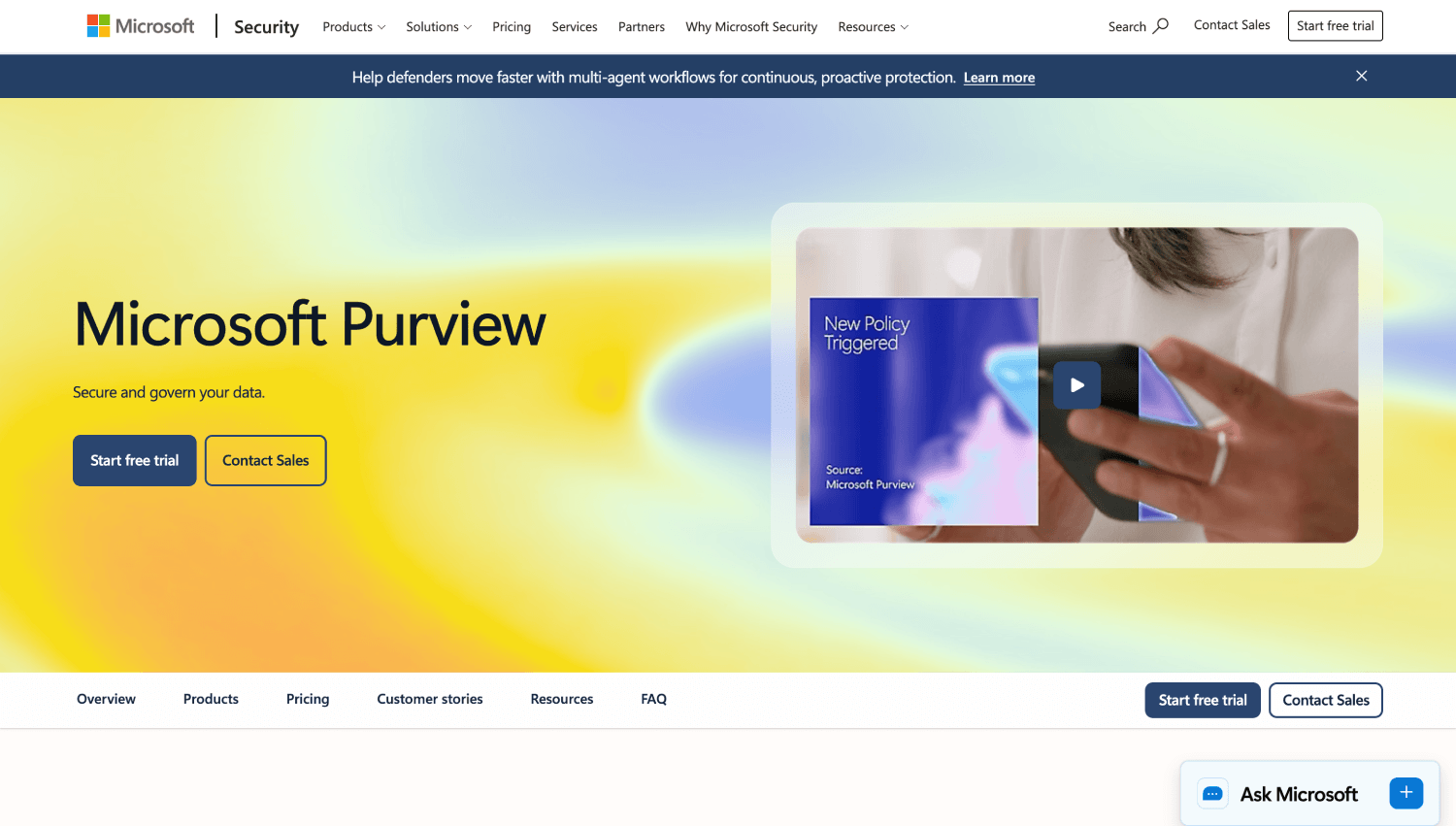
Microsoft Purview DSPM for AI is the most visible tool in this category by search volume, and also the most narrowly scoped. It provides a centralized dashboard for monitoring data interactions with Microsoft Copilot for Microsoft 365 and a defined set of Copilot connectors. It surfaces sensitivity labels from files that Copilot accesses, flags overshared SharePoint content, and reports on prompts that reference classified documents.
What it does not do: it does not govern third-party LLM usage, custom RAG pipelines, or any vector database outside the Microsoft connector space. If your AI team runs a LangChain application backed by Pinecone, Purview DSPM for AI sees none of that data flow. The tool is powerful inside the Microsoft perimeter and nearly invisible outside it.
Pricing is not separately listed from the Microsoft Purview suite. According to Microsoft’s documentation for DSPM for AI, the feature uses existing controls from Microsoft Purview information protection. Microsoft does not publish standalone pricing for this component; which specific Microsoft 365 licensing tiers include DSPM for AI features should be confirmed directly with Microsoft or through the Microsoft 365 licensing documentation, as tier eligibility is not fully specified in the available product documentation.
Cyera
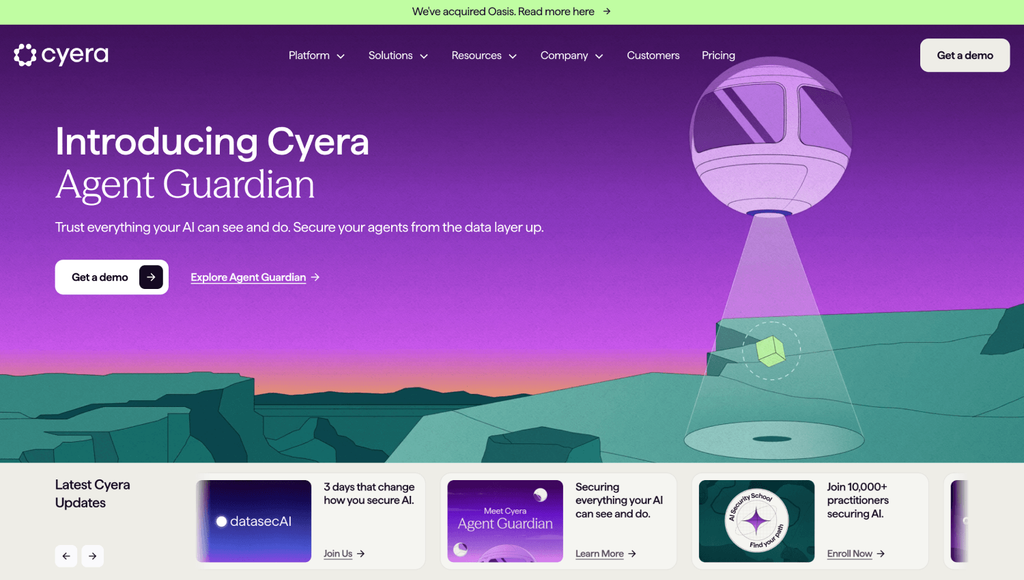
Cyera approaches AI data security as an extension of its cloud DSPM foundation. The platform discovers and classifies data across AWS, Azure, GCP, and a range of SaaS applications. Its AI-related positioning centers on identifying training data, detecting when sensitive data lands in AI-accessible storage, and flagging misconfigured permissions on data stores that AI models query.
Cyera’s documentation references AI data discovery but does not describe a specific vector store connector or a mechanism for classifying embedding artifacts. Teams running managed vector databases should verify connector coverage directly before assuming it. Cyera’s website includes a pricing section, though specific figures are not displayed publicly; pricing is quoted per environment through direct engagement with the sales team.
BigID
BigID has the broadest connector library of any tool in this list, covering hundreds of structured and unstructured data sources. Its AI data security positioning includes a dedicated AI security module that maps sensitive data to AI model usage and generates an AI data inventory. BigID’s strength is compliance-driven programs where the priority is knowing what sensitive data exists across the entire estate and proving it to auditors.
Its weakness relative to newer tools is depth of vector store support. BigID’s classification engine is document-oriented. Applying it to embedding vectors or native vector database formats requires custom configuration that its documentation does not fully describe. BigID does not publish list pricing.
Securiti
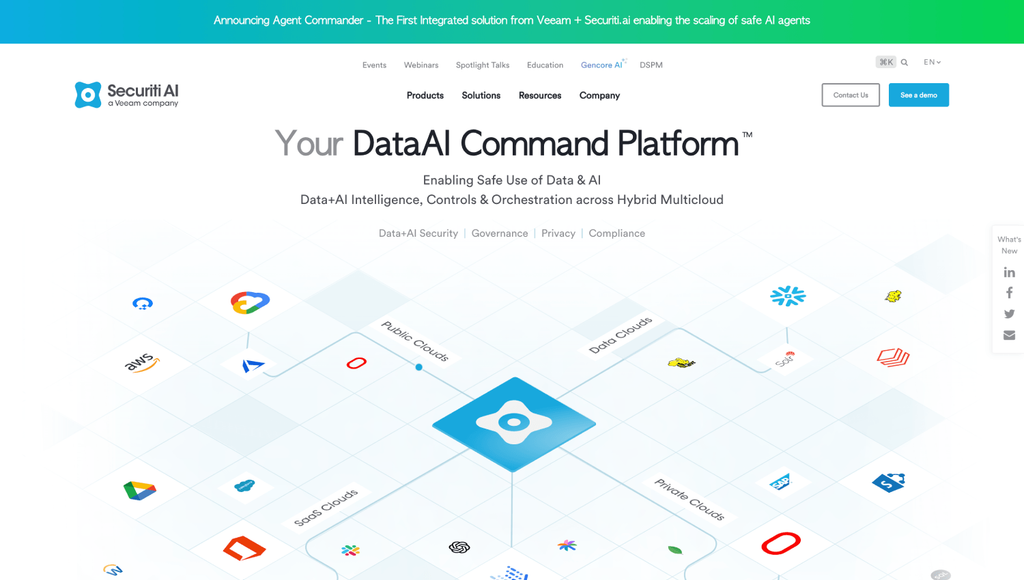
Securiti is the tool on this list with the most explicit vector store and prompt governance coverage in its public documentation. Its AI Data Firewall product is designed to inspect and govern data flowing into AI models at the API layer, with stated capabilities for detecting sensitive data in prompts and responses. Securiti also documents a RAG data security posture feature that maps sensitive data in retrieval sources.
For regulated industries running custom AI stacks, Securiti is the strongest candidate for Stage 3 and Stage 4 coverage in the AI Data Flow Audit framework above. Whether its RAG coverage extends to self-hosted vector databases or only to connected managed services requires direct verification. Securiti does not publish list pricing.
Sentra
Sentra positions itself as a cloud-native DSPM platform with AI data awareness. Its architecture uses agentless scanning across cloud data stores and applies classification to identify sensitive data that may feed AI pipelines. Sentra’s differentiation in the broader DSPM market is its data movement tracking , following data as it moves and is copied across cloud environments.
Applied to AI, that data movement tracking capability is relevant for catching training data exports and unauthorized copies of labeled datasets. Its public documentation does not describe embedding-level or vector store classification. Sentra does not publish list pricing. For teams evaluating Sentra in the context of the broader DSPM platform market, its agentless cloud-native architecture is a meaningful operational advantage over agent-deployed alternatives.
Cyberhaven
Cyberhaven is not a DSPM platform in the traditional sense. It is a data lineage and DLP tool that tracks data from its origin through every copy, transformation, and egress event, using an endpoint agent. Its AI-specific value is in detecting when employees paste sensitive data into ChatGPT, Claude, or other browser-accessible AI services , and tracing that data back to its source file in the corporate environment.
Cyberhaven’s coverage is strong for Stage 4 in the prompt direction: what employees type into AI tools. It does not classify embeddings, vector stores, or server-side AI pipeline artifacts. For organizations whose primary AI risk is employee-driven data leakage to consumer AI tools rather than a structured internal AI pipeline, Cyberhaven addresses a real gap that traditional DSPM entirely misses.
Varonis
Varonis has built its market position on deep Microsoft data store coverage , SharePoint, OneDrive, Exchange, Teams , combined with behavioral analytics. Its AI-related positioning centers on the same Microsoft surface: identifying what data Microsoft Copilot can access, finding overexposed files before Copilot can retrieve them, and alerting on anomalous Copilot access patterns.
Varonis’s strength overlaps significantly with Purview DSPM for AI for Microsoft-centric environments, with the difference that Varonis provides deeper behavioral analytics and longer data access history. For non-Microsoft AI stacks, Varonis’s coverage is limited. Varonis does not publish list pricing for its AI-related capabilities.
Zscaler
Zscaler approaches AI data security from the network proxy layer rather than the data classification layer. Its AI Security capabilities sit inside its Zscaler Internet Access platform and operate inline: inspecting HTTP/S traffic to AI services, applying DLP policies to prompts and responses, and controlling which AI applications employees can reach. Zscaler’s AI-specific features include an AI application discovery function that catalogs which AI tools employees are using.
This is a fundamentally different coverage model from DSPM. Zscaler sees what traverses the proxy. It does not classify data at rest in cloud storage, does not inspect vector databases, and does not govern server-side AI pipelines that stay within the cloud environment. For organizations deployed on Zscaler’s SASE platform, adding AI traffic inspection is operationally simple and requires no additional agent. Zscaler does not publish standalone pricing for AI-specific features.
Netskope
Netskope operates similarly to Zscaler from an architectural standpoint: inline CASB and DLP applied to traffic flowing to AI services. Netskope’s AI-specific positioning includes its Real-time Protection policies for generative AI applications, prompt-level DLP, and a catalog of AI application risk ratings. Its documentation describes the ability to apply sensitivity labels to content before it reaches an AI service.
Like Zscaler, Netskope does not govern AI pipeline artifacts at rest. Its coverage is strongest for controlling employee interactions with externally hosted AI tools. For organizations already running Netskope for CASB or SSE, the AI-specific controls are an extension of existing policy, not a new deployment. Netskope does not publish list pricing for AI-specific features separately from its platform tiers.
Protecto
Protecto is purpose-built for AI pipeline data protection, which makes it the most architecturally different tool on this list. Its product documentation was not included in the source material reviewed for this article; the capabilities described here reflect Protecto’s public positioning as an API-integrated PII detection and masking tool for AI and ML pipelines. Teams should verify specific feature claims , including coverage at training, fine-tuning, and inference stages , directly against Protecto’s current product documentation before drawing procurement conclusions. Protecto also offers de-identification and tokenization capabilities designed specifically for LLM contexts, where traditional regex-based masking fails on unstructured text.
Protecto does not provide the discovery-and-classification-across-cloud-estate functionality that defines a traditional DSPM platform. It is a pipeline integration tool, not a posture management platform. That distinction matters: Protecto fits engineering teams who need to sanitize data flowing through a specific pipeline, not security teams who need an inventory of where sensitive data lives. Protecto does not publish list pricing publicly. For AI/ML teams evaluating runtime protections, the AI guardrail platforms comparison on SecurityOpsWire covers the adjacent category of production LLM controls.
What Does Microsoft Purview DSPM for AI Cover and What Does It Miss?
Microsoft Purview DSPM for AI covers the Microsoft Copilot surface thoroughly and the rest of the AI market minimally. The product surfaces sensitivity labels from files accessed during a Copilot session, reports on overshared SharePoint and OneDrive content that Copilot could retrieve, generates a report of risky AI interactions across the Microsoft 365 tenant, and provides prompts for remediating common misconfigurations in Copilot’s data access.
Its gaps are structural. The product’s architecture depends on Microsoft’s sensitivity labeling infrastructure, which means unlabeled content produces incomplete coverage. Any AI workload running outside the Microsoft tenant , a custom Python application, a third-party AI platform, an internally hosted Ollama deployment , is outside Purview DSPM for AI’s scope entirely. Vector databases are not addressed in Microsoft’s public documentation for this product. Fine-tuning workflows that export Microsoft 365 data to a training platform are visible at the export event but not tracked through the downstream training pipeline.
For organizations whose AI strategy is primarily Microsoft Copilot adoption, Purview DSPM for AI is the right starting point and it requires no additional vendor. For organizations running custom AI stacks alongside Microsoft 365, it covers part of the problem and creates a false sense of completeness if treated as the full solution.
Can Any of These Tools Classify Inside Vector Stores and Embeddings?
This is the most important coverage question for teams running RAG architectures, and the honest answer is that public documentation across this entire market is thin. Securiti is the vendor that most explicitly claims vector store and RAG data security in its product documentation, through its AI Data Firewall and PrivacyLens features. Protecto addresses the input data flowing into embeddings but does not classify an existing vector index.
The core technical challenge is that an embedding vector is not classifiable by content inspection the way a PDF or a database row is. A 1,536-dimensional float vector does not contain the text that generated it , the text is gone. What a classification tool can do is track provenance: which source documents fed the embedding job, what sensitivity labels those documents carried, and whether the vector store metadata records that provenance. That is a data lineage problem, not a content inspection problem.
Practically, the strongest approach for teams running RAG today is not to rely on post-hoc vector store classification. It is to classify source documents before they enter the embedding pipeline and enforce that only documents with approved classification labels can feed the indexer. That control lives in the embedding pipeline itself, not in any of the ten tools on this list.
For teams mapping out how RAG and agent-based retrieval creates new attack surfaces, the AI agent security platform evaluation guide on SecurityOpsWire covers the runtime side of the same problem.
How Does DSPM for AI Price Alongside an Existing DSPM Licence?
None of the ten tools in this list publish a pricing page that cleanly separates AI-specific features from the base DSPM platform cost. That is not an accident. Most vendors bundle AI data security features into their existing platform tiers or sell them as add-on modules without public pricing.
The practical pricing question is whether a team already paying for a DSPM platform licence gets AI coverage included, or whether AI features require an upgrade. On pricing:
- Microsoft Purview DSPM for AI pricing depends on Microsoft 365 licensing. According to Microsoft’s documentation, the feature uses existing Microsoft Purview information protection controls, but the documentation does not explicitly confirm which licensing tiers include DSPM for AI features. Teams should consult Microsoft’s current licensing documentation or their Microsoft account team to confirm tier eligibility before assuming access.
- BigID, Securiti, Sentra, and Varonis do not publish list pricing. Their AI features are bundled into platform tiers or sold as modules; pricing requires direct engagement with their sales teams. Cyera’s website includes a pricing section, though specific figures are not displayed; pricing is quoted per environment.
- Zscaler and Netskope bundle AI application controls into their SSE and SASE platform tiers. Teams already paying for those platforms may have AI traffic inspection available without additional spend, depending on their current tier. Both vendors require direct engagement to confirm feature availability by tier.
- Protecto does not publish list pricing and sells through direct engagement for enterprise use cases.
- Cyberhaven does not publish list pricing publicly.
The operational cost of adding AI coverage to an existing DSPM programme is rarely just the licence. It includes connector configuration work for new AI data stores, policy tuning to reduce false positives on AI-generated content (which often resembles sensitive data structurally), and the ongoing effort of tracking a pipeline that changes with each model update or infrastructure change.
Which Tool Fits Which AI Data Security Scenario?
Consider a 600-person financial services firm running Microsoft 365 E5, a custom RAG application backed by Pinecone, and a fine-tuning workflow that exports customer interaction data to an Azure Blob Storage container for preprocessing. The firm has an existing Varonis deployment. Under the AI Data Flow Audit framework above, Varonis covers the Microsoft 365 source documents and can flag Copilot access anomalies. It does not cover the Pinecone vector store, the Azure Blob export, or the fine-tuning pipeline. Purview DSPM for AI covers the Copilot surface. Neither covers Stages 2, 3, or 4 of the custom RAG pipeline.
That firm needs either Securiti for its RAG governance claims, a pipeline-level control like Protecto at the embedding job boundary, or , most likely , a combination of source document classification enforcement before the embedding job runs, plus Securiti or a similar platform for posture monitoring of the vector store and retrieval layer.
Contrast that with a 200-person SaaS company whose AI risk is primarily employees pasting customer data into ChatGPT and Claude. That firm does not have a custom AI pipeline. Its coverage gap is entirely at the endpoint and browser layer. Cyberhaven or Netskope’s inline CASB covers that scenario. A full DSPM platform is oversized for the actual risk.
The tool selection decision follows the pipeline map, not the vendor’s category label. For teams whose AI stack includes autonomous agents orchestrating data retrieval, the AI agent discovery and monitoring tools comparison covers how to inventory what agents are running and what data they are accessing.
Frequently Asked Questions
What is DSPM for AI?
DSPM for AI is an extension of data security posture management that applies discovery, classification, and risk monitoring to data flowing through AI pipelines , including training datasets, embedding generation jobs, vector databases, and retrieval-augmented generation workflows. It differs from traditional DSPM in that the artifacts it must classify include non-traditional data types like embedding vectors and cached prompt context, not just files and database rows. Microsoft uses “DSPM for AI” as a specific product name inside Microsoft Purview; the broader category applies to any DSPM platform extended to cover AI data flows.
Can DSPM for AI detect risky AI usage?
Tools like Microsoft Purview DSPM for AI, Cyberhaven, Zscaler, and Netskope can detect when sensitive data flows into AI applications , Purview for Microsoft Copilot interactions, the others for externally hosted AI services via endpoint agent or network proxy. What none of these tools reliably detect is risky data usage inside a server-side AI pipeline that never crosses an endpoint or an internet gateway: an embedding job running in a VPC, a vector store being queried internally, or a fine-tuning job reading from a cloud storage bucket.
How do these tools govern data flowing into RAG pipelines?
Coverage varies significantly. Securiti documents the most explicit RAG governance capabilities, including data flow mapping and an AI Data Firewall for prompt-level inspection. Purview DSPM for AI covers Copilot-based retrieval. Most other platforms on this list govern the source documents that feed a RAG pipeline but do not inspect the vector index itself or the retrieval step at runtime. Teams should apply the AI Data Flow Audit framework , mapping training, embedding, indexing, and retrieval as separate stages , and verify connector coverage for each stage with any candidate vendor.
What does vector database security actually require?
Vector database security requires three distinct controls: access control on the vector store itself (who can query it and with what permissions), provenance tracking from source document to embedding (so you know what sensitivity labels apply to the derived vectors), and retrieval governance (so a RAG query cannot surface content that the querying user would not have access to in the source system). No tool in this list handles all three natively. Access control is handled at the vector database layer. Provenance tracking requires upstream classification at the source. Retrieval governance requires pipeline-level enforcement at query time.
Is AI data classification different from standard data classification?
Standard data classification identifies sensitive content in documents, database fields, and structured records using pattern matching, machine learning classifiers, and manual labels. AI data classification must extend to unstructured pipeline artifacts , embedding files, model checkpoints, tokenized datasets, and prompt caches , that do not have a standard file format and do not contain the original text in a readable form. The classification approach must shift from content inspection to provenance tracking: following the lineage of sensitive content through each transformation step rather than inspecting the transformed artifact directly.
Which DSPM tool covers GenAI data protection for non-Microsoft environments?
Securiti and Protecto are the strongest candidates for non-Microsoft AI environments. Securiti covers multi-cloud data stores and documents RAG governance capabilities. Protecto is positioned as an API-integrated tool for PII detection and masking in AI pipelines; teams should verify its specific pipeline integration capabilities directly against Protecto’s product documentation, as its source pages were not available for review in preparing this article. BigID’s broad connector library makes it suitable for compliance-driven programs spanning multiple clouds and data stores. Cyera and Sentra both offer cloud-native DSPM that extends to AI-adjacent storage, but neither documents explicit vector store or RAG pipeline classification. Verify connector coverage for your specific infrastructure before selecting any of them.
How does shadow AI affect DSPM coverage?
Shadow AI , AI tools deployed or used without security team knowledge , creates classification gaps that no DSPM platform closes automatically. A developer spinning up a local Ollama instance connected to a corporate data store, or an employee using a personal ChatGPT account from a corporate device, creates a data flow that bypasses cloud-native DSPM scanners entirely. Endpoint-based tools like Cyberhaven and network-layer tools like Zscaler and Netskope have better coverage for shadow AI usage than storage-scanning DSPM platforms. The shadow AI discovery tools comparison on SecurityOpsWire covers this gap in detail.
What Teams Actually Get Wrong When Evaluating These Tools
The most common mistake is conflating a vendor’s AI positioning with actual AI pipeline coverage. Every tool in this list has an “AI security” page. Most of those pages describe the same three capabilities: discovering data that AI can access, controlling employee usage of external AI services, and reporting on sensitive data exposure. That baseline describes the 2023 problem. The 2025 problem is the derivative artifact , the embedding, the index, the fine-tuned weight , that was never in scope for any of these platforms when they were built.
The second mistake is treating existing DSPM coverage as a proxy for AI coverage. A team with a mature Varonis or BigID deployment has strong posture on its traditional data estate. That maturity does not transfer to AI pipeline artifacts, because those artifacts live in different storage systems, in different formats, created by different teams who may not know they are handling sensitive data at all. The mapping work has to be done from scratch for the AI pipeline.
The right mental model is to treat every AI data flow as a new data store requiring its own coverage decision. Training data exports, embedding files, vector indexes, prompt caches, and model outputs are each a separate classification problem. Match each one to a specific tool and connector before assuming coverage exists. A gap in the map is a real coverage gap, not a future roadmap item.