
- Lean security teams are the primary beneficiaries of autonomous SOC tooling, not an afterthought , a five-person team has the most to gain from closing the tier-one triage gap, which consumes analyst hours without requiring human judgment.
- The realistic first-90-days tuning burden is the number most vendors bury: expect two to six weeks of active configuration before automated actions produce acceptable false-positive rates on your specific log mix.
- No platform today runs fully without a human in the loop for high-confidence actions against production assets , the distinction that matters is where the confidence threshold sits and what the escalation path looks like when the automation is wrong.
- The right entry point for automation is a bounded tier of work: alert deduplication, enrichment, and low-risk containment. Start there, set an explicit confidence threshold, and build escalation rules before touching lateral-movement response.
- Staffing reduction claims from vendors require a named customer source with a documented baseline. Treat any unsourced headcount figure as marketing.
Autonomous SOC platforms are security operations tools that use AI-driven detection, investigation, and response to handle alert triage and containment without requiring an analyst for every action. The best-fit environments for lean teams are those where tier-one triage volume is high, staffing is fixed, and the team is willing to define explicit confidence thresholds and escalation rules before enabling automated response. Platforms from vendors including Stellar Cyber, D3 Security, Torq, Radiant Security, Swimlane, and Intezer cover different slices of this workflow, and the right choice depends on where your team’s bottleneck actually sits.
What Does “Autonomous” Actually Mean in a SOC Platform?
The word autonomous covers a spectrum from “auto-closes duplicate alerts” to “remediates endpoint compromise without analyst approval.” Most platforms marketed as autonomous SOC tools sit somewhere in the middle, and the honest ones say so explicitly. D3 Security’s Morpheus defines it as AI that investigates, triages, and responds to every alert at analyst depth without routing alerts to a queue , a more specific claim than most.
The operational distinction that matters for a lean team is not whether a platform is autonomous in theory. It is which action classes run without a human confirmation, under what confidence threshold, and what triggers escalation when the system is uncertain. A platform that auto-closes low-fidelity alerts from a known-safe IP range is autonomous in a meaningful sense. A platform that claims to auto-remediate ransomware without a confidence gate is either lying or dangerous.
Three action tiers map cleanly to real autonomy levels: enrichment and deduplication (safe to automate from day one), containment of individual assets like isolating an endpoint or blocking an IP (safe after 30 to 60 days of tuning against your environment), and remediation of production services or identity changes (requires explicit confidence thresholds and human escalation paths even in mature deployments). The platforms below are organized by where they realistically operate within these tiers.
The SecurityOpsWire Confidence-Tier Framework for Autonomous SOC Adoption
Before evaluating any specific vendor, lean teams need a mental model for where to start. The SecurityOpsWire Confidence-Tier Framework breaks autonomous SOC adoption into three gates, each requiring a defined confidence threshold before the next gate opens.
Gate 1 , Enrich and Close: The platform enriches alerts with context (IP reputation, asset criticality, user risk score), deduplicates correlated events, and auto-closes alerts that match a high-confidence benign pattern. No production asset is touched. This gate should be active within the first two weeks and requires the least tuning.
Gate 2 , Contain and Notify: The platform isolates an endpoint, blocks a specific IP or hash, or suspends a user account, then immediately notifies the team with its reasoning. Human review confirms or reverses within a defined window, typically 15 to 60 minutes. This gate requires four to six weeks of environment-specific tuning to get false-positive rates low enough for production use.
Gate 3 , Remediate and Document: The platform executes multi-step response playbooks, updates firewall rules, revokes tokens, and closes the incident with a documented timeline. This gate is appropriate only after Gate 2 has run for at least 60 days with measured false-positive and false-negative rates. For most lean teams, Gate 3 is a 6-to-12-month horizon, not a day-one feature.
The framework’s value is that it gives procurement teams a concrete conversation starter with vendors: “Show me how your platform handles Gate 2 escalation when confidence drops below your threshold.” If the vendor cannot answer that question specifically, the product is not ready for autonomous operation in your environment.
What Does the First 90 Days of Tuning Actually Look Like?
This is the question lean teams ask least often in vendor evaluations and regret most in the first quarter. The tuning burden varies significantly across platforms, but a realistic baseline for a two-to-five person security team looks like this.
Weeks one through two: log source onboarding. Every platform requires you to map your existing SIEM, EDR, cloud provider logs, and identity events into its ingestion pipeline. Platforms with pre-built connectors reduce this to configuration; platforms that require custom parsers add one to three weeks of engineering time. Ask vendors for a connector inventory specific to your stack before signing.
Weeks three through six: false-positive suppression. The first wave of automated actions will fire on legitimate behavior your environment treats as normal , developers running privileged containers, automated scripts hitting authentication endpoints, scheduled tasks that look like lateral movement to a generic model. This phase requires an analyst to review automated decisions daily and build suppression rules. Expect 30 to 90 minutes per day of active tuning work during this window.
Weeks seven through twelve: threshold calibration. Once baseline noise is suppressed, the team sets confidence thresholds for Gate 2 actions. Most platforms surface a confidence score per alert; the team’s job is to find the threshold above which automated containment is reliable in their environment. This typically requires reviewing 200 to 400 closed alerts to establish the calibration baseline. After week twelve, a well-tuned deployment should run Gate 1 and Gate 2 actions with minimal daily oversight , the realistic payoff for a lean team.
What Happens When the Automation Is Wrong?
Every autonomous SOC platform will make a wrong call. The question is what the recovery path looks like and who owns it. Three failure modes show up most often in practice.
The first is a false-positive containment action: the platform isolates a production server or blocks a service account that turns out to be legitimate. Recovery requires a manual reversal, an audit of what downstream systems were affected, and an update to the suppression rules. Platforms that log every automated action with a full decision trace make recovery faster. Platforms that do not are a liability in this scenario.
The second is a false-negative: the platform closes an alert that was a real incident. This is harder to detect and harder to recover from. The mitigation is not better automation , it is a regular review of auto-closed alerts, sampled at five to ten percent, to catch drift in the model’s performance as your environment changes.
The third is a confidence collapse: the platform encounters an event type it has not seen before and either fails to act or acts with high confidence on a weak signal. Platforms with an explicit escalation path for low-confidence conclusions send these to a human queue rather than making a decision. This is the single most important architectural feature for a lean team, because a confident wrong answer is worse than no answer when nobody is watching.
If you are evaluating platforms that use AI agents for investigation and response, the oversight and audit questions become even more pointed. Our coverage of the top AI SOC platforms and how they handle triage automation covers the broader category with more depth on the detection side.
How Much Staffing Reduction Is Realistic for a Five-Person Team?
Vendors will cite headcount reduction figures in sales conversations. Without a named customer reference with a documented baseline, those figures are not verifiable and should not drive a purchase decision. What is realistic to estimate from publicly available information is time reallocation, not headcount reduction.
A five-person security team running 500 to 2,000 alerts per day typically spends 40 to 60 percent of tier-one analyst time on triage that does not require human judgment: deduplication, enrichment, and closing alerts that match well-known benign patterns. A Gate 1 automation deployment can recover that time and redirect it to detection engineering, threat hunting, or incident investigation. That is a meaningful operational change without requiring anyone to argue that headcount went down.
Gate 2 automation, once calibrated, can handle a significant share of containment actions for common scenarios like endpoint isolation after a confirmed malware execution. The time savings there are real but harder to generalize because they depend heavily on incident volume and the mix of alert types your environment generates. Ask vendors for their median time-to-containment figures on a log mix similar to yours, with a named reference customer, before treating any number as a planning assumption.
The 11 Autonomous SOC Platforms Worth Evaluating for Lean Teams
The platforms below cover the range from pure SOAR automation to full AI-driven investigation and response. Each entry identifies the primary automation tier it handles well, the realistic tuning burden, and the scenarios where it fits a lean team and where it does not.
1. Stellar Cyber
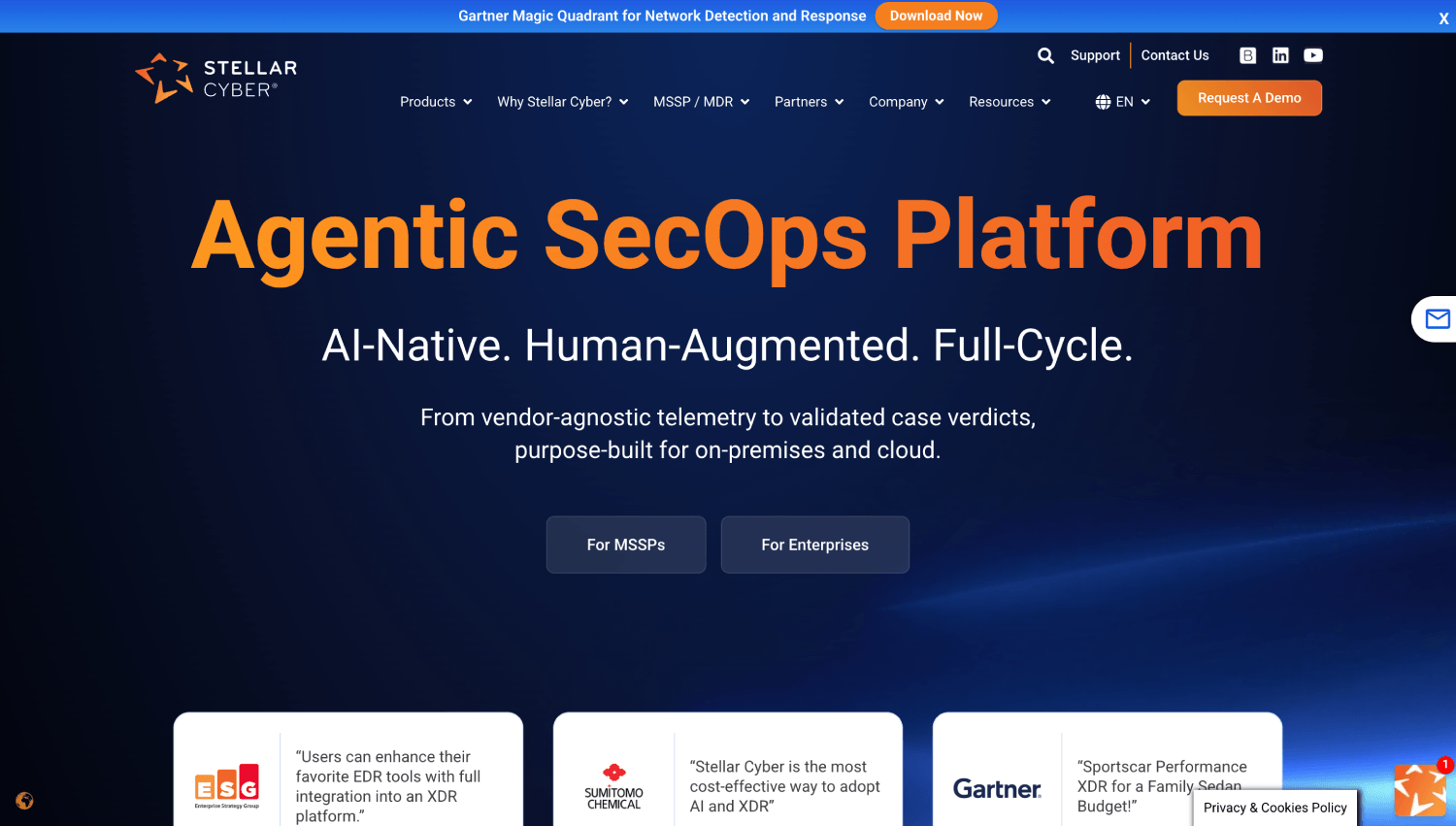
Stellar Cyber positions its platform as an open XDR with autonomous SOC capabilities built on a unified data lake. Its strength for lean teams is the breadth of its built-in detection library and its multi-source correlation, which reduces the alert volume a small team needs to manually review. The platform ingests logs from a wide range of sources including EDR, cloud providers, firewalls, and identity systems, correlating them into incident-level cases rather than individual alerts.
For a lean team, the practical advantage is that Stellar Cyber’s correlation engine does significant work before a human ever sees an event. The tuning burden in the first 90 days is moderate: the pre-built detection library covers common patterns well, but environment-specific tuning of correlation thresholds takes four to six weeks for a typical mid-market deployment. The platform does not publicly disclose pricing and quotes per environment.
Best fit: Teams that need broad detection coverage across a mixed-source environment and want to reduce alert volume before automating response. Less suited to teams that need deep SOAR playbook customization without a dedicated automation engineer.
2. D3 Security (Morpheus)
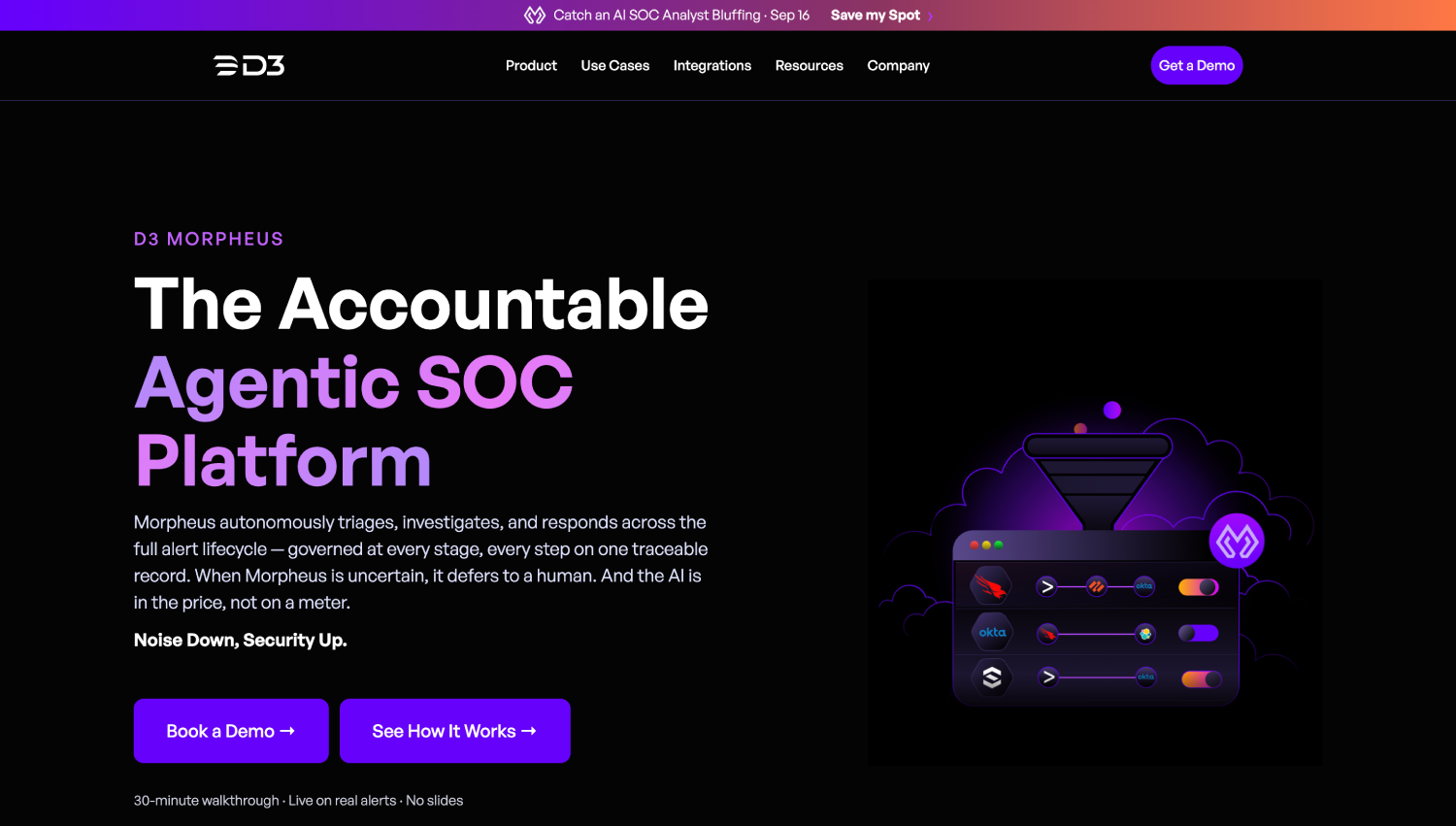
D3 Security’s Morpheus is the most explicit in the market about what “autonomous” means operationally. Its published definition , AI that investigates and responds at analyst depth without routing to a queue , is backed by a playbook architecture that covers investigation steps, not just containment actions. For lean teams, this means the platform can close an alert with a documented investigation chain rather than just a suppression rule.
The tuning burden is higher than average in the first 30 days because Morpheus’s playbooks require mapping to your specific asset inventory and integration set. Teams without a dedicated automation engineer will spend more time in this phase. After calibration, the platform handles Gate 1 and Gate 2 actions reliably for common incident types. Pricing is not publicly disclosed.
Best fit: Teams that want documented, auditable investigation logic per alert type. Less suited to teams that need a fast time-to-value deployment without playbook configuration work.
3. Torq
Torq is a hyperautomation platform for security operations that builds automated workflows across any combination of tools in your stack. Its HyperSOC product positions it as an autonomous SOC layer that sits above your existing SIEM and EDR rather than replacing them. For a lean team with an established tool stack, this is a meaningful architectural distinction: Torq automates the orchestration layer without requiring a full platform migration.
Tuning burden is front-loaded in workflow design. Torq’s no-code and low-code workflow builder is accessible without a dedicated developer, but the first 30 days require significant time designing the decision logic for each alert type you want to automate. The platform’s strength is flexibility; its liability for a lean team is that flexibility requires investment. Pricing is not publicly disclosed.
Best fit: Teams with an existing SIEM and EDR investment that want to add automation without replacing core tools. Less suited to teams that need out-of-the-box detection coverage rather than workflow automation on top of existing detections.
4. Radiant Security
Radiant Security is positioned as an AI-driven SOC analyst automation platform, with an architecture designed to mimic the investigation steps a tier-one analyst takes rather than just running playbooks. Based on publicly available descriptions of its approach, the platform ingests alerts from existing security tools, conducts an automated investigation for each alert, and produces a human-readable summary with a recommended action. SecurityOpsWire was unable to verify specific capability details against current vendor documentation at the time of publication.
For a lean team, the stated value is in reducing the cognitive load of tier-one work rather than just the volume , investigation summaries designed to give a human analyst enough context to make a decision quickly, rather than requiring them to pivot across multiple tools. Tuning burden in the first 90 days is reported to be lighter than playbook-based SOAR tools because the AI model adapts to your environment’s patterns. Pricing is not publicly disclosed. Verify current capabilities and architecture directly with the vendor before evaluation.
Best fit: Teams that are bottlenecked on investigation time rather than raw alert volume. Less suited to teams that need complex multi-step automated remediation in the first quarter.
5. Swimlane
Swimlane is a SOAR platform that has added AI-augmented case management and autonomous response capabilities to its core automation engine. Its strength is a mature integration library and a workflow engine that handles complex, branching playbooks. For lean teams that have already identified the specific alert types they want to automate, Swimlane’s pre-built integrations reduce the connector development work significantly.
The platform’s liability for a lean team is the same as any mature SOAR: initial configuration requires meaningful investment in playbook design. Swimlane has addressed this partially with pre-built use-case packages for common scenarios including phishing, endpoint compromise, and cloud misconfiguration alerts. Expect four to eight weeks of active configuration before production Gate 2 automation is reliable. Pricing is not publicly disclosed.
Best fit: Teams with a defined set of high-volume alert types and a part-time automation resource available for initial playbook setup. Less suited to teams that need autonomous investigation coverage across an undefined alert mix without pre-configuration work.
6. Intezer
Intezer takes a narrower scope than most platforms on this list, focusing specifically on autonomous alert triage for malware and endpoint-related alerts. Its AI analyzes code, binaries, and memory to determine alert legitimacy, then auto-closes or escalates based on its findings. For lean teams drowning in endpoint and malware alerts, this specialization is a feature rather than a limitation.
The tuning burden for Intezer is lower than general-purpose platforms because its model is pre-trained on malware analysis rather than requiring environment-specific calibration for detection logic. The first two weeks focus on connecting your EDR and alert sources rather than building decision logic. The trade-off is coverage: Intezer handles malware-related alerts well and handles cloud misconfiguration or identity alerts not at all. Pricing is not publicly disclosed.
Best fit: Teams whose primary alert volume is endpoint and malware-related and who want fast time-to-value on tier-one triage for that specific category. Less suited to teams that need broad autonomous coverage across cloud, identity, and endpoint in a unified platform.
7. Orca Security
Orca Security is a cloud security platform, not a general-purpose SOC automation tool, but it earns a place on this list because lean teams running multi-cloud environments often need autonomous prioritization of cloud security findings more than they need another endpoint alert automation tool. Orca’s agentless scanning and AI-driven attack path analysis reduce the triage burden for cloud misconfigurations and vulnerability findings without requiring a dedicated cloud security engineer.
For a lean team, the operational value is that Orca’s risk prioritization is pre-configured rather than requiring environment-specific tuning. Its attack path analysis identifies which misconfigurations represent real exposure given your specific asset relationships, reducing the number of findings that require human review. Pricing is not publicly disclosed. The platform integrates with SOC workflows through ticketing and alert forwarding but does not itself handle endpoint or identity alert triage.
Best fit: Teams running two or more cloud accounts with significant cloud-native infrastructure and no dedicated cloud security staff. Less suited as a primary autonomous SOC tool for teams whose alert volume is dominated by endpoint or identity events.
8. Anvilogic
Anvilogic focuses on detection engineering as a service layered on top of existing SIEM infrastructure including Splunk and Microsoft Sentinel. Its autonomous SOC angle is detection coverage rather than response automation: the platform continuously deploys and maintains detection rules against your log sources, reducing the detection engineering burden on a lean team.
For a team bottlenecked on detection quality rather than alert triage volume, Anvilogic addresses the root cause rather than the symptom. Its pre-built detection library maps to MITRE ATT&CK technique coverage, and the platform provides visibility into which techniques your current detection set covers and which it misses. Tuning burden is low because detection rules are maintained by Anvilogic rather than the customer team. Pricing is not publicly disclosed.
Best fit: Teams running Splunk or Sentinel with a gap in detection engineering capacity. Less suited to teams that need automated response and containment rather than improved detection coverage.
9. Dropzone AI
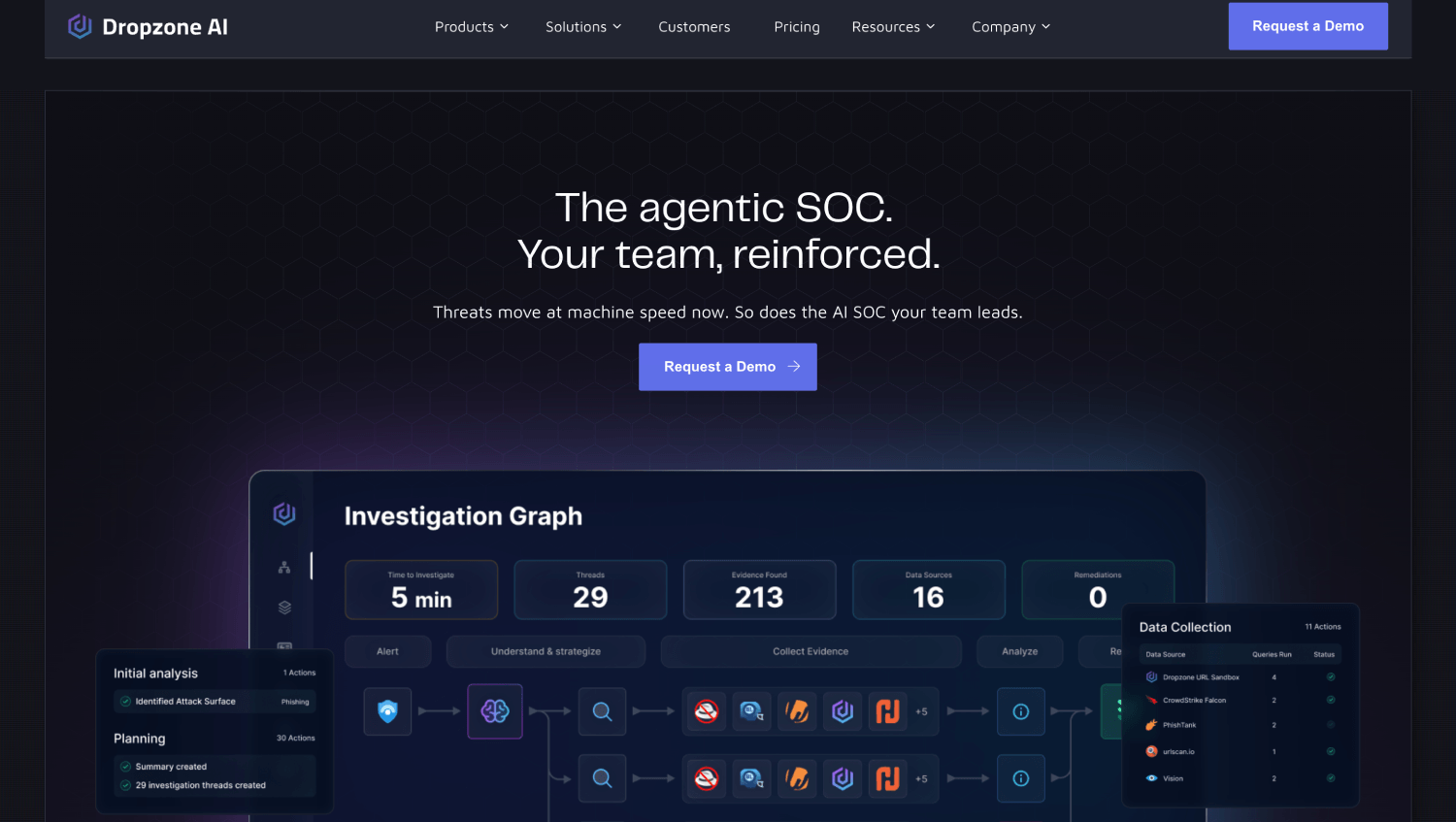
Dropzone AI is positioned as an autonomous SOC analyst that investigates alerts at the depth a senior analyst would, producing a written investigation report and a disposition recommendation. Based on publicly available positioning, its architecture uses AI agents to execute investigation steps across connected tools rather than running pre-defined playbooks. SecurityOpsWire was unable to verify specific capability details against official vendor documentation at the time of publication.
For a lean team, the key stated distinction from playbook-based SOAR is that Dropzone determines investigation steps dynamically based on the alert and the available tool integrations, which is reported to reduce the front-loaded tuning burden significantly. Its primary value is described as investigation and recommendation rather than execution, with autonomous response actions more limited than mature SOAR tools. Pricing is not publicly disclosed. Verify current capabilities and architecture directly with the vendor before evaluation.
Best fit: Teams that want to reduce investigation time across a wide range of alert types without building playbooks for each one. Less suited to teams that need high-volume automated remediation rather than improved investigation throughput.
10. Securonix
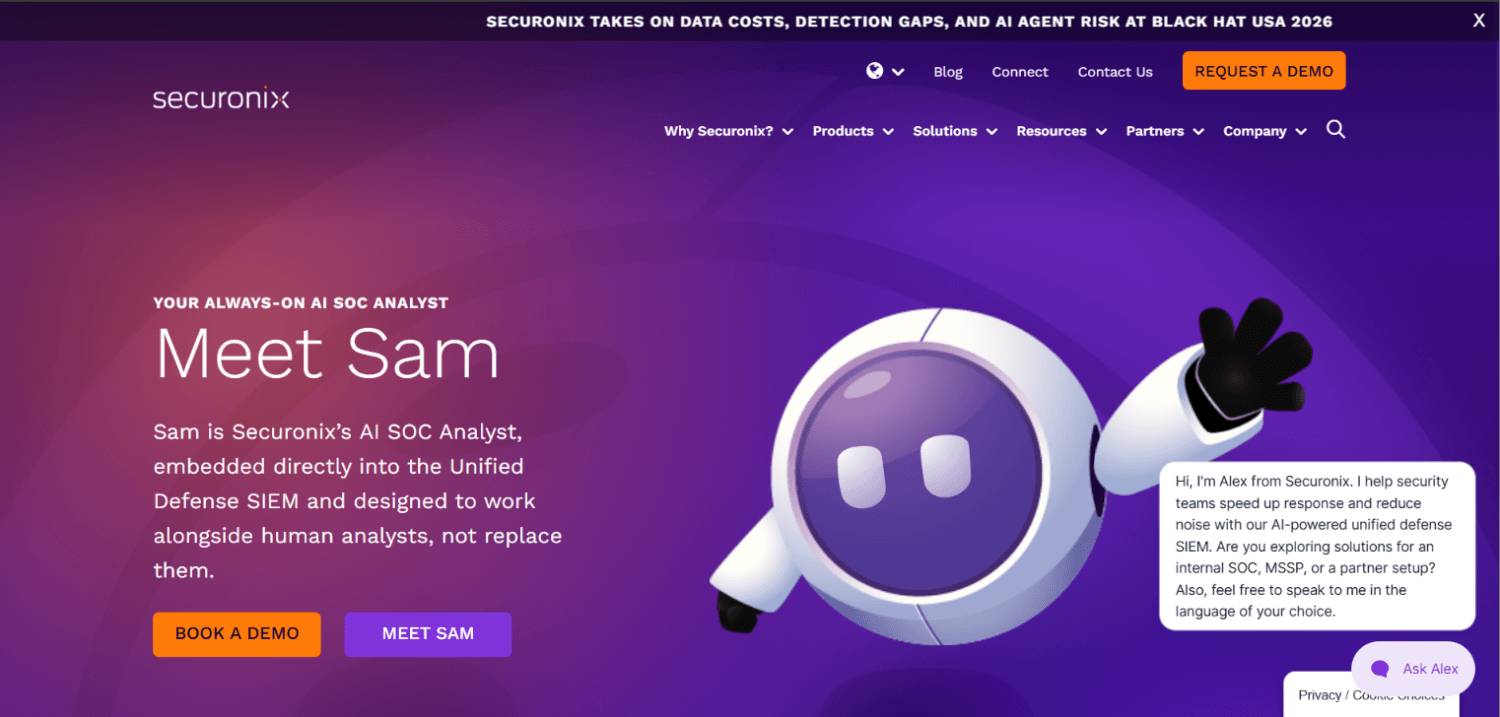
Securonix is described in public positioning as a SIEM and UEBA platform with autonomous threat response capabilities built on its core analytics engine. Its UEBA analytics are cited as particularly relevant for insider threat and identity-based attack scenarios, which are underserved by endpoint-focused autonomous SOC tools. SecurityOpsWire was unable to verify specific capability details against official vendor documentation at the time of publication.
Based on publicly available information, the tuning burden in the first 90 days is moderate: behavioral baselines require an observation period before producing reliable anomaly detection, and threshold calibration for automated response actions requires additional time beyond that. Connector configuration adds time to initial deployment. Pricing is not publicly disclosed. Verify current UEBA capabilities, behavioral baseline timelines, and integration breadth directly with the vendor before evaluation.
Best fit: Teams with a significant identity and user behavior monitoring requirement and limited dedicated UEBA tooling. Less suited as a fast-deployment autonomous SOC option for teams that need production automation within the first 30 days.
11. ReliaQuest GreyMatter
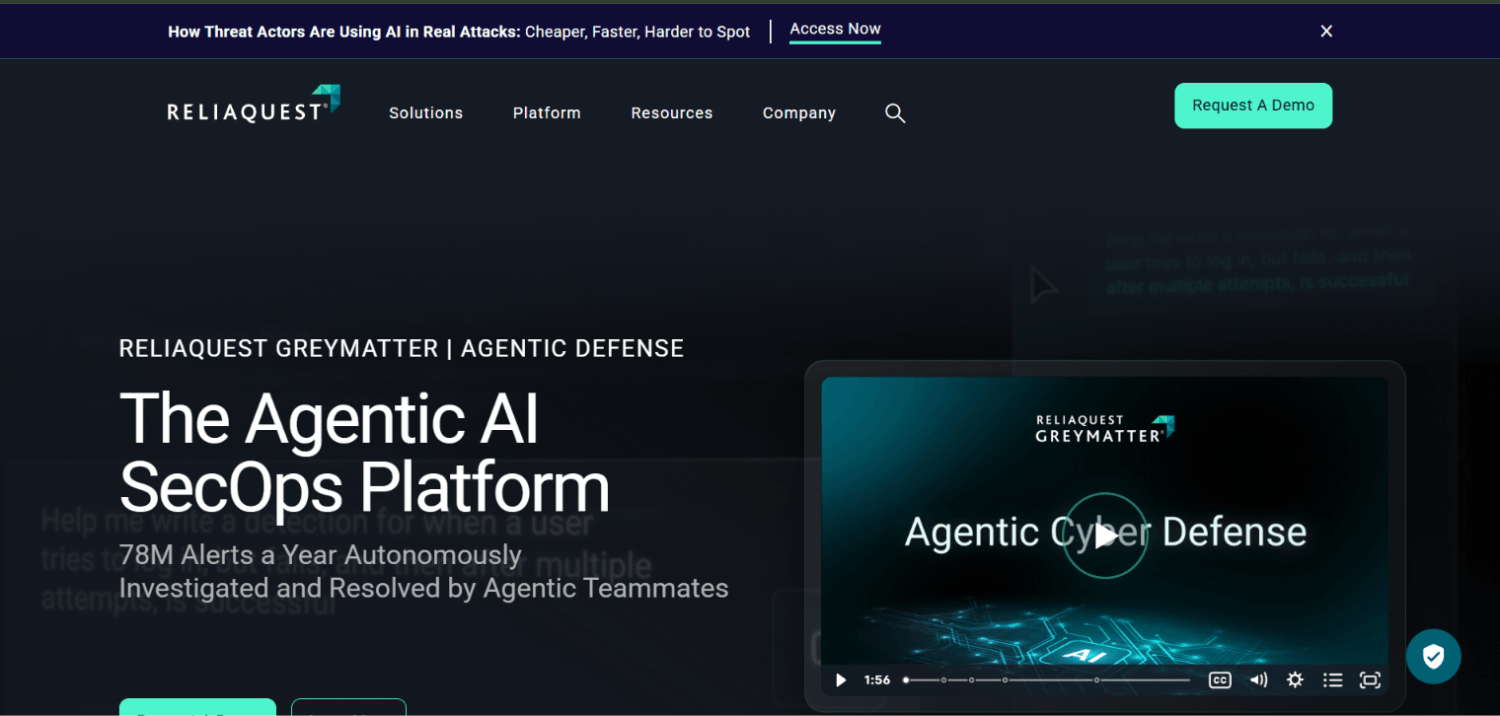
ReliaQuest GreyMatter is described in public positioning as a detection and response platform with MDR backing, which distinguishes it from every other platform on this list. SecurityOpsWire was unable to verify specific platform capabilities against official vendor documentation at the time of publication. Based on publicly available information, for lean teams that want autonomous SOC capabilities but are not willing to bet entirely on AI automation for high-confidence actions, the MDR-backed model provides AI-driven detection and automated playbook execution with human analyst escalation available for actions the automation is not confident about.
The tuning burden is reported to be lower than self-managed platforms because the analyst team handles initial configuration and ongoing detection tuning. The trade-off is cost: MDR-backed platforms carry a higher per-year price point than self-managed automation tools, and pricing is not publicly disclosed. Verify current platform architecture, MDR coverage terms, and escalation procedures directly with the vendor before evaluation. For a team of two or three people who cannot afford 30 to 60 days of internal tuning effort, the MDR model may be the correct buy even at higher cost.
Best fit: Teams of two to four people who need autonomous coverage with a human escalation backstop and cannot absorb the first-quarter tuning burden internally. Less suited to teams that have the internal capacity to tune and manage a self-service platform and want to reduce third-party dependencies.
Platform Comparison: Automation Tier, Tuning Burden, and Team Fit
| Platform | Primary Automation Tier | First-90-Day Tuning Burden | Best Team Size | Key Limitation for Lean Teams |
|---|---|---|---|---|
| Stellar Cyber | Gate 1 and Gate 2 (XDR correlation) | Moderate (4-6 weeks) | 3-10 people | Platform breadth requires time to configure |
| D3 Security (Morpheus) | Gate 1, Gate 2, and Gate 3 (playbook-driven) | High (6-10 weeks) | 3-8 people | Playbook configuration requires automation expertise |
| Torq | Gate 2 and Gate 3 (orchestration layer) | High (4-8 weeks workflow design) | 3-8 people | Flexibility requires investment to realize |
| Radiant Security | Gate 1 and Gate 2 (AI investigation) | Low-Moderate (2-4 weeks) | 2-6 people | Limited multi-step remediation out of the box |
| Swimlane | Gate 2 and Gate 3 (SOAR) | High (4-8 weeks) | 4-12 people | Pre-built packages help but playbook design still required |
| Intezer | Gate 1 (malware triage) | Low (2 weeks) | 2-8 people | Narrow scope: endpoint and malware only |
| Orca Security | Gate 1 (cloud finding prioritization) | Low (agentless, pre-configured) | 2-6 people | Cloud-only scope; not a general SOC tool |
| Anvilogic | Detection engineering layer | Low (managed detection rules) | 2-5 people | No autonomous response; addresses coverage not volume |
| Dropzone AI | Gate 1 and Gate 2 (AI investigation) | Low-Moderate (2-4 weeks) | 2-6 people | Response actions more limited than mature SOAR |
| Securonix | Gate 1 and Gate 2 (UEBA focus) | Moderate-High (6-8 weeks) | 4-12 people | Behavioral baselines require observation period |
| ReliaQuest GreyMatter | Gate 1, Gate 2, Gate 3 (MDR-backed) | Low (managed tuning) | 2-5 people | Higher cost than self-managed alternatives |
How Do You Set an Escalation Rule for Low-Confidence Automated Decisions?
This is the operational question that vendor demos almost never answer. An escalation rule for low-confidence conclusions has four components: a confidence threshold, a defined escalation target, a response window, and a documented reversal procedure.
The confidence threshold is platform-specific. Most platforms surface a numeric score per alert or action; the team’s job is to determine through the Gate 2 calibration process which threshold separates reliable automated actions from unreliable ones. A starting point is to set the automation threshold at the score above which 95 percent of historical auto-actions in your environment were correct, then adjust based on observed performance.
The escalation target should be a specific on-call rotation or a named slack channel, not a generic email alias. Low-confidence escalations that go to a group inbox with no ownership SLA are functionally the same as no escalation path. Set a response window , typically 15 to 60 minutes depending on the action severity , and document what the platform does if the response window expires without human input: hold the action, execute it anyway, or revert it.
The reversal procedure is the piece teams build last and regret not building first. Every automated containment action should have a documented one-command reversal that any analyst on the team can execute in under five minutes. Test it in your staging environment before enabling Gate 2 automation in production.
For teams deploying AI agents as part of their security automation stack, the oversight and audit surface extends further. The AI agent security platform coverage covers how to maintain visibility and control over autonomous agents operating in your environment.
Which Alert Types Should a Lean Team Automate First?
Start with the alert types that have the highest volume, the lowest true-positive rate, and the clearest automated investigation path. Three categories meet all three criteria for most environments.
Phishing alert triage is the most common entry point. Email security tools generate high alert volumes with significant false-positive rates, and the investigation steps , checking sender reputation, analyzing links and attachments, reviewing similar messages to the same recipient , are well-defined and automatable. Most platforms on this list handle phishing triage in their pre-built use-case libraries.
Known-malware endpoint alerts from EDR tools are the second natural entry point. When an EDR fires on a hash that matches a known-bad signature with a high confidence score, automated quarantine and investigation is safe for most environments. This is where Intezer’s specialized focus delivers fast value without broad platform adoption.
Cloud misconfiguration findings from posture tools are the third entry point, particularly for teams running Orca or a similar agentless cloud security tool. Auto-routing findings below a defined severity threshold to a ticketing system with enriched context reduces the triage queue without requiring automated remediation actions.
Lateral movement, credential-based attacks, and identity compromise alerts should not be in the first automation wave for a lean team. The investigation complexity is higher, the blast radius of an incorrect automated action is larger, and the model calibration required to produce reliable results takes longer. These become Gate 2 and Gate 3 targets after the lower-complexity categories are running reliably.
For teams thinking about how AI-driven security tooling fits within a broader platform strategy, the continuous threat exposure management platform comparison on SecurityOpsWire covers how exposure prioritization and automated response work together across the full attack surface.
Frequently Asked Questions
Can a two-person security team realistically run an autonomous SOC platform?
Yes, with two conditions. First, the team must be willing to invest four to eight weeks of active tuning time in the first quarter rather than expecting the platform to run out of the box. Second, the team must start with Gate 1 automation only , enrichment, deduplication, and auto-close of high-confidence benign alerts , before enabling any automated containment actions. Platforms like Radiant Security and Dropzone AI are specifically designed for small teams because they require less pre-configuration than playbook-based SOAR tools.
What is the realistic false-positive rate for automated SOC actions in the first 90 days?
Expect a higher false-positive rate in the first 30 days than your manual triage baseline, not a lower one. Automated systems act on what they have seen in training; your specific environment will contain legitimate behavior patterns the model has not accounted for. The tuning process in weeks three through six is specifically designed to drive that rate down. A well-tuned Gate 2 deployment in a stable environment typically reaches a false-positive rate comparable to experienced tier-one analysts after 60 to 90 days of calibration.
How do autonomous SOC platforms handle novel attack techniques they have not seen before?
Most platforms escalate low-confidence conclusions rather than making a decision. A novel attack technique produces an alert the platform cannot match against a known pattern or a high-confidence behavioral baseline, which should trigger escalation to a human queue rather than an automated response. Platforms that do not have an explicit low-confidence escalation path will either miss these events or take high-confidence action on a weak signal. Ask vendors specifically how they handle out-of-distribution alert types before selecting a platform for autonomous operation.
Do autonomous SOC platforms replace the need for a SIEM?
No. Autonomous SOC platforms consume and correlate data from a SIEM or ingest logs directly, but they do not replace the long-term log retention, compliance reporting, or forensic investigation capabilities a SIEM provides. Platforms like Stellar Cyber and Securonix include SIEM capabilities natively; others like Torq and Radiant Security sit on top of an existing SIEM. Whether you need a separate SIEM depends on your log retention requirements and your compliance posture, not on the autonomous capabilities of your response platform.
What happens to audit trails when an autonomous platform takes a containment action?
Every autonomous action should produce a timestamped, human-readable log entry that records what action was taken, which alert triggered it, what confidence score the platform assigned, and what evidence supported the decision. This audit trail is required for incident post-mortems, regulatory inquiries, and internal review of platform performance. Before selecting a platform, verify that automated action logs are immutable, exportable, and retained for your required compliance period. Platforms that do not surface complete decision traces per automated action create audit gaps that become compliance problems during incident investigations.
Is autonomous SOC tooling appropriate for regulated industries like healthcare or financial services?
The regulatory question is not whether to use autonomous tooling but how to configure it. Automated containment actions that affect access to systems holding regulated data , patient records under HIPAA or financial transaction data under PCI DSS , require documented escalation procedures and human review thresholds even when automation is running. The Gate framework described in this article applies directly: Gate 1 and reviewed Gate 2 actions are generally compatible with regulated environments; fully automated Gate 3 remediation of production systems holding regulated data requires legal and compliance review before deployment. See your external counsel on specific regulatory requirements rather than relying on vendor compliance claims.
The Single Most Important Insight for a Lean Team Buying Autonomous SOC
The belief that a lean team cannot adopt autonomous SOC tooling because there is nobody to supervise it has the problem backwards. A lean team cannot afford not to automate tier-one work because the cost of manual triage at high alert volumes is measured in analyst burnout and missed detections, not just hourly labor. The staffing constraint is exactly the condition that makes automation necessary.
What changes the calculation is being honest about the first 90 days. The tuning burden is real and front-loaded, and a team that goes into deployment expecting the platform to run autonomously from week one will have a bad first quarter and a fair amount of buyer’s remorse. The team that sets a Gate 1 target for week two, a Gate 2 target for week eight, and a Gate 3 evaluation at month six will get a different result from the same platform.
The escalation path for low-confidence conclusions is not a nice-to-have feature. It is the architectural requirement that determines whether autonomous tooling is safe to run in your environment. If you cannot articulate the answer to “what does this platform do when it is not sure?” before you sign, you are not ready to run autonomous actions in production. Get that answer first, in writing, before any other evaluation criterion. That single requirement, applied rigorously, will eliminate more bad platforms from your shortlist than any feature matrix.
For teams thinking through how AI-driven automation intersects with the security of the AI systems themselves, the AI red teaming platform comparison on SecurityOpsWire covers how to validate that the autonomous tools you deploy are not themselves an attack surface.