
- Generic cloud workload protection tools model CPU-based containerized services. They do not model GPU scheduling, training job isolation, notebook server access, or model artifact integrity, which are the four surfaces where AI infrastructure actually gets compromised.
- The model supply chain is the most unowned layer in most AI security programs: pickle deserialization attacks on downloaded weights, unsigned ONNX files, and Hugging Face repository poisoning all bypass standard CWPP scanning without purpose-built artifact analysis.
- Vector store access control is not covered by IAM alone. Query-level authorization, embedding theft via excessive retrieval, and prompt-to-store injection require dedicated controls that sit outside what Wiz, Orca, or Prisma Cloud were built to handle.
- Protect AI and HiddenLayer are the only vendors in this list whose primary product surface is the model artifact and ML pipeline layer. Every other vendor approaches AI infrastructure security from the cloud or container side and extends upward.
- Before buying any tool here, map your AI stack into three ownership zones: infrastructure layer (cloud, Kubernetes, GPU nodes), pipeline layer (training jobs, notebooks, MLflow, data loaders), and artifact layer (model weights, ONNX files, vector stores, registries). Each zone has different owners, different tools, and different attack paths.
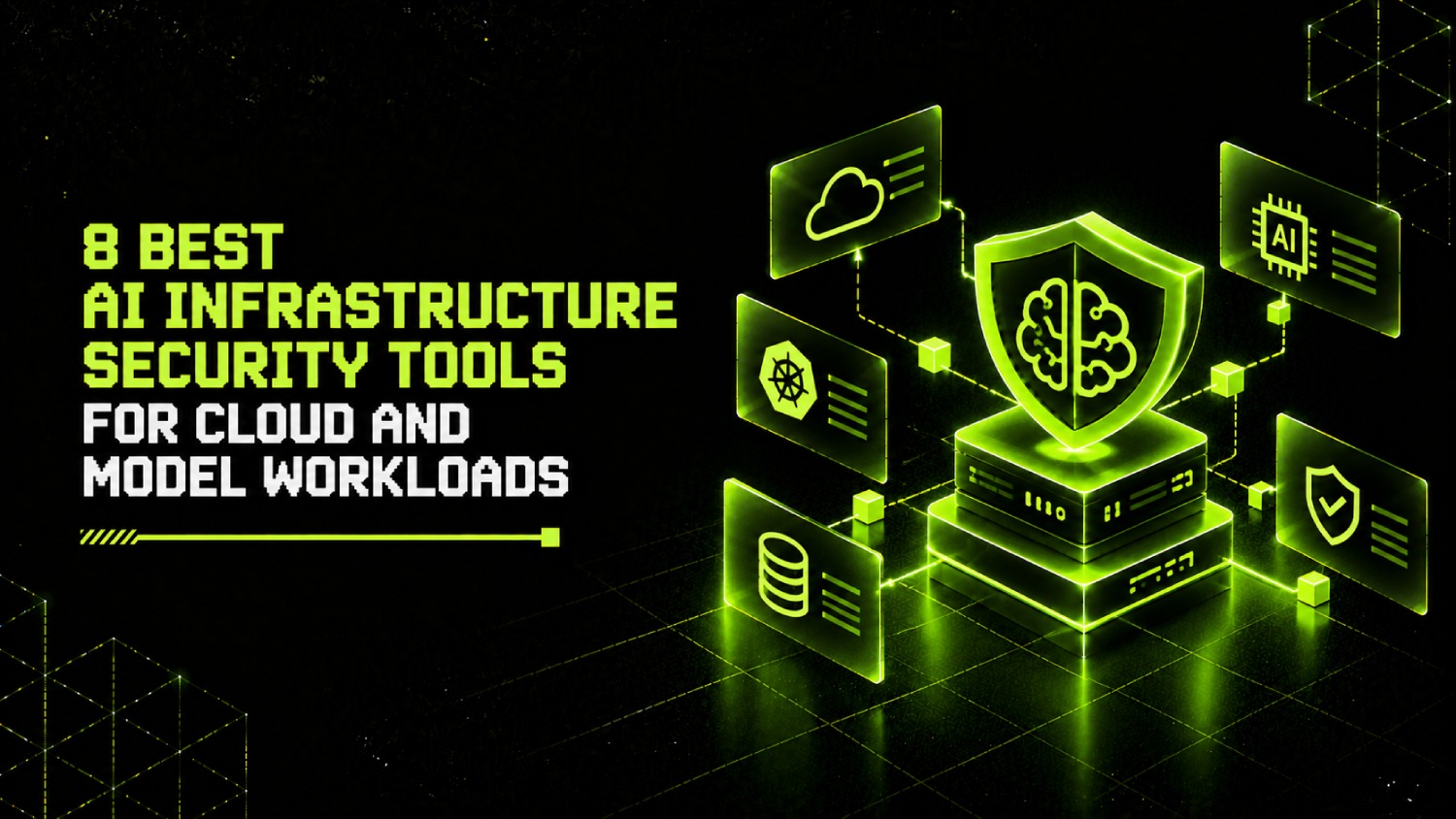
The best AI infrastructure security tools covering GPU clusters, training pipelines, and model artifacts include Wiz, Sysdig, Upwind, Orca Security, Aqua Security, Palo Alto Prisma Cloud, Protect AI, HiddenLayer, JFrog Security, and Chainguard. No single platform covers all three layers of the AI stack. Most security teams need to combine infrastructure-side CNAPP or CWPP coverage with purpose-built model artifact scanning and pipeline-specific controls to close the full attack surface.
Why AI Infrastructure Is Not Just Cloud Infrastructure With a GPU Attached
Most cloud workload protection platforms were designed around a specific mental model: containerized services pulling from registries, talking to databases, and exposing APIs. That model fits a web application. It does not fit a GPU training cluster running distributed PyTorch jobs across eight A100 nodes with shared NFS-mounted weights, a Jupyter notebook server accessible over a VPN, and an MLflow tracking server with no authentication on its artifact store.
The attack surfaces that generic CWPP tools miss are concrete and architectural. GPU scheduling in Kubernetes requires elevated privileges that CWPP policy engines were not built to flag contextually. Training jobs download model weights from external registries, and those weights can contain serialized Python objects that execute arbitrary code on deserialization. Notebook servers run as long-lived processes with broad filesystem access and are routinely over-privileged. Vector stores hold high-value embeddings and are often reachable by any service in the same VPC because query-level authorization was never wired up.
The SecurityOpsWire AI Stack Ownership Map names three distinct layers that a complete AI security program must cover: the infrastructure layer (cloud control plane, Kubernetes nodes, GPU scheduling, networking), the pipeline layer (training jobs, notebooks, experiment tracking, data loaders, CI/CD for ML), and the artifact layer (model weights, ONNX files, vector store contents, model registries, container images carrying model dependencies). Every tool in this list covers at least one layer well. None covers all three equally. Knowing which layer you are buying coverage for is the only purchase decision that matters.
What Makes Model Artifact Security Different From Container Image Scanning?
Container image scanning looks for known CVEs in OS packages and application dependencies. Model artifact scanning looks for something categorically different: serialized execution in formats that were never designed with security in mind.
The canonical example is Python’s pickle format. A pickle file is not data. It is a serialized bytecode stream that executes Python code when loaded. A malicious actor can publish a model to a public registry in pickle format, and when a data scientist runs torch.load("model.pt") without safe loading flags, arbitrary code runs in the training environment. PyTorch’s own serialization documentation warns explicitly against loading untrusted pickle files, and the PyTorch 2.x safe serialization path using safetensors format addresses this, but adoption is not universal across ML tooling in production.
ONNX files present a different problem. ONNX is a standardized format, but ONNX models can contain custom operators, and those operator implementations may be loaded from shared libraries at inference time. A tampered ONNX file that references a malicious custom operator produces code execution at the inference server, not at training time, making detection harder because the payload activates in production. Unsigned ONNX artifacts in a model registry, with no provenance chain, are the ML equivalent of an unsigned binary in a software package registry.
For teams evaluating the model supply chain problem alongside software supply chain controls more broadly, the overlap with ASPM tooling for GitHub-centric engineering teams is real: SBOM generation, dependency pinning, and registry provenance controls apply to ML pipelines as directly as they apply to application code.
The 8 Tools, Mapped to the Layer They Actually Cover
The tools below are sequenced roughly from infrastructure-layer coverage to artifact-layer coverage. The comparison table that follows shows which layer each tool addresses and what it does not model natively.
| Tool | Primary Layer | GPU Cluster Coverage | Pipeline / Notebook | Model Artifact Scanning | Vector Store Controls | Kubernetes Inference | Pricing Model |
|---|---|---|---|---|---|---|---|
| Wiz | Infrastructure | Partial (node config) | Limited | No | No | Strong | Not publicly disclosed |
| Sysdig | Infrastructure + Pipeline | Yes (eBPF runtime) | Yes (container runtime) | No | No | Strong | Not publicly disclosed |
| Upwind | Infrastructure + Pipeline | Yes (eBPF) | Yes | No | No | Strong | Not publicly disclosed |
| Orca Security | Infrastructure | Partial (agentless scan) | Limited | No | No | Moderate | Not publicly disclosed |
| Aqua Security | Infrastructure + Pipeline | Yes | Yes (CI/CD) | Partial (image layers) | No | Strong | Not publicly disclosed |
| Palo Alto Prisma Cloud | Infrastructure | Partial | Limited | No | No | Strong | Not publicly disclosed |
| Protect AI | Artifact + Pipeline | No | Yes (MLflow, Jupyter) | Yes (pickle, ONNX, H5) | Yes | Moderate | Not publicly disclosed |
| HiddenLayer | Artifact | No | Limited | Yes (format-agnostic) | No | Moderate | Not publicly disclosed |
None of these vendors publish per-node or per-cluster pricing publicly. This is consistent across the CNAPP and AI security categories: vendors quote based on environment size, number of cloud accounts, node count, or workload type. Requesting a proof-of-concept with your actual cluster size is the only way to compare cost against coverage.
Wiz: Strong Infrastructure Posture, No Artifact Awareness
Wiz approaches AI infrastructure the same way it approaches everything else: agentless scanning of cloud configurations, Kubernetes cluster posture, and network exposure. For teams that need to know whether their GPU node pools are reachable from the internet, whether their Amazon SageMaker training jobs have overly permissive IAM roles, or whether their EKS cluster hosting inference workloads has public endpoints, Wiz surfaces those findings through its Security Graph.
Wiz has added AI-specific posture findings, including detections around exposed AI service endpoints and misconfigured cloud AI services such as Amazon Bedrock and Azure OpenAI. Its AI Security Posture Management capabilities map to the infrastructure and configuration layer. It does not scan model weights, analyze pickle files, or monitor training job runtime behavior.
The operational reality is that Wiz is fast to deploy for infrastructure coverage because there is no agent. A team that already runs Wiz for cloud security gets AI infrastructure posture at no additional deployment cost if they configure the AI-relevant findings. Adding artifact or pipeline coverage requires a separate tool. Wiz fits teams that already own it and want to extend existing coverage, not teams buying a dedicated AI security platform.
Sysdig and Upwind: Runtime Telemetry Into GPU Nodes and Training Containers
Sysdig uses eBPF-based runtime instrumentation to capture syscall telemetry from containers and Kubernetes nodes. In an AI infrastructure context, this means Sysdig can observe what a training container actually does at runtime: which files it reads, which processes it spawns, which network connections it opens. If a malicious pickle file triggers a reverse shell during a training job, Sysdig’s runtime detection layer sees the process execution and the outbound connection.
That detection capability is real and operationally meaningful for ML pipeline security. The limit is that Sysdig does not inspect model artifacts before they are loaded. It detects the consequences of a malicious artifact at execution time, not the artifact itself at rest. Detection at execution time still stops the attack if the alert fires quickly and the training job can be killed, but it is a different control point than scanning artifacts before they enter the pipeline.
Upwind takes a similar eBPF-based approach but positions itself more explicitly around cloud-native and AI workload contexts, with runtime DNA profiling that builds behavioral baselines per workload. For Kubernetes-based inference serving, Upwind’s behavioral baselining can flag inference containers doing things outside their trained profile, such as spawning unexpected child processes or opening connections to external hosts. Upwind suits teams running Kubernetes-native AI stacks that want runtime protection without the Sysdig licensing footprint.
Orca Security: Agentless Coverage With Gaps at Runtime

Orca Security scans cloud environments using out-of-band snapshot analysis, reading disk images without deploying agents. For AI infrastructure, this surfaces misconfigured storage buckets holding training data, exposed MLflow servers, and vulnerable packages inside training container images before they run. The agentless model is its main advantage for teams that cannot or will not deploy agents to GPU nodes.
The gap is structural: agentless snapshot analysis cannot see what a training job does at runtime. It sees the configuration and package state of a workload at scan time, not the behavior of a distributed training run across eight nodes. Teams that need both posture and runtime coverage from a single vendor will find Orca’s runtime story thinner than Sysdig’s or Upwind’s. For teams that prioritize fast cloud posture coverage over runtime depth, Orca’s deployment simplicity is a genuine operational advantage.
Aqua Security: CI/CD Integration That Reaches Into ML Pipelines
Aqua Security covers the full container lifecycle from build to runtime, and its CI/CD integration is where it differentiates for ML pipeline security. Aqua can enforce policy gates in a GitHub Actions or Jenkins pipeline that runs model training or fine-tuning workflows, blocking container images that carry critical CVEs before a training job starts. Its supply chain security capabilities include image signing and provenance verification, which apply directly to base images used in training and inference containers.
Aqua does not scan model weights or pickle files natively. It scans the container image layers that carry those weights as package artifacts, so it will catch a CVE in the PyTorch version bundled in a training image, but it will not analyze the model.pt file that training job downloads at runtime from an external registry. That gap matters because the most dangerous ML supply chain attacks target the weights themselves, not the framework version.
For teams running Kubernetes-based inference, Aqua’s runtime policies can block privilege escalation inside inference pods, limit network egress from serving containers, and alert on unexpected binary execution. This maps directly to the inference server attack surface that Kubernetes introduces: a compromised inference container with cluster-admin bindings is a full cluster compromise.
Palo Alto Prisma Cloud: Broad Platform, AI Coverage Still Maturing

Palo Alto Prisma Cloud is a broad CNAPP platform covering CSPM, CWPP, KSPM, and data security. For AI infrastructure, its value is in organizations that already run Prisma Cloud and want consistent policy enforcement across cloud accounts that host AI workloads alongside conventional workloads. The platform can flag overly permissive service accounts attached to SageMaker instances, exposed vector database endpoints, and Kubernetes workloads with privileged pod security contexts.
AI-specific artifact scanning is not a Prisma Cloud capability as the platform is currently positioned. Teams evaluating Prisma Cloud for AI infrastructure security are buying infrastructure and Kubernetes posture coverage, not model supply chain controls. For organizations with an existing Palo Alto enterprise agreement, the marginal cost of extending Prisma Cloud coverage to AI workloads may be low. For organizations buying new, the platform’s breadth means it takes longer to configure and tune for AI-specific findings than a purpose-built tool.
Protect AI: The Closest Thing to a Full AI Security Platform
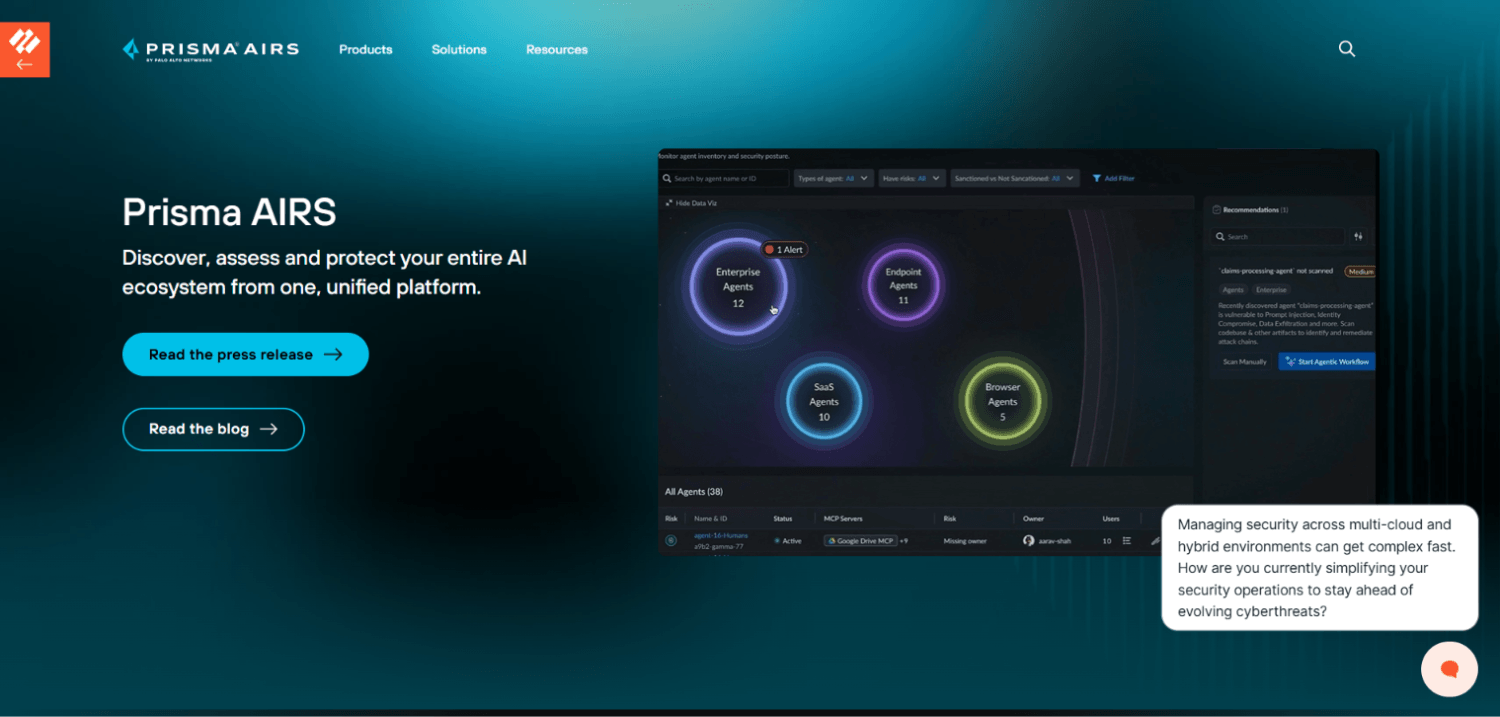
Protect AI is purpose-built for the AI and ML security problem. Its product suite covers model scanning, ML supply chain security, and AI application security. The model scanning capability, delivered through its Guardian product, scans pickle files, ONNX files, H5 files, and other serialization formats for malicious payloads before they are loaded. This is the control point that prevents the pickle deserialization attack at artifact ingestion rather than at execution time.
Protect AI also runs huntr.com, an AI and ML bug bounty platform that has surfaced vulnerabilities in MLflow, PyTorch, TensorFlow, and other ML framework components. This gives the company meaningful signal on the actual vulnerability surface in ML tooling, which informs its detection logic in a way that general CWPP vendors do not have access to.
Its Recon product addresses vector store and RAG pipeline security by discovering and mapping AI assets including embedding stores, model registries, and API endpoints. For teams asking which tool covers the model supply chain, Protect AI is the most complete answer available today. The operational trade-off is that it does not replace infrastructure-layer coverage. A team running Protect AI still needs Wiz, Sysdig, or equivalent coverage for the Kubernetes and cloud infrastructure layer beneath it.
The question of non-human identity coverage for AI workloads, including service accounts attached to ML training jobs and the API keys those jobs use to pull from model registries, sits at the boundary between Protect AI’s scope and dedicated non-human identity security platforms that model machine credential sprawl across cloud environments.
HiddenLayer: Model Detection Without Looking at Infrastructure
HiddenLayer focuses on model security: scanning model files for embedded malicious content, detecting adversarial attacks against production models, and monitoring model behavior in serving environments. Its Model Scanner product analyzes serialized model formats across multiple frameworks to detect malicious payloads without executing the model, using static analysis techniques rather than sandbox execution.
The positioning is sharply different from the infrastructure tools above. HiddenLayer does not care about your Kubernetes RBAC configuration or your S3 bucket policy. It cares about whether the model file itself carries a payload and whether the model behaves consistently when inputs are crafted to manipulate its outputs. For teams that have infrastructure coverage handled and need to close the artifact layer gap specifically, HiddenLayer is the most focused option in this list.
The operational question is integration: model scanning needs to sit in the path between model download or registry pull and model loading. HiddenLayer’s scanner can run as a CI/CD gate or as a pre-load check in the inference serving pipeline. Teams deploying NVIDIA NIM-based inference containers should treat model scanning as a prerequisite step before any NIM container loads external weights, which aligns with NVIDIA’s NIM security guidance around validating model provenance before deployment.
JFrog Security and Chainguard: Supply Chain Controls That Extend to ML Artifacts
JFrog Security addresses the supply chain layer through its Artifactory-based artifact management and Xray scanning engine. For ML teams, the relevant capability is using JFrog Artifactory as a controlled internal registry for model artifacts, with Xray policies that enforce scanning before artifacts are promoted to production. JFrog does not have ML-specific format scanning for pickle or ONNX payloads natively, but it provides the registry control plane that makes scanning by a dedicated tool possible and auditable. If your model weights pass through Artifactory with a mandatory scan gate, you have a chain of custody record that generic cloud storage does not provide.
Chainguard approaches the problem from the base image layer. Its hardened container images for ML frameworks, including Python, PyTorch, and TensorFlow base images, reduce the CVE surface area of training and inference containers by building from minimal, cryptographically signed base images. A Chainguard-based training container image will carry a lower CVE count than a standard python:3.11 base, and the image signature provides provenance verification. Chainguard does not scan model weights or monitor runtime behavior. Its contribution is reducing the exploitable surface in the container infrastructure that model workloads run inside.
For teams working on software supply chain security across both application and ML contexts, the SBOM and provenance controls that JFrog and Chainguard provide connect directly to the AI Security Posture Management discipline that tracks what AI assets exist, where they run, and whether they carry known vulnerabilities.
How to Handle Kubernetes-Based Inference Workloads Specifically
Kubernetes-based inference is where the infrastructure layer and the artifact layer collide in the same attack surface. An inference pod pulls a model file from a registry, loads it into GPU memory, and serves predictions over an HTTP endpoint. Three specific attack paths require controls that generic CWPP does not address without configuration work.
First, the registry pull trust problem: if the inference pod pulls model weights from an external registry at startup without signature verification, an attacker who compromises the registry or the network path can substitute a malicious weight file. The mitigation is admission control that validates artifact signatures before allowing a pod to start, using tools like Kyverno or Sigstore’s Cosign extended to cover model artifact signatures alongside container image signatures.
Second, the GPU memory isolation problem: GPU memory is not isolated between processes in the way CPU memory is on a properly configured host. A workload that shares a GPU node with an inference server can, in certain configurations, read residual data from GPU memory left by the inference process. This is a GPU cluster security concern that CWPP tools do not model. The mitigation is strict workload isolation at the GPU node level, with separate node pools for sensitive inference workloads and Kubernetes resource quotas that prevent co-tenancy of untrusted jobs on the same physical GPU.
Third, the inference API exposure problem: inference endpoints are often created with broad network exposure because the team building the model cares about latency, not access control. A Kubernetes Service of type LoadBalancer with no authentication layer in front of a large language model endpoint is a full model extraction risk. The mitigation is enforcing authenticated API gateways in front of all inference endpoints, combined with runtime monitoring that alerts on anomalous query volumes that may indicate model extraction attempts. Sysdig and Upwind both surface this class of anomaly at the network and syscall level.
For teams thinking about how inference API security connects to the broader agentic AI surface, the controls at the model serving layer are distinct from but complementary to the MCP security controls that govern how agents call tools and models through structured protocols.
Vector Store Access Control: The Gap Nobody Owns
Vector stores, including Pinecone, Weaviate, Chroma, and self-hosted pgvector instances, hold high-density embeddings that encode sensitive information. Querying a vector store does not require knowing what data was embedded. With access to the query API, an attacker can perform embedding inversion, systematically reconstructing original documents from their vector representations. This is not a theoretical attack path; it is a documented inference attack class against dense retrieval systems.
None of the CWPP or CNAPP tools in this list apply query-level authorization to vector stores. What they can do is flag misconfigured network exposure (Wiz, Orca), detect anomalous query patterns at the syscall or network level (Sysdig, Upwind), and identify vector store endpoints with no authentication (Wiz, Protect AI Recon). Full query-level authorization requires controls at the application layer, enforcing that a query to the vector store only retrieves embeddings the requesting principal is authorized to see. Protect AI’s Recon capability maps vector store assets and their exposure. Actual query authorization is an application design problem, not a tool problem.
The access control pattern for vector stores mirrors the challenge of data security posture for AI data pipelines more broadly, which is where DSPM tooling for AI data security intersects with this infrastructure security problem.
An Illustrative Scenario: Three Teams, Three Gap Profiles
Consider three representative AI infrastructure teams and the coverage gaps each one has.
Team A is a 600-person enterprise running a proprietary fine-tuned LLM on EKS, pulling base weights from Hugging Face, storing embeddings in a self-hosted Weaviate cluster on EC2, and exposing inference via an internal API gateway. They already run Wiz for cloud posture. Their gap is the artifact layer: nobody is scanning the Hugging Face weight files before they enter Artifactory, and nobody monitors Weaviate query patterns. They need Protect AI or HiddenLayer for artifact scanning plus JFrog Artifactory as a controlled registry gate, and they should add anomalous query detection to the Weaviate tier.
Team B is a 150-person ML-first startup running distributed PyTorch training on bare-metal GPU servers co-located in a data center, with a Jupyter Hub deployment accessible over a VPN and MLflow tracking server with default configuration. They have no CWPP at all. Their gaps are everywhere, but the highest priority is the Jupyter Hub server, which runs as a privileged process with access to training data, and the MLflow tracking server, which stores model artifacts with no access control by default. Sysdig or Upwind on the GPU servers gives them runtime visibility. Protect AI covers the MLflow and Jupyter attack surface specifically.
Team C is a platform engineering team at a 3,000-person enterprise that has standardized on Kubernetes for inference serving and uses Chainguard base images for all ML containers. They have Aqua Security in the CI/CD pipeline. Their gap is query-level authorization on the vector store and the fact that their model artifact promotion workflow has no signature verification step. Adding Cosign to the artifact promotion pipeline and deploying Protect AI’s Guardian as a pre-promotion scan gate closes the two specific gaps without adding another full platform.
Frequently Asked Questions
What is different about securing GPU and training workloads versus normal cloud workloads?
GPU workloads introduce three controls that normal CWPP does not model: GPU memory isolation between co-tenant workloads, model artifact integrity for weights loaded at runtime, and notebook server access control for interactive training environments. Training jobs also download external artifacts at runtime, creating a supply chain attack surface that does not exist in conventional containerized services where all dependencies are in the image at build time.
Which tools in this list cover the model supply chain specifically?
Protect AI and HiddenLayer are the purpose-built options. Protect AI’s Guardian scans pickle, ONNX, and H5 files for malicious payloads before they are loaded. HiddenLayer’s Model Scanner performs static analysis across serialized model formats. JFrog Artifactory provides the registry control plane for enforcing scan gates as part of model artifact promotion workflows. None of the CNAPP tools in this list, including Wiz, Orca, and Prisma Cloud, scan model weights natively.
How do these tools handle Kubernetes-based inference environments?
Sysdig, Upwind, and Aqua provide the strongest Kubernetes-native runtime coverage for inference workloads, using eBPF or kernel instrumentation to observe container behavior at the syscall level. Wiz and Prisma Cloud cover Kubernetes Security Posture Management, flagging misconfigurations like privileged inference pods and exposed LoadBalancer Services. Admission controllers such as Kyverno, used alongside model signing tools like Cosign, handle artifact provenance validation at pod startup time, which none of the CWPP tools do natively.
What does pickle deserialization mean as an attack vector in ML pipelines?
Python’s pickle format serializes arbitrary Python objects, including callable functions. A malicious model file in pickle format can execute arbitrary Python code when loaded with torch.load() or similar calls. An attacker who places a malicious model file in a public registry or compromises a model download path can achieve code execution on the training server or inference node that loads the file. The mitigation is using safe serialization formats like safetensors for model weights and scanning any pickle-format artifacts from untrusted sources before loading.
How should vector store access control be implemented beyond network-level controls?
Network-level controls limit which services can reach the vector store endpoint but do not control what any authorized service can query. Query-level authorization requires middleware that enforces user or service identity context on each vector store query, filtering results to embeddings the requesting principal is permitted to retrieve. This is an application design decision. Infrastructure tools like Wiz and Protect AI Recon can discover exposed vector store endpoints and flag missing authentication, but they cannot enforce row-level or embedding-level query authorization without application-layer changes.
What does NVIDIA’s NIM security guidance recommend for model provenance?
NVIDIA’s NIM documentation addresses model validation as part of deploying NIM microservices. The core recommendation is validating model artifact provenance before a NIM container loads external weights, which aligns with using a pre-load scanning step from a tool like HiddenLayer or Protect AI Guardian before the NIM inference container starts. Teams running NIM-based inference should treat the weight file as an untrusted input until it passes a format and integrity scan, regardless of where it was sourced.
Do any of these tools cover both infrastructure and model artifact layers without combining vendors?
No single tool in this list covers the infrastructure layer and the model artifact layer with equal depth. Protect AI comes closest to covering the artifact and pipeline layers together. Sysdig comes closest to covering the infrastructure and pipeline runtime layers together. Every complete AI infrastructure security program currently requires at least two tools: one for the infrastructure and Kubernetes layer, and one for the model artifact and ML-specific pipeline layer. This is a genuine gap in the market, not a vendor marketing problem.
How to Map Coverage Against the Three-Layer Framework Before You Buy
Before evaluating any tool in this list, run the SecurityOpsWire AI Stack Ownership Map against your actual environment. Write down which team owns each of the three layers: infrastructure (who manages the Kubernetes clusters and cloud accounts), pipeline (who owns the MLflow server, the Jupyter Hub, the training job CI/CD), and artifact (who decides which model weights are trusted and how they enter the environment). In most organizations, the infrastructure layer has an owner, the pipeline layer is split between ML engineers and platform engineering, and the artifact layer has no owner at all.
That ownership gap is the purchase decision. Buying a second CNAPP for AI posture when you already have Wiz does not solve the actual problem. The artifact layer, specifically the question of how model weights are validated before they are loaded in training or inference environments, is where most AI infrastructure security programs have no control and no owner today.
The teams that will get ahead of this are the ones that assign artifact layer ownership before a malicious weight file makes it onto a GPU node. The tooling exists. Protect AI and HiddenLayer both have production-ready scanning capabilities. The blocker is almost never the tool. It is the three-way conversation between security, ML engineering, and platform engineering about who is responsible for what happens between a model download and a model load. Have that conversation first, then buy the tool that covers the gap the conversation surfaces.