
TLDR
- Most teams treat software supply chain security as dependency scanning against a CVE database. That covers one of four distinct attack surfaces: the open source packages you pull in, the build system that assembles them, the artefacts that come out, and the delivery path to production.
- Attacks on build infrastructure are growing because build systems carry implicit trust that most security controls never inspect. A compromised build step can produce a signed, clean-looking artefact from clean source code.
- SBOM generation is table stakes in 2026, but an SBOM auditors and customers accept requires a verifiable provenance chain, not just a file listing package names. CISA’s SBOM guidance and the SLSA framework define what that chain must include.
- The tools in this list are organized by the supply chain layer they primarily address, because buying a dependency scanner when your build pipeline has no integrity controls is the wrong sequence.
- Pricing is rarely published in this category. Where public pricing exists, it is linked. Where it does not, the pricing model is described and noted as undisclosed.
The nine platforms covered here address software supply chain security tools across four layers: open source dependency risk, build pipeline integrity, artefact signing and attestation, and delivery provenance. The strongest programs combine controls at all four layers. Most teams start with dependency scanning and stop there, which leaves the build and artefact layers uncontrolled. Tools like Chainguard, Sigstore, and Anchore address those gaps; tools like Snyk, Endor Labs, and Socket focus on the dependency layer with meaningful differences in signal quality. The right starting point depends on which layer has no control today.
What Does Software Supply Chain Security Actually Cover Beyond Dependency Scanning?
Dependency scanning checks whether a known-vulnerable version of a package is in your code. It is useful and necessary. It does not tell you whether your build system was tampered with, whether the artefact that came out of CI matches the source that went in, or whether the container image you deployed to production was the one your pipeline produced.
The SecurityOpsWire Supply Chain Layer Model breaks the problem into four discrete controls:
- Dependency layer: which open source packages enter your build, what licenses they carry, whether they are malicious or contain known vulnerabilities.
- Build layer: whether the build environment itself is trustworthy, hermetic, and producing a reproducible output. SLSA v1.0 defines four levels of build integrity, with Level 3 requiring a hosted, hardened build platform that generates signed provenance.
- Artefact layer: whether the compiled binary, container image, or package is signed, has an attached SBOM, and can be verified as unchanged between build and deployment.
- Delivery layer: whether the image or package that reaches production is the one that was approved, and whether every step from source to deployment is logged and auditable.
Most commercial tools lead with dependency scanning in their marketing because that is where buyers start. The table below maps each tool in this list to its primary layer, which is the signal that actually differentiates them.
| Tool | Primary Layer | Secondary Coverage | SBOM Output | SLSA Support |
|---|---|---|---|---|
| Chainguard | Artefact / Delivery | Dependency | Yes (CycloneDX, SPDX) | Yes (SLSA Level 3+) |
| Sigstore / cosign | Artefact (signing) | Build provenance | Via attestation | Yes |
| Anchore | Artefact / SBOM | Dependency, delivery | Yes (CycloneDX, SPDX) | Partial |
| JFrog Xray | Artefact / Delivery | Dependency | Yes (CycloneDX, SPDX) | Partial (via Artifactory) |
| Snyk | Dependency | Container, IaC | Yes (CycloneDX) | Limited |
| Endor Labs | Dependency | SBOM, reachability | Yes | Limited |
| Socket | Dependency (malicious) | Build | Limited | Limited |
| Sonatype Lifecycle | Dependency | Artefact, SBOM | Yes (CycloneDX) | Partial |
| Mend.io | Dependency | SBOM, license | Yes (SPDX, CycloneDX) | Limited |
Note: Cycode and Legit Security are positioned primarily as application security posture management (ASPM) platforms that include supply chain controls as part of a broader developer security program. They are referenced in the context section but not profiled as standalone supply chain tools here, because their primary differentiation is pipeline visibility and policy enforcement across the SDLC rather than artefact integrity or SBOM generation.
Layer 1: Which Tools Best Secure Open Source Dependencies?
Dependency security tools split into two camps: those that scan against known CVE databases (SCA tools), and those that analyze package behavior to detect malicious intent before a CVE exists.
Snyk Open Source
Snyk Open Source is the most widely deployed SCA tool in developer-led security programs. Its differentiation is developer experience: IDE plugins, pull request checks, and a fix PR feature that opens a remediation pull request automatically. The vulnerability database is curated by Snyk’s security research team rather than pulled directly from NVD, which means Snyk sometimes publishes findings before NVD has scored them and vice versa.
For teams already using Snyk for static analysis, adding open source scanning to the same workflow has low friction. The weakness is the same as any CVE-based tool: it cannot detect a malicious package that has not yet been reported. Snyk publishes pricing tiers including a Free plan, a Team plan, and an Enterprise plan on its product page; Enterprise pricing requires a quote.
Endor Labs
Endor Labs is built around reachability analysis: rather than flagging every vulnerable package in your dependency tree, it traces whether the vulnerable code path is actually called by your application. A Java application with 200 vulnerable transitive dependencies might have five where the vulnerable function is reachable. That distinction matters for prioritization. Teams running Java or Go with deep dependency trees will see a meaningful reduction in prioritized findings compared to tools that surface all dependencies regardless of reachability.
Endor Labs includes SCA functionality and surfaces SBOM-related output in the context of compliance reporting, according to its product documentation. Pricing is not publicly disclosed.
Socket
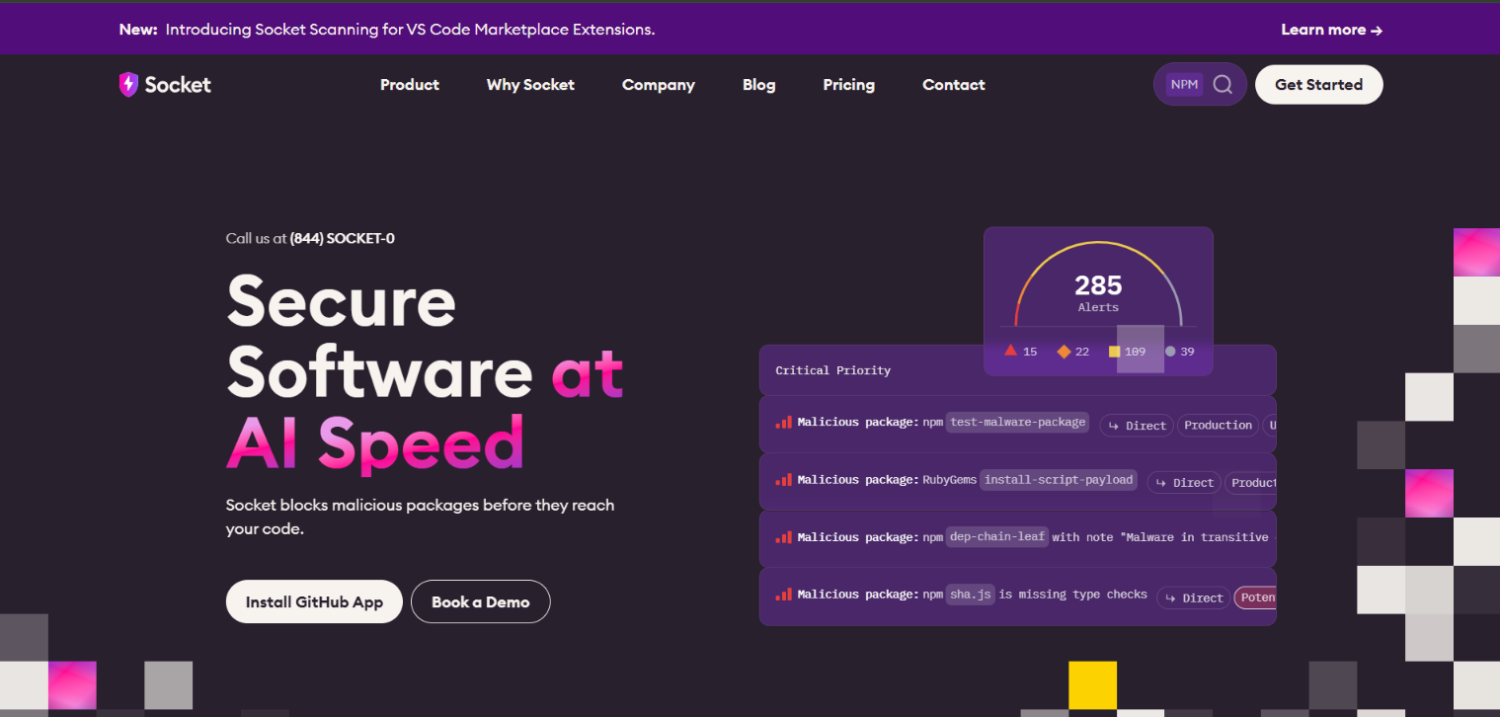
Socket takes a different approach to open source risk management. Rather than matching package versions against a vulnerability database, it analyzes package behavior at install time: new install scripts, new network requests, unexpected permission requests, and indicators of dependency confusion or typosquatting. This catches malicious packages before they appear in any CVE feed.
The trade-off is alert volume. Behavioral detection flags things that are suspicious but not necessarily malicious, which means a triage workflow is required. For teams worried about the class of attacks where a legitimate package is taken over by a malicious maintainer and a new version published before any researcher notices, Socket addresses a gap that pure SCA tools leave open. Pricing is available on a per-seat model through Socket’s pricing page.
Sonatype Lifecycle
Sonatype Lifecycle integrates into build tools (Maven, Gradle, npm) and blocks vulnerable or policy-violating dependencies at build time rather than at scan time. The Sonatype OSS Index provides the underlying vulnerability data. For organizations that want hard gates at the build step rather than advisory findings in a dashboard, Lifecycle’s build-time blocking is a practical control. Pricing is not publicly disclosed.
Mend.io
Mend.io covers SCA, container scanning, and license compliance in one platform. Its SBOM export in both SPDX and CycloneDX format is well-documented and has been used in regulated industry workflows where auditors want a machine-readable inventory. For teams that need license risk management alongside vulnerability tracking, Mend handles both without requiring a separate tool. Pricing is not publicly disclosed.
Layer 2: Which Tools Verify Build Pipeline Integrity?
Build pipeline integrity is where most security programs have a genuine gap. A build system that accepts arbitrary input from a pull request, uses a mutable base image, or runs without provenance signing can be manipulated to produce a different artefact from the same source code. SLSA v1.0 defines what a provenance record must contain and what build platform requirements must be met to generate a trustworthy one.
Sigstore and cosign
Sigstore is an open source project under the Linux Foundation that provides the cryptographic infrastructure for signing software artefacts without managing long-lived private keys. The core tools are cosign (for signing and verifying container images and other artefacts), fulcio (a certificate authority that issues short-lived signing certificates tied to an OIDC identity), and rekor (a transparency log that records all signing events).
The operational model matters here. Cosign does not require a developer to manage a private signing key. The signer authenticates with their GitHub, Google, or Microsoft identity, fulcio issues a certificate for that session, and the signing event is logged in rekor. Anyone verifying the artefact later can confirm both the signature and that it was logged at the time of signing. For teams pursuing SLSA Level 2 or 3, cosign is the standard implementation path.
Sigstore is free and open source. Operational cost is the CI integration effort and the policy enforcement layer that checks signatures at admission. Chainguard and others build commercial products on top of Sigstore’s infrastructure.
Chainguard
Chainguard addresses the artefact and delivery layers through two products: Chainguard Images and Chainguard Libraries. Chainguard Images are minimal, hardened container base images built from source, signed with cosign, and published with attached SBOMs. Because they are built from source with known provenance, they typically carry far fewer CVEs than standard upstream base images, a comparison Chainguard publishes for common images on its site.
For teams whose primary problem is a container base image with hundreds of CVEs, Chainguard Images shift the problem structurally rather than requiring ongoing patching of upstream vulnerabilities. The images are rebuilt and re-signed when upstream packages change. Chainguard does not publish per-image pricing publicly; enterprise licensing is negotiated. Chainguard Libraries extends the same approach to language runtime packages (Java, Python, Go).
Layer 3: Which Tools Produce SBOMs That Auditors and Customers Accept?
An SBOM is only as useful as the provenance chain behind it. A file listing package names and versions with no verifiable link to the build that produced it does not satisfy CISA’s minimum elements for SBOMs, which require supplier name, component name, version, distinct identifiers, dependency relationships, author of the SBOM data, and a timestamp. More demanding customers and federal procurement processes expect the SBOM to be signed and traceable to a specific build event.
Anchore Enterprise
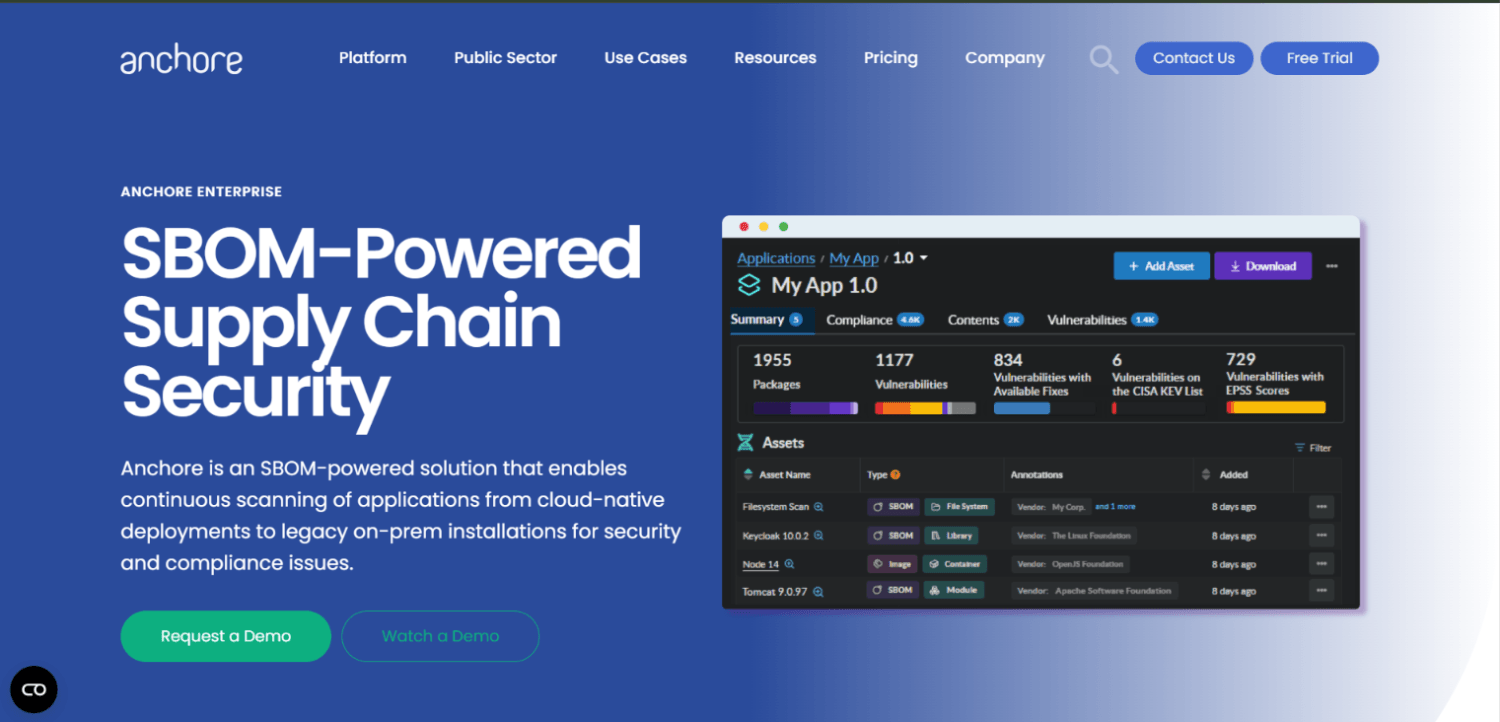
Anchore Enterprise is built around the SBOM as a first-class artefact. The platform generates SBOMs at build time using its Syft tool (also available as open source), stores them in a central policy engine, and then uses the SBOM as the basis for vulnerability matching, policy evaluation, and compliance reporting. This means vulnerability scans are always run against a fixed inventory rather than re-scanning a live container, which matters for audit reproducibility.
Anchore’s policy engine supports VEX (Vulnerability Exploitability eXchange) documents, which allow teams to assert that a specific CVE is not exploitable in their context and have that assertion travel with the SBOM. For organizations responding to customer security questionnaires or government procurement requirements, being able to produce a signed SBOM with an attached VEX document is a practical differentiator. Anchore does not publish per-environment pricing publicly.
JFrog Xray and Artifactory
JFrog Xray works inside the JFrog Platform, with Artifactory as the artefact repository. The integration means Xray scans every artefact as it moves through the repository, blocking promotion to production registries based on policy. The SBOM generation uses CycloneDX and SPDX formats. For teams already running Artifactory as their binary repository, adding Xray is the lowest-friction path to artefact-level scanning and SBOM generation.
JFrog’s model is platform-centric: the security value is tied to using Artifactory. Teams using other registries (ECR, GCR, Nexus) can integrate Xray, but the experience is less cohesive. Xray pricing is bundled with the JFrog Platform and is not publicly itemized at a per-repository level.
Layer 4: Which Tools Track Delivery Provenance From Commit to Production?
Delivery provenance answers a specific question: is the running workload in production traceable, step by step, to a specific commit in a specific repository, through a verified build, with no unsigned intermediate steps? Most organizations cannot answer that question without assembling evidence from multiple systems.
Tools like Cycode and Legit Security position themselves as application security posture management platforms with supply chain visibility, meaning they map the full SDLC pipeline, identify where controls are missing (no branch protection, no required code review, build steps running without provenance), and surface policy violations across the pipeline. Their coverage of the delivery layer is broader than deep: they will tell you that a pipeline step lacks signing, but they are not the tool that adds the signing. They work as inventory and policy layers above the tools that provide the actual controls.
For teams that need to answer the board question “can we trace our production workloads back to source?” without a six-month implementation project, ASPM platforms with supply chain coverage are a practical starting point. The deeper controls described in layers 1 through 3 are what fill the gaps those platforms surface. SecurityOpsWire’s coverage of ASPM tools for GitHub-centric engineering teams goes deeper on that evaluation.
How Do These Tools Map to SLSA Compliance Requirements?
SLSA is a framework developed within Google and now stewarded by the OpenSSF. SLSA v1.0 defines four levels, each requiring progressively stronger guarantees about build provenance:
- SLSA Level 1: Build process is scripted and produces provenance. Protects against accidental mistakes in the build.
- SLSA Level 2: Build uses a version-controlled build service and provenance is signed. Protects against unauthorized builds.
- SLSA Level 3: Build runs on a hardened, isolated build platform with no persistent credentials and signed provenance generated by the platform itself, not the developer.
Most commercial CI platforms (GitHub Actions, GitLab CI, Google Cloud Build) support SLSA Level 2 or Level 3 provenance generation through existing integrations. The tooling question is not usually “which tool generates provenance” but “which tool verifies it at admission and enforces policy against it.”
Sigstore’s cosign is the verification layer most widely used for this. Chainguard’s images ship at SLSA Level 3 by design. Anchore’s policy engine can evaluate provenance attestations as part of admission decisions. JFrog’s Artifactory can enforce signature requirements before promoting artefacts.
For teams in regulated industries or responding to federal procurement requirements, CISA’s software supply chain security guidance maps directly to SLSA levels and specifies which controls satisfy which requirements. Starting with CISA’s guidance rather than a vendor’s SLSA marketing is the faster path to a defensible program.
What Does This Actually Cost Per Repository or Per Artefact?
The pricing question is genuinely hard to answer because almost no vendor in this category publishes per-repository or per-artefact rates. Here is an honest accounting of what is and is not publicly available.
| Tool | Pricing Model | Public Pricing? | Notes |
|---|---|---|---|
| Snyk | Per developer, per product | Partial (free tier available) | Enterprise pricing requires a quote |
| Socket | Per seat / organization | Yes (see site) | Free tier for public repos |
| Sigstore / cosign | Open source, free | Yes (no cost) | Operational cost is CI integration effort |
| Chainguard Images | Per image / enterprise agreement | No | Developer tier available; enterprise pricing not disclosed |
| Anchore Enterprise | Per environment / per node | No | Anchore Engine is open source; Enterprise pricing not disclosed |
| JFrog Xray | Bundled with JFrog Platform | No per-unit rate | Platform pricing requires quote |
| Endor Labs | Not publicly disclosed | No | Enterprise SaaS, quote-based |
| Sonatype Lifecycle | Not publicly disclosed | No | Enterprise, quote-based |
| Mend.io | Not publicly disclosed | No | Enterprise, quote-based |
The pricing model matters more than any undisclosed rate, because the model tells you where costs scale. Per-developer pricing scales with headcount. Per-repository pricing scales with application sprawl. Per-scan pricing scales with CI frequency and can become expensive in continuous deployment environments. When evaluating quotes, ask specifically whether artefact scans, SBOM generations, and API calls to the policy engine count against any metered component of the contract.
Which Tool Fits Which Team and Environment?
A 20-person engineering team shipping a SaaS product in containers to AWS needs a different starting point than a 500-person organization managing a mix of internal builds, commercial off-the-shelf software, and third-party integrations. Here is a direct-answer mapping based on the distinct strengths of each tool.
| Scenario | Best Starting Point | Why |
|---|---|---|
| High CVE count in container base images, team wants structural fix | Chainguard Images | Removes the vulnerability class at the source rather than requiring ongoing patching |
| Need signed SBOMs for government or enterprise customer requirements | Anchore Enterprise | SBOM-native policy engine, VEX support, audit-reproducible scanning against stored SBOM |
| Developer-led security with IDE and PR integration priority | Snyk | Strongest developer toolchain integration; fix PR automation reduces remediation friction |
| Detecting malicious packages before CVE publication | Socket | Behavioral detection at install time, not CVE matching |
| Deep Java or Go dependency trees needing prioritization | Endor Labs | Reachability analysis reduces false-positive volume on transitive dependencies |
| Already running Artifactory, need artefact scanning | JFrog Xray | Native integration eliminates registry integration overhead |
| Adding cryptographic signing to existing CI pipelines | Sigstore / cosign | Open source, no key management overhead, widely supported |
| SDLC policy enforcement with visibility across pipelines | Cycode or Legit Security | Pipeline inventory and posture management across the full SDLC |
| License compliance alongside vulnerability management | Mend.io or Sonatype Lifecycle | Both provide license risk management as a first-class feature alongside SCA |
Consider a company running 80 microservices, each containerized, deploying to Kubernetes via GitHub Actions. The security team has two people. Dependency scanning is already in place through Snyk. The gap is that no container image is signed, there is no artefact policy at admission, and no SBOM exists for any image. In that environment, the right next purchase is not a second dependency scanner. Adding cosign signing to the GitHub Actions workflow, enforcing signature verification at Kubernetes admission with a policy controller, and generating SBOMs with Anchore’s open source Syft closes three of the four supply chain layer gaps without a budget line item beyond implementation time. The incremental commercial decision is then whether Anchore Enterprise’s policy management and VEX support justifies the license cost given customer or compliance requirements.
For a deeper look at how software supply chain controls fit into a broader application security program, SecurityOpsWire’s comparison of ASPM platforms for GitLab and DevSecOps teams covers how pipeline security policies integrate with SBOM and signing workflows.
What Should Security Teams Know About Open Source Risk Management Beyond CVEs?
The CVE-centric model of open source risk has a structural blind spot: it only catches vulnerabilities that have been reported, triaged, and published. Package takeovers, dependency confusion attacks, and typosquatting do not generate CVEs until after they have been discovered in the wild, which may be after they have been installed in production environments.
CISA’s supply chain security guidance addresses this by recommending that organizations verify package integrity at install time, not just at scan time. That means checking that the package hash matches the registry, that the package was signed by a trusted key, and that no unexpected scripts run during installation. Socket’s behavioral model is one commercial implementation of this principle. For teams managing internal package mirrors or proxies, Sonatype’s Nexus Firewall applies the same logic at the proxy level, blocking suspicious packages before they reach developer machines.
The non-human identity angle is worth noting: package registries, build systems, and signing infrastructure all rely on service accounts, deploy keys, and API tokens with significant access. A compromised build service account has more access to the software supply chain than most developers do. SecurityOpsWire’s coverage of non-human identity security platforms addresses how those credentials are inventoried and controlled, which is a prerequisite for any meaningful build pipeline security program.
How Does Red Hat Fit Into the Software Supply Chain Security Stack?
Red Hat addresses supply chain security through its distribution model rather than as a standalone security product. Red Hat Enterprise Linux and Red Hat Universal Base Images are built with documented provenance and signed packages. Red Hat Advanced Cluster Security (ACS), built on the open source StackRox project, provides container image scanning and policy enforcement in Kubernetes environments. For organizations standardized on the Red Hat platform, ACS reduces integration overhead for image scanning and admission control. For organizations running mixed environments, the coverage is narrower than a dedicated artefact security platform.
Red Hat also contributes to Sigstore and to the OpenSSF more broadly, which means the open source tooling community around supply chain signing benefits from their engineering input without requiring a Red Hat commercial relationship to use it.
Frequently Asked Questions
What is the difference between SCA and software supply chain security?
Software composition analysis (SCA) scans code dependencies for known vulnerabilities and license issues. Software supply chain security is broader: it covers the build system that processes those dependencies, the artefacts the build produces, and the delivery path from build to production. SCA is the dependency layer of the supply chain. A program that only runs SCA has no controls on the other three layers, which is where several notable build-time compromises have occurred.
What should an SBOM contain to satisfy auditors and customers?
CISA’s minimum elements require: supplier name, component name, version string, other distinct identifiers (such as package URL or CPE), dependency relationships, SBOM author, and a timestamp. Customers in regulated industries or federal procurement often additionally require the SBOM to be signed and traceable to a specific build event, which means the SBOM must be generated at build time rather than reconstructed after the fact from source analysis.
What is SLSA and which tools support it?
SLSA (Supply-chain Levels for Software Artifacts) is a framework for defining and verifying build integrity. It defines four levels of assurance, from scripted builds with provenance at Level 1 to isolated, hardened build platforms with platform-signed provenance at Level 3. Chainguard ships images at SLSA Level 3. Sigstore’s cosign is the primary tool for signing and verifying SLSA provenance. GitHub Actions, GitLab CI, and Google Cloud Build can generate SLSA provenance through official generators maintained by those platforms.
How do dependency confusion attacks work and which tools detect them?
A dependency confusion attack exploits package manager resolution logic to cause a build system to pull a malicious public package instead of a legitimate internal one of the same name. The attacker publishes a package with the same name as an internal package but a higher version number. Tools that detect this at the behavioral layer, like Socket, can flag unexpected new packages with suspicious characteristics. Sonatype’s Nexus Firewall and similar proxy-level controls can enforce allow-lists that block packages not explicitly approved, which prevents the confusion class entirely rather than detecting it after the fact.
Can open source tools replace commercial supply chain security platforms?
For the artefact signing and SBOM generation layers, open source tools, specifically Sigstore’s cosign and Anchore’s Syft, are production-grade and widely deployed. The gap is operational: policy management, audit reporting, VEX document handling, and integration with ticketing or CI gates require either custom engineering or a commercial platform. For a two-person security team, the engineering cost of building and maintaining custom policy enforcement often exceeds the license cost of a commercial platform. For teams with dedicated platform engineering resources, the open source stack is viable at scale.
What is a VEX document and when does it matter?
A VEX (Vulnerability Exploitability eXchange) document is a machine-readable assertion that a specific CVE is not exploitable in a specific product, because the vulnerable code path is not reachable, the vulnerable component is not present in the final build, or a mitigating control exists. VEX travels alongside an SBOM and allows downstream consumers to suppress known false-positive findings without losing traceability. It matters most when delivering software to enterprise customers or government agencies who run their own vulnerability scans against received artefacts and expect documented justification for unfixed CVEs.
How does software supply chain security relate to securing AI-generated code?
AI code generation tools can introduce dependencies, inline code snippets, and package versions that a developer would not have chosen manually, without going through the normal code review gate that catches supply chain risk. The same SBOM, SCA, and build integrity controls apply, but the volume and velocity of introduced dependencies can increase significantly. SecurityOpsWire’s analysis of ASPM platforms for AI-generated code security covers how application security programs are adapting to this pattern.
What does build pipeline integrity actually require in practice?
At minimum: version-controlled build definitions (no ad hoc build scripts run manually), a build environment that does not persist state between runs, signed provenance generated by the build platform (not by the developer triggering the build), and a verification step at artefact promotion or admission that checks the signature and provenance chain. SLSA Level 2 is achievable with current CI platforms without additional commercial tooling. Level 3 requires a hosted, hardened build service, which GitHub Actions and Google Cloud Build support through their official SLSA build provenance generators. Teams managing application security posture across multiple application repositories may also want to review SecurityOpsWire’s coverage of application vulnerability prioritization tools for how to sequence remediation once supply chain findings surface.
The Layer You Are Missing Is Probably Not Dependencies
Most security programs that have been running for more than two years have some form of dependency scanning. It may be inconsistently enforced, the findings may be largely unactioned, but the tooling exists. The layer that genuinely has no control in most organizations is artefact integrity: nothing verifies that the container image running in production is the one the pipeline produced, signed, and approved. That gap is addressable without a large budget. Sigstore’s cosign, a Kubernetes admission controller with signature verification, and Anchore’s open source Syft for SBOM generation can close that gap at a cost measured in engineering hours rather than license fees.
The commercial decision comes when the operational overhead of maintaining those open source components, generating audit-ready reports, managing VEX documents for customer deliveries, or enforcing consistent policy across dozens of pipelines exceeds what the team can absorb. That is where Anchore Enterprise, JFrog Xray, or Chainguard’s commercial offering earns its cost. The build and delivery layers matter most, and they are the ones most purchase decisions underweight because the marketing surface area of dependency scanning is so much larger than everything else in the category.
Start by mapping your own four layers against the SecurityOpsWire Supply Chain Layer Model: dependencies, build, artefacts, delivery. The layer with no current control is the one to buy for. Any tool that covers a layer you already have controls on, however imperfectly, is a lower priority than one that addresses a layer with zero coverage today.