
- AI coding assistants don’t introduce random vulnerabilities. They repeat the same insecure pattern across every file they touch, which means a single misconfigured prompt or a bad training example becomes a systematic codebase-wide defect.
- Existing SAST scanners catch the same classes of bug in AI-generated code that they catch in human-written code. The difference is volume and consistency: what used to be an occasional oversight is now a predictable pattern you can scan for at commit time.
- The practical control is a gate at pull request or merge, not a quarterly audit. Tools that run only in CI/CD pipelines after the fact are catching issues too late, after the pattern has replicated.
- Platform coverage varies: some tools integrate directly with GitHub Copilot and Cursor; others treat all code the same and rely on the scanner, not the source, to catch the issue. For most teams, the scanner-side approach is sufficient and easier to operate.
- AI code remediation tools like Corgea and Mobb change the economics of fixing findings. Whether that matters depends on whether your bottleneck is detection or fix throughput.
The best ASPM platforms for ai generated code security tools evaluation are Semgrep, Checkmarx One, Snyk, Apiiro, Cycode, Endor Labs, Aikido Security, Ox Security, and GitHub Copilot Autofix. Each addresses a different part of the AI code risk chain: static analysis at commit, software composition analysis for AI-suggested dependencies, code risk profiling for pattern concentration, and automated remediation. Corgea, Mobb, and Sourcegraph round out the picture for teams whose fix throughput is the constraint, not detection.
What Actually Fails Differently in AI-Generated Code
The skepticism on threads like the Reddit discussion about trusting AI code in security-critical systems is not unfounded, but it points at the wrong problem. Large language models do not produce exotic or novel vulnerability classes. The defects that show up in AI-generated code are familiar: SQL injection, hardcoded credentials, insecure deserialization, path traversal, improper input validation. Scanners already have rules for all of them.
The real problem is mechanical. A developer who writes an insecure pattern once introduces one instance. A coding assistant prompted to build a data access layer writes that insecure pattern into every function it generates, in one session, before a reviewer sees any of it. The research on AI-generated code security from academic institutions consistently finds that assistants generate insecure code at a rate that varies significantly by model, prompt, and code category, but the more operationally meaningful finding is the consistency: when a model gets something wrong, it gets it wrong the same way every time.
This is why the control has to sit at generation and review time, not at release. By the time a weekly SAST scan runs in a CI/CD pipeline, the pattern may already exist in dozens of functions across multiple modules. The gate belongs at the pull request.
The SecurityOpsWire AI Code Concentration Test: One Framework for Evaluating These Tools
Before comparing specific products, it is worth defining what you are actually evaluating. Most ASPM vendors market themselves as “AI-aware,” which means different things to different vendors. The AI Code Concentration Test is a four-question framework for separating tools that address the specific risk profile of AI-generated code from tools that are applying a general label to existing capabilities.
- Does the tool gate at PR or commit, or only at pipeline run? Tools that run only in scheduled CI jobs catch findings after the pattern has already propagated. PR-level or commit-level gates are the operative control.
- Can it detect repeated insecure patterns, not just individual instances? A tool that reports 47 instances of the same SQL injection pattern is less useful than one that surfaces “this pattern appears in 47 locations, probably originating from a single AI-generated template.”
- Does it scan AI-suggested dependencies as well as AI-generated code? Coding assistants frequently suggest third-party packages. Those packages carry their own vulnerability and license risk, separate from the generated code itself.
- What does the fix path look like? Detection without a usable fix workflow creates a backlog that teams ignore. Remediation velocity is part of the risk calculus.
Run this test against any vendor demo. The answers sort the field quickly.
9 Best ASPM Platforms for AI-Generated Code
| Tool | Primary Strength for AI Code | PR/Commit Gate | Dependency Scanning | Remediation Assist | Pricing Model |
|---|---|---|---|---|---|
| Semgrep | Custom rule authoring for AI code patterns | Yes | Supply Chain (separate product) | Autofix suggestions | Per developer, free tier available |
| Checkmarx One | Enterprise SAST + AI model risk posture | Yes | SCA included | Remediation guidance | Not publicly disclosed |
| Snyk | Developer-native IDE + PR scanning | Yes | Yes, core product | Fix PRs | Per developer, free tier available |
| Apiiro | Code risk profiling and change analysis | Yes | Yes | Risk-prioritized remediation | Not publicly disclosed |
| Cycode | Secrets detection + pipeline security | Yes | Yes | Limited | Not publicly disclosed |
| Endor Labs | Reachability-based SCA for AI dependencies | Yes | Core product | Upgrade recommendations | Not publicly disclosed |
| Aikido Security | Mid-market all-in-one AppSec | Yes | Yes | Autofix | Per developer, public pricing available |
| Ox Security | SBOM + supply chain risk for AI-generated output | Yes | Yes | Pipeline posture remediation | Not publicly disclosed |
| GitHub Copilot Autofix | In-editor fix generation for Copilot output | Yes (via Code Scanning) | Dependabot | Core capability | Included with GitHub Advanced Security |
1. Semgrep
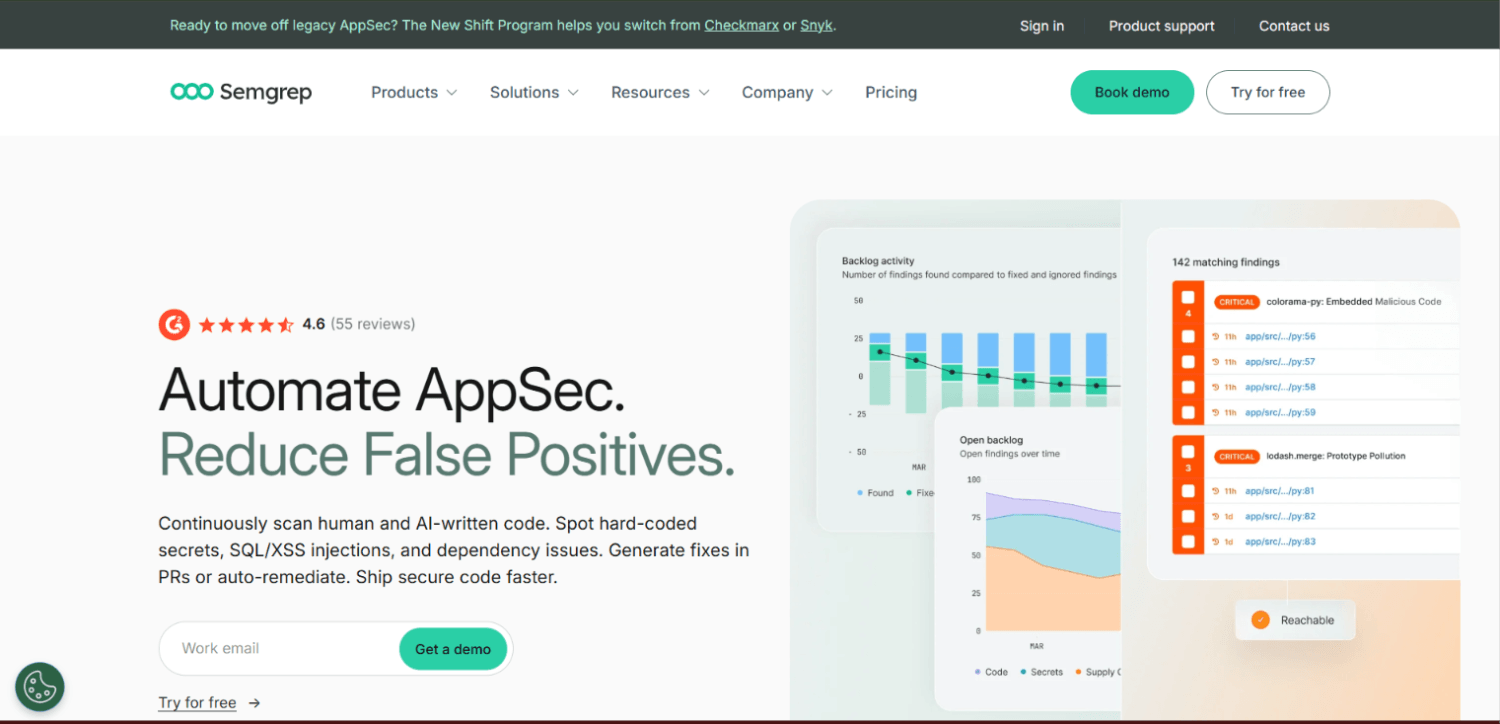
Semgrep earns its position here for one specific reason: custom rule authoring. When a coding assistant produces a consistently insecure pattern that your organization’s existing ruleset doesn’t catch, you can write a Semgrep rule to detect exactly that pattern and deploy it across every repository in under an hour. That is operationally important when you are dealing with pattern repetition at scale.
Semgrep Code runs as a PR check natively on GitHub, GitLab, and Bitbucket. The free Community tier covers a broad SAST ruleset. Semgrep Supply Chain, which handles dependency scanning, is a separate paid product. For teams whose AI-generated code risk is primarily in the code itself rather than suggested dependencies, the combination of free SAST plus a small set of custom rules covers most of the exposure without significant cost. For teams dealing with AI-suggested package imports, Supply Chain adds reachability analysis to filter noise from the SCA findings.
The operational cost people underestimate with Semgrep is rule maintenance. The community ruleset is extensive, but tuning it to your specific stack and suppressing false positives from AI-generated boilerplate takes engineering time. Budget for it.
2. Checkmarx One
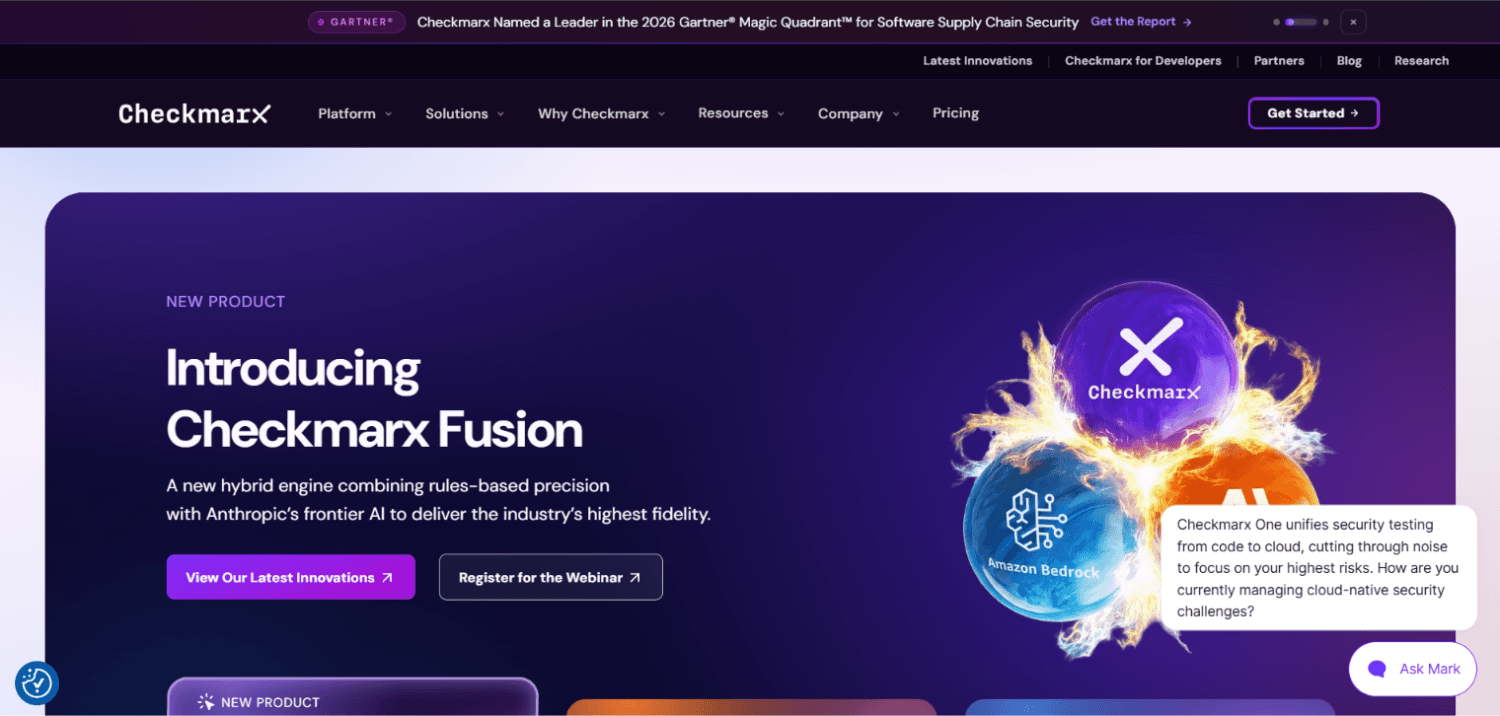
Checkmarx One is the enterprise-grade choice, and its CISO-facing positioning on AI code security is deliberately explicit. The platform covers SAST, SCA, IaC scanning, secrets detection, and API security in a single pane, and its documentation addresses AI-generated code risk directly, including guidance on governing coding assistant use within development workflows.
What Checkmarx offers beyond the scan is context. Its correlation engine ties a SAST finding to its data flow path, which is useful when you need to explain to a developer why a pattern the coding assistant generated is actually exploitable in your specific codebase, not just flagged by a rule. That reduces the “this is a false positive” friction that otherwise kills scan gate adoption.
Pricing is not publicly disclosed. Checkmarx quotes per environment and per developer count. For larger organizations already running Checkmarx SAST, One is a consolidation move rather than a net-new cost. For organizations evaluating from scratch, plan for an enterprise software negotiation cycle.
3. Snyk
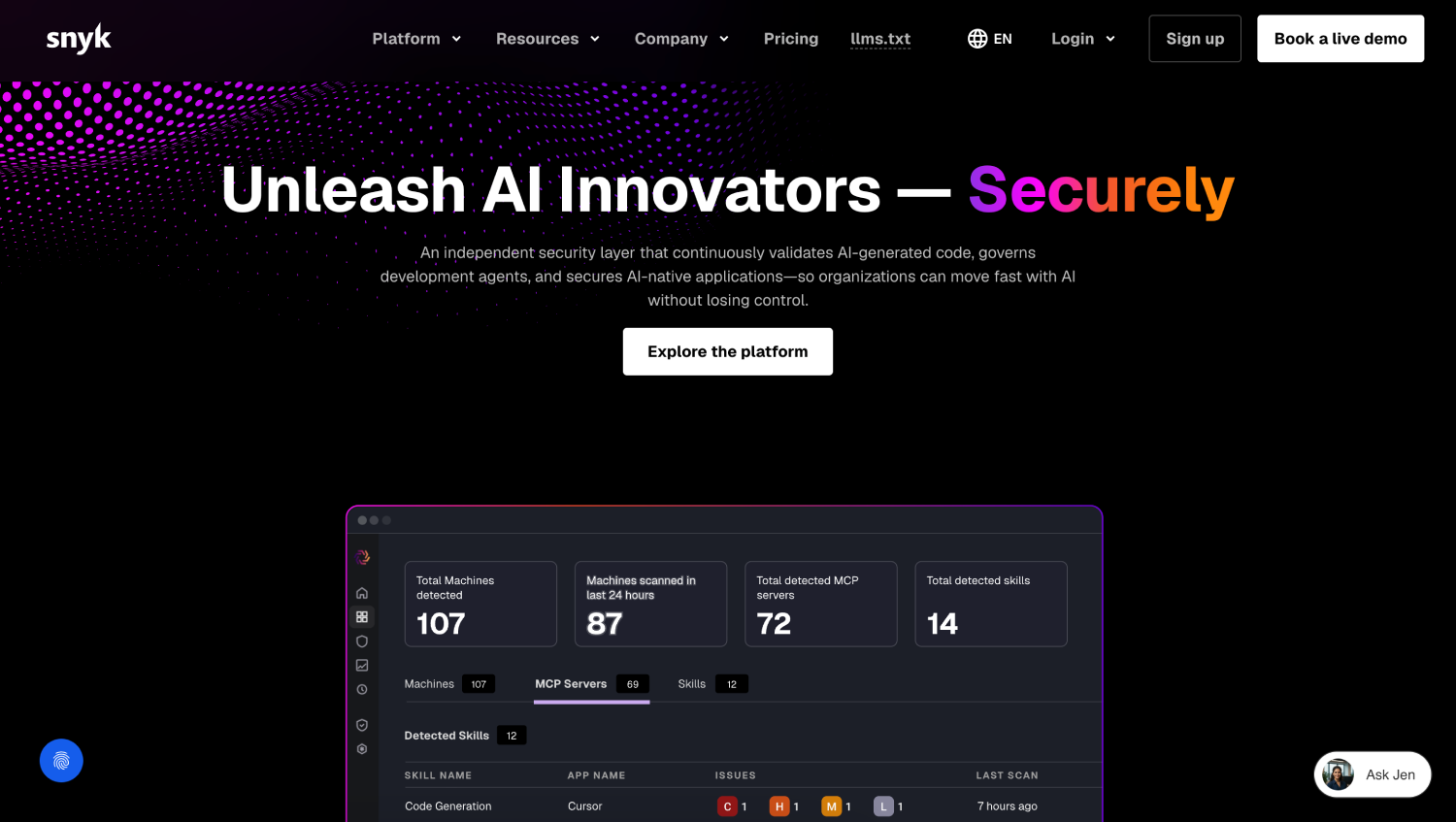
Snyk sits at the intersection of developer tooling and security scanning, which is precisely where AI-generated code risk lands. The IDE plugin gives developers scan results inline while they are accepting or editing Copilot suggestions. The PR check runs on merge. Fix PRs are automated for a subset of findings. That chain of friction removal is why Snyk has adoption in development-led organizations that would otherwise push back on a security gate.
Snyk’s SCA capability is the strongest part of the product for AI code risk. Coding assistants frequently suggest specific package versions, sometimes outdated ones. Snyk catches vulnerable and malicious packages before they land in the dependency graph. The SAST capability (Snyk Code) is solid but narrower than Checkmarx or Semgrep’s custom rule depth.
A free tier is available for open source projects and small teams. Paid tiers are per developer; Snyk does not publicly disclose per-unit pricing for enterprise plans, and quotes are negotiated per organization.
4. Apiiro
Apiiro takes a different angle: code risk profiling rather than pure vulnerability detection. Its platform builds a semantic model of your codebase and identifies which changes carry material risk based on what the code does, who changed it, and how it connects to sensitive logic or external exposure points. For AI-generated code specifically, this matters because a block of AI-written code that touches payment processing carries different risk than the same block touching internal logging.
Apiiro’s PR gate integrates with GitHub and GitLab and surfaces risk scores on each pull request. The platform connects code changes to cloud exposure and identity context, which is relevant if your organization also uses infrastructure-as-code generated by AI assistants. Pricing is not publicly disclosed.
For teams already managing ASPM at scale on GitHub-centric workflows, Apiiro’s risk-based prioritization reduces the noise problem that pure SAST gates create when AI output volume is high. It is not the right fit for a small team running one repository. The value shows at 50+ repositories with multiple development teams.
5. Cycode
Cycode leads with secrets detection and pipeline security, which makes it specifically relevant to one of the most consistent failure modes in AI-generated code: hardcoded credentials. Coding assistants that generate connection strings, API clients, or authentication modules frequently produce example code with placeholder credentials that developers leave in place. Cycode catches these at commit before they reach the repository.
Beyond secrets, Cycode covers SAST, SCA, and IaC scanning as part of its complete ASPM platform. The pipeline security capability audits the CI/CD pipeline itself, which is a distinct control point when AI is generating pipeline configuration files. Pricing is not publicly disclosed. Cycode positions for mid-market and enterprise organizations.
6. Endor Labs
Endor Labs is the right choice when your primary concern is AI-suggested dependencies rather than the generated code itself. Its core differentiation is reachability-based SCA: instead of flagging every vulnerable package in your dependency graph, it determines whether the vulnerable function is actually called in your application. The result is a dramatically smaller set of findings that warrant developer attention.
This matters specifically for AI-generated code because coding assistants tend to suggest well-known, well-used packages, many of which carry historical CVEs in functions that applications never call. A traditional SCA scanner generates noise; Endor Labs filters it down to what is actually reachable and therefore actually exploitable. Endor Labs also covers dependency lifecycle risk: deprecated packages, packages with no active maintainer, and packages that have had their ownership transferred, all of which show up in AI-suggested imports. Pricing is not publicly disclosed.
7. Aikido Security
Aikido Security is the mid-market option with the most transparent pricing model in this category. Its platform covers SAST, SCA, container scanning, IaC scanning, secrets detection, and DAST in a single product with a per-developer pricing model. Aikido makes pricing information available on its website; check aikidosecurity.com directly for current tiers, as published rates were not available in the sources reviewed for this article.
For a team of 20 to 80 developers moving fast with AI-assisted coding and no dedicated AppSec engineer, Aikido’s all-in-one coverage with automated PR blocking and autofix suggestions handles the most common AI code risks without requiring a security team to tune and maintain separate scanners. The trade-off is depth: Aikido’s SAST ruleset is less customizable than Semgrep’s, and its SCA reachability analysis is less sophisticated than Endor Labs’. If your codebase is large and complex, you will hit the limits. For most mid-market teams, those limits are not the constraint.
8. Ox Security
Ox Security focuses on the software supply chain from end to end, including SBOM generation, pipeline posture, and secrets detection. Its positioning on AI-generated code risk centers on the supply chain angle: when a developer accepts AI-generated code that imports packages, those packages enter the supply chain. Ox tracks them, generates the SBOM artifact, and flags risk introduced by new AI-suggested dependencies before they reach production.
Ox also monitors the CI/CD pipeline for configuration drift, which is relevant when pipeline YAML files are themselves AI-generated. A misconfigured GitHub Actions workflow generated by Copilot can introduce privilege escalation paths that SAST scanners don’t catch. Ox’s pipeline posture checks address this. Pricing is not publicly disclosed. For teams with mature AppSec programs evaluating ASPM as a consolidation layer, Ox’s supply chain and SBOM coverage complements rather than replaces existing SAST tooling.
9. GitHub Copilot Autofix
GitHub Copilot Autofix is described by GitHub’s documentation as running inside GitHub Code Scanning, using CodeQL for detection, and generating fix suggestions directly in the pull request interface. A developer who accepted a Copilot suggestion that introduced a vulnerability would see the fix suggestion in the same PR review interface, before merge. This article has not independently verified current feature behavior against GitHub’s documentation pages, and readers should confirm specifics at docs.github.com/en/code-security/code-scanning.
The coverage is tied to what CodeQL detects, which is broad but not as tunable as Semgrep and not as deep on dependency risk as Endor Labs. For organizations already running GitHub Advanced Security, Autofix adds meaningful remediation velocity with no additional tooling. For organizations not on GitHub Advanced Security, it is not a reason to switch platforms on its own. GitHub Advanced Security pricing is per committer; GitHub does not publicly disclose current pricing figures in the sources reviewed, so confirm directly with GitHub sales or at github.com/enterprise/advanced-security.
Where Corgea, Mobb, and Sourcegraph Fit
These three tools address a specific operational problem that the nine platforms above don’t fully solve: fix throughput when the finding backlog is large.
Corgea and Mobb are AI-driven remediation platforms. They take findings from existing SAST scanners (Checkmarx, Snyk, Semgrep, and others) and generate verified fix suggestions that developers can accept or reject. The distinction from Autofix is that they are scanner-agnostic and designed to handle large backlogs. For a team that ran its first comprehensive SAST scan on an AI-assisted codebase and found 600 findings, Corgea or Mobb can accelerate the fix cycle significantly. Pricing for both is not publicly disclosed; they position primarily for enterprise and mid-market teams with existing SAST investments.
Sourcegraph plays a different role: code intelligence and search across large codebases. Its relevance for AI code security is in pattern discovery. If you suspect a specific insecure pattern has been introduced across multiple repositories by AI-generated code, Sourcegraph lets you search for it structurally across your entire codebase in a way that grep-style tools don’t. It is not a scanner, but it is a useful investigation tool for teams quantifying the blast radius of a repeated AI-generated pattern before prioritizing the fix work.
What Does Scanning Cost as AI-Generated Code Volume Grows?
The cost question is not primarily about per-developer pricing. Most of the tools above use per-developer or per-committer models, which scale predictably with headcount rather than with AI output volume. The operational cost that scales with AI-generated volume is scanner throughput and false-positive triage time.
Consider a team of 30 developers where half are using Copilot for 40% of their output. The raw line count of code entering review each week increases substantially without a change in developer count. SAST scans that took three minutes now take eight. PR queues back up. Developers start bypassing the gate. This is the actual scaling problem, and it is a tuning problem, not a licensing problem.
The tools that handle AI-output volume best are the ones with the lowest false-positive rates on boilerplate code, because AI assistants generate a lot of boilerplate. Semgrep’s tunable rules let you suppress specific patterns. Endor Labs’ reachability analysis filters SCA noise. Apiiro’s risk scoring prevents every finding from being treated as equally urgent. These are the mechanisms that keep gates usable as AI-generated volume grows. A scanner with a high false-positive rate on AI boilerplate will be turned off by developers within two sprints.
For teams evaluating the best ASPM tools for GitHub-centric engineering teams, the AI code volume question intersects directly with how the platform handles PR check latency and finding deduplication.
Can Scanners Tell AI-Authored Code from Human Code?
Most cannot, and for the purposes of security scanning, they don’t need to. The scanner doesn’t care whether a SQL injection was written by a developer or generated by GPT-4. What matters is whether the vulnerability is present and reachable.
Some vendors have added AI code attribution features, typically working from metadata in commits or IDE telemetry. Checkmarx’s AI security posture documentation describes awareness of AI coding assistant context. This attribution is useful for reporting and governance: a CISO who needs to report on what percentage of recent findings originated in AI-generated code has a governance story, not just a detection story. It is not a prerequisite for effective scanning.
The more useful question is whether the scanner can detect repeated pattern occurrences and group them rather than reporting them as independent findings. A scanner that reports 47 SQL injection findings in 47 separate alerts creates 47 separate tickets. A scanner that groups them by pattern and traces them to a common origin reduces the remediation work to one fix applied systematically. Semgrep, Apiiro, and Checkmarx One all have grouping or correlation capabilities worth evaluating on this dimension.
Which Tools Gate AI Output at Commit or at Pull Request?
All nine platforms in the main list support PR-level or commit-level gates. The differences are in how they integrate and what the developer experience looks like when a gate blocks a merge.
Snyk and Semgrep have the most mature IDE plugin experiences, which means developers see findings before they even open a PR. GitHub Copilot Autofix surfaces findings in the PR itself. Checkmarx One, Apiiro, Cycode, and Ox run as PR checks that block merge on configurable policy thresholds. Endor Labs and Aikido follow the same pattern.
The developer experience question is worth operational attention. A gate that produces a finding with no clear guidance on how to resolve it gets bypassed. A gate that produces a finding with a one-click fix gets used. When evaluating these tools in a proof of concept, test the full loop: AI assistant generates code, developer commits, gate fires, developer sees finding, developer resolves it. Time that loop. If it takes more than five minutes for a developer to go from blocked to unblocked on a common finding type, the gate adoption will be poor.
Teams managing security across multiple cloud-native services and AI workloads can explore how these application-layer controls connect to runtime posture in our coverage of ASPM tools for cloud-native application security.
The Supply Chain Risk That AI Suggestions Add
AI coding assistants don’t only generate code. They suggest imports. They recommend specific package versions. They auto-complete dependency declarations in package.json, requirements.txt, and go.mod files. Each of those suggestions is a supply chain risk vector that operates independently of the vulnerability in the generated code itself.
The Cloud Security Alliance has documented AI and software supply chain risk as a distinct concern for organizations adopting coding assistants. The risk is specific: a model trained on older code may suggest packages that were safe at training time but have since received critical CVEs. A model with no visibility into your internal package registry may suggest public packages that shadow internal ones. These are not theoretical scenarios; they are reproducible behaviors in production coding assistant use.
Endor Labs is the most focused tool on this specific risk. Ox Security covers it from the SBOM and pipeline posture angle. Snyk’s SCA handles it at the package level. For teams that generate significant volumes of AI-assisted code and have not yet added a dedicated SCA gate, the supply chain angle is the highest-priority gap to close. For more on how non-human identity and secrets risks intersect with AI-generated code, the coverage of non-human identity security platforms addresses the credential and service account surface that AI-generated code frequently expands.
Frequently Asked Questions
What fails differently in AI-generated code compared to human-written code?
The vulnerability classes are the same: injection flaws, hardcoded credentials, insecure deserialization, improper input validation. The difference is pattern consistency and volume. A coding assistant that generates an insecure pattern produces it identically across every function it writes in a session. What would be an isolated human mistake becomes a systematic codebase-wide defect. Scanners catch the same bug either way; the control problem is catching it before it replicates across dozens of files.
Can SAST scanners detect whether code was AI-generated?
Most cannot, and most do not need to. Security scanners evaluate the code, not the author. Some platforms like Checkmarx One have added AI code attribution features that use IDE or commit metadata to flag AI-assisted changes, which is useful for governance reporting. For detection purposes, the scanner’s job is the same regardless of code origin: find the vulnerability, assess reachability, surface a fix path.
Which tools gate AI output specifically at pull request, not just in CI/CD pipelines?
All nine platforms covered in this article support PR-level gates: Semgrep, Checkmarx One, Snyk, Apiiro, Cycode, Endor Labs, Aikido Security, Ox Security, and GitHub Copilot Autofix. The meaningful distinction is developer experience: Snyk and Semgrep also provide IDE plugins so findings appear before a PR is opened. GitHub Copilot Autofix generates fix suggestions directly in the PR review interface. The rest run as PR checks that block merge based on configurable policy.
How does AI-generated code volume affect scanning costs?
Most tools in this category price per developer or per committer, not per line of code or per finding. Licensing costs scale with headcount, not AI output volume. The operational cost that scales with volume is triage time and scanner latency. Higher AI output volume means more findings, longer scan times, and greater false-positive burden. Tools with reachability analysis (Endor Labs), risk scoring (Apiiro), and tunable rules (Semgrep) manage this better as volume grows. A scanner without noise-reduction mechanisms becomes operationally unusable at high AI output volumes.
Is there a meaningful difference between ASPM platforms and standalone SAST scanners for AI code risk?
Yes. Standalone SAST scanners report findings at the code level. ASPM platforms add context: which findings are reachable from external entry points, which codebases have the highest concentration of risk, how findings connect to cloud exposure or identity permissions. For AI code risk specifically, the concentration analysis that ASPM platforms provide matters: knowing that 80% of your SQL injection findings originated in AI-generated code in one service is a finding you can act on. Knowing you have 80 SQL injection findings is less so.
What is the role of Corgea and Mobb if I already have a SAST scanner?
They address fix throughput, not detection. If your SAST scanner is finding issues in AI-generated code faster than your developers can fix them, Corgea and Mobb accelerate the remediation cycle by generating verified fix suggestions for existing findings from scanners like Checkmarx, Snyk, and Semgrep. They do not add detection capability. Their value is in organizations where the finding backlog, not the detection gap, is the limiting factor in reducing risk from AI-generated code.
Does GitHub Copilot Autofix work if we are not using GitHub Copilot for code generation?
Yes. Copilot Autofix is part of GitHub Code Scanning, which runs CodeQL analysis on any code in a GitHub repository regardless of how it was written. The autofix suggestions are generated for findings from CodeQL analysis, not specifically for Copilot-generated code. Organizations using other coding assistants like Cursor or Amazon CodeWhisperer can still use GitHub Copilot Autofix as a PR-level remediation tool as long as their repositories are on GitHub and they have GitHub Advanced Security enabled.
How should a security team prioritize which tool to add first?
Start with a PR-level SAST gate if you don’t have one. Semgrep with a base ruleset is deployable in a day and free for most team sizes. Add SCA for AI-suggested dependencies second: Snyk or Endor Labs depending on whether you need developer-native tooling or reachability-filtered findings. Add secrets detection third, specifically to catch hardcoded credentials in AI-generated authentication and connection code. Apiiro, Checkmarx One, or Ox for full ASPM consolidation is a phase-two decision once you have visibility into your baseline finding volume.
The Pattern Problem Is an Organizational Problem, Not Just a Tool Problem
Adding a PR gate catches AI-generated vulnerabilities before they ship. That is the right first move. But the scanner will keep firing on the same pattern as long as the coding assistant keeps generating it. The tools in this article are detection and remediation controls, not configuration controls on the assistant itself.
The more durable fix is upstream: giving developers context about which patterns to reject when an assistant generates them. That means security engineering owning the prompt guardrails, the IDE plugin configuration, and the team-specific Semgrep rules that encode your organization’s secure coding standards in a form the assistant’s output can be checked against. The gate at PR catches the failures; the custom rules make the gate specific to your actual risk, not just the generic OWASP Top 10.
Teams extending their security posture into AI agent infrastructure and production LLM deployments will find that the code-level controls here connect to a broader set of runtime risks covered in our analysis of AI agent security platforms and the AI security posture management tools designed for AI-deployed environments. The code is the starting point. What that code does at runtime, and what data it touches, is the next layer of the problem.