
- Workload identity assigns cryptographic identities to services, containers, and jobs so they authenticate without storing static credentials anywhere in your environment.
- SPIFFE defines the standard; SPIRE implements it. Everything else in this list either speaks SPIFFE natively, wraps it, or offers a proprietary equivalent you will eventually want to migrate off.
- AWS, Azure, and GCP each have a managed workload identity primitive. They solve the cloud-to-cloud credential problem but leave the Kubernetes-to-third-party-API problem to you.
- The operational cost of running an identity issuer is not the software license. It is the certificate rotation on-call, the attestation policy maintenance, and the audit trail you must produce when a regulator asks who authorized a workload to talk to your data store.
- The platforms below split into three categories: standards-based issuers, cloud-native managed services, and policy-plus-brokerage layers. Buying in the wrong category for your maturity level is the most common mistake security teams make.
Workload identity security covers the mechanisms that give software workloads verifiable, cryptographic identities so they can authenticate to other services without long-lived secrets. The field spans open standards like SPIFFE/SPIRE, cloud-native services like AWS IAM Roles for Service Accounts and Microsoft Entra Workload ID, service mesh identity from Istio, and commercial platforms from vendors including Aembit, HashiCorp, Teleport, and Venafi. Each solves a different slice of the problem, and choosing among them requires knowing which credential-removal problem you are actually trying to close.
Why Most Teams Misconfigure Workload Identity Before They Even Start
Platform teams treat workload identity as a deployment feature. Security teams inherit whatever the platform team shipped. The result is a Kubernetes cluster where service accounts have wildcard RBAC permissions, projected tokens expire after 24 hours by default, and nobody has an inventory of which workloads are talking to which external APIs using static secrets they committed to a Helm chart two years ago.
The governance gap is the real problem. Workload identity is not configuration management. It is the control plane that decides which code is allowed to act as which identity, under what conditions, with what scope. When that control plane has no owner, no audit log, and no rotation policy, it produces the same standing-privilege problem that PAM was supposed to solve for human accounts. The difference is that a compromised service account credential is often harder to detect because it generates API traffic that looks exactly like normal application behavior.
What follows is a direct evaluation of ten platforms. Each entry names what the tool actually does, where it fits in the workload identity stack, and what it costs to operate. For teams looking at broader non-human identity coverage, the non-human identity security platforms comparison covers the wider category including service accounts, API keys, and OAuth clients.
What Does SPIFFE Actually Standardise, and What Does SPIRE Add?
SPIFFE, the Secure Production Identity Framework for Everyone, is a set of open standards that defines how workloads prove who they are. It specifies three things: the format of a workload identity document (the SPIFFE Verifiable Identity Document, or SVID), the structure of a SPIFFE ID (a URI in the form spiffe://trust-domain/path), and the Workload API that a workload calls locally to receive its SVID without handling key material directly.
SPIFFE does not run anything. SPIRE, the SPIFFE Runtime Environment, is the reference implementation. SPIRE has two components: a server that acts as the certificate authority and manages attestation policies, and an agent that runs on each node, attests workload identity to the server, and delivers SVIDs via the Workload API. The agent attestation process is where the security actually happens: the agent uses node attestation plugins (AWS instance identity documents, GCP instance identity tokens, TPM attestation on bare metal) to prove to the server that the node is what it claims to be, and workload attestation plugins (Kubernetes, Docker, Unix process selectors) to confirm which specific workload is requesting an identity.
SPIFFE SVIDs come in two forms: X.509 certificates for mTLS, and JWT tokens for cases where mutual TLS is not practical. The two are not interchangeable security-wise. X.509 SVIDs provide channel-level identity and are harder to relay; JWT SVIDs are bearer tokens and carry the standard bearer-token relay risk. A common operational mistake is issuing JWT SVIDs for internal service-to-service calls where X.509 would work, because JWT feels more familiar to developers who have written OAuth flows.
SPIRE’s operational cost is real. Running a SPIRE server with high availability requires etcd or a supported datastore backend, certificate rotation automation, and attestation policy review whenever a new workload is onboarded. At steady state, a well-run SPIRE deployment is low maintenance. Getting to steady state for a 50-service Kubernetes environment typically takes a dedicated engineer two to four weeks, not counting downstream mTLS policy work.
What Is the Difference Between a Managed Identity and a Workload Identity in Azure?
A managed identity in Azure is a system-assigned or user-assigned identity tied to an Azure resource, such as a virtual machine, an App Service instance, or an Azure Kubernetes Service node pool. Azure manages the credential lifecycle; the resource fetches tokens from the instance metadata endpoint without storing secrets. Managed identities authenticate to Azure services that support Azure AD token-based auth.
Microsoft Entra Workload ID (formerly Azure AD Workload Identity) extends the model to Kubernetes pods inside AKS. The pod receives a projected service account token, which it exchanges for an Entra ID access token via OpenID Connect federation. The distinction matters for one specific reason: managed identities are node-level by default, so every pod on a node shares the managed identity unless you have explicitly deployed the workload identity webhook. Without the webhook, a compromised pod can request Azure tokens for resources it should never reach.
The AKS-specific version of this concern is the difference between a node-level managed identity (what the kubelet and system components use) and a pod-level workload identity (what your application pods should use). Using the node managed identity for application workloads is a common misconfiguration that flattens the security boundary between the control plane and your application layer. Microsoft’s documentation on AKS workload identity covers the webhook deployment and the federation configuration, but does not call out the node-versus-pod distinction as prominently as it should.
How Do AWS, Azure, and GCP Workload Identity Compare Across Clouds?
| Cloud | Feature Name | Kubernetes Integration | Federation Standard | Token Lifetime | Cross-Cloud Use |
|---|---|---|---|---|---|
| AWS | IAM Roles for Service Accounts (IRSA) | EKS OIDC provider per cluster | OIDC / JWT | Default 1 hour, configurable via STS | No native cross-cloud; use federation from external IdP |
| Azure | Entra Workload ID | AKS workload identity webhook | OIDC federation | Default 1 hour Entra access token | Supports external OIDC providers via federated credentials |
| GCP | Workload Identity Federation | GKE Workload Identity; external via WIF | OIDC, SAML, AWS | Short-lived; up to 1 hour via STS | Native cross-cloud: can federate AWS IAM or Azure AD tokens |
All three providers use short-lived tokens issued by their STS. The security difference is in what can federate in from outside. GCP Workload Identity Federation accepts AWS IAM, Azure AD, and arbitrary OIDC providers natively, which makes it the most flexible for multi-cloud pipelines. AWS IRSA is cluster-scoped: each EKS cluster gets its own OIDC issuer URL registered in IAM, and there is no native way to share an IRSA role between an EKS cluster and a workload running in a GitHub Actions runner without additional federation setup. Azure’s federated credentials feature allows external OIDC tokens to be exchanged for Entra access tokens, which is how GitHub Actions and other CI systems authenticate without storing Azure secrets.
The gap all three leave open: none of them solve authentication from a Kubernetes workload to a non-cloud API. If your service calls a third-party SaaS product, a database with its own credential system, or a partner API, you are back to managing a secret. That gap is exactly what the commercial platforms in this list fill.
The SecurityOpsWire Workload Identity Stack Test
Before evaluating individual tools, this framework helps teams identify which layer of the stack they actually need to fix. Call it the Stack Test. It has four checkpoints:
- Inventory checkpoint: Can you list every service account, pod identity, and cloud role your workloads currently hold? If no, start with discovery before buying an issuer.
- Credential checkpoint: Do your workloads authenticate using static secrets, API keys, or certificates with lifetimes longer than 24 hours? Every yes is a standing-credential risk that workload identity directly addresses.
- Attestation checkpoint: If a credential is stolen, does your identity system have enough context to detect an out-of-context use? Attestation-rich systems (SPIRE with process selectors, Entra with conditional access) can flag a service account token used from an unexpected IP or process tree. Static secrets cannot.
- Audit checkpoint: When a regulator asks which workload was authorized to access your key management service on a specific date, can you produce a signed, tamper-evident log? If the answer is a Jira ticket or a Terraform comment, you have a governance gap, not just a tooling gap.
Tools that score well on checkpoint one often fail checkpoint four. Tools that score well on checkpoint four (HashiCorp Vault audit logging, Entra sign-in logs) often require additional work to pass checkpoint two for non-cloud APIs. Use the Stack Test to locate your actual gap before evaluating features.
10 Best Workload Identity Security Platforms Evaluated
1. SPIFFE/SPIRE
SPIFFE and SPIRE are the open-source foundation of the workload identity stack. No other tool in this list matches SPIRE’s portability: it runs on Kubernetes, VMs, bare metal, and on-premises hardware with equal fidelity. SPIRE’s federation model allows multiple trust domains to establish cross-domain mTLS, which matters for multi-cluster or multi-cloud environments where you want workloads to authenticate to each other without routing through a cloud-specific STS.
The operational burden is real. SPIRE’s server needs a persistent datastore, a CA chain, and high-availability deployment for production. The attestation policy model is powerful but requires disciplined management: a misconfigured workload selector that over-matches will issue SVIDs to workloads that should not have them, silently. For teams with dedicated platform engineering capacity, SPIRE is the right foundation. For teams without it, one of the managed options below reduces the operational surface at the cost of portability.
Best for: Multi-cluster, multi-cloud, or hybrid environments with dedicated platform engineering. Starting point for any team that wants to own their PKI rather than delegate to a cloud provider.
2. Aembit
Aembit positions itself as a workload identity and access management platform focused specifically on the workload-to-external-API problem. Where SPIRE handles workload-to-workload authentication inside a trust domain, Aembit brokers authentication from your workloads to third-party SaaS APIs, databases, and cloud services. The architecture uses an access proxy model: workloads request access through the Aembit agent, policies evaluate the request in context, and short-lived credentials are injected at request time rather than stored in the workload environment.
The policy model includes time-of-day controls, workload attestation conditions, and integration with your existing IdP for approval workflows. Aembit does not publicly disclose pricing and quotes per environment. The operational cost is lower than running SPIRE for the external-API use case because Aembit manages the credential lifecycle and audit logging. The trade-off is lock-in to a commercial control plane for a security-critical path. For teams managing secrets sprawl across dozens of SaaS integrations, that trade-off is often worth it.
Best for: Teams whose primary pain is workload-to-SaaS credential management, not internal service mesh identity. Works well alongside SPIRE or Istio rather than replacing them.
3. HashiCorp Vault
HashiCorp Vault is not a workload identity issuer in the SPIFFE sense, but it is the most widely deployed workload credential management layer in enterprise environments. Vault’s Kubernetes auth method allows pods to authenticate using their projected service account tokens, which Vault validates against the Kubernetes API server. On successful auth, Vault issues dynamic, short-lived credentials for databases, cloud providers, PKI certificates, and SSH certificates.
The distinction from SPIRE is important: Vault controls what a workload can receive after authentication; SPIRE controls the workload’s identity itself. They are complementary. Many production deployments use SPIRE to issue the workload’s SVID and Vault to issue the dynamic database credential the workload needs after proving its identity. HashiCorp does not publicly publish Vault Enterprise pricing; Vault OSS is free and runs on self-managed infrastructure. Vault’s operational cost includes seal/unseal management, policy maintenance, and the audit log backend. The audit log is one of Vault’s strongest features: every credential issuance and every policy evaluation is recorded, which directly addresses the audit checkpoint in the Stack Test above.
Best for: Enterprises that need dynamic secrets for databases and cloud APIs, and that already have or can resource Vault operators. Less suited to teams that need an out-of-the-box SPIFFE-compliant identity issuer.
4. Microsoft Entra Workload ID
Microsoft Entra Workload ID is the right choice if your workloads authenticate primarily to Azure services and your developers are already using Entra for human identity. The federated credentials feature removes the need for client secrets in CI/CD pipelines and Kubernetes pods: instead of storing an Entra app registration secret in a GitHub Actions secret or a Kubernetes secret, the pipeline presents its OIDC token, and Entra validates it against the configured federation trust.
Entra Workload ID Free is included in Entra ID. Entra Workload ID Premium, which adds Conditional Access policies for workload identities and anomalous token detection, is licensed separately. Microsoft does not consistently publish current list pricing for Workload ID Premium on a public pricing page; check the Microsoft product terms directly for current rates. Conditional Access for workload identities is the feature that moves Entra Workload ID from a federation utility to a workload identity security control: you can require that a workload identity only receive tokens when the request originates from a specific IP range or network location, which adds context-aware enforcement that static secrets cannot provide.
Best for: Azure-centric environments, especially those with AKS and Azure DevOps or GitHub Actions pipelines. Does not solve multi-cloud or on-premises workload authentication.
5. AWS IAM Roles for Service Accounts (IRSA)
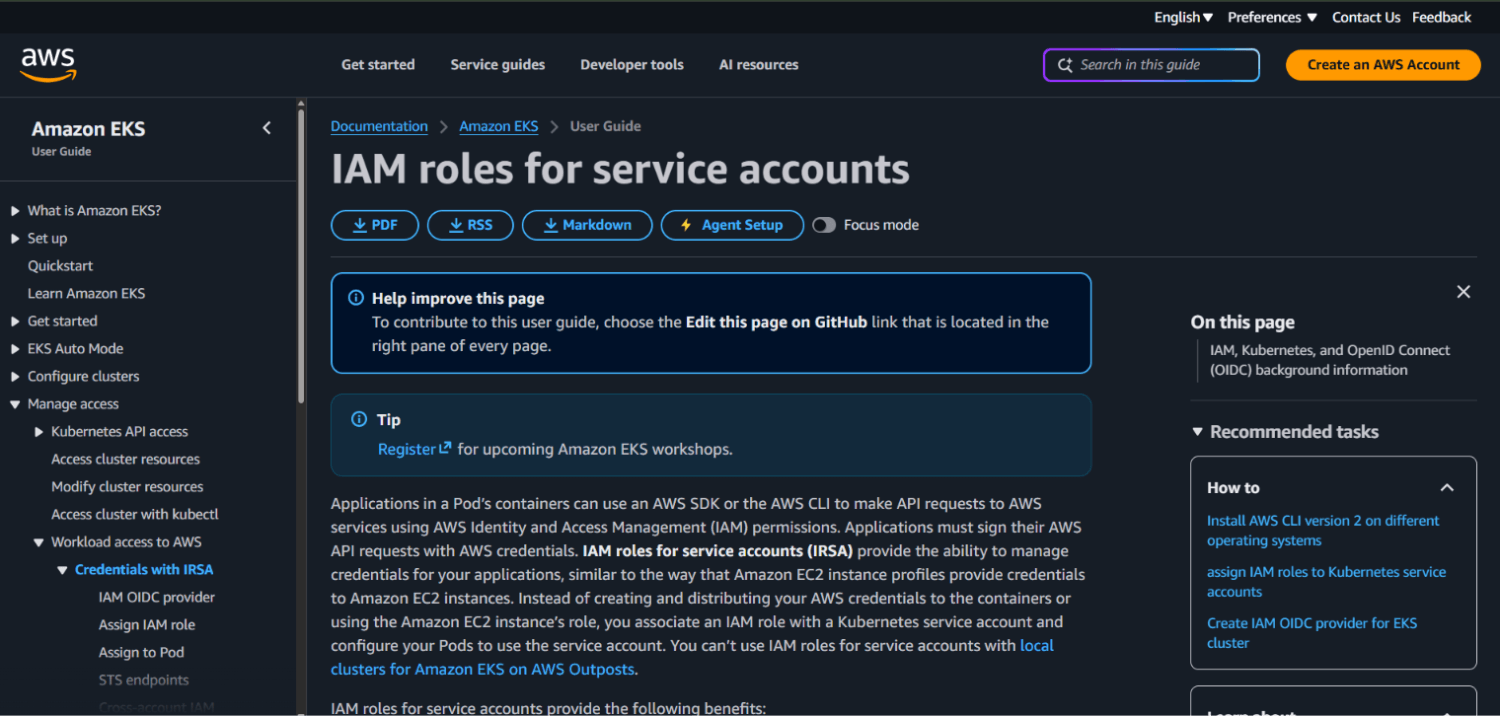
IRSA is AWS’s native mechanism for giving EKS pods fine-grained IAM permissions without node-level credentials. Each EKS cluster registers an OIDC issuer with IAM. A Kubernetes service account is annotated with an IAM role ARN. The pod receives a projected service account token, which it exchanges for temporary STS credentials. The STS credentials are scoped to the annotated role and expire after a configured duration.
IRSA is free as part of EKS; you pay for STS API calls at AWS standard rates. The operational consideration is that each EKS cluster gets its own OIDC issuer, which means IAM trust policies reference specific cluster issuers. In large multi-cluster environments, this produces trust policy sprawl. AWS introduced EKS Pod Identity as a successor mechanism that simplifies the trust policy model, though IRSA remains widely deployed. Neither IRSA nor EKS Pod Identity solves authentication from AWS workloads to non-AWS APIs.
Best for: AWS-native EKS deployments. Pair with Vault or Aembit when workloads also authenticate to non-AWS services.
6. GCP Workload Identity Federation
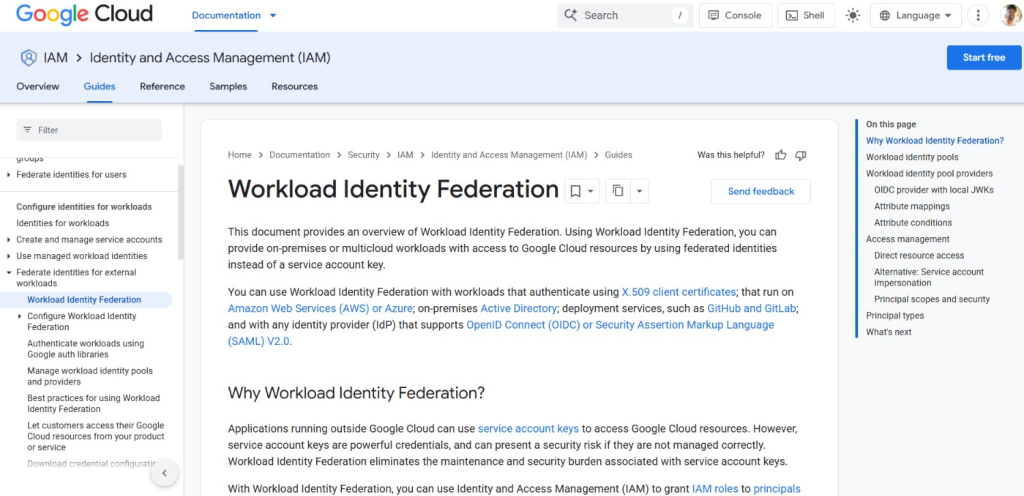
GCP Workload Identity Federation is the most flexible of the three cloud-native options because it accepts tokens from AWS IAM, Azure AD, GitHub Actions, and any OIDC or SAML provider. A GKE workload uses GKE Workload Identity to bind a Kubernetes service account to a GCP IAM service account. Workloads outside GCP exchange their external token for a short-lived GCP access token via the Security Token Service API.
The cross-cloud federation capability is genuinely useful: an AWS Lambda function can authenticate to a GCP Cloud Storage bucket without storing a GCP service account key, by presenting its AWS IAM identity to GCP’s STS. GCP Workload Identity Federation is included in GCP IAM at no additional license cost; STS API calls are billed at standard GCP API pricing. The operational surface is lighter than SPIRE or Vault because Google manages the issuer infrastructure. The constraint is the same as the other cloud-native options: it only solves authentication to GCP services.
Best for: GCP-primary environments and multi-cloud pipelines where one side is GCP. The preferred choice for replacing GCP service account keys in both GKE and external workloads.
7. Istio
Istio provides workload identity as part of its service mesh certificate infrastructure. Each Envoy sidecar receives an X.509 certificate with a SPIFFE-compliant SVID, issued by Istio’s built-in CA (Istiod). Peer authentication policies enforce mTLS between services within the mesh. Authorization policies use the SPIFFE ID in the client certificate to control which services can call which endpoints at the HTTP method and path level.
Istio’s workload identity is tightly coupled to the mesh. It handles identity for services running in the mesh well. It does not help with authentication to external APIs, and it does not provide an audit log of credential issuance separate from the Envoy access logs. The operational cost of Istio is not the identity component; it is the full sidecar deployment, the control plane scaling, and the mTLS policy debugging that follows any configuration change. Teams that are adopting Istio for traffic management get workload identity as part of the deal. Teams adopting Istio solely for workload identity should consider whether SPIRE is a lighter path.
Best for: Kubernetes environments already adopting a service mesh for traffic management, observability, and policy. Not a good fit as a standalone identity tool.
8. Teleport
Teleport approaches workload identity from the access plane rather than the identity plane. It issues short-lived X.509 certificates to workloads, machines, and humans through a unified certificate authority. Teleport’s Machine ID component handles non-human identity: a CI/CD pipeline or service can authenticate to Teleport using a machine identity token, receive a short-lived certificate, and use that certificate to access infrastructure resources (SSH hosts, Kubernetes clusters, databases) that Teleport proxies.
The architecture differs from SPIRE in that Teleport’s CA is access-path-aware. Every connection goes through a Teleport proxy, which logs the session. This produces a session-level audit trail that neither SPIRE nor Vault alone provides. The trade-off is that Teleport is an access proxy, not a general-purpose identity fabric: it works for infrastructure access and CI/CD pipelines, but it does not help a running microservice authenticate to a third-party API. Teleport does not publicly disclose pricing details; contact Teleport directly for a quote based on your environment. For teams that need both human and machine identity unified under one certificate authority with session recording, Teleport is the most operationally complete option in this list. The machine identity management platform comparison covers Teleport alongside other certificate-based tools in more depth.
Best for: Teams that need unified identity for humans and machines accessing infrastructure, with session-level audit trails. CI/CD pipeline authentication is a strong use case.
9. Venafi (TLS Protect for Kubernetes)

Venafi TLS Protect for Kubernetes addresses machine identity from the PKI and certificate lifecycle angle. The product integrates with cert-manager to enforce certificate policies across Kubernetes clusters: which Certificate Authorities are allowed, what key lengths are required, what certificate lifetimes are permitted, and where certificates are being issued outside policy. Venafi operates in the machine identity space broadly, covering TLS certificates, SSH certificates, and code signing, and the Kubernetes product extends that governance to cluster-issued certificates.
Venafi’s value is governance and visibility at scale, not identity issuance. A large organization running dozens of Kubernetes clusters with teams issuing their own certificates gets audit coverage and policy enforcement from Venafi that they cannot get from cert-manager alone. Venafi does not publicly disclose pricing; procurement goes through a direct sales conversation and is quoted per environment. The operational model assumes you already have cert-manager deployed; Venafi adds the policy and reporting layer above it. For teams that need to prove to an auditor that no cluster in their fleet is issuing certificates with 10-year lifetimes or weak key material, this is the right tool. For broader non-human identity discovery across cloud environments, see the non-human identity discovery tools comparison.
Best for: Large enterprises with multiple Kubernetes clusters needing certificate governance across a fleet. Complements rather than replaces an identity issuer.
10. Oasis Security / Entro Security
Oasis Security and Entro Security address workload identity from the secrets and non-human identity discovery angle. Rather than acting as an issuer, they discover existing service accounts, API keys, certificates, OAuth tokens, and other machine credentials across cloud environments, code repositories, and SaaS platforms, then provide risk scoring, ownership attribution, and remediation workflows. SecurityOpsWire was not able to independently verify each vendor’s full capability set against primary source documentation for this article; prospective buyers should validate specific features directly with each vendor.
These tools answer the inventory checkpoint from the Stack Test: they tell you what standing credentials exist before you can eliminate them. Oasis focuses on NHI governance and lifecycle management; Entro emphasizes secrets posture across the SDLC, including secrets found in code, pipeline configuration, and cloud IAM. Neither publishes public pricing. For teams at the beginning of a workload identity program, starting with one of these platforms to map the current standing-credential inventory is more productive than deploying SPIRE into an environment where you do not know what you are replacing. The non-human identity security platforms comparison at securityopswire.com/best-non-human-identity-security-platforms covers both in the broader NHI context alongside service account governance tools.
Best for: Early-stage workload identity programs that need to inventory existing credentials before deploying an issuer. Also useful for ongoing governance once an issuer is deployed, to detect credentials that bypass the issuer.
How Do You Replace Long-Lived Credentials in a Single Kubernetes Namespace?
The fastest path to a working pilot is to pick one namespace, one external dependency (a database or a cloud storage bucket), and replace the static secret with a native workload identity mechanism. Here is a concrete sequence:
- Run Oasis or Entro (or a manual audit with
kubectl get secrets -n target-namespace) to enumerate every secret in the namespace. Identify which secrets are credentials versus configuration. - For each credential, determine the target system. Cloud API credentials map to IRSA, Entra Workload ID, or GCP Workload Identity depending on the cloud. Database credentials map to Vault’s database secrets engine. Third-party API keys map to Aembit or a similar broker.
- For a cloud credential: annotate the Kubernetes service account with the IAM role ARN (IRSA) or the workload identity provider (GCP). Deploy the relevant webhook or SDK. Remove the static secret from the deployment manifest. Confirm the pod fetches a valid short-lived token from the instance metadata endpoint.
- For a database credential: deploy Vault with the Kubernetes auth method enabled. Configure a Vault role that maps the Kubernetes service account to a Vault policy. Update the application to fetch the database credential from the Vault agent sidecar or the Vault SDK at startup. Set the credential TTL to match your application’s restart cadence.
- Delete the old static secret. Confirm the deployment is healthy. Add an admission controller or OPA policy to reject new static credentials in the namespace going forward.
The OPA or Kyverno policy at step five is the control that prevents drift. Without it, the next engineer who deploys to the namespace will use what they know: a Kubernetes Secret with a static value. The policy is what turns a one-time replacement into a security control with an audit trail.
For AI agents and autonomous pipelines authenticating to services, the same SPIFFE-based or cloud-native workload identity mechanisms apply, but the attack surface is wider because agent behavior is harder to predict. The AI agent security platform comparison covers the identity and access control dimension for agent workloads specifically.
What Is the Operational Cost of Running an Identity Issuer?
The question teams under-estimate: not the license cost, but the engineering cost to keep the issuer healthy. A SPIRE deployment in production requires attention in three areas. First, the CA certificate chain: the root CA should be offline and the intermediate should rotate on a schedule, which means an on-call runbook and someone who understands the implications of an intermediate rotation on outstanding SVIDs. Second, attestation policy: every new workload that needs an SVID requires a registration entry in SPIRE, which means a workflow, ideally integrated with your deployment pipeline. Third, cross-domain federation: when a trust domain needs to talk to another trust domain, both servers need to exchange trust bundles and keep them current.
Managed options (Entra Workload ID, IRSA, GCP WIF) eliminate the CA management overhead by delegating it to the cloud provider. The trade-off is that the cloud provider’s STS is now a dependency in your application’s authentication path. A GCP STS outage in a GKE-dependent architecture affects every workload that needs a GCP IAM token simultaneously, whereas a self-managed SPIRE cluster’s blast radius is scoped to your own infrastructure decisions.
For most teams below 50 engineers, the managed cloud-native option for the dominant cloud plus Vault for database credentials is the right operational balance. SPIRE becomes the right choice when portability across clouds and on-premises matters more than operational simplicity.
Frequently Asked Questions
What is workload identity and how is it different from a service account?
A service account is a Kubernetes or cloud IAM construct that provides a name and permissions to a workload. Workload identity is the mechanism that proves a workload’s claim to that service account without relying on a long-lived static credential. The service account is the authorization boundary; workload identity is the authentication proof. In practice, a Kubernetes service account without workload identity federation is authenticated only by a token that any process on the node could potentially read from the mounted secret.
What is the difference between SPIFFE and OAuth?
SPIFFE defines how workloads get cryptographic identities (SVIDs) and how those identities are attested based on infrastructure properties, such as the process, the container image, or the node. OAuth defines how a principal (human or machine) gets authorization tokens from an authorization server after proving identity. SPIFFE handles the identity layer; OAuth handles the delegation layer. Many architectures use both: a SPIFFE SVID proves the workload’s identity, and the workload exchanges that identity for an OAuth access token scoped to the resource it needs.
Is SPIFFE the same as mTLS?
SPIFFE is not a protocol. It is a standard for workload identity documents. SPIFFE SVIDs can be X.509 certificates, which are used to establish mTLS connections where both sides present their SVID. When people say “SPIFFE does mTLS,” they mean that the X.509 SVID format is compatible with standard TLS certificate validation, so mTLS libraries can validate a peer’s SPIFFE identity using normal certificate chain verification against the SPIFFE trust bundle.
What is workload identity federation?
Workload identity federation is the mechanism that allows an external identity provider’s tokens to be trusted by a cloud platform’s IAM system. Instead of storing a cloud service account key in a GitHub Actions secret or a Kubernetes secret, the external workload presents its own identity token (from its own IdP), and the cloud STS validates that token against a configured federation trust, then issues a short-lived cloud credential. GCP, Azure, and AWS all support variations of this pattern using OIDC as the federation protocol.
How does a SPIRE agent attest a workload?
The SPIRE agent uses workload attestation plugins to verify the identity of a process requesting an SVID. On Kubernetes, the agent queries the Kubernetes API to confirm the pod’s service account, namespace, and labels match the registration entry for the requested SPIFFE ID. On Linux, Unix process attestation can verify the UID, GID, or process path. The agent never trusts the workload’s self-reported identity; it verifies against an authoritative source. This is the fundamental difference between SPIRE-attested identity and a JWT that a workload generates itself.
How should security teams govern workload identities, not just deploy them?
Governance requires three things beyond deployment: an inventory of all workload identities and their permissions, an audit log of every credential issuance and every access decision, and a policy that prevents workloads from using credential types outside the approved model. Vault’s audit log, Entra’s sign-in logs, and SPIRE’s registration entry history each cover parts of this. Tools like Oasis Security and Entro Security add the discovery layer for credentials that exist outside the approved issuer, which is where most governance gaps appear in practice. For organizations building out broader non-human identity governance, the non-human identity security platforms comparison at securityopswire.com/best-non-human-identity-security-platforms covers the governance layer in detail.
Conclusion
The most durable insight from evaluating these ten platforms is that workload identity is a stack, not a product. An identity issuer (SPIRE, a cloud-native STS, or Istio’s CA) handles attestation and SVID issuance. A credential broker (Vault, Aembit) handles what happens after the identity is established. A governance layer (Venafi, Oasis, Entro) ensures that the issuer is the only path and that no standing credentials survive outside it. Buying a product from one layer and expecting it to cover the others is how teams end up with a partially deployed workload identity program that still has hundreds of static secrets in Kubernetes Secrets objects, undiscovered and unrotated.
The pilot instruction in this article’s behavioral goal is the right instinct. Pick one namespace, one external dependency, and one issuer. The constraint is not a limitation; it is a forcing function that surfaces every assumption your deployment pipeline makes about credential availability. Those assumptions are where the actual secrets sprawl lives, and surfacing them in a single namespace is far cheaper than discovering them after a credential exfiltration incident.
Workload identity configuration is security policy. The team that decides which workloads get which identities, under what attestation conditions, with what scope and lifetime, is making the same category of decision as the team that writes firewall rules or PAM policies. Treat it accordingly: put it in version control, gate it with a review workflow, and produce an audit trail that survives an incident investigation.