
- A CVSS 9.8 finding does not mean your environment is exploitable. Exposure validation tests whether your actual controls stop the attack path before you schedule the remediation sprint.
- Gartner defines the Adversarial Exposure Validation (AEV) category. Vendor marketing pages reference the AEV label, but for Gartner’s own definition of what the category consolidates, consult Gartner’s AEV glossary entry directly. The underlying testing methods , breach and attack simulation, automated penetration testing, and red team automation , predate the category name.
- Production-safety is the practitioner question no vendor answers clearly. Safe-by-design platforms simulate attacker behavior without executing destructive payloads. Know which model your shortlisted tool uses before you approve a production scan window.
- The output that matters is not a vulnerability count. It is a control gap map: which detections fired, which did not, and which findings your existing stack already neutralizes.
- Platform fit depends on three variables: whether your team runs automated testing autonomously or feeds results to a human red team, whether you need breadth (BAS-style coverage across hundreds of techniques) or depth (full kill-chain exploitation against a specific target), and whether your budget is per-asset or subscription-flat.
Exposure validation tools test whether your security controls actually stop an attacker traversing your environment, not just whether a vulnerability exists in a scanner’s database. The nine platforms below represent the core of the Gartner AEV category: Pentera, Picus Security, Cymulate, SafeBreach, AttackIQ, XM Cyber, Horizon3.ai, Scythe, and Prelude. They split across two methods: breach and attack simulation (BAS), which replays attack techniques safely at scale, and automated penetration testing, which chains those techniques into real exploitation paths. Knowing which method fits your environment is the first decision, not the last.
What Does Exposure Validation Prove That Scanning Does Not?
A vulnerability scanner tells you a CVE exists. An exposure validation platform tells you whether an attacker can reach it, exploit it, and then move laterally before any of your controls fire. Those are fundamentally different questions, and confusing them is what produces remediation queues that are 90 days long and still miss the exploitable path.
Consider a medium-severity finding on an internal web server. The CVSS score suggests it is lower priority than the critical patch sitting above it in the queue. Exposure validation might show that the medium finding sits on a path from a compromised developer workstation directly to a production database, with no EDR coverage on the hop between them and no network segmentation blocking it. The critical finding, by contrast, lives on a system that is air-gapped from anything sensitive. The scanner ranked them backwards. Validation reorders the queue by exploitability inside your specific environment rather than by theoretical severity.
That reordering is the operational value. It is also why mapping to MITRE ATT&CK technique coverage matters more than a raw finding count. When a platform reports that Credential Dumping (T1003) fired and your EDR did not alert, that is a control gap. When it reports that Lateral Movement via Pass-the-Hash (T1550.002) was blocked and logged, that is a validated control. One tells you to fix something. The other tells you to stop worrying about that technique for now.
How Safe Are Exposure Validation Tests in Production Environments?
Production-safety is the question practitioners ask and vendors rarely answer directly. There are two architecturally distinct approaches, and they carry different risk profiles.
Simulation-only platforms (Picus, SafeBreach, AttackIQ, Cymulate in its BAS mode) replay the observable signatures of attack techniques without executing destructive payloads. They send the same byte pattern a ransomware dropper would send, check whether your controls detect it, and stop there. Nothing encrypts. Nothing exfiltrates real data. The risk in production is minimal, and these platforms are generally run continuously on live infrastructure.
Automated penetration testing platforms (Pentera, Horizon3.ai in its autonomous mode) actually exploit vulnerabilities and chain them into attack paths. They authenticate with real credentials, move laterally through real network segments, and escalate privileges using real techniques. The risk profile is different. A credential obtained during a test is a real credential. A misconfigured service that gets exploited opens a real session. These platforms include safeguards: throttling, rollback mechanisms, and test-environment isolation modes. Running them in production requires a defined change window, coordination with the SOC so alerts are correlated to the test, and an understanding of what the platform will and will not stop automatically.
The practical answer for most security teams: start BAS platforms in production immediately, and run automated pen testing against a representative staging environment or during a scheduled maintenance window for the first several runs. Once you understand how your environment behaves under test, expanding autonomous testing to production is reasonable, with the SOC notified and correlation turned on.
How Do AEV Results Map to Control Gaps Rather Than Vulnerability Counts?
The output format separates platforms that help security teams make decisions from platforms that generate reports for compliance. A finding count is almost useless. A control gap map is what a detection engineer can act on.
The SecurityOpsWire Control Gap Taxonomy describes three output types that matter, in order of operational value:
- Undetected technique execution: the platform ran a technique, no alert fired, no log was generated. This is a detection gap. The response is to write or tune a detection rule, not necessarily to patch something.
- Detected but not blocked: the SIEM or EDR logged the technique, but no prevention action occurred. The alert exists but would require human triage in real time. This is a response gap and a staffing conversation.
- Blocked and logged: the control worked. This finding confirms control effectiveness and can be removed from the active remediation queue. It is evidence for board reporting.
Platforms that produce only finding counts collapse all three into one undifferentiated list. Platforms with strong SIEM and EDR integration, like Picus, SafeBreach, and AttackIQ, can close the loop automatically by pulling alert data and mapping it against the technique that fired. That closed-loop reporting is what converts validation output into something a CISO can present without a ten-slide translation layer. If you are also building out your continuous threat exposure management program, the comparison of leading CTEM platforms covers how exposure validation sits inside the broader CTEM workflow.
The 9 Best Exposure Validation Platforms Compared
| Platform | Primary Method | Best Fit | MITRE ATT&CK Coverage | Production Safety Model | Pricing Model |
|---|---|---|---|---|---|
| Pentera | Automated pen testing | Enterprise with active red team or SecOps ownership | Full kill-chain across Windows, Linux, AD | Real exploitation with throttling controls | Not publicly disclosed; quoted per environment |
| Picus Security | BAS + detection analytics | SOC teams prioritizing detection tuning | Broad technique library with detection mitigation content | Simulation-only; safe in production | Not publicly disclosed; quoted per environment |
| Cymulate | BAS + automated pen testing | Mid-market through enterprise; compliance-heavy environments | Broad; organized by attack vector and kill chain | BAS mode is simulation-only; APT mode exploits | Not publicly disclosed; quoted per environment |
| SafeBreach | BAS | Large enterprises with complex, multi-vendor control stacks | Extensive playbook library; third-party threat intel integration | Simulation-only; safe in production | Not publicly disclosed; quoted per environment |
| AttackIQ | BAS + control validation | Teams running MITRE ATT&CK-aligned programs; MSSP delivery | Deep ATT&CK alignment; scenario library mapped per technique | Simulation-only; safe in production | Not publicly disclosed; quoted per environment |
| XM Cyber | Attack path analysis + BAS | Hybrid environments; cloud and on-premises attack path prioritization | Strong lateral movement and privilege escalation coverage | Graph-based simulation; safe in production | Not publicly disclosed; quoted per environment |
| Horizon3.ai | Autonomous pen testing | Mid-market without dedicated red teams; quarterly pen test replacement | Credential attack, lateral movement, network exploitation | Real exploitation; coordinate with SOC before running | Not publicly disclosed; quoted per environment |
| Scythe | Red team automation platform | In-house red teams building custom campaigns | Operator-defined; full ATT&CK coverage possible with content | Operator-controlled; real techniques | Not publicly disclosed; quoted per environment |
| Prelude | Continuous automated testing | Security engineers building detection-as-code workflows | Technique-level tests mapped to ATT&CK; open-source core available | Simulation-based; designed for continuous production runs | Open-source core; enterprise tier not publicly priced |
Pentera
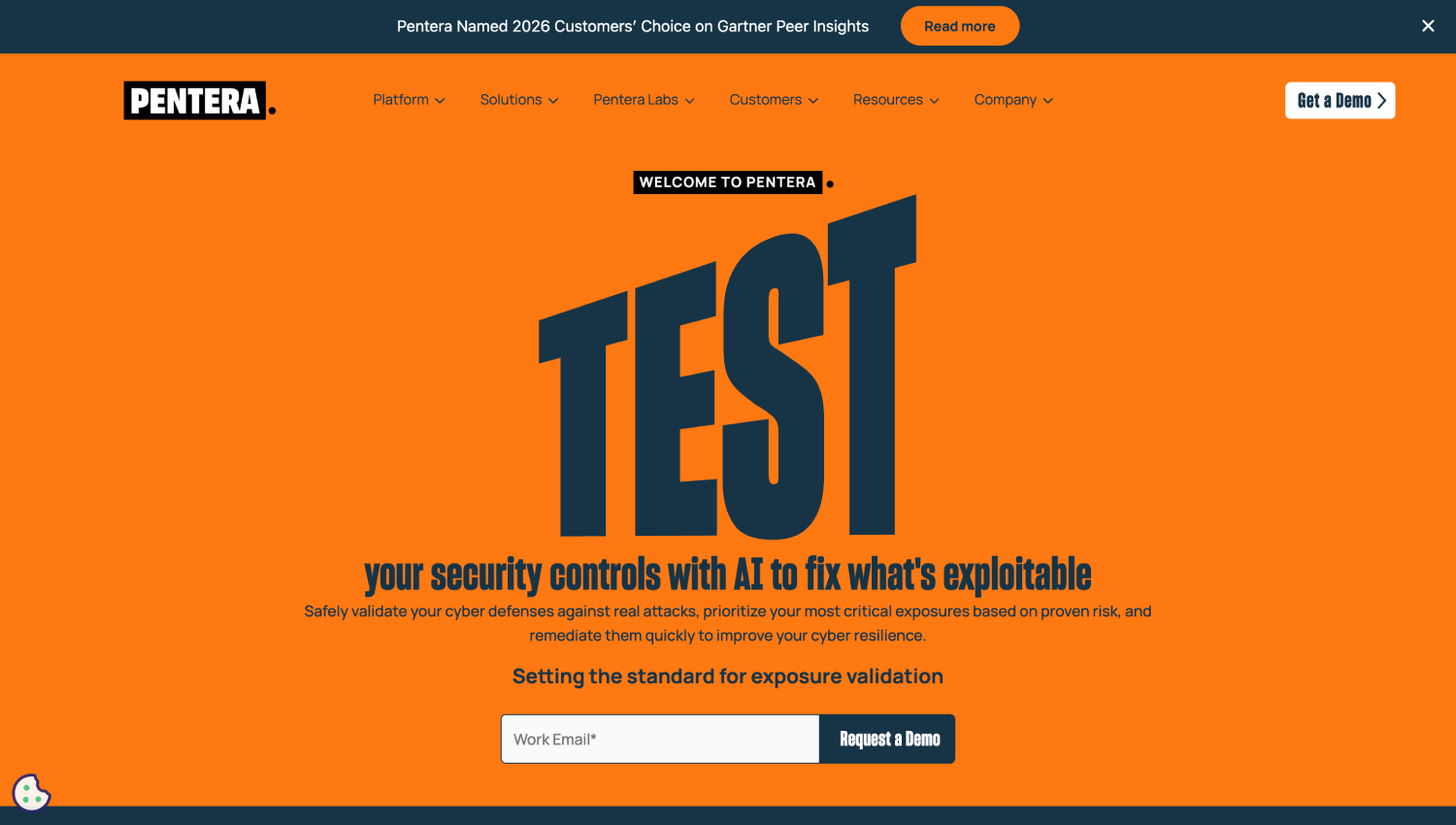
Pentera describes its platform as providing continuous validation through real adversarial emulation, safe-by-design, with algorithmic and AI-driven attacks against live production environments. It authenticates, escalates privileges, and moves laterally using real techniques, then reports which controls fired and which paths remained open. The platform is positioned as a replacement for periodic manual penetration testing, producing results on a continuous or scheduled basis rather than once a year.
The operational trade-off is real: because Pentera actually exploits, it surfaces paths that simulation-only tools miss. It also requires a more structured test-window process. Teams that run it well have a dedicated contact in the SOC who receives test notifications and can correlate Pentera’s activity against the SIEM in real time. Without that coordination, the alerts generated during a test either flood the queue or get suppressed entirely, and neither outcome produces useful data.
Pentera does not publish pricing. Quotes are structured per environment scope.
Picus Security
Picus Security built its platform around detection analytics rather than exploitation. Its attack simulation library covers a wide range of ATT&CK techniques, and the platform’s strongest differentiation is on the mitigation side: for each technique that fires without detection, Picus provides vendor-specific mitigation content mapped to the control that should have caught it. According to Picus’s product documentation, this mitigation content is vendor-specific, though the depth of prescriptive output , such as whether detection rule templates are provided for specific SIEM or EDR vendors , should be confirmed with Picus directly during a proof-of-concept evaluation.
That mitigation content library is what makes Picus a strong fit for SOC teams that want to close detection gaps systematically rather than just identify them. It shortens the cycle from “this technique fired undetected” to actionable remediation guidance tied to the specific control that should have caught it. Picus does not publish pricing; quotes are per environment.
Cymulate
Cymulate covers the widest surface area of any platform in this list by attack vector. Its modules include email security, web gateway, web application firewall, endpoint, lateral movement, and data exfiltration, and they can be run independently. That modular structure makes Cymulate well-suited for compliance-driven environments where a specific audit requires evidence of email gateway control effectiveness, for example, without running a full-scope campaign.
Cymulate added automated penetration testing capability alongside its BAS foundation. The two modes operate differently: BAS modules are safe for continuous production runs, while the penetration testing module performs real exploitation and should be scoped accordingly. Teams that need both methods under one subscription will find this useful. Teams that only need one method may prefer a platform purpose-built for their use case. Pricing is not publicly disclosed.
SafeBreach
SafeBreach targets large enterprises running complex, multi-vendor security stacks where the primary question is whether the combination of controls works as a system, not whether any individual tool functions correctly. According to SafeBreach’s platform page, its playbook library integrates third-party threat intelligence and covers an extensive range of attack scenarios. It also integrates with a wide range of SIEM, SOAR, and EDR platforms to close the loop on alert correlation automatically.
SafeBreach’s threat intelligence integration is worth noting for teams tracking specific threat actor groups. The platform’s playbook library incorporates third-party threat intel feeds, which allows scenario runs to incorporate known adversary TTP data. The specific depth of that integration , including whether the platform can be configured to test industry-specific campaign patterns identified by your own threat intelligence function , is a capability to verify directly with SafeBreach during a scoping conversation. Pricing is not publicly disclosed.
AttackIQ
AttackIQ is positioned as a platform for running MITRE ATT&CK-aligned security programs, with a scenario library organized around ATT&CK techniques and reporting that maps control effectiveness to ATT&CK coverage. AttackIQ also operates an MSSP partner program, which means managed service providers can deliver BAS as a service to clients who do not have the internal headcount to run it themselves. SecurityOpsWire was not provided a source page for AttackIQ during preparation of this article; the capabilities described here reflect AttackIQ’s public positioning and should be verified against AttackIQ’s own product documentation before making procurement decisions.
For teams building or maturing a detection engineering practice, AttackIQ’s scenario content is intended to function as a test harness for detection rules. Write a new Sigma rule, run the relevant AttackIQ scenario, confirm the rule fires. That workflow reduces tuning debt on new detections before they go to production. AttackIQ does not publish pricing.
XM Cyber
XM Cyber approaches validation through attack path modeling rather than technique replay. It maps the graph of relationships between entities in your environment, including users, machines, cloud resources, and misconfigurations, and identifies which nodes sit on critical paths to crown jewel assets. It then shows how many attack paths run through a given finding, which is a more useful prioritization signal than CVSS alone.
XM Cyber is particularly strong in hybrid environments where the attack surface spans on-premises Active Directory and cloud accounts simultaneously. A finding on an on-premises endpoint that grants access to an AWS IAM role through a misconfigured trust relationship shows up as a critical path in XM Cyber, even though neither the on-premises finding nor the cloud finding looks severe in isolation. That cross-domain path analysis is where XM Cyber earns its place in environments where the cloud estate is growing alongside a legacy infrastructure footprint. Pricing is not publicly disclosed.
Horizon3.ai
Horizon3.ai markets its NodeZero platform as an autonomous penetration testing product designed for teams without a dedicated red team. It runs a full kill chain, including reconnaissance, exploitation, credential access, and lateral movement, and delivers findings scoped to what was actually exploitable rather than what a scanner flagged as potentially vulnerable.
For mid-market security teams that currently contract annual penetration tests, Horizon3 is worth evaluating as a more frequent alternative. An annual pen test produces a point-in-time report that is often outdated before the remediation work is complete. Running NodeZero after each significant infrastructure change produces continuous evidence of control effectiveness, which is more operationally useful. The exploitation-based model means the same production-safety considerations apply as with Pentera: test windows, SOC notification, and rollback awareness are required before running in production. Pricing is not publicly disclosed.
Scythe
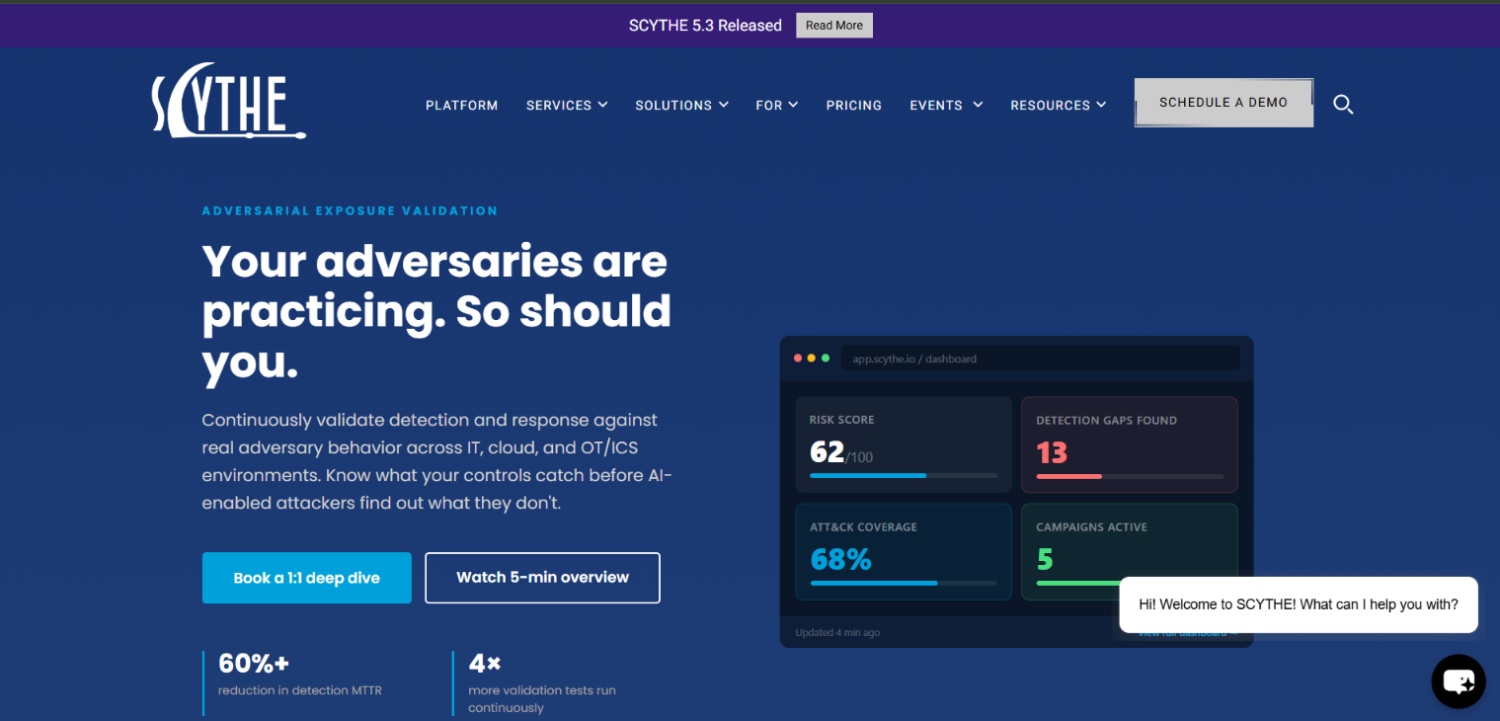
Scythe is a red team automation platform, not a push-button BAS tool. It gives operators a framework for building, executing, and replaying adversary campaigns using a modular threat emulation library. The platform is most valuable to organizations that already have an internal red team or purple team function and want to build reusable, repeatable campaigns rather than running ad hoc engagements every quarter.
The key distinction from SafeBreach or Picus is operator control. Scythe does not run campaigns autonomously by default; a human operator builds the campaign, defines the techniques, and executes. That requires skilled personnel, but it also means the campaign can be scoped to a specific threat model rather than a pre-built playbook. Organizations without an internal red team capability will find Scythe operationally demanding. Organizations with one will find it more flexible than a closed BAS platform. Pricing is not publicly disclosed.
Prelude
Prelude is the most developer-oriented platform in this list. Its open-source core gives detection engineers a framework for writing, running, and automating technique-level tests mapped to ATT&CK. Tests are written as small, composable probes, and the platform is designed to run continuously in CI/CD pipelines or scheduled production sweeps rather than periodic campaigns. Whether an open-source component is available via a public repository should be confirmed directly on Prelude’s website, as this was not confirmed by the source page reviewed during preparation of this article.
Prelude fits a specific profile: a security engineering team that writes detection-as-code, wants to test new detections automatically before promoting them to production, and has the engineering capacity to build and maintain a test library. It does not deliver the pre-built playbook depth of SafeBreach or the automated kill-chain exploitation of Pentera. Enterprise pricing is not publicly disclosed.
What Does Continuous Security Validation Actually Cost Per Environment?
Every platform in this category declines to publish list pricing. That is not unusual in enterprise security, but it does make procurement comparisons difficult. The cost drivers that consistently appear in practitioner discussions are worth mapping even without published figures.
For BAS platforms, the primary cost variables are the number of agents or simulators deployed, the number of attack scenarios run per period, and whether you need dedicated tenant infrastructure or can run on shared SaaS. SafeBreach and Cymulate are both SaaS-delivered and agent-based; more assets generally means a higher cost tier.
For automated penetration testing platforms, Pentera and Horizon3 typically scope by IP range or asset count. A small environment, say 500 internal assets, costs substantially less than an enterprise spanning tens of thousands of endpoints across multiple segments. The relevant comparison for budget conversations is the cost of replacing periodic manual penetration tests: external pen test engagements are priced per scope and duration, and produce point-in-time results that are often stale before remediation completes. A continuous platform at higher annual cost frequently wins on coverage frequency and detection gap specificity, though actual figures vary widely by vendor and environment size and should be obtained directly through vendor quotes.
Prelude’s open-source core reduces licensing cost to near zero but raises the engineering cost substantially. Building and maintaining a useful test library is not a part-time task.
Which Platform Fits Which Team and Environment?
Take a 600-person financial services company running a hybrid environment: 70% of workloads on AWS, the rest on-premises Windows infrastructure with Active Directory, two people on the security team, and a quarterly pen test from an external firm. The security team’s problem is not finding vulnerabilities, it is knowing which of the 400 open findings on the current scan report are actually exploitable given their control stack.
For that environment, XM Cyber or Cymulate’s BAS module is the right starting point. XM Cyber maps the attack paths from external exposure through the AD estate into the AWS accounts, which matches the hybrid architecture. Cymulate’s modular approach lets the two-person team run specific vectors, such as lateral movement, without committing to a full-scope autonomous test that requires more SOC coordination than they have capacity for. Pentera or Horizon3 become the right choice once the team has used BAS results to reduce the open finding count and has SOC processes in place to handle autonomous test output.
For an enterprise with a 15-person security team that already runs purple team exercises, Scythe or AttackIQ adds structure to what the team is already doing manually. Scythe gives the red team a reusable campaign framework. AttackIQ gives the detection engineering side a formal ATT&CK coverage matrix to track progress against.
Building out a full continuous threat exposure management program involves more than just the validation layer. The exposure management platform comparison covers how asset inventory, attack surface management, and risk prioritization sit alongside validation in a mature CTEM program.
How Should Security Teams Validate a High-Severity Finding Before Scheduling Remediation?
Run the validation before the ticket hits the remediation sprint. That is the behavioral change this category is designed to produce, and it requires a specific workflow rather than a general policy.
The SecurityOpsWire Pre-Remediation Validation Workflow covers the four steps that convert a scanner finding into an evidence-backed remediation priority:
- Scope the validation: identify the asset, the credential context likely available to an attacker at that stage of the kill chain, and the target resource that makes the path worth following. A finding on a server that holds no sensitive data and sits on an isolated VLAN is a different risk than the same finding on a server that holds session tokens for a payment processing service.
- Select the technique coverage: map the CVE or misconfiguration class to its corresponding ATT&CK technique. Run the validation scenario that covers that technique against the asset. If your platform provides it, run the lateral movement and privilege escalation scenarios that would follow a successful initial exploitation.
- Check the control response: pull the SIEM and EDR logs from the validation window. Confirm whether an alert fired, whether it was high-fidelity or a generic signature, and whether any automated response action triggered. A finding that your EDR blocked silently and logged is a different operational priority than one that executed undetected for 90 seconds before a rule caught it.
- Classify and route: if the control stopped the technique, move the finding to a lower-priority queue and document the evidence. If the technique executed undetected, treat it as an active detection gap and route it to detection engineering before patching, since patching the vulnerability without fixing the detection gap leaves the same gap open for a different technique that reaches the same target.
That fourth step is the one most teams skip. Patching without building the detection creates a false sense of closure. The vulnerability that was exploitable through CVE-X may get remediated, but the lateral movement path that depends on insufficient network segmentation between the workstation segment and the server segment remains exploitable through the next unpatched finding in the queue.
For teams managing vulnerability prioritization across a large estate, the intersection of exploitability scoring and exposure validation is where the external attack surface management tools complement the internal validation platforms. The external attack surface management tool comparison covers how EASM feeds the exposure context that makes validation prioritization more precise.
Frequently Asked Questions
What is adversarial exposure validation and who coined the term?
Adversarial Exposure Validation is a Gartner-defined category that groups tools that test whether security controls stop real attack paths, not just whether vulnerabilities exist. Gartner introduced the AEV category label to distinguish continuous adversarial testing from periodic assessments and point-in-time scans. For the precise definition of which testing methods Gartner includes under the AEV label, the Gartner glossary entry is the authoritative source. The underlying testing methods, particularly BAS, predate the category name by several years.
What is the difference between BAS and automated penetration testing within the AEV category?
Breach and attack simulation platforms replay the observable signatures of attack techniques, such as the network traffic pattern of a lateral movement attempt, without actually exploiting a live vulnerability. They are safe to run continuously in production. Automated penetration testing platforms exploit real vulnerabilities, chain findings into attack paths, and move laterally using real credentials and sessions. They produce higher-fidelity results on actual exploitability but require more careful scoping and SOC coordination before running in production. Platforms like Cymulate offer both modes; most platforms are built primarily around one or the other.
How does exposure validation map to MITRE ATT&CK coverage?
Most AEV platforms organize their technique libraries against the MITRE ATT&CK framework. Each test scenario corresponds to one or more ATT&CK technique IDs. When a technique fires without detection, the platform maps the gap to the corresponding technique so detection engineers can write or tune rules against a specific, known technique rather than a vague vulnerability class. Coverage matrices show which ATT&CK techniques your control stack currently detects, blocks, or misses entirely, which provides a structured way to measure detection program maturity over time.
Can these platforms run in cloud environments, or are they primarily on-premises tools?
All nine platforms in this list support cloud environments to varying degrees. XM Cyber has strong cloud attack path coverage across AWS, Azure, and GCP. Cymulate, SafeBreach, and Picus support cloud workload simulation. Pentera and Horizon3 can test cloud-connected assets during a broader network test. The depth of cloud-specific coverage, such as IAM misconfiguration exploitation, container escape, or cross-account role assumption, varies by platform. Teams with predominantly cloud environments should evaluate cloud coverage depth specifically rather than assuming on-premises capability translates directly.
What does it take to operationalize a BAS platform for a small security team?
A two-to-three person security team can operationalize a BAS platform like Picus or Cymulate without dedicated red team expertise. The platforms are SaaS-delivered, the scenario libraries are pre-built, and the initial configuration typically involves deploying a lightweight agent on representative systems, selecting a scenario set, and scheduling runs. The ongoing operational load is reviewing results, routing detection gaps to whoever owns detection rules, and tracking coverage improvement over time. The work is real but manageable. Automated penetration testing platforms require more SOC coordination and are harder to operate lean.
How do AEV tools relate to continuous threat exposure management programs?
In Gartner’s CTEM framework, exposure validation is the fourth stage of a five-stage cycle that begins with scoping, moves through discovery and prioritization, then validates findings through adversarial testing before mobilizing remediation. AEV tools provide the validation stage evidence. They confirm which prioritized findings are actually exploitable in the current environment and which existing controls already block them. Without the validation stage, CTEM programs tend to produce large, unordered remediation lists that look similar to traditional vulnerability management outputs. The validation layer is what produces the control gap data that makes prioritization defensible to the board.
What should security teams ask vendors about production safety before approving a test window?
Ask four specific questions: Does the platform execute real payloads or simulate observable behavior only? What is the rollback or cleanup mechanism if a test leaves artifacts, open sessions, or modified configurations on a target? What controls prevent the platform from following an exploit chain into an asset that was not in scope? And what does the platform do if it obtains a privileged credential during testing, specifically whether it uses it to access sensitive data or stops at the access confirmation step? Platforms that cannot answer these questions specifically are not ready for a production approval discussion.
What Running Exposure Validation Actually Changes
The shift exposure validation produces is not a new finding list. It is a different mental model for what a severity score means. A CVSS 9.8 with no reachable attack path and a compensating control that blocks the technique is a lower operational priority than a CVSS 5.5 sitting on a hop between a compromised workstation and a production database with no detection coverage on the segment. Scanners cannot tell you that. Validation can.
Teams that run BAS continuously and review control gap maps monthly consistently find that a significant portion of their high-severity backlog is already blocked by existing controls, and that a smaller number of medium-severity findings represent genuinely unblocked paths. Remediating the unblocked paths first, regardless of CVSS score, is a more defensible use of engineering time and is easier to explain to a board or auditor when you have the validation evidence to support the decision.
For security teams also responsible for agentic infrastructure, where the risk surface is expanding into autonomous systems that can take privileged actions, the control validation discipline from AEV programs applies directly. The frameworks for red teaming AI agent systems follow the same logic: test the control before asserting it works, map the gap before routing the remediation, and build detection before the patch closes the path.