
TLDR
- ASPM does not scan code. It aggregates, correlates, and prioritizes findings that scanners like SAST, DAST, and SCA already produced.
- A team with thin scanner coverage buying ASPM first is paying to organize a pile of findings that does not exist yet.
- SAST finds vulnerabilities in source code at rest. ASPM decides which of those vulnerabilities, combined with runtime context and business risk, actually deserve an engineer’s time this sprint.
- The real cost of SAST is not the license. It is the triage burden: false-positive rates that can exceed 50% on large codebases, and the engineering time required to disposition each finding without correlation context.
- Teams with solid scanner coverage but no prioritization layer are not safer than teams with gaps. They are drowning in signal with no way to sort it.
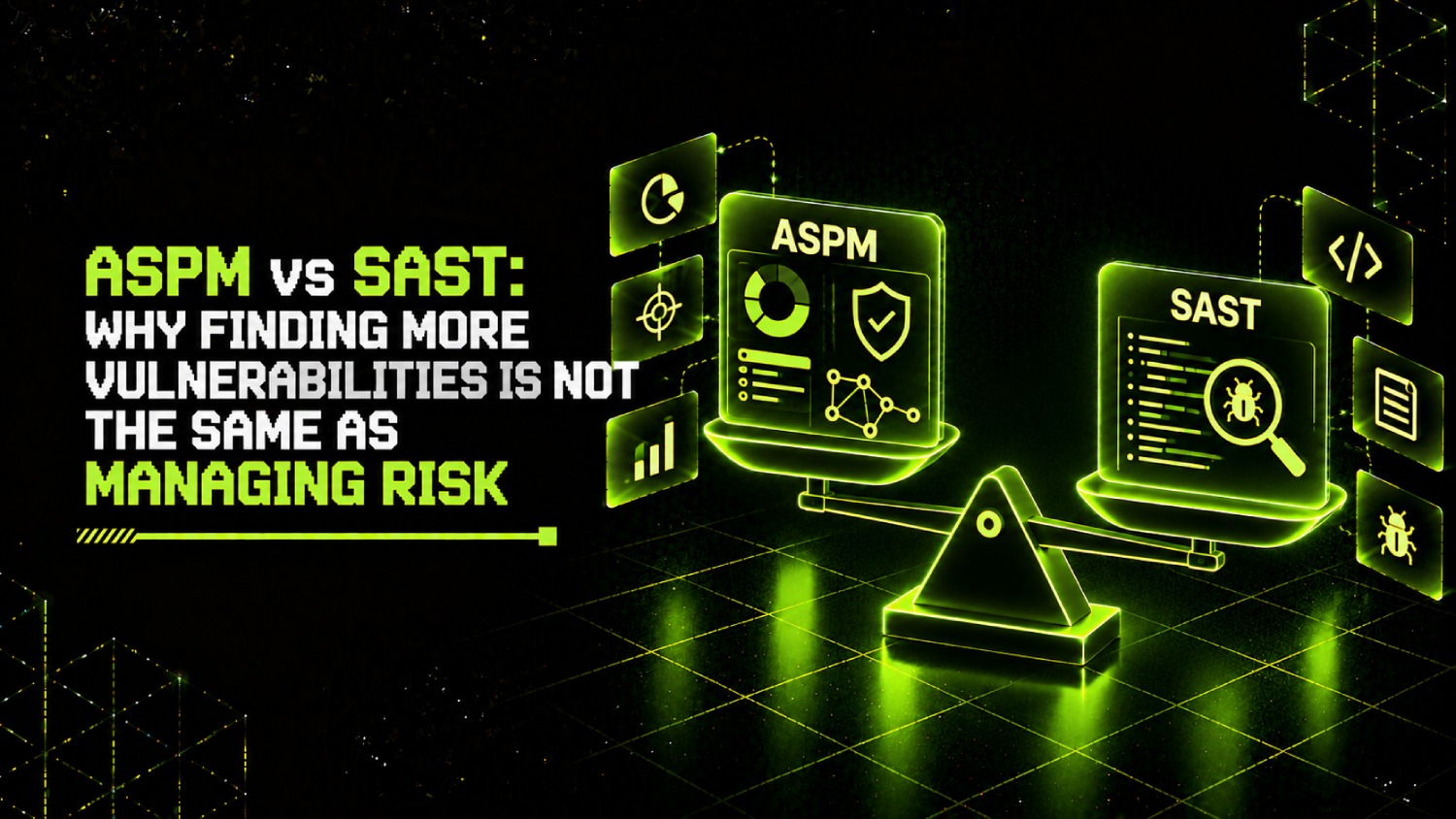
ASPM does not replace SAST. ASPM is a management and prioritization layer that sits above scanners, correlating findings from SAST, DAST, SCA, and other testing tools with runtime context, asset criticality, and reachability data. A team with no static analysis coverage should invest in scanning first. ASPM only delivers its value when there are findings worth organizing.
What Is SAST and What Problem Does It Actually Solve?
Static application security testing (SAST) analyzes source code, bytecode, or binary code without executing the application. It runs during development, in CI/CD pipelines, or as a scheduled scan against a repository. Invicti is positioned primarily as a DAST platform , confirmed by Miercom as “the industry’s most accurate DAST” , that bundles SAST, SCA, IaC, and secrets capabilities, with its documentation describing SAST as a module that “connects static analysis to verified runtime vulnerabilities.” Pure SAST tools like Snyk Code, Semgrep, and SonarQube sit in this category alongside it, though Invicti’s primary positioning differs meaningfully from those tools.
The value proposition is early detection. A SAST tool can flag a SQL injection pattern, a hardcoded credential, or an insecure deserialization call before the code ships. That is genuinely useful, and it is not something an ASPM platform replaces. ASPM has no engine that reads source code.
What SAST cannot do is tell you whether the vulnerable function is reachable from the internet, whether it runs in a service that processes payment card data, or whether an exploit exists in the wild. It reports what the code contains. It has no view of the environment those findings will eventually run in.
The Real Limitations of SAST in Production AppSec Programs
False positives are the operational tax every SAST deployment pays. On a large codebase with multiple frameworks, a SAST scanner’s signal-to-noise ratio can degrade significantly, producing findings that a developer will mark “won’t fix” after thirty seconds of review. At scale, that triage burden compounds: each false positive costs developer time, erodes trust in the tool, and creates pressure to suppress entire rule categories.
SAST also has no runtime context. A vulnerability in a dead code path is categorically different from the same class of vulnerability in a function called on every authenticated request. Without reachability analysis, both look identical in the scanner output. Teams end up remediating low-impact findings because the CVSS score is high, while genuinely exploitable paths sit in the queue.
Language and framework support is a real constraint. Most enterprise environments run several languages across dozens of repositories. A SAST tool optimized for Java may produce shallow results on Go or Rust. Some teams run multiple scanners to cover their polyglot stack, which multiplies the finding volume without multiplying the team that triages it.
What Is ASPM and What Does It Actually Do?
Application security posture management (ASPM), a category Gartner first described and vendors like Apiiro, Cycode, and Endor Labs have built products around, is not a scanner. It is an aggregation and correlation layer. An ASPM platform ingests findings from SAST tools, DAST scanners, SCA analysis, container scanners, secrets detection tools, and IaC analyzers, then attempts to deduplicate, normalize, and prioritize the combined output.
The prioritization step is where ASPM earns its cost. A standalone SAST finding tells you that a vulnerable dependency exists in a service. An ASPM platform that also ingests runtime telemetry, asset inventory, and code-to-cloud context can tell you whether that dependency is actually loaded at runtime, whether the service is internet-facing, and whether the business unit that owns it has a remediation SLA. That is a materially different answer.
Some ASPM platforms also provide risk scoring at the application level rather than the individual finding level, which is what engineering managers and security directors actually need when allocating sprint capacity. A SAST tool gives you a list. An ASPM platform is supposed to give you a ranked work queue.
What ASPM Cannot Do
ASPM does not generate net-new vulnerability coverage. If your SAST tool misses a class of injection vulnerability because it lacks the rule, ASPM will not find it either. The platform only works with what its connected scanners produce. Gaps in scanner coverage become gaps in posture visibility.
ASPM also requires data sources to be worth connecting. A team running one SAST tool on part of its codebase, with no DAST coverage and no SCA, will pay for an ASPM platform to correlate a thin and incomplete dataset. The correlation engine delivers diminishing returns when the input is sparse.
Is SCA the Same as SAST?
No. SCA (software composition analysis) and SAST are distinct techniques that examine different things. SAST analyzes custom code written by your developers, looking for security flaws in the logic, data handling, and control flow your team authored. SCA analyzes the open-source and third-party dependencies your code imports, checking them against known vulnerability databases like the NVD and package advisories. A SAST tool will not tell you that a vulnerable version of Log4j is in your build. An SCA tool will not tell you that your custom authentication handler has a logic flaw. Most mature AppSec programs run both. Some vendors bundle SAST and SCA capabilities in a single product, which can create the impression that they are the same capability. They are not.
How SAST Limitations Create the Demand for ASPM
The practical argument for ASPM starts with a specific operational problem: most teams that have been running SAST for more than eighteen months are sitting on an unmanageable backlog of open findings. The scanner keeps running. The backlog keeps growing. Engineering teams stop trusting the queue because they know it contains thousands of items they will never touch.
That trust erosion is where ASPM makes its case. An ASPM platform that can deduplicate findings across tools, filter by reachability, and surface the twenty findings most likely to be exploited in a production environment is more operationally useful than a scanner producing five hundred undifferentiated findings per week. The value is not coverage. It is reduction of cognitive overhead.
The AppSec community has made the reasonable point that ASPM is not a magic answer, because the quality of the prioritization output is entirely dependent on the quality of the data flowing in. That is correct. ASPM is a multiplier on existing scanner investment, not a substitute for it. Teams that have not done the foundational work of deploying scanners with well-tuned rulesets, integrating them into CI/CD, and building developer-facing workflows will not get a useful ASPM output.
The Coverage-First Rule: Which Layer Should a Team Buy First?
Buy scanner coverage before buying posture management. A team with no SAST coverage, no SCA, and no DAST should not spend a dollar on ASPM. The platform would have nothing meaningful to ingest.
The decision sequence looks like this. First, establish baseline coverage across the code surface: static analysis on all repositories, SCA on all build manifests, and at minimum a DAST scan against external-facing applications. Second, integrate those tools into the CI/CD pipeline so findings are generated continuously rather than on a quarterly scan schedule. Third, assess whether the finding volume and backlog have grown past what a human triage process can manage. If the answer is yes, ASPM becomes a defensible investment.
The threshold where ASPM starts to pay for itself operationally is roughly when a team is managing findings across five or more applications from two or more scanner types, with a backlog that has outpaced the team’s remediation capacity. Below that threshold, a well-configured SAST tool with a sensible suppression policy and a developer-facing dashboard does the same job for less.
The SecurityOpsWire Scanner-Posture Sequencing Model
A useful mental model for this decision is what we call the Scanner-Posture Sequencing Model. It has three stages, and you cannot skip one.
Stage one is coverage: can you see vulnerabilities across your application portfolio? Stage two is signal quality: are the findings your scanners produce accurate enough that developers act on them rather than ignore them? Stage three is prioritization at scale: do you have a way to rank findings by actual exploitability and business impact, not just CVSS score? ASPM addresses stage three. If you have not solved stages one and two, buying ASPM moves you sideways, not forward. You are paying to organize noise.
For teams evaluating application vulnerability prioritization beyond raw scanner output, the application vulnerability prioritization tools comparison covers what the dedicated prioritization layer actually looks like in practice.
What Running Both SAST and ASPM Actually Costs
Our review found no public pricing pages for Snyk, Apiiro, Cycode, Endor Labs, or Invicti. All use quote-based pricing that varies by number of contributors, number of applications, and the specific module set licensed. The vendors do not publish standard list pricing, so no verifiable budget figures are available without a direct quote.
The more important cost is operational. Running SAST tools across a large repository estate requires someone to maintain the integration, tune the rulesets, and manage the false-positive backlog. That is ongoing engineering work, not a one-time deployment cost. Adding an ASPM layer adds a second integration surface: the ASPM platform needs connectors to each scanner, a way to ingest runtime and asset context, and someone to maintain the prioritization logic as the application portfolio changes.
Consider a team of three security engineers supporting forty microservices across two cloud accounts, running Snyk for SCA and a SAST tool on their GitHub Actions pipelines. Their weekly finding volume is manageable, and their backlog is growing but not chaotic. Buying an ASPM platform adds connector maintenance and a new UI to learn, for correlation value that their existing tooling, combined with a shared Jira board and clear SLA tiers, could approximate at a fraction of the cost. The same team at 150 microservices with five scanner types and a backlog in the thousands looks completely different. That is the team ASPM was built for.
Teams evaluating whether to run ASPM in a GitHub-centric environment will find the detailed breakdown of ASPM tools for GitHub-centric engineering teams useful for comparing integration depth across platforms.
How Do ASPM Platforms Compare on Core Capabilities?
| Capability | SAST (e.g., Snyk Code, Semgrep) | ASPM (e.g., Apiiro, Cycode, Endor) |
|---|---|---|
| Finds code-level vulnerabilities | Yes, native | No, ingests from scanners |
| Analyzes open-source dependencies | No (SAST scope); SCA tools do this | Ingests SCA findings |
| Correlates findings across tools | No | Yes, core capability |
| Reachability analysis | Some tools (partial) | Yes, when runtime context is available |
| Business context and asset criticality | No | Yes, if configured |
| Developer-facing remediation guidance | Yes, inline in IDE/PR | Varies by platform |
| CI/CD pipeline integration | Yes, native | Yes, through connectors |
| Supply chain risk visibility | No | Yes, via SCA and SBOM ingestion |
| Useful with zero scanner coverage | Yes | No |
What About the Substack Skeptics: Is ASPM Just a Dashboard Play?
The criticism that ASPM is just a dashboard on top of scanners you already have is worth taking seriously rather than dismissing. For teams where the ASPM platform does not add reachability analysis, runtime context, or genuine deduplication across tools, the criticism is largely accurate. A normalized view of findings from three scanners that still requires a human to assign priority is not much more useful than three scanner dashboards open in separate tabs.
The ASPM platforms that justify their cost are the ones where the correlation logic produces a prioritized queue that is meaningfully different from what any individual scanner would produce. Apiiro’s approach of combining code risk with design-level analysis of code changes is one example of analytical value beyond aggregation, though Apiiro’s source documentation was not available for review at time of writing and that specific capability description should be verified against their current product documentation before purchase. Endor Labs describes tracing dataflow across repositories and pull requests to reduce false positives, and its platform discusses reachability-based analysis for dependency findings; the specific mechanics of how that applies to SCA prioritization are detailed on Endor Labs’ site. Cycode’s platform, per its own documentation, covers pipeline posture, AI SAST, SCA, secrets scanning, supply chain security, and code-to-cloud context , capabilities that address gaps standalone SAST tools do not cover, though the specific phrase “code-to-cloud traceability” does not appear verbatim in Cycode’s current documentation and buyers should confirm current feature terminology directly with Cycode.
The test to apply is simple: take your ten highest-priority ASPM findings and ask whether you would have identified those same ten as highest priority using only your scanner outputs. If the answer is yes, you are paying for a dashboard. If the answer is no, you are paying for risk intelligence.
Software Supply Chain Security and ASPM’s Expanding Scope
One area where ASPM has expanded past pure finding aggregation is software supply chain security. Platforms like Endor Labs and Cycode have built pipeline integrity monitoring, dependency graph analysis, and SBOM-level visibility into their platforms. This addresses a different problem than SAST covers: not what vulnerabilities exist in your code, but whether your build process itself has been compromised, whether your dependencies have been tampered with, and whether the artifacts you ship correspond to the source you audited.
For teams evaluating how ASPM fits into a broader supply chain program, the software supply chain security platforms comparison covers the adjacent tooling in more depth.
Frequently Asked Questions
Does ASPM replace SAST?
No. ASPM does not perform static analysis and has no engine to read source code for vulnerabilities. It aggregates and prioritizes findings that SAST tools, DAST scanners, and SCA tools produce. A team that shuts off its SAST tools and keeps its ASPM platform would have no findings to manage. The correct model is SAST as the discovery layer and ASPM as the prioritization and management layer above it.
What is a major drawback of SAST testing?
The primary operational drawback is false positives. SAST tools flag code patterns that resemble vulnerabilities but are not exploitable in context, and on large codebases that false-positive rate can be high enough to undermine developer trust in the tool. A secondary drawback is the absence of runtime context: SAST cannot tell you whether a vulnerable function is actually reachable from an external entry point, which makes severity-based prioritization unreliable without additional tooling.
Is SCA the same as SAST?
No. SAST analyzes code your developers wrote, looking for security flaws in custom logic. SCA analyzes third-party and open-source dependencies your code imports, checking them against known vulnerability databases. A SAST tool will not surface a vulnerable version of a library. An SCA tool will not surface a logic flaw in custom authentication code. Both are required for full application vulnerability coverage. Some vendors bundle both capabilities, which can create confusion, but the underlying techniques and the problems they address are different.
Which should a team buy first, SAST or ASPM?
SAST first. An ASPM platform delivers its value by correlating and prioritizing findings across multiple scanners. Without scanner coverage producing a steady stream of findings, ASPM has nothing to work with. Teams should establish baseline static analysis coverage across their repository estate, integrate it into CI/CD, and let a backlog develop before evaluating whether ASPM-level prioritization is operationally necessary. For most teams below forty or fifty active applications, a well-tuned scanner with a clear remediation workflow is sufficient.
What does running both SAST and ASPM cost in triage time?
Triage time does not double when you add ASPM. In a mature deployment, triage time should decrease because the ASPM platform’s prioritization layer reduces the number of findings requiring human review each week. The operational cost shifts from raw triage volume to connector maintenance, platform configuration, and the ongoing work of keeping asset criticality and runtime context accurate. The net result depends heavily on how well the ASPM platform is configured and how complete the scanner coverage is feeding it.
Can ASPM tools detect secrets in code?
ASPM platforms typically ingest findings from dedicated secrets detection tools rather than performing secrets scanning natively. Standalone secrets scanners and tools with native secrets detection , such as GitHub Advanced Security, which includes secret scanning as a documented capability , generate those findings, and an ASPM platform can incorporate them into its consolidated risk view alongside SAST and SCA results. Whether that integration adds prioritization value for secrets findings specifically depends on whether the ASPM platform can contextualize secret exposure by the sensitivity of the service it affects.
What is ASPM in cybersecurity?
Application security posture management is a management layer for AppSec programs that aggregates findings from multiple testing tools, normalizes and deduplicates them, and applies contextual risk signals like asset criticality, reachability, and runtime exposure to produce a prioritized remediation queue. It does not perform security testing itself. The category emerged from the operational problem of managing finding volume and backlog at scale, where teams running multiple scanner types were generating more findings than they could triage without correlation tooling.
How does ASPM relate to CTEM?
Continuous threat exposure management, a category Gartner defined to describe programs that continuously identify, prioritize, and validate exposure across an organization’s attack surface, overlaps with ASPM at the application layer. ASPM can function as the application-specific input to a broader CTEM program, providing the code and application findings that feed into cross-domain exposure prioritization. CTEM typically spans infrastructure, identity, and external attack surface alongside application findings. Teams building a CTEM program can position ASPM as the AppSec data source rather than a standalone capability. The CTEM platforms comparison covers how the broader category handles cross-domain prioritization.
ASPM vs SAST: A Buying Decision Framework
The buying decision reduces to a single diagnostic question: what is the binding constraint on your AppSec program right now? If the answer is that you cannot see vulnerabilities because scanner coverage is incomplete, buy scanner coverage. If the answer is that you have coverage but cannot act on it because finding volume has overwhelmed your triage capacity, evaluate ASPM.
Teams running AI-generated code at scale face an accelerated version of this problem. AI code assistants can produce code that passes SAST rules while still introducing subtle logic vulnerabilities, and they generate code volume that dramatically increases finding rates. That context changes the scanner-posture sequencing calculation for teams with heavy AI code generation, which is covered in more depth in the ASPM tools built for AI-generated code security comparison.
One more thing worth stating plainly: ASPM platforms are not a shortcut past the operational work of running a scanner program well. The teams that get the most from ASPM investment are the teams that have already tuned their SAST rulesets to reduce false positives, integrated their scanners into developer workflows, and built remediation SLAs with engineering. ASPM extends a mature program. It does not build one.