
- Detection tuning alone cannot eliminate alert volume above a floor set by detections your team cannot safely disable. That floor is where triage automation does its actual work.
- Enrichment and decisioning are different functions. A tool that adds context is not the same as one that closes or escalates tickets. Most products on this list do both, but weight them differently.
- Measure your baseline false-positive rate before you pilot anything. Without a number, you cannot prove ROI, and vendors will fill that gap with their own benchmarks.
- Placement matters: tools that sit before the SIEM ingest fewer signals with less context; tools that sit after it work with correlated events but inherit every tuning debt the SIEM carries.
- The real operating cost is not the subscription. It is the playbook maintenance, the integration surface, and the analyst time required to review what the tool got wrong.
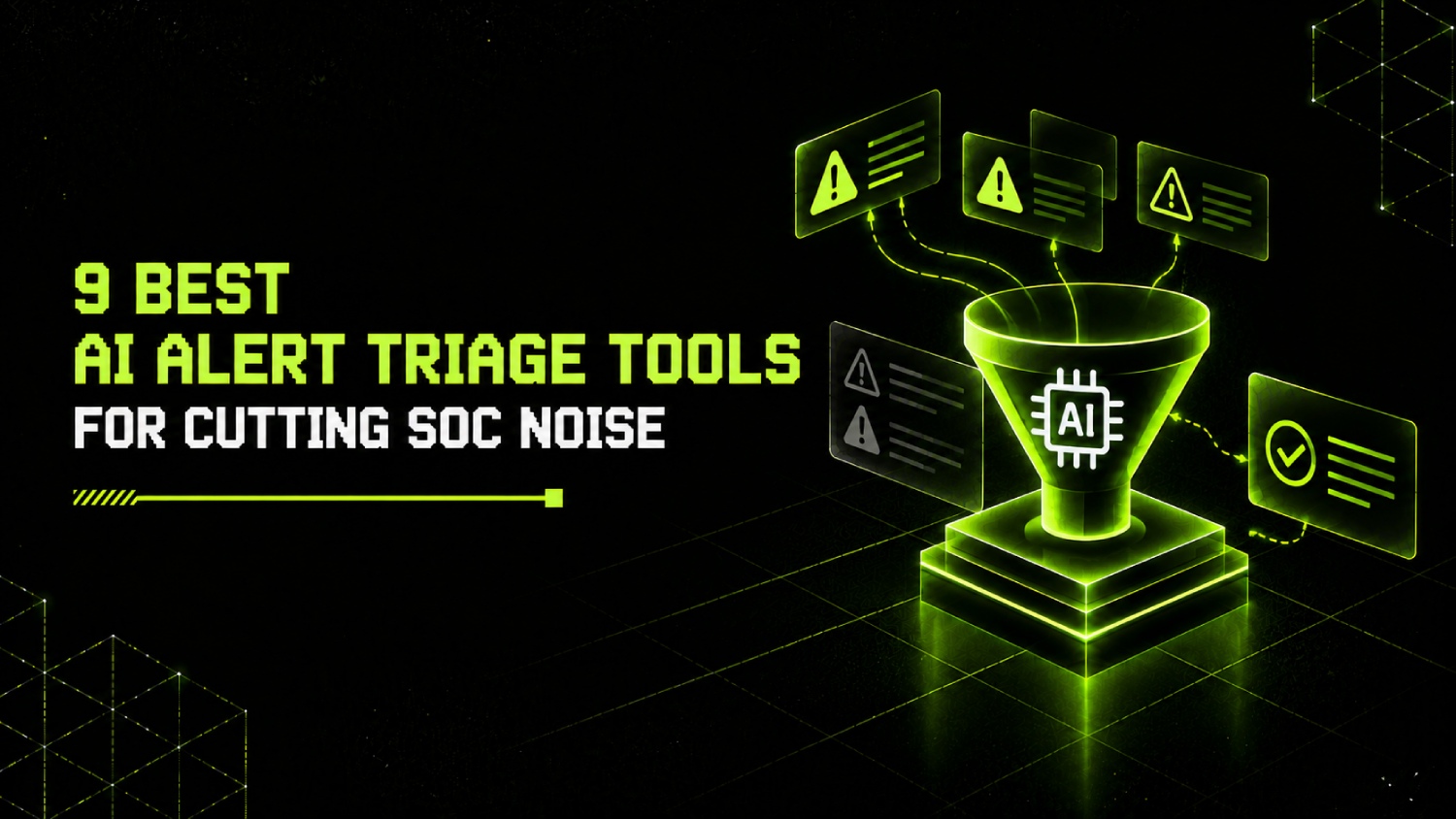
The best AI alert triage tools in wide use today include Dropzone AI, Prophet Security, Radiant Security, Intezer Analyze, Torq, Swimlane, Panther, Rapid7 InsightIDR, and Anomali ThreatStream, each positioned differently across the enrichment-to-decisioning spectrum. Choosing between them depends on where in the pipeline you need automation, whether your team needs the tool to close tickets or surface ranked candidates, and what your SIEM already does.
Why Tuning Has a Floor and What That Means for Triage Tooling
Most security leaders encounter alert fatigue as a detection-quality problem first. The instinct is to tune: raise thresholds, suppress low-signal rules, retire detections that fire constantly but never produce incidents. Tuning works, up to a point.
The floor appears when the remaining high-volume detections are ones you cannot safely disable. Broad authentication anomaly rules, cloud API abuse detections, endpoint process chain alerts on endpoints running developer tooling. These fire constantly, most are false positives, and none can be turned off without accepting genuine blind spots. This is where alert triage automation actually earns its keep, not as a substitute for good detection engineering, but as the mechanism that handles volume above what tuning can safely address.
The distinction between enrichment and decisioning is the most important architectural choice in this category, and most vendor pages blur it deliberately. Enrichment adds context to an alert: threat intelligence matches, asset ownership, user behavior baseline, geolocation, vulnerability status. Decisioning takes a position: this alert is a true positive, this one is a false positive, close it, escalate it, page someone. A tool that only enriches still requires an analyst to decide. A tool that decisions without enrichment is guessing.
How to Measure Your False-Positive Rate Before You Buy Anything
Running a pilot without a baseline is how vendors win evaluations. You need a number before you talk to anyone.
The SecurityOpsWire Alert Load Audit is a three-step measurement method your team can run in two weeks against your existing queue without buying anything.
Step 1: Tag every closed alert for 14 days. Add a disposition field to your ticketing workflow if you do not already have one. Four values only: confirmed true positive, confirmed false positive, inconclusive (not enough data to decide), and duplicate (a second alert for the same event). Do not merge inconclusive with false positive. That conflation is how teams undercount their actual accuracy gap.
Step 2: Calculate three ratios. False-positive rate: confirmed false positives divided by total disposed alerts. Inconclusive rate: inconclusives divided by total. Duplicate rate: duplicates divided by total. Your real triage automation opportunity is false positives plus duplicates. Inconclusives indicate enrichment gaps, not volume problems.
Step 3: Segment by detection source. Break the false-positive rate down by the rule or detection that generated it. You will almost always find that 20 percent of detections produce 70 to 80 percent of the false positives. Before piloting any triage tool, send that list back to your detection team. Anything that can be tuned should be tuned first. What remains is your actual pilot target.
Now you have a denominator. When a vendor tells you their tool achieves 80 percent auto-closure, you can ask: 80 percent of what alert type, from what source, with what base rate? Without your baseline, that number is theater.
Does the Tool Sit Before or After the SIEM?
Architecture determines what the tool can actually see, and that shapes everything downstream.
Tools that ingest raw telemetry before SIEM correlation work with higher signal volume and less structured data. They can apply their own correlation logic, but they also inherit every data quality problem in your pipeline. Tools that sit after the SIEM receive correlated, contextualized events, which are easier to triage accurately. They also inherit whatever suppression and tuning debt the SIEM already applies, which means their auto-closure rates look better partly because the SIEM already filtered the obvious noise.
A third placement is native to the SIEM itself. Rapid7 InsightIDR’s alert triage function operates inside InsightIDR rather than as a separate layer. Panther’s detection-as-code architecture processes rules at ingest time. These embedded approaches have lower integration overhead but less portability if you migrate your SIEM.
Most of the tools in this list sit after the SIEM and connect via API or webhook. That is the right placement for teams with an established SIEM that already does correlation but produces too much output for manual review.
What Does Triage Automation Actually Cost Per Thousand Alerts?
Almost none of the vendors in this category publish per-alert pricing. The honest answer to this question is: it depends on your contract structure, your alert volume, and which features you license.
Pricing models in this category generally follow one of four structures: per-analyst seat, per-alert volume tier, per-endpoint (for tools embedded in EDR or SIEM platforms), or flat platform fee for mid-market tiers. The per-analyst model benefits high-volume SOCs with small teams. The per-alert model benefits teams with low, predictable volume. The flat-fee model is usually a loss leader for vendors targeting the mid-market before upselling to enterprise contracts.
To calculate your own cost per thousand alerts, take the annual contract value, divide by your annual alert volume in thousands, and you have a rough per-unit figure. Then add the operational cost: how many analyst hours per week does the tool require for playbook maintenance, exception handling, and review of auto-closed alerts? At a fully burdened analyst rate, that number often exceeds the licensing cost in year one.
The 9 Tools: What They Do, Where They Fit, and What They Cost
Dropzone AI
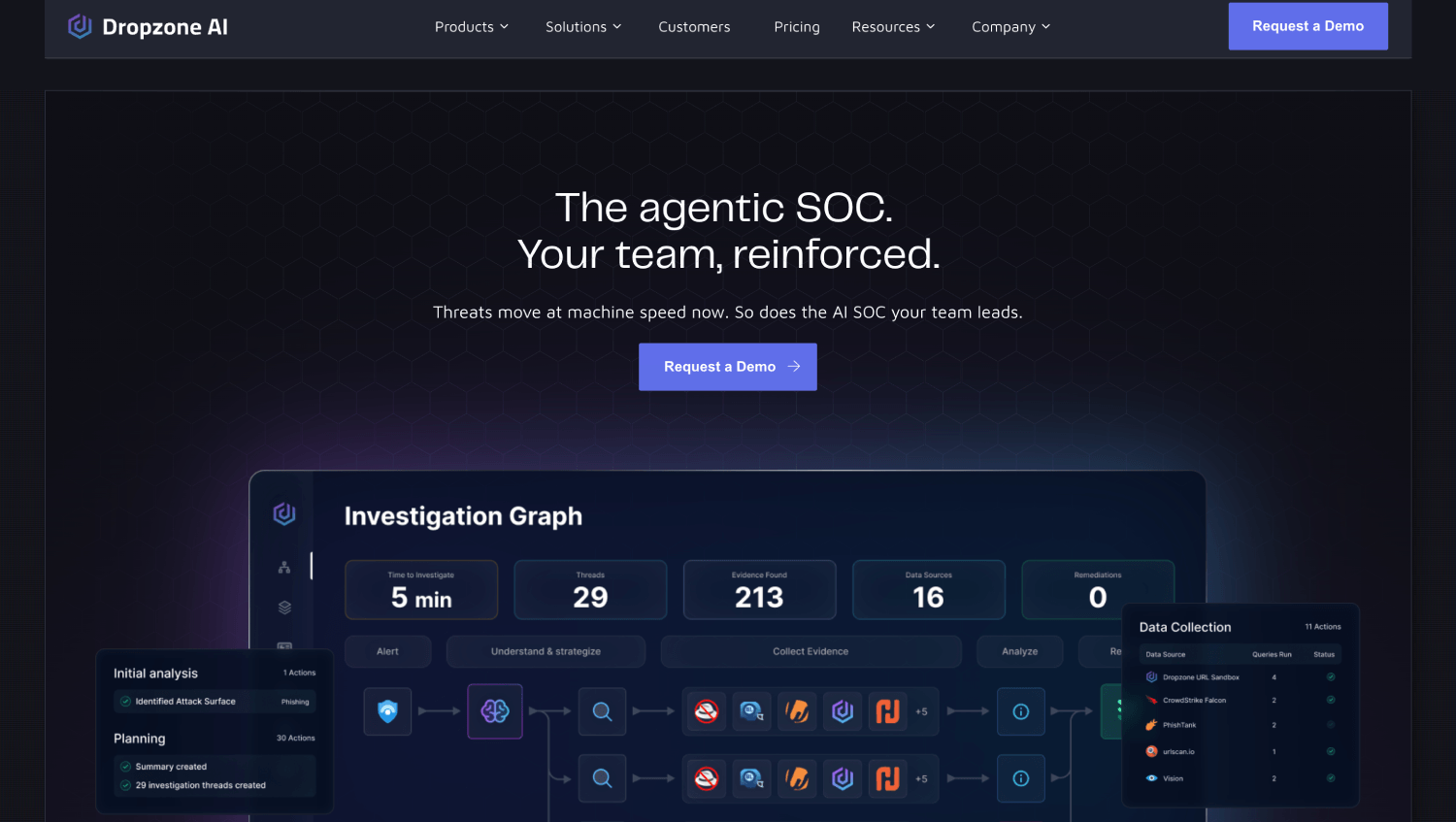
Dropzone positions as a fully autonomous tier-1 analyst. The product connects to your SIEM, EDR, identity provider, and threat intelligence feeds, then runs an investigation workflow on each alert: gathering evidence, assessing context, and writing a disposition recommendation in natural language. The output is an investigation report, not just a score, which means an analyst reviewing the work can see the reasoning rather than just accepting a verdict.
The decisioning depth is the differentiator here. Most enrichment tools hand a richer alert back to an analyst. Dropzone hands back a concluded investigation. For teams running Tier-1 with one or two analysts, that distinction determines whether the tool replaces headcount or just accelerates it.
Dropzone does not publish pricing publicly. Contact for enterprise quotes.
Prophet Security
Prophet is built around AI agent-driven investigation workflows. Each incoming alert spins up a set of AI agents that query connected data sources, build a timeline, assess severity, and produce a written disposition. The architecture is explicitly agentic, meaning different agents handle different investigation steps rather than a single model processing the whole alert.
That design matters for complex alerts spanning multiple data sources. An authentication anomaly that also correlates with an endpoint behavior change and a cloud API call is a harder investigation than any single-source alert. Multi-agent workflows handle the parallelism better than sequential enrichment pipelines. The tradeoff is that the system requires more integration surface to be useful, and integrations require maintenance.
Pricing is not publicly disclosed.
Radiant Security
Radiant focuses on SOC-specific AI triage with a strong emphasis on reducing analyst fatigue through automated alert clustering and context assembly. The product groups related alerts into unified investigations before routing them to analysts, which reduces the number of discrete decisions a human has to make even when the total alert volume remains constant.
The clustering approach addresses a different failure mode than single-alert enrichment tools. When an attacker generates five related alerts across different detection categories, treating each as a separate ticket multiplies analyst effort and delays pattern recognition. Radiant’s grouping logic addresses that specific problem. For teams whose primary complaint is alert fragmentation rather than raw volume, that is the more useful capability.
Pricing is not publicly disclosed.
Intezer Analyze
Intezer approaches alert triage from a malware analysis lineage. The product’s strongest capability is genetic code analysis: comparing suspicious files, scripts, and binaries against a large library of known malware families to identify shared code. That gives it unusual accuracy on endpoint and email alerts involving novel malware that has not yet generated threat intelligence signatures.
Where Intezer is weaker is on behavioral and network alerts that do not involve file-based artifacts. An identity anomaly or a cloud API abuse alert is not a problem that code similarity analysis solves. Teams running hybrid alert queues should expect to use Intezer alongside another tool rather than in place of one.
Intezer does not publish list pricing for its enterprise triage product.
Torq
Torq is a security automation platform with a triage-specific use case built on top of its broader SOAR capabilities. Triage workflows are built as no-code or low-code sequences that can query enrichment sources, evaluate conditions, and route or close alerts based on logic the team defines.
The difference from a purpose-built triage product is that Torq requires your team to build and maintain the decision logic. The AI components assist with building workflows and handling natural language inputs, but the triage accuracy depends on how well your playbooks are written. For teams with strong detection engineers who want to own the logic, that is a feature. For teams looking for an out-of-the-box decisioning engine, it is an operational burden. Torq’s pricing is not publicly listed.
Swimlane
Swimlane is an established SOAR platform that has added AI triage capabilities through its Turbine AI layer. The triage functionality sits inside the broader automation platform, meaning teams that already use Swimlane for incident response can extend into triage automation without a separate tool. For organizations that want a single automation platform rather than a point solution, that consolidation has real operational value.
The triage features in Swimlane are more configurable than those in purpose-built tools like Dropzone, but they require more setup. A net-new customer should expect a meaningful implementation period before achieving useful auto-closure rates. Swimlane does not publish pricing publicly.
Teams evaluating platform-level consolidation in the SOC may also find the coverage in our overview of AI SOC platforms useful when comparing Swimlane against broader automation suites.
Panther
Panther is a cloud-native SIEM built on a detection-as-code architecture. Alert triage is a native capability rather than a bolt-on layer, which means the platform applies triage logic at the same stage as detection. Analysts write detections in Python, which gives detection engineers precise control over what fires and at what severity.
The triage automation in Panther is best understood as tuning-at-detection-time rather than post-SIEM decisioning. High-confidence detections can be auto-closed by rule rather than by AI inference. That approach produces deterministic behavior, which some security teams prefer over probabilistic AI decisions. The limitation is that it requires ongoing detection engineering investment to maintain accuracy. Panther is positioned for security engineering teams, not for SOC analysts who need a decision made for them. Pricing is available on request.
Rapid7 InsightIDR
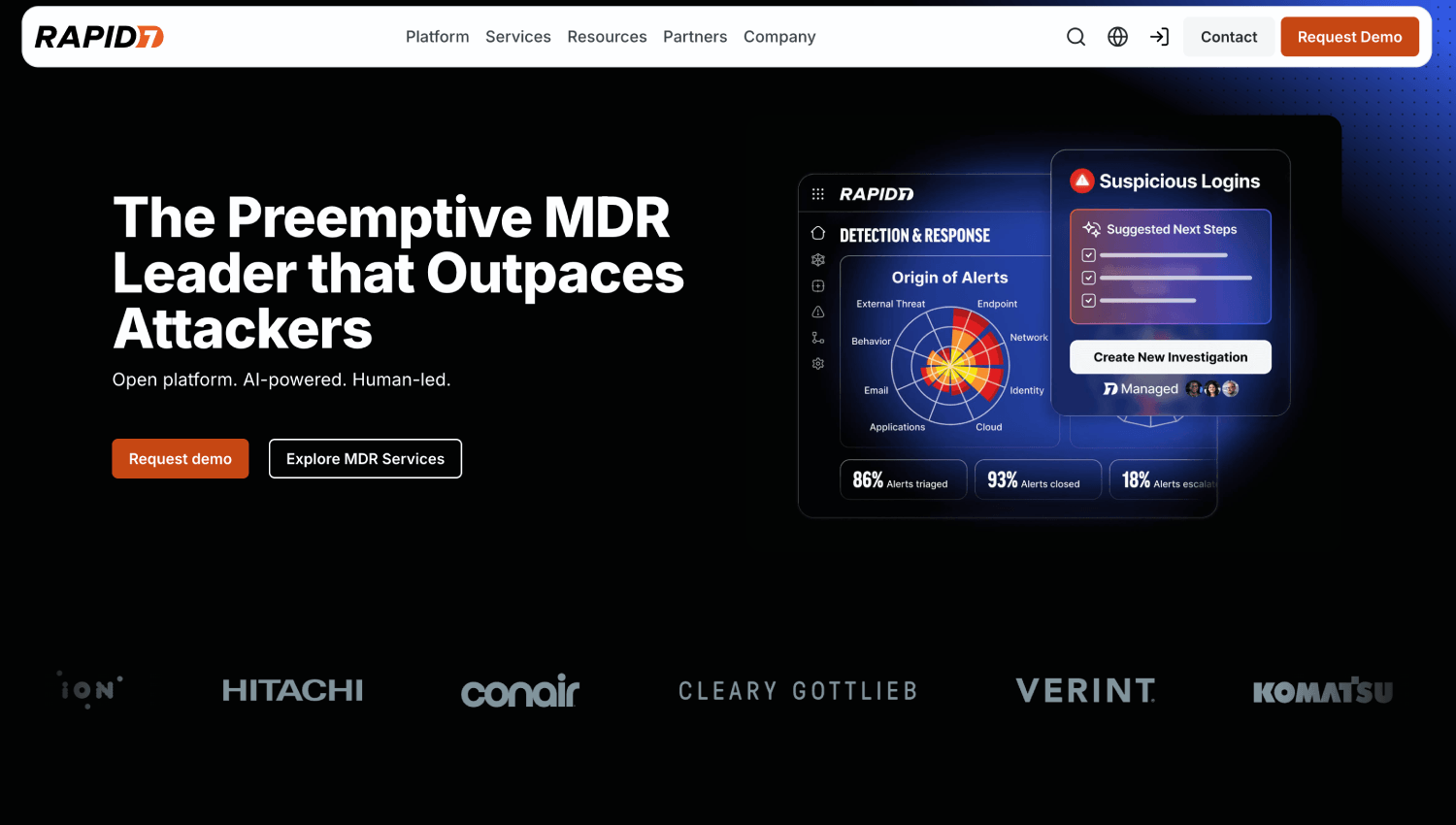
Rapid7’s AI Alert Triage feature inside InsightIDR automatically classifies alerts and recommends dispositions. The function works within the InsightIDR platform, meaning it has direct access to endpoint telemetry, user behavior analytics, and network context collected by the platform. Rapid7’s documentation describes the feature as reducing the manual review burden by classifying alerts as likely true or false positives before an analyst sees them.
The embedded placement is both its strength and its constraint. Teams running InsightIDR as their primary SIEM get triage automation without an additional integration layer. Teams running a different SIEM get nothing from this feature. For Rapid7 customers specifically, it is the lowest-friction path to triage automation available. Pricing is bundled with InsightIDR licensing, which Rapid7 does not publicly list at list rates.
Anomali
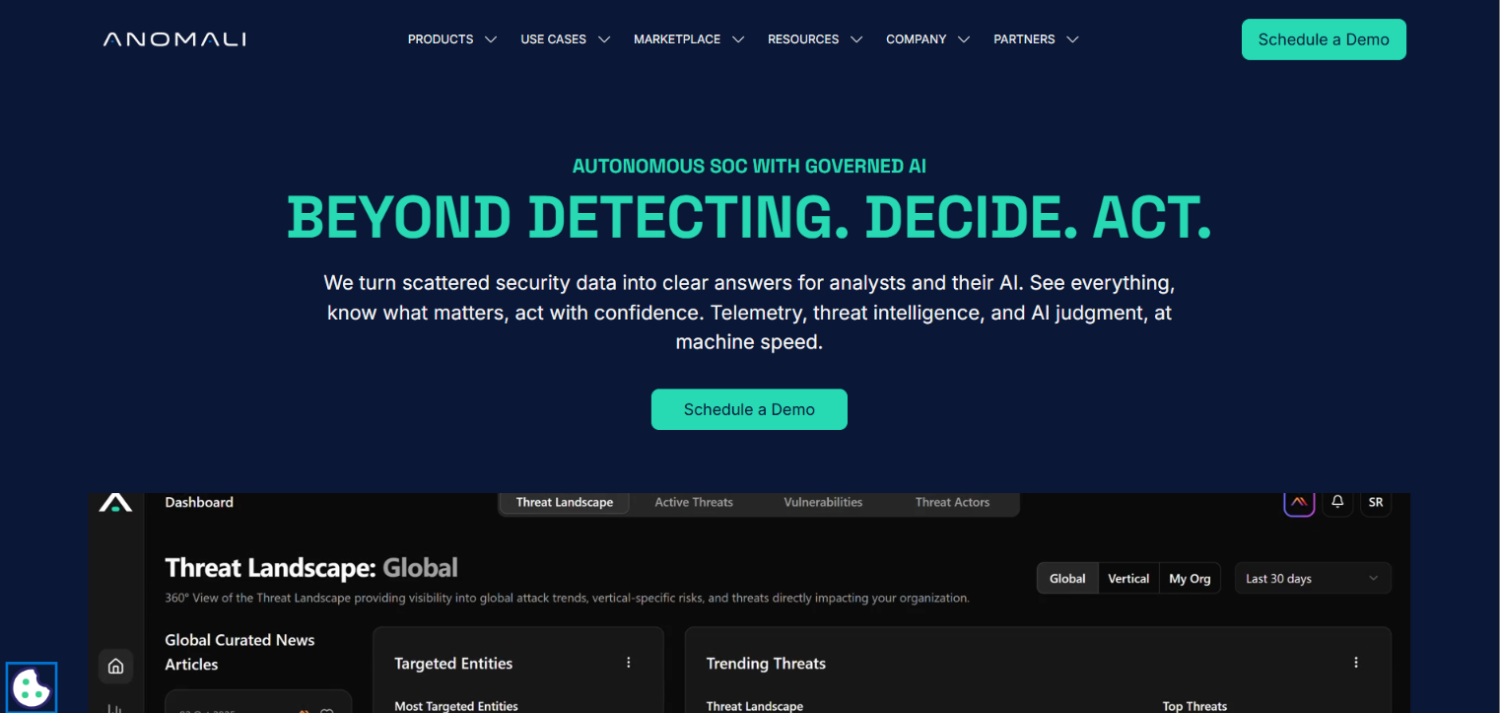
Anomali sits further toward the threat intelligence enrichment end of the spectrum than the decisioning end. The platform ingests threat intelligence from commercial, open-source, and government feeds, then applies that intelligence to enrich alerts with indicators of compromise matches, actor attribution, and campaign context.
For SOCs where the primary bottleneck is analyst time spent manually looking up indicators, Anomali’s automated enrichment removes a concrete workflow step. But enrichment alone does not close tickets. Anomali is most useful as a data layer that feeds a decisioning tool or a SIEM, rather than as a standalone triage solution. Teams evaluating Anomali against purpose-built triage tools should compare what happens after enrichment: who or what makes the disposition call. Pricing is not publicly listed.
Side-by-Side Comparison: How the 9 Tools Stack Up
| Tool | Primary Function | Placement | Decisioning Depth | Best Fit | Pricing Model |
|---|---|---|---|---|---|
| Dropzone AI | Autonomous Tier-1 investigation | Post-SIEM | Full disposition with written reasoning | Lean SOC replacing manual Tier-1 | Not publicly listed |
| Prophet Security | Multi-agent alert investigation | Post-SIEM | Full disposition via agent workflow | Complex multi-source investigations | Not publicly listed |
| Radiant Security | Alert clustering and context assembly | Post-SIEM | Grouped investigation handoff | Teams with alert fragmentation problem | Not publicly listed |
| Intezer Analyze | Malware and file analysis | Post-SIEM or EDR | File-based verdict | Endpoint/email-heavy queues | Not publicly listed |
| Torq | Security automation with triage use case | Post-SIEM or SOAR layer | Configurable by team | Detection engineering teams owning logic | Not publicly listed |
| Swimlane | SOAR with AI triage layer | Post-SIEM | Configurable via Turbine AI | Existing Swimlane customers | Not publicly listed |
| Panther | Detection-as-code SIEM | At-detection (native) | Rule-based deterministic | Engineering-led security teams | Available on request |
| Rapid7 InsightIDR | Embedded SIEM triage | Native to InsightIDR | Classification with recommendation | Rapid7 SIEM customers | Bundled with InsightIDR |
| Anomali | Threat intelligence enrichment | Pre- or post-SIEM | Enrichment only | Teams with indicator lookup bottleneck | Not publicly listed |
How Is Triage Accuracy Measured and Reported?
Vendor-reported accuracy figures are almost always recall rates, not precision rates. Recall measures how many true positives the tool correctly identified. Precision measures how many auto-closed alerts were genuinely false positives. A tool can achieve 95 percent recall while auto-closing a meaningful number of real incidents if its precision is poor.
The metrics that actually matter for a triage tool evaluation are: auto-closure rate (what fraction of alerts does the tool decide without human review), false-negative rate on auto-closed alerts (how often did it close a real incident), and analyst agreement rate (when an analyst reviews an auto-closed alert during a quality-check sample, what percentage do they agree with). Most vendors will not proactively give you the false-negative rate on auto-closures. Ask for it explicitly.
For your pilot, structure a quality-check process from day one. Auto-close a percentage of alerts, then have an analyst review a random sample of those auto-closures weekly. Track analyst agreement. If it drops below your defined threshold, that is a model drift signal, not just a bad week. Most purpose-built triage tools include some version of this feedback loop in their product. Verify that the tool you are piloting actually logs the feedback and uses it to improve outcomes.
Teams building out their SOC measurement framework alongside triage automation will find our comparison of AI SOC analyst tools for Tier-1 investigation covers complementary metrics around MTTD and MTTR that apply here.
How Much Alert Volume Can Realistically Be Closed Automatically?
This varies more by alert type than by tool capability. Alerts generated by well-defined detections with high historical false-positive rates, like certain cloud storage access anomaly rules or repeated authentication failures from known scanners, are easier to auto-close because the tool can match patterns reliably. Novel or complex alerts involving multiple entities, lateral movement indicators, or rare activity types are harder to auto-close accurately.
Consider a mid-sized company running three cloud accounts, a single EDR platform, and one identity provider, generating roughly 4,000 alerts per month. After the SecurityOpsWire Alert Load Audit, suppose the team identifies that 1,800 of those alerts come from five detection rules with a historical false-positive rate above 85 percent. Those 1,800 are strong auto-closure candidates. The remaining 2,200 have mixed profiles, some suitable for auto-closure with high confidence, others requiring enrichment and human review. A realistic auto-closure target for that queue is 40 to 55 percent of total volume, not the 80 to 90 percent figures that sometimes appear in vendor materials.
The gap between 55 percent and 80 percent is where the tool matters less than the underlying detection quality. Pushing auto-closure above 60 to 65 percent without a corresponding investment in detection accuracy increases the risk of closing real incidents. Set your target based on your false-negative tolerance, not on what the vendor’s case study claims.
Tines: Where It Fits in This Evaluation
Tines is a security workflow automation platform that handles alert triage as one of many use cases. Like Torq, it is not purpose-built for triage decisioning. Teams build triage workflows using Tines’ story-based no-code automation, pulling enrichment data from external sources and routing alerts based on configured logic.
Tines is best suited for teams that want to build a triage automation layer on top of an existing SIEM investment without buying a standalone AI triage product. The time-to-value is longer than a purpose-built tool because workflow design is the team’s responsibility. The ongoing operational cost is lower once workflows are mature. For teams with the engineering capacity to build and maintain the logic, Tines is a credible alternative to the dedicated AI triage products on this list. Tines does not publicly list pricing for its enterprise tier.
Organizations evaluating Tines or Torq as broader automation platforms, rather than triage-specific tools, may want to review our coverage of autonomous SOC platforms built for lean security teams for a broader platform-level comparison.
What to Watch for in Integrations and Playbook Maintenance
The integration surface of a triage tool is the primary source of operational cost that does not appear in licensing. Every connected data source is an integration that can break when the source API changes, when authentication tokens expire, when schema changes upstream. A triage tool connected to a SIEM, an EDR, an identity provider, and two threat intelligence feeds has four distinct integration failure modes.
Playbook maintenance is the second hidden cost. Triage accuracy depends on playbooks that reflect current environment conditions. A playbook written when the primary endpoint OS was Windows 10 needs revision when your fleet moves to a different configuration. A playbook calibrated to your cloud environment in one region needs revision when you add a second region. The tools that maintain accuracy with lower ongoing maintenance are the ones where AI inference does more of the decisioning work, because the playbook logic is simpler. The tools where the team writes most of the logic require proportionally more ongoing maintenance.
Ask vendors specifically: what does playbook drift look like in your product, and how does it surface? Tools that surface degrading auto-closure accuracy through a dashboard metric are easier to operate than tools that require the team to notice a problem through manual review.
Security teams running agentic workflows alongside their triage tooling should also consider how autonomous action boundaries apply to auto-closed alerts. Our coverage of AI agent security platforms addresses how organizations are setting control boundaries for autonomous security actions more broadly.
Frequently Asked Questions
What is the difference between alert enrichment and alert decisioning in triage tools?
Enrichment adds context to an alert: threat intelligence matches, asset metadata, user behavior history, geolocation, and related events. Decisioning takes a position on the alert: it is a false positive, a true positive, a duplicate, or requires escalation. A tool that only enriches still requires a human to decide. A tool that decisions automates the conclusion. Most modern triage tools do both, but differ significantly in how much decisioning authority they give to the AI versus the analyst.
How do you measure false-positive rate in a SOC before piloting a triage tool?
Manually tag every disposed alert for two weeks with one of four dispositions: confirmed true positive, confirmed false positive, inconclusive, or duplicate. Divide confirmed false positives by total disposed alerts for your false-positive rate. Segment that rate by detection source to identify which rules generate most of the noise. This gives you a baseline denominator to compare against vendor claims during a pilot. Without this number, any vendor-reported improvement figure is unverifiable.
What auto-closure rate is realistic for AI alert triage tools?
For most enterprise SOC environments, a realistic auto-closure rate after a well-configured pilot is 40 to 60 percent of total alert volume. Rates above 65 percent require either exceptionally high detection quality or an acceptance of elevated false-negative risk on auto-closed alerts. Vendor case studies often reflect best-case environments with specific alert type distributions. Measure your own alert composition and historical false-positive rates before setting an auto-closure target.
Does an AI triage tool replace a SIEM or sit on top of it?
Almost all purpose-built AI triage tools sit on top of an existing SIEM rather than replacing it. They consume correlated, contextualized alerts from the SIEM via API or webhook, then apply additional enrichment and decisioning logic. Exceptions include native triage capabilities built into SIEM products themselves, such as Rapid7 InsightIDR’s AI Alert Triage feature, and detection-as-code platforms like Panther that apply triage logic at the detection stage rather than as a separate layer.
How is triage accuracy reported and what metrics should I ask vendors for?
The three metrics that matter most are auto-closure rate (fraction of alerts resolved without analyst review), false-negative rate on auto-closed alerts (how often the tool incorrectly closes a real incident), and analyst agreement rate (percentage of auto-closed alerts an analyst agrees with on review). Vendors typically lead with auto-closure rate and recall. Ask explicitly for the false-negative rate on auto-closures and the methodology for quality-checking auto-closed decisions.
What is the operational cost of running an AI alert triage tool beyond licensing?
The main operational costs are integration maintenance, playbook maintenance, and analyst review of auto-closed alerts. Integration maintenance scales with the number of connected data sources and the frequency with which those source APIs change. Playbook maintenance scales with how much decision logic the team owns versus the AI. Quality-check review, where analysts sample auto-closed alerts to catch false negatives, is a fixed ongoing cost regardless of which tool you use. In year one, these costs often match or exceed the licensing cost for configurable tools like Torq or Tines.
Which AI triage tools are best for a small security team with no dedicated detection engineer?
For teams without a dedicated detection engineer, purpose-built tools that own the decision logic rather than requiring the team to write playbooks are the better fit. Dropzone AI and Radiant Security both operate with less team-built logic than platforms like Torq or Tines. Rapid7 InsightIDR’s embedded triage is also low-configuration for existing InsightIDR customers. The tradeoff is less customization in exchange for faster deployment and lower ongoing maintenance overhead.
What is the difference between a SOAR platform and an AI alert triage tool?
A SOAR platform automates security workflows broadly, including incident response, case management, and integrations across the security stack. Alert triage is one workflow a SOAR handles among many. Purpose-built AI triage tools focus narrowly on the disposition decision for incoming alerts, typically with AI models trained specifically on security alert patterns. SOAR platforms like Swimlane and Torq can handle triage but require teams to build the triage logic. Purpose-built triage tools like Dropzone and Radiant Security start with triage-specific AI and may lack the broader workflow automation of a full SOAR.
The Actual Decision: Match the Tool to Your Bottleneck
Every tool on this list reduces alert volume, in the same way that every painkiller reduces pain: they work on the symptom as described. The difference is whether you have correctly identified the bottleneck. If your analysts spend most of their time on indicator lookups and context assembly, enrichment tools address that directly. If the bottleneck is the volume of decisions that need to be made, not the time per decision, then you need a tool that makes decisions, not one that accelerates decision preparation.
The SecurityOpsWire Alert Load Audit gives you the data to answer that question before a vendor call. Run it, segment by detection source, then map the output to the enrichment-versus-decisioning spectrum on this list. A queue dominated by known-bad indicators from the same five rules is an enrichment problem with a clear Anomali or Intezer-shaped solution. A queue dominated by high-volume behavioral anomaly alerts that require contextual judgment is a decisioning problem that requires Dropzone, Prophet, or Radiant.
The teams that get the most out of triage automation are the ones that treat the pilot as a measurement exercise rather than a proof-of-concept exercise. Set your baseline false-positive rate before the pilot starts. Define your acceptable false-negative rate on auto-closures before you configure anything. Build the quality-check process before the vendor asks you to. Those three steps take two weeks and cost nothing. They also make it impossible for a vendor to define success on their own terms.