
TLDR
- DSPM classifies and governs data wherever it lives: cloud storage, databases, SaaS, and data pipelines. It was not designed to understand that a vector store is a different kind of data artifact than a relational table.
- AI-SPM inventories AI assets, models, agents, and their configurations. It governs how those systems are built and what they can reach, but it does not classify the underlying data those systems consume.
- Vector stores and embeddings sit in the gap between the two categories. DSPM tools that do not parse embedding formats will miss sensitive data encoded inside them. AI-SPM tools that do not classify data cannot tell you whether a retrieval-augmented generation pipeline is pulling PII into a model response.
- Most organizations running a RAG deployment need both tools covering different control layers, not a single tool attempting to own the whole problem.
- The vendors pushing DSPM-first or AI-SPM-first framings are not wrong about their own coverage. They are just describing half the problem.
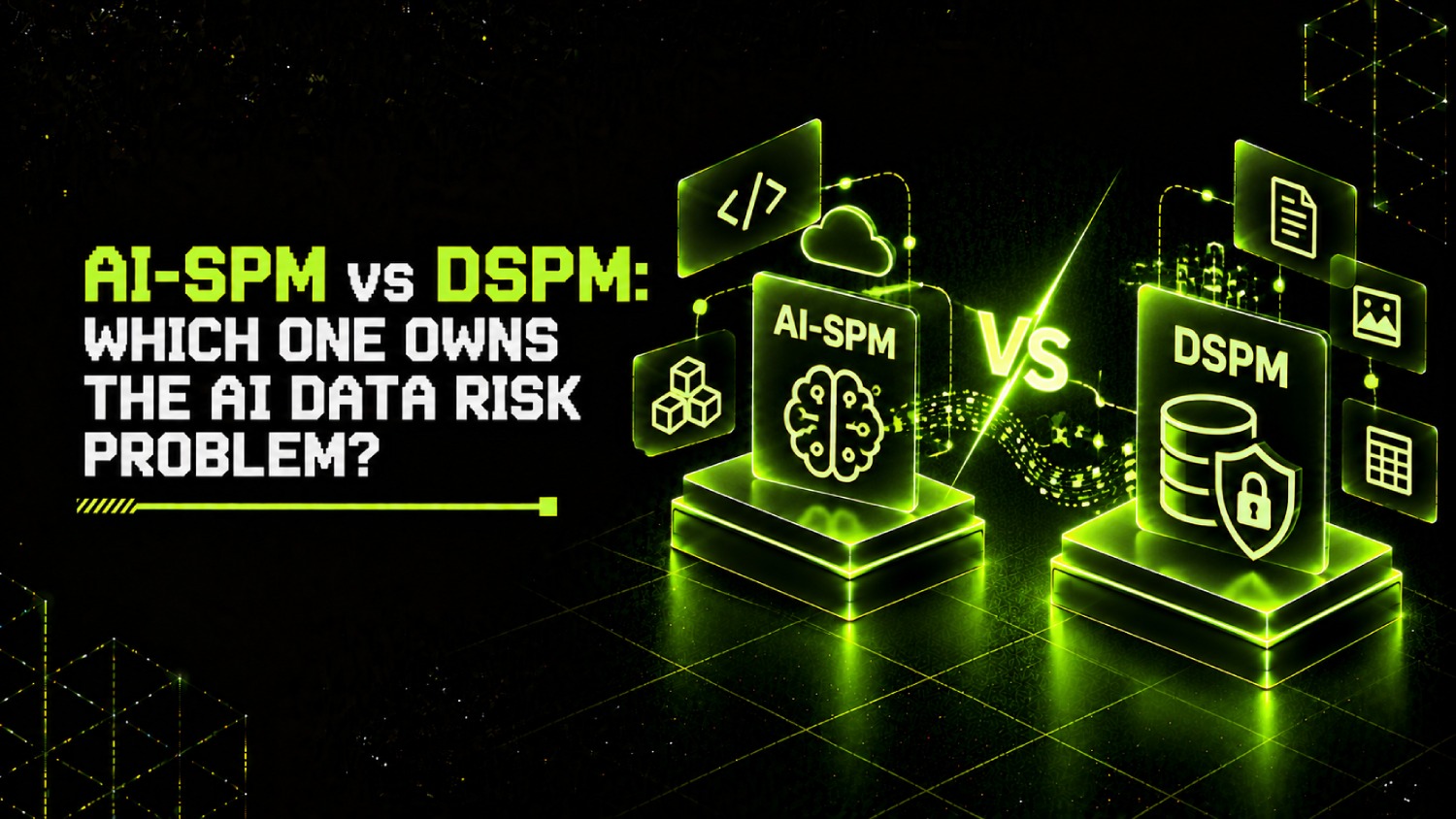
Understanding the AI-SPM vs DSPM distinction matters because these two categories cover adjacent but distinct surfaces. DSPM finds and classifies sensitive data across cloud environments and enforces access policy at the data layer. AI-SPM inventories AI models, agents, pipelines, and their configurations to detect misconfigurations and excessive permissions in the AI stack. For a RAG deployment or any system where agents retrieve data at inference time, neither tool covers the full risk alone. The seam between them is where vector stores, embeddings, and retrieval pipelines actually live.
Why the Vector Store Is the Sharpest Illustration of the Coverage Gap
Start with a concrete scenario. Say a company ingests 200,000 internal documents into a vector database to power an employee-facing AI assistant. The documents include HR records, legal contracts, and engineering specifications. The vector database stores those documents as high-dimensional numerical arrays, not as plaintext rows.
A conventional DSPM tool crawls structured and semi-structured data: S3 buckets, relational databases, Snowflake schemas, SharePoint libraries. It classifies content by reading it. A vector store does not expose content in a form that most DSPM classifiers can parse. The embeddings are not text. The sensitive data is encoded inside them. If the DSPM tool does not understand the embedding format and cannot reconstruct the source documents for classification, it sees a database with a lot of numerical arrays and moves on.
The AI-SPM tool, scanning the same environment, finds the vector database. It flags that the database is accessible to an agent service account with overly broad permissions. It notes that no retrieval filter enforces access control by user role. Those are real findings. But AI-SPM has no mechanism to tell you that 12,000 of those embedded documents contain employee PII, or that 3,400 of them are attorney-client privileged. It is not a classification engine.
That gap is not theoretical. It is where a data exposure actually happens in a retrieval-augmented generation deployment: a user asks a question, the retrieval layer surfaces documents they were never authorized to see, and the model includes that content in its response. The DSPM tool missed the storage artifact. The AI-SPM tool missed the data sensitivity. Neither tool alone would have flagged the risk before it surfaced in production.
What DSPM Actually Covers and Where It Stops
DSPM tools work by discovering data stores, sampling or scanning their contents, and applying classification policies to identify sensitive data classes such as PII, PHI, payment card data, and intellectual property. Vendors like Cyera, Wiz, and Varonis have expanded their scanning coverage to include cloud-native data stores and, increasingly, AI-adjacent infrastructure.
DSPM’s native strength is answering the question: where does sensitive data live, who can access it, and is that access appropriate? It connects data classification to identity and access policy. It detects oversharing: a storage bucket readable by all authenticated users, a database accessible by a service account that has not been used in 90 days. Those are data governance problems that exist with or without AI. DSPM solves them at scale.
Where DSPM runs into friction with AI workloads:
- Embedding formats (dense vectors from models like Ada or BGE) are opaque to classifiers built for structured data. Coverage depends heavily on whether the vendor has built specific parsers for the embedding formats your organization uses.
- Model training datasets stored as serialized formats, Parquet files, or HuggingFace datasets require classification logic that understands those schemas. Generic file classifiers may miss the sensitivity entirely.
- Inference logs and prompt histories stored in object storage or logging services may contain extracted PII from user interactions. These are new data classes that most DSPM policies were not written to detect at ingestion time.
- DSPM has no concept of model behavior. It can tell you that data was accessed, but not what the model did with it, what it returned, or whether retrieval filters were bypassed.
For teams evaluating DSPM platforms specifically for AI environments, the comparison of DSPM tools built for AI data security covers which vendors have extended their classification engines to handle these formats.
What AI-SPM Actually Covers and Where It Stops
AI-SPM (AI Security Posture Management) is a marketing category, coined by several vendors in approximately 2023, to describe tooling that inventories AI assets and assesses their security configurations. What it actually does: discover models, agents, fine-tuned deployments, and pipelines across a cloud environment; identify misconfigurations in how those systems are deployed; and flag where permissions, network exposure, or pipeline architecture deviate from a defined policy baseline.
AI-SPM’s native strength is answering the question: what AI is running in our environment, how is it configured, and is that configuration safe? It catches things like an agent service account with overly broad IAM permissions, a model endpoint exposed without authentication, a fine-tuned model stored in a public S3 bucket, or a pipeline that passes user input directly to a model without any input validation layer. These are configuration and architecture problems specific to AI deployments.
Where AI-SPM runs into friction with data risk:
- AI-SPM tools understand the architecture of a pipeline, not the sensitivity of the data flowing through it. They can tell you the pipeline exists; they cannot tell you the pipeline is moving regulated data.
- Without data classification, AI-SPM cannot prioritize risk by data sensitivity. An AI-SPM tool might flag 40 misconfigurations of equal severity. The one that matters most is the one touching the most sensitive data, and AI-SPM alone cannot make that determination.
- Retrieval policies in RAG architectures require data-level labeling to enforce. If documents in a vector store are not classified, an AI-SPM tool cannot verify whether the retrieval filter actually enforces the right access boundaries.
- AI-SPM does not govern what happens after a model generates a response. Output inspection, data leakage in model responses, and prompt injection leading to data exfiltration fall outside its scope. Those belong to AI guardrail platforms operating at inference time.
The relationship between AI-SPM and the broader AI agent security space is covered in the AI agent security versus AI-SPM comparison, which draws the line between posture tools and runtime controls.
The Seam Between Them: RAG Pipelines, Embeddings, and Training Data
RAG architecture creates three distinct data risk surfaces that fall between DSPM’s current coverage and AI-SPM’s current coverage.
The first is the ingestion pipeline: the process that reads source documents, chunks them, generates embeddings, and writes them to a vector store. This pipeline accesses sensitive data at high volume and typically runs as an automated service account. DSPM should govern the source documents before ingestion. AI-SPM should govern the pipeline’s permissions and configuration. If either tool is absent, the pipeline is a blind spot.
The second is the vector store itself. As noted above, DSPM tools with vector-store-aware classifiers can partially cover this. AI-SPM tools can flag access control misconfigurations. Neither tool alone gives a complete picture.
The third is the retrieval and inference layer: the moment the agent queries the vector store, retrieves documents, and passes them to the model as context. This is where a row-level access control failure becomes a data exposure. DSPM cannot observe this in real time. AI-SPM can flag that no retrieval filter exists at the architecture level, but it does not monitor live queries. Runtime observation here belongs to agent monitoring tooling, not posture tools.
Training data is a fourth surface, relevant for teams running fine-tuning workloads. Training datasets are typically large files in object storage. DSPM covers this well if the classifier handles the file format. AI-SPM covers the access configuration of the training job and the resulting model artifact. The data inside the training set is DSPM’s territory.
Coverage Comparison: Where Each Tool Owns the Risk
| Risk Surface | DSPM Coverage | AI-SPM Coverage | Gap or Overlap |
|---|---|---|---|
| Source documents in cloud storage | Strong: classification, access review, policy enforcement | Minimal: not primary scope | DSPM owns this |
| Ingestion pipeline permissions | Partial: detects oversharing by service account | Strong: pipeline configuration, IAM review | AI-SPM owns this, DSPM assists |
| Vector store access control | Partial: depends on vendor support for vector DB format | Strong: flags missing auth, overly broad access | Overlap, with gaps in each |
| Embeddings (data sensitivity inside vectors) | Partial: only if vendor parses the embedding format | None: not a classification engine | Gap. Neither tool reliably covers this today |
| Training datasets in object storage | Strong: if file formats are supported | Minimal: covers storage config, not content | DSPM owns this |
| Model artifact storage | Partial: detects oversharing on the file | Strong: integrity, provenance, access control | AI-SPM owns this |
| Inference logs and prompt histories | Partial: detects PII in log storage if classified | Minimal: not primary scope | Neither tool covers this well at runtime |
| Agent permissions and IAM configuration | Partial: detects access anomalies | Strong: primary scope | AI-SPM owns this |
| Retrieval filter enforcement at query time | None: not a runtime tool | Partial: flags missing filter in configuration review | Runtime gap: belongs to agent monitoring |
| Fine-tuning job configuration | None | Strong: compute config, access, data path | AI-SPM owns this |
The SecurityOpsWire AI Data Risk Layer Model
One way to think about where each tool belongs: AI data risk in a production deployment spans four layers, each requiring a different control mechanism. Call this the AI Data Risk Layer Model.
Layer 1: Data at rest. What sensitive data exists, where it lives, and who can reach it. This is DSPM’s core function. The tool answers classification and access governance questions across all data stores, including those that feed AI systems.
Layer 2: AI asset configuration. What AI systems are deployed, how they are configured, and whether their architecture follows security policy. This is AI-SPM’s core function. The tool answers inventory and posture questions about models, agents, pipelines, and their permission structures.
Layer 3: Data in motion through AI pipelines. What data flows through ingestion pipelines, retrieval layers, and inference calls. This layer partially belongs to both tools and is where the coverage gap is most visible. DSPM governs the data before and after. AI-SPM governs the pipeline configuration. Neither tool governs what actually moves through the pipeline during a live query.
Layer 4: Runtime model behavior. What the model returns, whether it leaks sensitive content in responses, and whether retrieval filters are actually enforcing access controls at query time. This layer belongs to runtime tools: agent monitoring platforms, guardrail systems, and agentic DLP. Posture tools do not operate here.
Security teams running a RAG deployment need coverage at all four layers. DSPM owns Layer 1. AI-SPM owns Layer 2. Layers 3 and 4 require additional tooling, coordination between the two posture tools, or both. For teams evaluating what lives at Layer 4, the coverage of AI agent discovery and monitoring tools maps the runtime observation space.
Do Teams Actually Need Both, or Is One Sufficient?
The answer depends on what an organization is doing with AI and what they already have deployed.
A team with mature DSPM coverage and no AI workloads beyond basic SaaS AI tools (think Copilot or ChatGPT Enterprise) probably does not need AI-SPM immediately. Their data risk is a data governance problem, and DSPM covers it. The AI surface is limited to SaaS configuration and employee usage policy.
A team building or running custom AI: fine-tuning models, deploying agents, operating a RAG pipeline, or managing inference infrastructure, has AI-specific configuration risks that DSPM does not address. They need AI-SPM for the asset inventory and pipeline configuration review, and they need DSPM for the underlying data governance. Running AI-SPM without DSPM means the posture tool is flagging configuration issues without any ability to prioritize them by the sensitivity of the data at risk.
Consider a 600-person SaaS company running two RAG-powered internal assistants, one for engineering documentation and one for HR policy. They have three AWS accounts, use Pinecone as their vector store, and have a two-person security team. AI-SPM without DSPM gets them an inventory of the agent configurations and a list of IAM misconfigurations. Useful. But they cannot answer the board’s question: “What data could an employee access through these assistants that they shouldn’t?” DSPM without AI-SPM gets them classification of the source documents and access controls on the S3 buckets holding them, but no visibility into whether the Pinecone index is misconfigured or whether the agent service accounts are over-permissioned. Neither half is sufficient.
Several vendors offer combined coverage in a single platform. Wiz, for example, describes DSPM capabilities within its cloud security platform , including the ability to detect sensitive training data in AI pipelines , but positions this as part of its DSPM offering rather than as a distinct AI-SPM product. According to Wiz’s DSPM documentation, capabilities such as identifying sensitive data in AI pipelines are listed under DSPM rather than as a separate AI-SPM module. Whether any combined platform delivers equivalent depth to two dedicated tools is a separate evaluation question, and the answer varies by vendor and environment. The comparison of AI-SPM platforms covers the current field of dedicated tools and their depth across each coverage area.
How Non-Human Identity Complicates the Picture Further
RAG pipelines run as service accounts or workload identities, not as users. The agent that queries the vector store is a non-human identity. The pipeline that ingests documents is a non-human identity. These identities are often provisioned with far more access than they need, because the engineers who built the pipeline granted broad read permissions during development and never revisited them.
DSPM can detect that a service account has access to sensitive data. AI-SPM can detect that the same service account has overly broad IAM permissions relative to its function in the AI pipeline. Neither tool, on its own, connects the identity risk to the data risk and to the AI asset risk in a single finding. That connection is where the real exposure is: a misconfigured pipeline identity with access to sensitive data, running as part of an AI system that has no retrieval filter.
Non-human identity management platforms address this identity governance problem at a different layer. The relationship between agent identities and the broader NHI security space is worth understanding separately for teams managing pipeline service accounts at scale. For those evaluating NHI tooling, the non-human identity security platform comparison covers the current market in that space.
Frequently Asked Questions
What is AI-SPM and how is it different from DSPM?
AI-SPM (AI Security Posture Management) inventories AI models, agents, and pipelines, then assesses their configurations for security risks such as exposed endpoints, overly permissive service accounts, and missing input validation. DSPM (Data Security Posture Management) discovers and classifies sensitive data across cloud environments and governs who can access it. DSPM starts with data. AI-SPM starts with AI assets. They cover different layers of the same production AI environment.
Does DSPM cover vector stores and embeddings?
It depends on the vendor. DSPM tools built for traditional structured and semi-structured data stores often cannot parse embedding formats directly, because embeddings are numerical arrays rather than readable content. Some vendors have added specific support for vector databases. Teams should verify, with their DSPM vendor, whether their product can reconstruct and classify source content from a specific vector database (such as Pinecone, Weaviate, or pgvector) before assuming coverage exists.
Do security teams need both AI-SPM and DSPM for a RAG deployment?
For most production RAG deployments, yes. DSPM governs the sensitivity of source documents before they are ingested and can partially govern data in vector storage. AI-SPM governs the pipeline architecture, the agent’s IAM permissions, and the retrieval layer configuration. Without DSPM, AI-SPM cannot prioritize misconfigurations by data sensitivity. Without AI-SPM, DSPM misses the AI-specific configuration risks entirely. The combination provides materially better coverage than either tool alone.
Where does agentic DLP fit relative to DSPM and AI-SPM?
Agentic DLP operates at runtime, inspecting what an AI agent does with data in real time during an active session or inference call. DSPM and AI-SPM are both posture tools: they assess state at a point in time and flag misconfigurations or policy violations. Agentic DLP enforces policy during live data movement, including blocking a model response that contains PII or preventing an agent from writing sensitive data to an unauthorized destination. It complements both posture tools rather than replacing either.
Can a single platform cover both DSPM and AI-SPM?
Several vendors offer combined coverage within a single platform. The depth of that coverage varies. Some vendors extend DSPM to include AI-adjacent data stores and pipeline data classification, while others approach the problem from an AI asset inventory angle and layer in data governance. Organizations with complex RAG deployments or large-scale fine-tuning operations should evaluate the classification depth for their specific vector database and model formats, rather than assuming that platform integration delivers equivalent coverage to two dedicated tools.
What happens when AI-SPM flags a misconfiguration but there is no DSPM context?
Without data classification context, AI-SPM findings are difficult to prioritize. A pipeline with overly broad read access to a storage bucket is a different risk level depending on whether that bucket holds publicly available documentation or regulated PII. Security teams without DSPM often end up triaging AI-SPM findings manually, pulling in data governance teams to assess sensitivity on a case-by-case basis. That process does not scale well across dozens of AI pipelines and hundreds of data stores.
How does AI-SPM relate to AI agent security platforms?
AI-SPM is a posture tool. It assesses the security configuration of AI assets and pipelines before or between runtime events. AI agent security platforms extend coverage into runtime behavior: monitoring what agents do during active sessions, detecting prompt injection, enforcing guardrails on agent actions, and managing the permissions agents exercise through tool calls. The two categories are complementary. The boundary between them is covered in the AI agent security versus AI-SPM distinction , for a full breakdown, see the AI agent security platforms comparison.
Where This Leaves Security Leaders Making a Buying Decision
The reader’s original assumption, that DSPM already covers AI because AI risk is fundamentally a data problem, is partially correct. Data sensitivity is the core variable that determines how bad an AI-related data exposure actually is. But data sensitivity alone does not explain how an agent got access to data it should never have touched. That is an AI architecture and identity configuration problem, and it requires different tooling to detect and remediate.
DSPM and AI-SPM are not competing for the same problem. They are covering different layers of a production AI environment, and the vendors framing it as a choice between the two are typically doing so because they sell one of them. The honest answer is that vector stores, embedding pipelines, and retrieval architectures sit squarely in the seam between these two categories, and that seam is where most AI-related data exposures will actually originate.
The practical path forward for most teams: deploy DSPM first if you do not have strong data classification coverage, because AI-SPM findings without data context are hard to prioritize. Add AI-SPM when you are running custom AI infrastructure, because DSPM alone will not catch the configuration risks specific to model deployments and agent pipelines. And identify, explicitly, who owns the retrieval layer and inference runtime in your environment, because neither posture tool will tell you what happens during a live model query.