
TLDR
- Cyera and BigID are not interchangeable products. Cyera was designed as a cloud-native data security posture management tool, while BigID was built from a data governance and privacy lineage with cataloguing at its core.
- BigID covers on-premises data stores, legacy databases, and mainframe-adjacent sources where Cyera’s coverage is primarily cloud. If your data estate is split, that gap is not a footnote.
- Cyera’s strength is speed of deployment and classification accuracy at cloud scale. BigID’s strength is depth: workflow automation, policy management, data rights, and a classifier library that runs into the hundreds of categories.
- Neither vendor publishes list pricing. Both bill based on data volume scanned or environment size, and both require a scoping call before a quote. Expect negotiation room in competitive deals.
- A team choosing between these two is really choosing between a governance program with discovery built in versus a security posture product with governance bolted on later. That order of build matters operationally.
Cyera fits cloud-first security teams that need fast, accurate classification across AWS, Azure, and GCP with minimal deployment overhead. BigID fits organizations running mixed estates, privacy programs, or governance workflows that require cataloguing, data lineage, and subject rights automation alongside security posture work. The right choice depends on whether your primary requirement is cloud data risk reduction or an enterprise-grade governance and compliance program.
Why Teams Keep Comparing These Two Products
The confusion is understandable. Both products scan data stores, classify sensitive data, and surface security risk. Both appear on shortlists when a CISO or privacy officer asks for a data security platform. And both are used to satisfy overlapping regulatory requirements around data location, access controls, and retention.
What creates the confusion is that the products solve those shared problems from completely different starting points. Cyera was founded on the premise that cloud environments move faster than legacy discovery tools can track, and its architecture reflects that: agentless scanning, fast initial deployment, and a focus on continuous classification as cloud storage changes. BigID was founded to solve enterprise data privacy at scale, with governance workflows, consent management, data subject access requests, and a classifier framework designed for legal and compliance teams as much as security teams.
A framing from Relyance‘s comparison of this space is worth addressing directly. The “scanner generation” framing, which positions products by whether they prioritize speed or depth, captures something real. Cyera belongs to a generation of cloud-native scanners that optimize for deployment speed and cloud coverage. BigID belongs to an earlier, deeper generation that optimizes for classifier breadth, workflow integration, and governance process support. Neither generation is objectively better. The question is which one fits your current program gap.
What Does Cyera Actually Do, and Where Does It Come From?
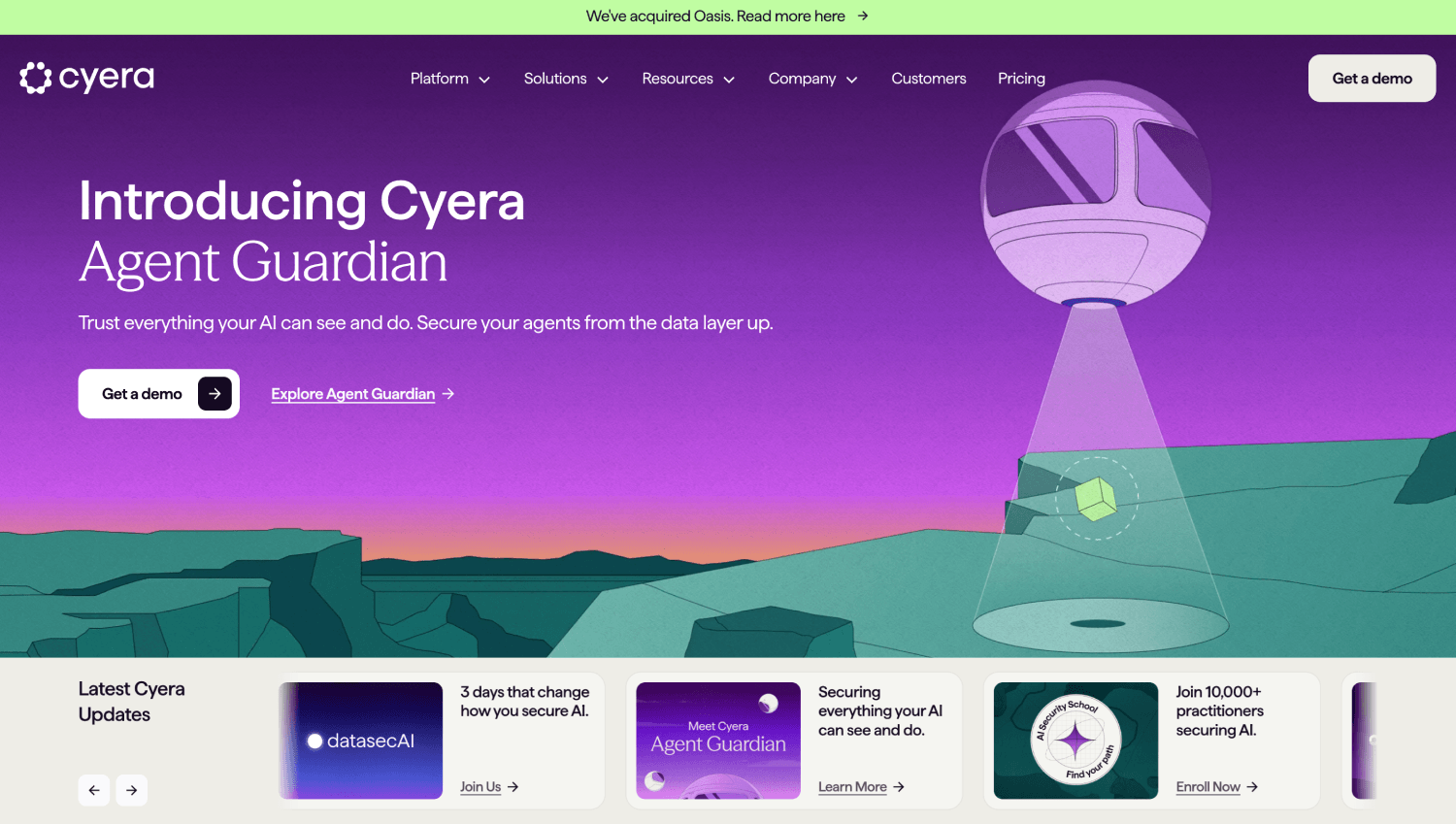
Cyera positions itself as a Data Security Platform with DSPM at its foundation. Its architecture is agentless: it connects to cloud environments via read-only APIs and scans data in place without deploying agents to hosts or databases. According to Cyera’s public documentation, it supports AWS, Azure, and GCP, with coverage spanning object storage, managed databases, SaaS data stores, and data pipeline outputs.
Cyera’s classification engine focuses on accuracy. The product uses a combination of pattern matching, AI-based content analysis, and contextual metadata to reduce false positives in classification, which has historically been the weakest point in DSPM tools. Classification accuracy on unstructured data, particularly documents, emails, and collaboration platform content, is where Cyera focuses its differentiation claims.
The security posture layer sits on top of classification. Once data is located and labeled, Cyera maps access controls, identifies overexposed data, surfaces misconfigurations in storage policies, and generates risk findings tied to specific data assets. This makes it legible to a security team running cloud risk reduction programs. If you are looking at how DSPM relates to broader cloud security posture work, the relationship between DSPM and CSPM is worth understanding before you scope a deployment.
Cyera’s Honest Weakness
Cyera’s on-premises coverage is limited compared to BigID. Teams with significant data in on-premises SQL Server, Oracle, or legacy file shares will hit a gap. According to the SERP data and community comparisons on Reddit and PeerSpot, this limitation is one of the most frequently cited reasons teams choose BigID or Varonis instead of Cyera. Cyera is built for cloud, and that is a strength in a cloud-only environment and a real constraint everywhere else.
What Does BigID Actually Do, and Where Does It Come From?
BigID started as a data privacy and governance platform and added security posture capabilities over time. Its architecture supports structured and unstructured data across cloud, on-premises, SaaS, and hybrid environments. BigID’s public documentation references connectors for a wide range of sources including AWS, Azure, GCP, Snowflake, Salesforce, on-premises file servers, SQL databases, and mainframe environments.
The classifier library is BigID’s most cited differentiator. According to BigID’s marketing and documentation, it includes hundreds of built-in classifiers covering PII, PHI, financial data, intellectual property, and jurisdiction-specific data types. The depth here matters for organizations operating under multiple regulatory regimes simultaneously, where a single scan needs to tag data for GDPR, CCPA, HIPAA, and internal retention policies in one pass.
BigID’s workflow layer is also more developed than Cyera’s at this point. The platform includes data subject access request automation, data retention policy enforcement, consent management integration, and data remediation workflows. These capabilities exist because BigID’s original customers were privacy officers and legal teams, not security engineers. That heritage is visible in the product’s UX and its integration patterns.
BigID’s Honest Weakness
BigID’s deployment complexity is higher than Cyera’s. Organizations that have documented their BigID implementations in community forums and peer review sites consistently note that initial configuration, classifier tuning, and connector setup require significant effort, often measured in weeks rather than days. The depth that makes BigID powerful also creates a steeper operational ramp. A team without a dedicated data governance or privacy program owner to drive the deployment will accumulate tuning debt quickly, with classifiers generating noise that no one has the mandate to resolve.
Which Platform Classifies More Accurately on Unstructured Data?
This is the question that matters most for teams whose risk is concentrated in SharePoint, OneDrive, Google Drive, Confluence, or document repositories. On structured data in well-defined cloud databases, both platforms perform reasonably well. Unstructured data, where classification requires reading document content and inferring context, is where the difference is measurable.
Cyera has made classification accuracy its primary technical differentiator, particularly on cloud-resident unstructured data. Its AI-based content analysis is designed to reduce false positive rates, which historically plague pattern-match-only classifiers on documents with complex layouts, mixed languages, or non-standard data formats.
BigID’s classifier depth gives it an advantage in coverage breadth, meaning the number of data types it can identify. But breadth and accuracy are different properties. A classifier that tags 1,500 categories will generate more noise than one that tags 400 categories accurately, if the underlying content analysis is less precise. Teams evaluating classification accuracy should run both tools against the same unstructured data corpus and measure precision and recall directly, not rely on classifier count as a proxy for quality.
For AI-related data risks, where training data, model outputs, and inference logs create new classification challenges, the DSPM requirements for AI data security differ meaningfully from traditional PII discovery, and both platforms are still building out coverage in this area.
Which Platform Covers On-Premises and Legacy Data Stores?
BigID covers more on-premises environments than Cyera. According to BigID’s documentation, it connects to on-premises Oracle, SQL Server, PostgreSQL, file shares, and select mainframe sources. For organizations running hybrid environments where a meaningful portion of sensitive data still lives outside the cloud, this is not a minor distinction.
Cyera’s coverage documentation focuses on cloud environments. Teams trying to extend Cyera into on-premises infrastructure will find the connector library significantly thinner. Community comparisons, including discussions on Reddit and PeerSpot for queries like “Cyera vs Varonis vs BigID,” repeatedly surface this as a decision point rather than a minor caveat.
If your data estate is 80 percent or more cloud-resident and the remainder is accessible via cloud-connected services, Cyera’s gap matters less. If you are running a financial services or healthcare organization where core systems of record are still on-premises Oracle or IBM Db2, and where cloud migration is multi-year, then BigID’s on-premises connector depth is a genuine requirement, not a nice-to-have.
| Capability | Cyera | BigID |
|---|---|---|
| Cloud data stores (AWS, Azure, GCP) | Strong, primary focus | Strong, broad connector library |
| On-premises databases (Oracle, SQL Server) | Limited | Strong, documented connectors |
| SaaS data stores (Salesforce, Workday) | Partial, cloud-oriented | Broad connector library |
| File shares and unstructured storage | Cloud-resident unstructured data | Cloud and on-prem file shares |
| Snowflake and cloud data warehouses | Supported | Supported |
| Governance and privacy workflows | Basic, security-oriented | Mature, compliance-oriented |
| Data subject access request automation | Limited | Core feature |
| Deployment model | Agentless, API-based | Agentless with some connector agents |
| Initial deployment speed | Faster | Slower, more configuration required |
| Classifier depth | Accuracy-focused | Volume and breadth-focused |
How Does Cyera vs BigID Pricing Work, and What Drives the Bill?
Neither Cyera nor BigID publishes list pricing. Both vendors require a scoping call and quote based on the environment. Based on public documentation, community discussion, and the structure of comparable DSPM and data governance platforms, both products price on data volume scanned, number of data stores connected, or a combination of those factors. Neither uses a per-endpoint model.
What drives the bill in practice is different for each product. For Cyera, the primary cost lever is the volume of cloud data scanned and the number of cloud accounts or environments connected. Continuous scanning, which is necessary to keep classification current as data changes, adds to the recurring cost relative to periodic snapshot scanning. For BigID, cost drivers include data source count, workflow module selection, and which add-on modules are required (privacy, security, governance, and data rights are separate capability tiers in some configurations).
The operational cost difference is also worth naming. Cyera’s deployment is described by users as fast, often within days for initial cloud coverage. BigID’s deployment is heavier, and the time required to configure classifiers, map workflows, and train internal teams represents real cost that does not appear on the contract line item. A team that underestimates BigID’s configuration effort will carry that debt in slow time-to-value and in analyst hours spent tuning rather than responding.
For teams evaluating the broader DSPM market and wanting to understand where both products sit relative to the full set of alternatives, the category includes Varonis, Securiti, Normalyze (now part of Zscaler), Sentra, and Wiz Data Security.
Which Platform Fits a Team That Needs Governance Workflows Alongside Discovery?
BigID is the answer here, without equivocation. Governance workflows, meaning the automated routing of data findings to policy owners, the generation of data retention schedules, the management of data subject rights requests, and the integration with consent management systems, are part of BigID’s original design. Cyera can surface the data risk; it does not automate the governance process around that risk at the same depth.
The distinction matters for teams where the primary driver is regulatory compliance rather than cloud security posture. A privacy team running a GDPR or CCPA program needs to know not just where personal data lives, but who has access to it, what the lawful basis for processing is, when it should be deleted, and how to fulfill a subject access request within the statutory window. BigID has purpose-built features for each of those steps. Cyera does not, at least not at the same maturity level.
For teams where the primary driver is cloud security posture and data risk reduction without a formal governance program, Cyera’s simpler workflow model is an asset rather than a limitation. A security engineering team that wants to find and remediate overexposed S3 buckets and misconfigured cloud databases does not need data subject rights automation. Adding that surface area increases complexity without adding value to the security use case.
The SecurityOpsWire Scanner Generation Test: Four Questions Before You Choose
Every comparison in this space runs into the same problem: the products look similar on a feature checklist but behave differently in the first ninety days after deployment. The following four questions, drawn from the operational patterns that distinguish successful deployments from expensive shelfware, will tell you which product fits before you sign.
Question 1: Where does your sensitive data actually live today? If more than 20 percent is on-premises, BigID’s connector depth is a requirement. Cyera will leave you with a blind spot in your most critical stores.
Question 2: Who owns the output? If a security team owns the findings and closes them via a risk remediation workflow, Cyera’s security-native UX will fit naturally. If a privacy officer, legal team, or data governance committee owns the output, BigID’s workflow layer reduces the handoff friction.
Question 3: What does the first twelve months of success look like? If the goal is cloud data visibility and posture improvement, Cyera can deliver a measurable outcome faster. If the goal is a functioning data governance program with audit trails, policy documentation, and subject rights process, BigID is the right investment, with the understanding that it takes longer to produce that outcome.
Question 4: Do you have the internal bandwidth to configure a complex platform? BigID rewards teams with a dedicated data governance owner. Cyera is more forgiving for lean security teams where one engineer needs to get coverage working without months of configuration. Be honest about your headcount before you commit.
What About Varonis? The Third Option That Keeps Appearing
Community discussions comparing Cyera and BigID almost always surface Varonis as a third option, and for good reason. Varonis operates from a different lineage than either product. Its origins are in file system monitoring and user behavior analytics on unstructured data, particularly Active Directory-connected file shares and on-premises collaboration platforms.
Note that Varonis has announced it is joining Proofpoint. Buyers evaluating Varonis should factor that corporate transition into their vendor risk assessment and confirm current roadmap and support commitments directly with the vendor.
Varonis is the strongest option when the primary risk is insider threat and excessive access permissions on unstructured data in on-premises or Microsoft 365 environments. Its access graph and behavioral detection capabilities go deeper than either Cyera or BigID on that specific problem. Teams whose threat model centers on data exfiltration by internal users or compromised accounts, rather than misconfigured cloud storage or governance program compliance, should evaluate Varonis alongside the other two rather than treating this as a two-horse race.
That said, Varonis’s cloud-native data store coverage is less mature than Cyera’s, and its governance workflow depth is less mature than BigID’s. It is a strong specialist tool in its original domain that has expanded outward, the inverse of how both Cyera and BigID have developed.
Running a Bake-Off: How to Set Up a Scoped Classification Evaluation
The most reliable way to resolve a Cyera versus BigID decision is a scoped classification bake-off against your own data. Neither vendor will object to a proof-of-concept engagement, and both typically offer structured POC programs.
To get a result that actually informs the decision, the test scope should include three components. First, select a representative cross-section of your data estate: at least one cloud object store, one managed database, one SaaS source, and if relevant, one on-premises source. Second, build a ground truth set: manually review a sample of files or records before the scan and label which ones contain which sensitive data types. A few hundred records is sufficient to measure precision and recall. Third, run both platforms against the same scope and compare classification output against your ground truth, not against each other’s marketing claims.
Measure false positive rate on unstructured data specifically. That is where the operational burden accumulates: every false positive is an analyst hour spent validating a non-finding. A platform that classifies with 90 percent precision at half the classifier count is more valuable operationally than one with 1,500 classifiers running at 70 percent precision. For teams running Snowflake-heavy architectures, the evaluation criteria for DSPM on Snowflake differ from general-purpose cloud storage assessments and should be scoped separately.
Time the deployment setup as part of the evaluation. The delta between “first connection” and “first useful finding” is a real operational metric that the contract price does not reflect. If one platform takes three days to produce initial results and another takes three weeks, that difference compounds across the full deployment timeline.
Frequently Asked Questions
Who are BigID’s main competitors in the data security platform market?
BigID’s primary competitors include Cyera, Varonis, Securiti, and Wiz’s data security capabilities. In the data governance and privacy management segment, OneTrust and Collibra also compete for budget. BigID’s competitive set shifts depending on whether the primary use case is data security posture management, privacy program management, or enterprise data cataloguing. Each of those use cases draws a somewhat different shortlist.
How is Cyera priced?
Cyera does not publish list pricing. Pricing is quoted per environment and is based on the volume of data scanned and the number of cloud accounts connected. Both factors drive the recurring cost, since Cyera’s model includes continuous scanning rather than point-in-time snapshots. Prospective buyers should request a scoping call and ask specifically how pricing scales as cloud data volume grows, since that is the primary cost driver.
Is BigID better than Cyera for compliance-driven data security programs?
BigID is the stronger fit for compliance-driven programs that require governance workflows, data subject access request automation, retention policy enforcement, and multi-jurisdiction regulatory tagging. Cyera provides classification and security posture findings but does not include the same depth of workflow automation for privacy and compliance program management. If the primary audience for the platform’s output is a legal or privacy team, BigID’s feature set maps more directly to their working process.
Does Cyera support on-premises data stores?
Cyera’s primary coverage is cloud environments, including AWS, Azure, and GCP. Its on-premises connector coverage is limited compared to BigID and Varonis. Organizations with significant data in on-premises Oracle, SQL Server, or legacy file shares should verify specific connector availability with Cyera’s sales team before committing, since this is one of the most frequently cited limitations in peer reviews and community comparisons.
What is the difference between DSPM and a data governance platform?
DSPM (Data Security Posture Management) is a security-oriented category focused on discovering sensitive data, identifying misconfigurations and overexposure, and reducing data risk in cloud environments. Data governance platforms focus on managing data assets across their lifecycle, including lineage, access policy, retention, quality, and compliance workflows. BigID spans both categories. Cyera focuses primarily on the DSPM use case. The practical difference is that a data governance platform produces outputs consumed by privacy officers and data stewards, while a DSPM produces outputs consumed by security teams. For more on how DSPM relates to adjacent security categories, the DSPM versus DLP comparison is a useful reference.
Can either platform secure data used by AI systems and machine learning pipelines?
Both platforms are developing coverage for AI-related data risks, including training datasets, model outputs, and inference logs. This is an area of active product development across the DSPM category. Teams building security programs for AI data should evaluate current connector and classification support for the specific data stores and pipeline tools in their environment, since AI data security requirements differ from traditional PII discovery. The relationship between AI-SPM and DSPM clarifies where these responsibilities intersect and diverge.
How long does a BigID deployment typically take?
Based on community feedback on PeerSpot and Reddit, BigID deployments range from several weeks for initial coverage to multiple months for full governance workflow configuration. The variation depends on the number of data sources connected, the complexity of the classifier configuration, and whether the organization has a dedicated data governance owner to drive the rollout. Teams that underestimate this timeline tend to end up with the platform running in discovery-only mode without the workflow layer activated, which limits the return on the investment.
Is Cyera or BigID better for a lean security team without a dedicated data governance owner?
Cyera fits a lean security team more naturally. Its agentless deployment, cloud-native connector model, and security-oriented UX mean a single security engineer can get initial cloud coverage running within days and produce findings that map directly to a cloud risk remediation backlog. BigID requires more configuration, classifier tuning, and workflow design to deliver value, which presupposes someone with the mandate and time to own that work. Without a dedicated owner, BigID’s complexity accumulates as tuning debt rather than as a functioning program.
Which One Should You Actually Deploy?
The reader who opened this article believing these are the same product with different logos will find the actual difference more structural than cosmetic. Cyera was designed by people solving cloud security posture. BigID was designed by people solving enterprise data governance. Those origins are still visible in every architectural decision each product has made, from connector libraries to UX to the type of findings each platform surfaces by default.
The decision reduces to a single operational question: who owns the output? A security team running cloud risk reduction will find Cyera’s model more natural and more immediately useful. An organization building a formal data governance or privacy compliance program, particularly one with hybrid infrastructure or a complex regulatory footprint, will find BigID’s depth necessary even if the deployment is harder.
Run the bake-off against your own data before you commit to either. Measure precision on your unstructured data, time the deployment from first connector to first useful finding, and involve the person who will own the platform’s output in the evaluation. That last point matters more than any feature comparison: a platform is only as useful as the person with the mandate to act on what it finds.