
- CVSS describes a vulnerability in isolation. Reachability analysis, EPSS, and asset context describe it inside your system. The gap between those two views is typically the difference between hundreds of critical findings and a dozen that actually warrant emergency response.
- Reachability is computed by static call-graph traversal, dynamic runtime tracing, or some combination. Each method has failure modes practitioners should understand before trusting the output.
- EPSS scores are generated by Empirical Security and published freely by FIRST. KEV listings are confirmed exploitations catalogued by CISA. Neither is a substitute for the other, and conflating them is a common triage error.
- Most of the tools covered here integrate with Jira, GitHub Issues, or Azure DevOps. Ticket fidelity varies: some push raw CVE metadata; the better ones include fix guidance and reachability justification in the ticket body.
- Application-layer prioritization tools are distinct from infrastructure vulnerability management. If your primary concern is cloud misconfigurations or OS-level patches, the framing here does not transfer directly.
The best application vulnerability prioritization tools move beyond CVSS severity to combine reachability analysis, exploit prediction scoring, CISA Known Exploited Vulnerabilities status, and asset context. The tools that do this well include Endor Labs, Snyk, Apiiro, ArmorCode, Cycode, Ox Security, Oligo, Kodem, Nucleus Security, and Phoenix Security, plus platform-adjacent options from Wiz, ARMO, Mend, NopSec, Safe Security, and Pentera. Choosing among them depends primarily on where your application code lives, how much runtime telemetry you can collect, and whether your security team or your developers are doing the triage.
Why CVSS Alone Produces the Wrong Remediation Queue
A CVSS score describes a vulnerability as it exists in the abstract: attack vector, complexity, privileges required, and impact scope. It does not know whether the vulnerable function is called by your code, whether the library is reachable from the internet, or whether a working exploit has been observed in the wild. Those three factors routinely move a finding from “patch this week” to “deprioritize until the next sprint” or vice versa.
The practical consequence is backlog distortion. A team relying on CVSS severity ordering will accumulate hundreds of critical and high findings, nearly all of which are unreachable or unexploitable in their specific environment. Security engineers burn cycles triaging findings that developers cannot act on meaningfully, and the genuinely dangerous subset gets buried. This is not a hypothetical failure mode; it is the standard state of most mid-market AppSec programs before they introduce contextual prioritization.
The signals that actually move priority are exploitability scoring (primarily EPSS), confirmed exploitation status (CISA KEV), reachability from an attack surface, and asset criticality. Each of these is a distinct input. Treating them as interchangeable is a triage error.
What EPSS, KEV, and SSVC Actually Measure
The Exploit Prediction Scoring System (EPSS) produces a daily probability estimate that a given CVE will be exploited in the wild within the next 30 days. According to FIRST’s documentation, scores are generated by Empirical Security and published freely to the community; FIRST maintains the EPSS Special Interest Group but does not generate the scores itself. The score runs from 0 to 1. A CVE with an EPSS of 0.90 has a 90 percent predicted probability of exploitation activity. EPSS is a forward-looking prediction, not a confirmation of exploitation. It can shift substantially as a vulnerability ages and as proof-of-concept code appears in public repositories.
The CISA Known Exploited Vulnerabilities catalog is backward-looking. A KEV entry means CISA has confirmed active exploitation of that CVE in the wild. Federal agencies are required to patch KEV entries within defined windows, but the catalog is useful for any organization as a high-confidence filter. KEV entries represent a small fraction of all CVEs. A high EPSS score does not guarantee KEV inclusion, and a CVE can appear in KEV without having a high EPSS score at the time of listing. Using both together is more informative than either alone.
SSVC, the Stakeholder-Specific Vulnerability Categorization framework developed by CISA and Carnegie Mellon University, replaces numeric severity with a decision tree. It classifies vulnerabilities by exploitation status, automation potential, and mission impact, producing an action recommendation rather than a score. SSVC is more useful for policy design than for real-time triage at scale, but some of the tools covered here incorporate its decision logic.
How Reachability Is Computed and Where the Approach Breaks Down
Reachability analysis determines whether a vulnerable function in a dependency is actually invoked by your application code. A library may be listed in your dependency tree without any of its vulnerable functions ever being called. Reachability analysis filters those out.
There are three main implementation approaches. Static call-graph analysis builds a map of function calls at rest from source code or compiled binaries without running the application. It is fast and works in CI, but it can report false negatives for reflection-based calls and dynamically loaded code. Runtime analysis instruments the application in production or staging and records which library functions are actually executed during normal operation. It eliminates most false positives but requires instrumentation overhead and a representative traffic sample. Hybrid approaches combine the two, using static analysis to narrow the candidate set and runtime telemetry to confirm.
A practitioner thread on Reddit’s r/netsec raised a pointed objection to context-aware reachability claims that deserves a direct answer rather than a wave of the hand. The critique: vendors claim reachability analysis but deliver what amounts to shallow static traversal that flags a function as reachable the moment any code path touches the containing class, regardless of whether that path is ever executed in production. That criticism is accurate for some implementations. When evaluating any tool, ask specifically whether call-graph depth is bounded, how reflection and dynamic dispatch are handled, and whether the vendor can show you a case where their reachability filter changed a critical finding to informational. If they cannot, the reachability claim is marketing shorthand for “we ran SCA and looked at more than one dependency layer.”
The SecurityOpsWire Prioritization Signal Stack
Before covering individual tools, it helps to have a consistent evaluation frame. The following model, which we call the Prioritization Signal Stack, describes the five layers a complete application vulnerability prioritization system should address. Most tools cover two or three layers well and approximate the others. Knowing where a tool falls short tells you where your program still carries manual debt.
- Vulnerability discovery: SCA, SAST, DAST, container image scanning. The foundation. Every tool on this list starts here.
- Exploitability signal: EPSS score, KEV status, public proof-of-concept availability, active threat actor use.
- Reachability: Is the vulnerable code path reachable from an attack surface in your specific application? Static, runtime, or hybrid analysis.
- Asset context: What is the business criticality, data sensitivity, and internet exposure of the asset that carries the finding?
- Developer workflow integration: Does the priority finding get to the right person with enough context to act, or does it land in a spreadsheet?
Use this stack when reading the tool descriptions below. Where a tool is strong at layer three but weak at layer five, you will need compensating process or a second tool.
10 Application Vulnerability Prioritization Tools Worth Evaluating
1. Endor Labs
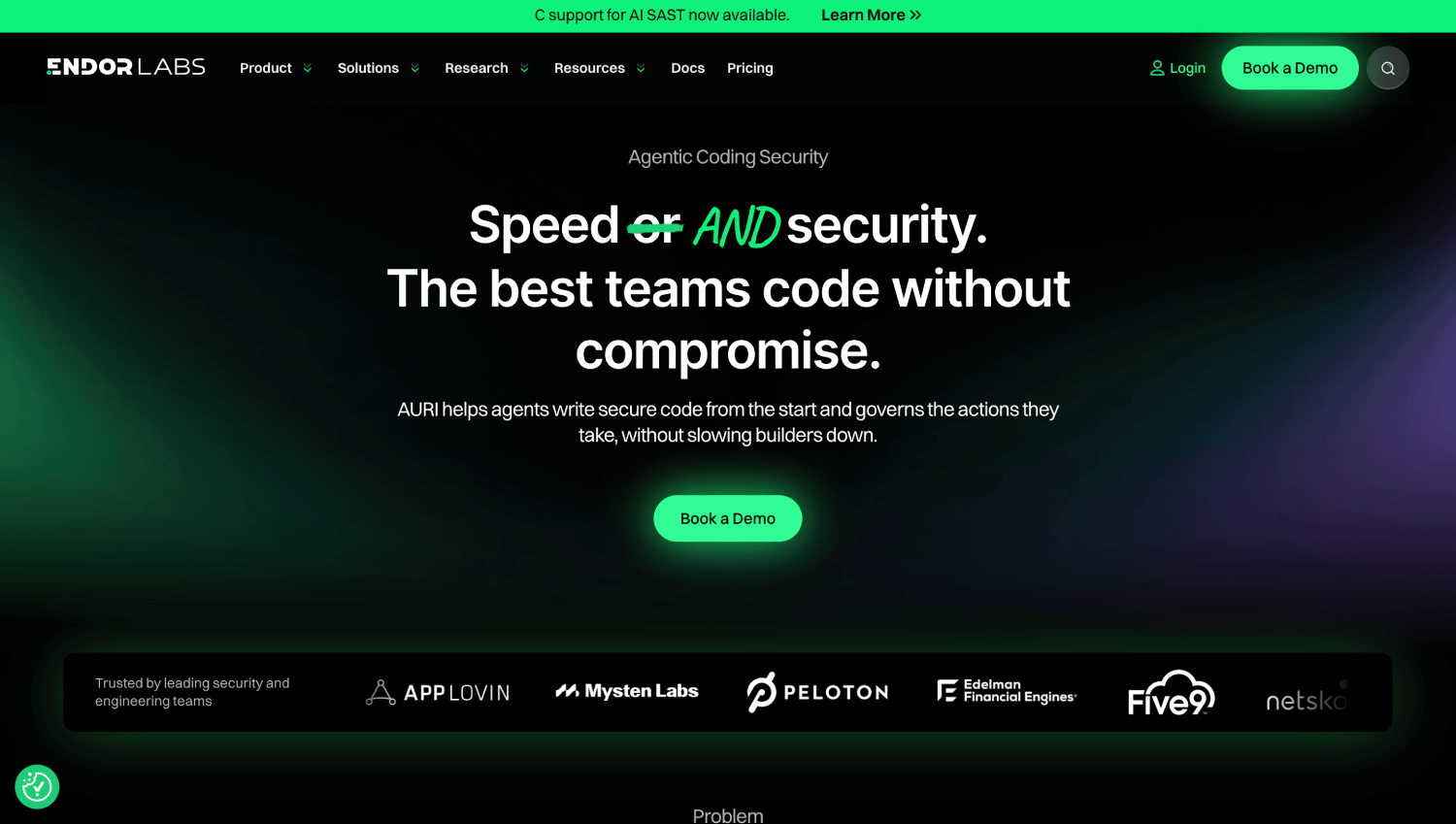
Endor Labs is built specifically around dependency lifecycle management and reachability-filtered SCA. Its call-graph reachability analysis is one of the most thoroughly documented implementations in the market. The product identifies not just whether a library is in your dependency tree, but whether the specific vulnerable function is called, using a static analysis approach that accounts for transitive dependencies across multiple dependency levels.
The output is a prioritized list where findings marked reachable carry justification traces showing exactly which code path leads to the vulnerable function. For teams drowning in SCA noise, this is the primary value proposition. Pricing is not publicly disclosed; the company quotes per application or per active developer depending on the engagement.
Endor Labs fits best for engineering teams with large dependency graphs in Java, Python, Go, or JavaScript/TypeScript. It is less mature for mobile or embedded application scanning.
2. Snyk
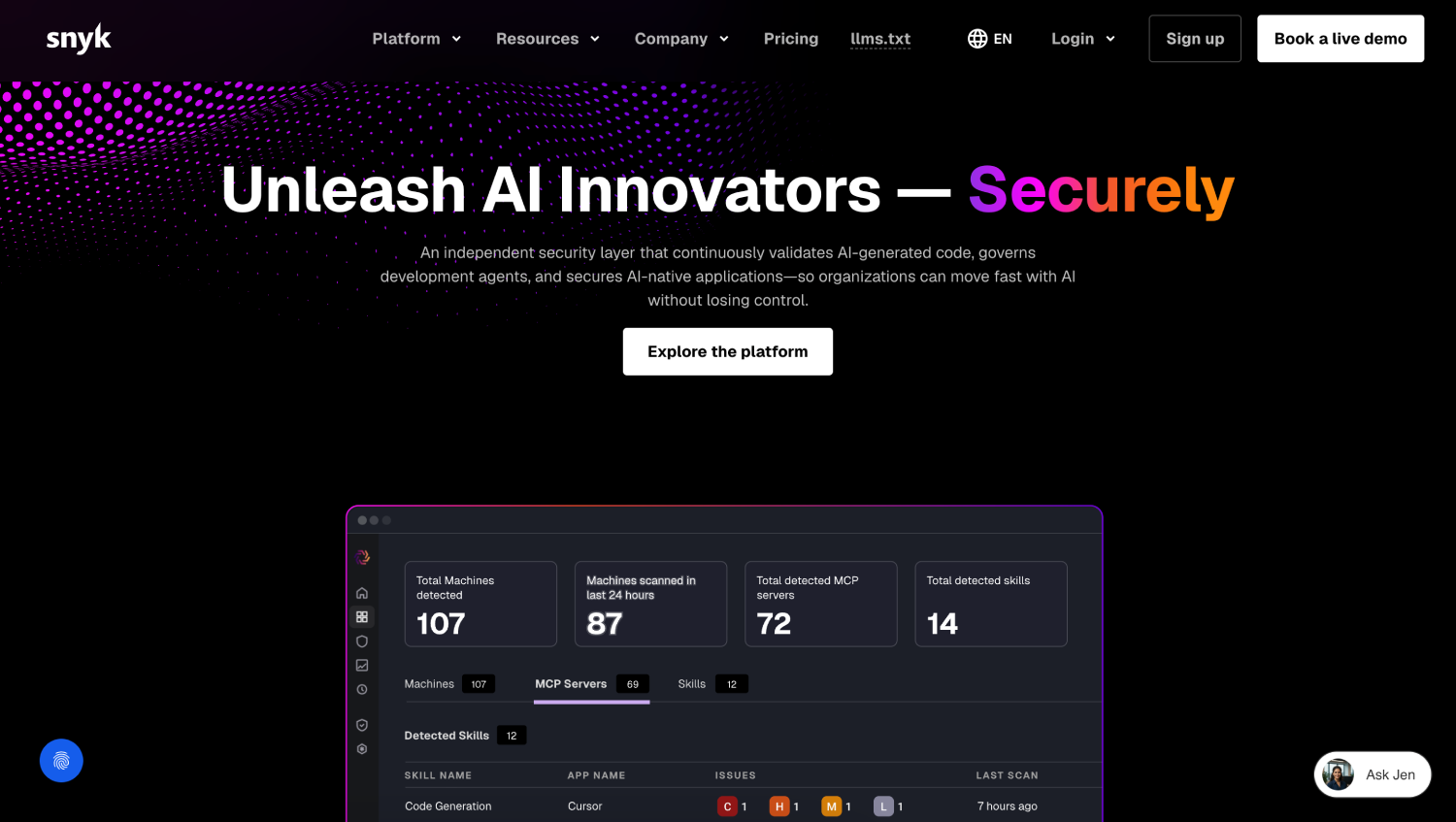
Snyk covers SCA, SAST, container scanning, and infrastructure-as-code in a single platform. Its Risk Score system, which Snyk documents on its platform, combines CVSS base score, EPSS, exploit maturity (whether a proof of concept or weaponized exploit exists publicly), and reachability for supported languages. The reachability signal is available for Java, JavaScript/TypeScript, and Python as of the current documentation on Snyk’s site.
Snyk’s developer-side integration is among the strongest in the field. IDE plugins, pull request decorations, and CLI tooling give developers prioritized findings at the point of code change. The Jira integration pushes tickets with fix advice and reachability context rather than raw CVE IDs. Snyk offers a free account for individual developers with no credit card required; paid plan details and organizational pricing are not publicly listed and require direct engagement with the vendor. Enterprise pricing is negotiated.
For teams already using Snyk for SCA, the risk scoring layer is an incremental addition rather than a replacement workflow. The weakness is depth of static analysis compared to purpose-built SAST tools like Semgrep or Checkmarx on complex codebases.
3. Apiiro
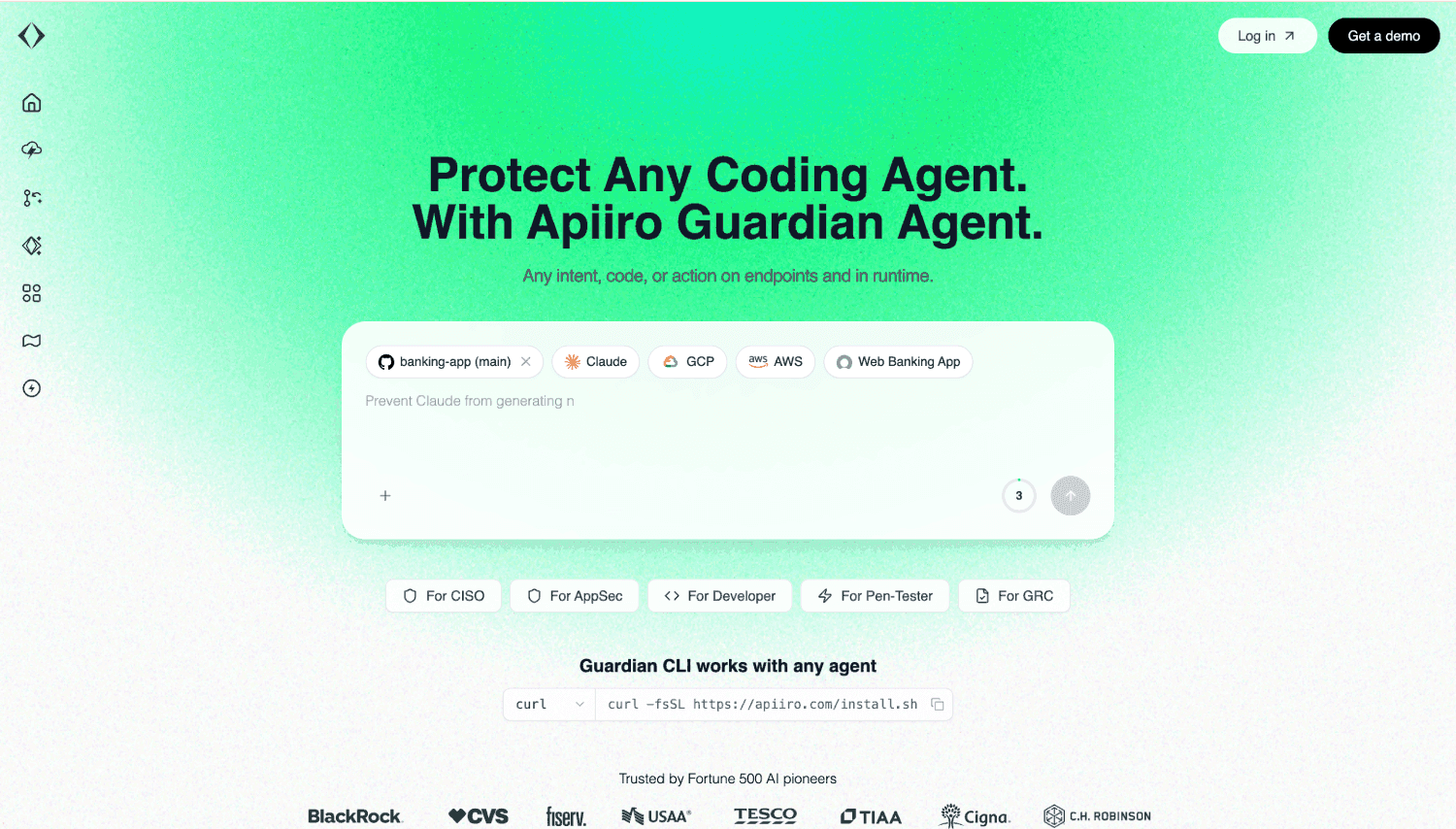
Apiiro sits at the intersection of application security posture management and risk-based prioritization. Its approach to prioritization is built on a code-to-cloud risk graph that connects source code changes, third-party dependencies, API exposures, and deployment topology. A finding in a microservice that exposes a public API endpoint and handles PII ranks differently than the same finding in an internal batch processor, because Apiiro’s graph knows the difference.
The platform performs risk analysis at the code commit level, flagging risky changes before they reach production. This shifts prioritization left in a meaningful way: rather than triaging a finding after a scan, developers see the risk context during code review. Apiiro’s reachability analysis incorporates API reachability, which is a distinct and important capability for teams building service-oriented architectures. Pricing is not publicly disclosed.
4. ArmorCode
ArmorCode is an application security posture management platform that aggregates findings from existing scanners rather than running its own. It ingests results from SAST, DAST, SCA, and container tools, then applies its own risk scoring layer combining CVSS, EPSS, KEV status, asset criticality tags, and deduplication. The result is a normalized, deduplicated finding set with a single priority queue across tools.
For teams with five or more scanning tools producing overlapping findings, ArmorCode’s deduplication and normalization is the primary value. It also handles developer workflow integration by pushing findings to Jira, ServiceNow, or Azure DevOps with configurable ticket templates. ArmorCode does not add its own reachability analysis for SCA findings; it surfaces reachability data if the underlying scanner produces it. That is an important distinction if reachability filtering is the primary driver of the evaluation. Pricing is not publicly disclosed.
5. Cycode
Cycode positions its platform as a complete application security platform spanning SAST, SCA, secrets detection, IaC scanning, and ASPM. Its prioritization approach uses a risk engine that weights findings by exploitability, asset exposure, and business context tags applied to repositories. The platform’s secrets detection is notable: it scans the full git history rather than just the current branch, which surfaces secrets that were committed and removed but remain in history.
Cycode integrates EPSS and KEV into its SCA prioritization and provides developer-facing PR comments with contextual risk explanations. Its risk engine allows AppSec teams to define custom policies that adjust priority based on repository tags like “customer-facing” or “handles payments.” Reachability analysis for SCA is available for supported runtimes but is not as central to the product as in Endor Labs or Snyk. Pricing is not publicly disclosed.
6. Ox Security
Ox Security covers the software supply chain from source to deployment, including pipeline security, dependency analysis, and artifact integrity. Its prioritization model uses what the company calls an attack chain analysis: it maps how a vulnerability in a dependency, combined with a pipeline misconfiguration or a compromised build artifact, could produce an actual exploitation path. This is a more complete framing than per-finding CVSS scoring, connecting individual findings to actual supply chain attack scenarios.
For teams concerned specifically about software supply chain risk beyond open source dependencies, such as build system compromise, artifact tampering, and CI/CD credential exposure, Ox Security covers ground that pure SCA tools do not. Pricing is not publicly disclosed.
7. Oligo Security
Oligo Security is built around runtime application security using eBPF-based instrumentation. Rather than relying on static analysis to estimate reachability, Oligo observes which library functions are actually called in production and flags only those that are both vulnerable and demonstrably executed. This approach produces the lowest false-positive rate of any method, because the reachability signal comes from observed behavior rather than code-path inference.
The tradeoff is deployment friction. Oligo requires an eBPF agent on each workload, which means kernel compatibility requirements, deployment coordination with platform teams, and runtime overhead to budget for. For Kubernetes-native environments where daemonset deployment is straightforward, that friction is minimal. For legacy application servers or heavily regulated environments with strict agent deployment controls, it is a harder sell. Oligo is well suited for production-grade runtime reachability in cloud-native applications. Pricing is not publicly disclosed.
8. Kodem Security
Kodem Security also uses runtime analysis to determine reachability, combining runtime observation with static SCA to produce what it describes as evidence-based prioritization. The runtime layer confirms whether a vulnerable package is loaded and whether the vulnerable function is called, reducing the noise from libraries that are installed but never exercised in the code paths that actually run.
Kodem targets cloud-native application environments and produces findings that include a runtime evidence trace alongside the CVE detail, EPSS score, and fix recommendation. This evidence trace is useful for developer conversations: instead of asking a developer to fix something because a scanner flagged it, the ticket shows that the vulnerable function was called 47 times in the last 24 hours by the checkout service. That specificity changes the developer’s willingness to prioritize the fix. Pricing is not publicly disclosed.
9. Nucleus Security
Nucleus Security is a vulnerability management platform that aggregates findings across application, infrastructure, and cloud scanners. Within the application layer, it ingests SAST, DAST, and SCA results and applies a prioritization model incorporating CVSS, EPSS, KEV status, asset grouping, and SLA tracking. It does not perform its own scanning or add native reachability analysis, but it normalizes and deduplicates across scanners and provides risk-based scoring on the aggregated data.
Nucleus fits organizations that have scanner sprawl and need centralized tracking for remediation SLAs across teams. Its strength is operational: tracking who owns a finding, where it stands in a remediation workflow, and whether the team is meeting defined SLA targets. For pure prioritization signal quality, purpose-built tools like Endor Labs or Oligo are stronger. Nucleus pricing is not publicly disclosed; the company offers a demo on its website.
10. Phoenix Security
Phoenix Security takes a business-risk framing, mapping application vulnerabilities to the business services and revenue flows they underpin. A vulnerability in the payment processing service ranks differently than the same vulnerability in an internal reporting dashboard, and Phoenix uses business context tags to make that distinction explicit in the priority queue.
Phoenix integrates with common SAST, DAST, and SCA tools, ingests their findings, and applies its own risk scoring that incorporates CVSS, EPSS, KEV, asset criticality, and the business context layer. It also provides developer-facing workflow integrations for Jira and ServiceNow. Phoenix is particularly suited for organizations with clear internal service criticality hierarchies, such as regulated financial or healthcare companies, where the business impact of a vulnerability in a specific system is well understood and documented. Pricing is not publicly disclosed.
Platform-Adjacent Options Worth Understanding
Wiz
Wiz is primarily a cloud security platform, and its vulnerability prioritization capabilities operate at the intersection of cloud workload context and application-layer findings. Wiz’s graph-based model connects a CVE in a container image to the network exposure, identity permissions, and secrets access of the workload running that image. The resulting prioritization is more about cloud deployment context than code-level reachability. For teams evaluating broader cloud-native application security that extends into cloud posture, Wiz is relevant. For teams whose primary need is SCA reachability or SAST findings prioritization, Wiz is not the right fit.
ARMO
ARMO builds on top of Kubescape, the open source Kubernetes security tool. Its vulnerability prioritization is Kubernetes-native: it considers whether a vulnerable container is running in a reachable pod, whether the pod has elevated privileges, and whether the vulnerability is exposed through a service. This runtime-aware framing is relevant for teams whose application workloads run entirely in Kubernetes. ARMO’s coverage is narrower than general AppSec tools; it is not designed for source-code-level SCA or SAST triage.
Mend
Mend provides SCA and SAST with a prioritization layer that incorporates EPSS scores, exploit maturity, and reachability analysis for supported languages. Mend’s reachability uses static call-graph analysis and is available in its SCA product for Java and JavaScript. The platform integrates with CI/CD pipelines and developer ticketing workflows. Mend is a solid mid-market choice for teams that primarily need SCA with contextual prioritization and do not require the depth of runtime reachability that Oligo or Kodem provide.
NopSec
NopSec offers a risk-based vulnerability management platform that aggregates scanner findings and applies a prioritization model using threat intelligence, asset criticality, and exploitability signals. Its focus has historically been infrastructure vulnerability management, but it covers application findings from DAST and SCA inputs. Teams evaluating NopSec for application-layer prioritization should confirm current product coverage for their specific application scanning sources. Pricing is not publicly disclosed.
Safe Security
Safe Security approaches vulnerability prioritization through a cyber risk quantification lens, translating findings into financial exposure estimates. Its SAFE platform aggregates data from application and infrastructure scanners and uses a quantification model to express risk in dollar terms. For CISOs who need to present remediation priorities in business risk language to a board or executive team, the financial framing is useful. For practitioners running day-to-day triage, the abstraction from technical finding to dollar figure adds a layer that is not always useful in a sprint planning conversation. Pricing is not publicly disclosed.
Pentera
Pentera is an automated security validation platform, not a vulnerability prioritization tool in the traditional sense. It validates whether a discovered vulnerability is actually exploitable in your environment by attempting to exploit it in a controlled manner. The output is a confirmed exploitability status rather than a predicted one. For teams that want ground-truth exploitability data rather than probabilistic EPSS estimates, Pentera provides that. It is an exposure validation tool; pairing it with an application-layer prioritization tool is a reasonable architecture for mature programs. For more on exposure validation as a category, see our coverage of continuous security testing platforms.
Comparison Table: Prioritization Signal Coverage by Tool
| Tool | Native Scanning | EPSS Integration | KEV Integration | Reachability Type | Developer Workflow | Best Fit |
|---|---|---|---|---|---|---|
| Endor Labs | SCA | Yes | Yes | Static call-graph | Jira, GitHub, GitLab | Dependency-heavy Java/Python/Go |
| Snyk | SCA, SAST, Container, IaC | Yes | Yes | Static (select languages) | IDE, PR, Jira, GitHub | Developer-driven AppSec programs |
| Apiiro | SAST, SCA, API | Via risk graph | Via risk graph | Code-to-cloud graph | PR review, Jira | Service-oriented, API-heavy apps |
| ArmorCode | Aggregator (no native) | Yes | Yes | Surfaces if scanner provides | Jira, ServiceNow, ADO | Multi-scanner normalization |
| Cycode | SAST, SCA, Secrets, IaC | Yes | Yes | Static (select runtimes) | PR comments, Jira | Supply chain + secrets coverage |
| Ox Security | Pipeline, SCA, IaC | Yes | Yes | Attack chain (supply chain) | Jira, GitHub | Supply chain risk-focused teams |
| Oligo Security | Runtime (eBPF) | Yes | Yes | Runtime observed | Jira, GitHub | Cloud-native Kubernetes workloads |
| Kodem Security | SCA + Runtime | Yes | Yes | Runtime observed + static | Jira, GitHub | Cloud-native with runtime evidence |
| Nucleus Security | Aggregator (no native) | Yes | Yes | Surfaces if scanner provides | Jira, ServiceNow, ADO | SLA tracking across AppSec programs |
| Phoenix Security | Aggregator (no native) | Yes | Yes | Surfaces if scanner provides | Jira, ServiceNow | Business-risk-framed prioritization |
What Does Application Vulnerability Prioritization Actually Cost Per Application?
None of the tools on this list publish per-application pricing publicly. The common pricing models are per active developer (seat-based), per application or repository (asset-based), and per finding volume or scan frequency (consumption-based). Snyk offers a free account for individual developers with no credit card required; all other vendors on this list require a direct quote, and none publish their organizational tier pricing publicly.
The more relevant cost question for a security leader is the operational cost. Consider a team with 12 applications, three of which are customer-facing, running SCA with a tool that does not filter by reachability. Say the monthly SCA output is 800 findings across all applications, with 120 rated critical or high by CVSS. Engineers spend roughly half a sprint triaging that queue, and developers push back because many findings are in libraries never called by their code.
Introducing reachability analysis, even static call-graph analysis, typically reduces the working subset to 15 to 30 percent of the original CVSS-based queue. That arithmetic is what drives the purchasing conversation. The tool does not cost what it costs to license; it costs what it costs minus the engineering hours saved on false-positive triage. Most security leaders who have run this calculation find the net cost lower than the status quo, even at enterprise licensing rates.
For teams evaluating broader AppSec program investments, our comparison of ASPM tools for GitHub-centric teams covers how these prioritization signals plug into a broader application security posture management workflow.
How Should Developer Teams Receive and Act on Prioritized Findings?
A finding that lands in a security dashboard without reaching the developer who owns the code is not prioritized; it is filed. Developer workflow integration is where many of these tools lose value in practice. The minimum viable integration is a Jira ticket with: the CVE or finding ID, the affected component and version, the EPSS score and KEV status, the reachability determination with the code path that makes it reachable, and the fix recommendation with a specific version to upgrade to.
Tools that push only a CVE ID and severity rating into a ticket create developer friction because the developer has to look up everything else. Tools that include a call-graph trace or runtime evidence log materially reduce that friction. The difference in developer remediation time between a well-formed ticket and a bare CVE notification is significant enough that it belongs in the ROI conversation when justifying the tool purchase.
For teams thinking through how vulnerability findings connect to broader detection and response workflows, the continuous threat exposure management platform comparison covers how CTEM programs aggregate application and infrastructure findings into a single prioritized exposure view.
Which Signals Beyond CVSS Actually Change Remediation Priority?
In order of impact on a typical application vulnerability backlog, ranked by how much each signal changes the working queue:
- Reachability: Filters 40 to 80 percent of findings in most codebases, depending on dependency graph size and how many libraries are included but unused. This is the highest-impact signal for reducing noise.
- KEV status: A confirmed KEV entry should override almost any other consideration. The number of application-layer CVEs that appear in KEV is a small fraction of total findings, but each one represents confirmed active exploitation and warrants immediate response regardless of other signals.
- EPSS score: A high EPSS score on a reachable vulnerability is a strong indicator that patching cannot wait for the next sprint. An EPSS score above 0.5 on a reachable, internet-exposed finding is a candidate for emergency remediation regardless of CVSS rating.
- Asset exposure: A critical vulnerability in a library used by a customer-facing payment service ranks above the same vulnerability in an internal analytics dashboard. Asset context requires metadata about the application, which most tools support through tags or integrations with your CMDB or service catalog.
- Exploit maturity: Whether a proof of concept exists in a public repository, or whether a weaponized exploit is available in a commercial exploitation framework, shifts the exposure timeline. EPSS partially captures this, but some tools track exploit maturity as a distinct signal from EPSS.
Frequently Asked Questions
What is reachability analysis and how reliable is it for SCA findings?
Reachability analysis determines whether a vulnerable function in a dependency is actually invoked by application code. Static implementations use call-graph traversal and can misclassify findings where dynamic dispatch, reflection, or runtime code loading is involved. Runtime implementations observe actual execution and are more accurate but require agent deployment. Reliability varies by language and implementation. Java and Python static analysis is more mature than Go or Rust. Ask vendors for documented false-negative and false-positive rates on codebases similar to yours, and verify with a trial on a known-good test set.
Is EPSS a replacement for CVSS scoring?
No. CVSS describes the characteristics of a vulnerability: attack vector, complexity, required privileges, and impact. EPSS predicts the probability of exploitation within 30 days. They measure different things. A high-CVSS, low-EPSS vulnerability may be severe in principle but rarely exploited. A low-CVSS, high-EPSS vulnerability may be trivially exploitable and actively targeted. Effective prioritization uses both: CVSS for impact scope, EPSS for exploitation likelihood, and reachability to determine whether either applies in your environment.
Do these tools integrate with Jira and developer ticketing workflows?
All of the major tools on this list offer Jira integration. The integration quality varies: some push raw CVE IDs with severity ratings, while better implementations include fix guidance, reachability justification, EPSS score, and component context in the ticket body. Snyk, Apiiro, and Kodem are noted for higher-quality ticket content. Before selecting a tool, test the actual ticket output on a representative finding and evaluate whether a developer who did not run the scan would have enough information to act without additional research.
What is the difference between application-layer and infrastructure vulnerability prioritization?
Application-layer prioritization focuses on vulnerabilities in source code, open source dependencies, container images, and application APIs. Infrastructure vulnerability prioritization covers OS-level CVEs, network device firmware, cloud misconfigurations, and host-level patch gaps. The signals differ: reachability analysis is primarily an application-layer concept, while exposure surface and network path analysis are more relevant to infrastructure findings. Many of the tools covered here address application-layer findings. Infrastructure vulnerability management is a distinct practice with different tooling.
How do I know if my SCA tool’s reachability claims are accurate?
Run the tool against a codebase where you know the execution paths. Include at least one library with a documented CVE where the vulnerable function is called by your code, and at least one where it is not. Verify that the tool correctly classifies both. Check how the tool handles indirect calls, interfaces, and dynamic dispatch in your primary language. Ask the vendor to document their approach to transitive dependency reachability and what happens with dynamically loaded modules. If they cannot provide technical documentation on the analysis method, treat the reachability claim with proportional skepticism.
Can runtime reachability tools run in production without impacting application performance?
eBPF-based runtime agents like Oligo operate at the kernel level and are generally lower overhead than traditional APM instrumentation. Published overhead figures vary by workload type. Vendors typically publish benchmark numbers for common application profiles. Test in a staging environment with representative load before deploying to production. For latency-sensitive applications, measure p99 latency with and without the agent under peak load rather than relying on vendor-provided averages.
What is SSVC and should AppSec teams use it?
SSVC (Stakeholder-Specific Vulnerability Categorization) is a decision-tree framework from CISA and Carnegie Mellon University that replaces numeric severity with action recommendations based on exploitation status, deployment context, and mission impact. It is well suited for organizations that want to formalize a vulnerability response policy rather than score every finding numerically. For real-time triage at scale, EPSS combined with reachability and KEV status is more operationally practical. SSVC is most useful for setting organizational thresholds and defining escalation policies.
Where Does the Backlog Actually Land After You Apply These Signals?
The exercise worth running before any tool purchase is a retrospective on your current backlog. Take the last 90 days of SCA or SAST findings rated critical or high by CVSS. Apply EPSS scores from the daily feed published by FIRST (publicly available at first.org/epss). Cross-reference against the CISA KEV catalog. Then apply whatever reachability determination you can make manually, even if it is a coarse filter based on whether the library is imported in any code that runs in production. The backlog does not shrink a little. For most mid-market teams, the genuinely urgent subset drops to single digits or low double digits.
That arithmetic is the actual case for contextual prioritization tooling, and it is more persuasive to a development team than any vendor presentation. When a developer sees that 94 percent of the findings their team was told to fix have either no known exploit, no real-world exploitation, or no reachable call path in the application, the conversation about AppSec tooling shifts from “why is security adding to our backlog” to “how do we make sure we only see the ones that matter.” That shift is the operational outcome worth optimizing for, and the tools covered here are the mechanisms for getting there. For teams also thinking through how application findings connect to broader security program tracking, our coverage of exposure management platforms shows how application and infrastructure risk feeds into a unified program view. And for teams considering how AI-generated code changes the SCA and SAST finding profile, the ASPM tools for AI-generated code coverage addresses that specific operational context.