

TLDR
- Attack path management tools earn their budget when they surface choke points: single nodes or misconfigurations that appear across dozens of paths simultaneously. Remediating the highest-severity finding is almost never the highest-leverage action.
- Hybrid environments require data from at least three planes: on-premises Active Directory, cloud IAM and resource configurations, and endpoint telemetry. Tools that cover only two of the three produce incomplete path graphs that mislead as often as they inform.
- Collection architecture matters as much as the graph itself. Agentless, read-only collection against AD and cloud APIs is operationally very different from agent-based endpoint instrumentation, and the difference shows up in deployment timelines and change-management friction.
- Pricing scales differently by vendor: some charge per node or managed asset, others per identity, others by module. A 5,000-identity environment with 800 servers can land in a wildly different price tier depending on which metric the vendor uses.
- The eight platforms here are not interchangeable. Each has a distinct coverage model, a different sweet spot for environment type, and real operational costs that vendor pages omit.
The best attack path management platforms for hybrid environments are XM Cyber, SpecterOps BloodHound Enterprise, Microsoft Security Exposure Management, Tenable Identity Exposure, Cymulate, Picus Security, Silverfort, and Rezonate. Each models attacker movement differently across on-premises Active Directory, cloud IAM, and endpoint layers. The right choice depends on whether your environment is AD-heavy, cloud-first, or a mix, and whether your team needs graph-based choke point analysis, continuous simulation, or identity-layer coverage.
What Attack Path Management Actually Does (And Why Diagrams Are the Least Important Output)
Most security teams encounter attack path analysis as a visualization product: a graph that shows how an attacker could move from a compromised endpoint to a domain controller. The graph is accurate. It is also, by itself, nearly useless.
The operational value is in choke point identification: finding a node, permission, or misconfiguration that sits on the intersection of dozens of distinct paths. A single over-privileged service account with unconstrained delegation, for example, may appear in 40 separate paths to domain compromise. Removing that delegation breaks all 40. Patching the highest-severity CVE on a different machine might break one path. The math favors the choke point every time.
This is the core reframe the category asks of security leaders. Attack path management is not a scanning product. It is a graph problem: model the environment as nodes and edges, identify which nodes have the highest betweenness centrality, and prioritize remediation there. The visualization is just how you communicate that to the team responsible for fixing it.
What Data Do These Platforms Need, and How Intrusive Is Collection?
Every tool in this category needs to ingest at least three data classes to produce a usable hybrid path graph: Active Directory object and permission data (users, groups, GPOs, ACLs, delegation settings), cloud configuration data (IAM roles, resource permissions, trust relationships across accounts), and some form of endpoint or identity session data to model realistic entry points. Tools that skip the cloud layer produce AD-only graphs; tools that skip AD produce cloud-only graphs. Neither reflects how attackers actually operate in 2024 enterprise environments, where credential compromise in Azure AD can translate directly into on-premises domain movement.
Collection intrusiveness varies significantly. Agentless, read-only approaches query AD via LDAP and cloud APIs via read-only service principal or IAM roles. These are low-friction to deploy and carry minimal change-management overhead, but they miss runtime behavior: active sessions, in-flight credentials, and lateral movement that happens in memory. Agent-based approaches instrument endpoints to capture process-level activity and credential access patterns. Richer signal, but you are now managing an agent footprint and accepting the change-management cost that comes with it.
Most platforms in this list default to agentless collection for the initial graph build and optionally layer in agent-based or API-based runtime enrichment. Understanding that boundary matters before you scope a proof of concept.
The SecurityOpsWire Path Plane Test: Three Questions Before You Evaluate Any Tool
Before committing to a proof of concept, run this three-question audit against every vendor. The answers tell you whether the tool will produce a complete hybrid graph or a partial one that creates false confidence.
- Which AD attack techniques does your graph model natively? The answer should include at minimum: Kerberoastable accounts, AS-REP roastable accounts, unconstrained and constrained delegation, ACL abuse paths (WriteDACL, GenericAll, GenericWrite), and GPO-linked abuse. If a vendor answers with a short list or deflects to “we cover the major ones,” press for the full technique library.
- How do you correlate on-premises identities with cloud identities? In a hybrid Azure AD Connect environment, on-premises accounts sync to Entra ID. A tool that does not model this synchronization boundary will miss paths that cross it, which is exactly where sophisticated intrusions go.
- What is the refresh cycle on the graph? A static snapshot from last Tuesday is not the same as a continuously updated model. Permission changes happen constantly: service accounts are created, group memberships change, new trust relationships appear. A tool with a 24-hour or longer refresh cycle leaves a gap an attacker can exploit after you have already reviewed the graph.
A second scenario worth running through the same audit: a partially migrated organization that runs Okta as its primary IdP, retains on-premises AD for legacy applications, and deploys workloads across AWS and Azure. Ask each vendor to describe specifically how their graph handles authentication hops that cross Okta, Entra ID, and AWS IAM in a single lateral movement chain. That topology is common enough that a vague answer should be disqualifying.
9 Best Attack Path Management Platforms for Hybrid Environments
1. XM Cyber
XM Cyber built its platform around continuous attack path simulation rather than periodic scanning. The engine models attacker movement across cloud, on-premises, and identity layers simultaneously, producing a ranked list of critical attack paths with specific choke points labeled. The platform identifies which assets appear most frequently across all simulated paths and surfaces those as prioritized remediation targets, which is the choke point methodology applied at scale.
For hybrid environments, XM Cyber connects AD data with cloud configuration from AWS, Azure, and GCP, correlating cross-environment trust relationships. Its “Chokepoint” view explicitly shows which single fix would eliminate the largest number of distinct attack paths. That is the right output format for a security leader trying to justify a specific remediation to an engineering team that has a full sprint backlog.
XM Cyber does not publish list pricing; quotes are per environment and scoped by asset count. Teams evaluating XM Cyber should ask for pricing on both managed assets and identity objects separately, since the two metrics can diverge significantly in cloud-heavy shops.
2. SpecterOps BloodHound Enterprise
BloodHound Enterprise is the commercial offering from SpecterOps, the team behind the original open-source BloodHound tool that became the de facto standard for Active Directory attack path research. The enterprise product adds continuous data collection, a managed backend, and prioritized remediation guidance on top of the graph engine practitioners already know.
The AD coverage is the deepest of any tool in this category. BloodHound Enterprise models the full range of AD attack techniques, including object-level ACL abuse paths that many competitors approximate rather than enumerate precisely. Its Tier Zero asset concept identifies the crown jewel nodes in the AD graph (domain controllers, the domain object itself, critical service accounts) and then calculates how many principals have a path to those assets. That number, often called the “blast radius” exposure count, is a concrete metric for board-level reporting.
Cloud coverage has expanded through Azure and Entra ID path modeling, but BloodHound Enterprise remains strongest in AD-heavy environments. Teams running a predominantly cloud-native environment with minimal on-premises AD will find more value in the cloud-first tools below. Pricing is not publicly disclosed; SpecterOps quotes based on the number of Active Directory objects in scope.
3. Microsoft Security Exposure Management
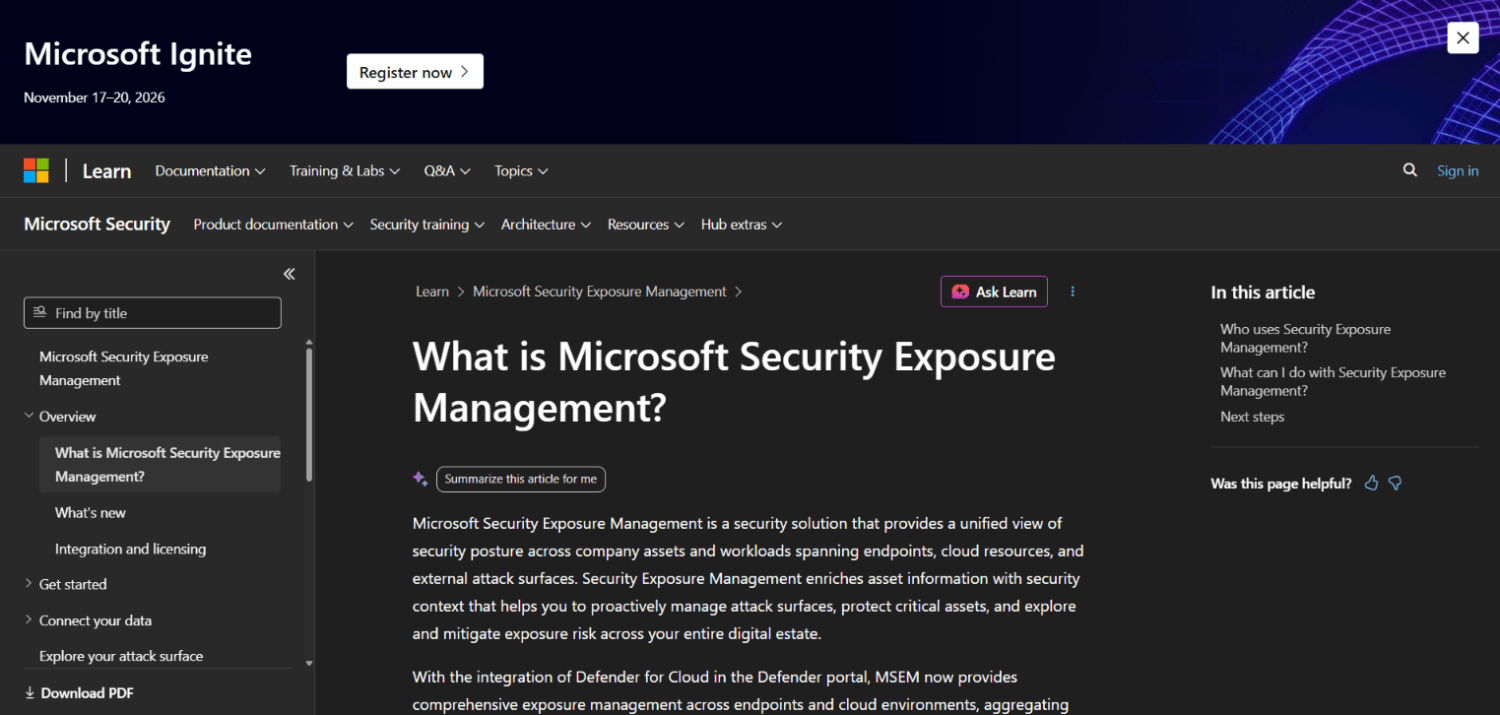
Microsoft Security Exposure Management is built into the Microsoft Defender XDR portal and is available to organizations with qualifying Microsoft 365 or Defender licensing. The attack path capability within the product combines signals from Defender for Endpoint, Defender for Identity, and Entra ID to build a graph across the Microsoft security product suite.
The key advantage is zero additional collection infrastructure for shops already running Defender at scale. The graph draws on telemetry already flowing into the Microsoft security stack. According to Microsoft’s documentation, attack paths combine assets and techniques to show end-to-end paths from an entry point to a critical asset, and the platform continuously updates as new signals arrive from connected Defender products.
The constraint is coverage scope. The graph is richest when the environment is predominantly Microsoft-managed. Third-party endpoint telemetry, non-Microsoft cloud workloads, and non-Azure identity providers appear in the graph only through integrations that vary in depth. For a Microsoft-first organization running Windows endpoints, Entra ID, and Azure workloads, Exposure Management is the most operationally efficient option in this list. For hybrid environments with significant AWS or GCP footprint, or mixed-OS endpoint fleets, the graph will have gaps. Exposure Management is included with applicable Microsoft 365 E5 or Defender licensing tiers; Microsoft does not publish standalone pricing for the feature.
4. Tenable Identity Exposure
Tenable Identity Exposure focuses specifically on Active Directory and Entra ID security, with attack path analysis as a core output. The platform continuously analyzes AD configurations and surfaces risky relationships between objects, including delegation abuse paths, shadow admin chains, and GPO-linked exposure vectors.
Tenable positions Identity Exposure as part of its broader exposure management portfolio, which includes Tenable One for vulnerability data correlation. Teams already running Tenable for vulnerability management can connect identity attack path data with CVE-level vulnerability findings in a single exposure view, which matters for the specific use case of correlating a Kerberoastable service account with the unpatched host it runs on. That correlation is where attack path analysis and traditional vulnerability prioritization tools intersect, and Tenable handles it better than most pure-play identity tools.
Tenable Identity Exposure does not publish standalone list pricing. It is sold as part of Tenable One or as a standalone product; buyers should request a quote scoped by AD domain object count and Entra ID identity count separately.
5. Cymulate
Cymulate approaches attack path management from a breach and attack simulation starting point. Its attack path analysis capability maps paths and then validates them through safe simulation, testing whether a path is theoretically possible or actually exploitable given current security controls. This is a meaningful distinction: a graph-only tool shows you every possible path assuming all edges are traversable; Cymulate tests whether your existing controls would actually block traversal at each step.
For teams that have already built an attack path graph and want to validate which paths their defenses would actually stop, Cymulate fits cleanly. For teams that have not yet built a complete hybrid graph, starting with a simulation-first tool before establishing a full inventory creates an incomplete baseline. Cymulate is best suited as a continuous validation layer on top of a more comprehensive graph platform, or in environments where control validation is the primary use case rather than initial graph construction. Cymulate does not publish list pricing; quotes are per environment.
6. Picus Security
Picus Security combines breach and attack simulation with attack path analysis in its Complete Security Control Validation Platform. Like Cymulate, Picus simulates attack scenarios to test whether controls are operating as expected, but it also generates attack graphs that highlight lateral movement opportunities. Its detection analytics component maps simulated attacks to MITRE ATT&CK technique IDs and surfaces gaps in detection coverage.
The Picus differentiation for security operations teams is the direct mapping between attack paths and detection gaps. A path that traverses MITRE ATT&CK technique T1558 (Steal or Forge Kerberos Tickets) will surface whether your SIEM or EDR has detection coverage for that specific technique. That output is directly usable for a detection engineer in a way that a pure graph visualization is not. Picus is a strong fit for teams building detection engineering programs alongside their attack path work. Pricing is not publicly listed.
7. Silverfort

Silverfort takes a different architectural approach from every other tool on this list. Rather than building an attack path graph from static configuration data, Silverfort instruments the authentication layer itself. It proxies authentication requests across on-premises AD, Entra ID, RADIUS, LDAP, and other authentication protocols to build a real-time model of which identities are authenticating to which resources, from where, and with what methods.
This architecture produces two categories of output that config-based tools cannot match. First, behavioral attack path data: a service account that holds GenericWrite permissions on a sensitive group but authenticates only to a single application server looks very different from one authenticating to domain controllers dozens of times a day. The former may be a theoretical path; the latter is an active one. Second, real-time detection signals: because Silverfort sits inline with authentication traffic, it can alert on authentication patterns that match known attack path traversal techniques, Pass-the-Hash, lateral movement via service account credential reuse, or unusual Kerberos delegation invocations, rather than waiting for a periodic configuration poll to surface the structural condition. The trade-off is deployment complexity. Proxying authentication at scale requires integration with every authentication protocol in the environment, and misconfiguration of the proxy layer carries availability risk that a read-only LDAP collector does not. Teams evaluating Silverfort should test the authentication proxy integration against their full protocol mix during the proof of concept, not just the primary AD path. For organizations also focused on non-human identity security and service account exposure, Silverfort’s authentication-plane visibility is particularly useful. Silverfort does not publish list pricing.
8. Rezonate
Rezonate is positioned as an identity attack path management platform with an emphasis on cloud and SaaS identity relationships alongside AD. According to the vendor’s site, the platform maps paths that originate in cloud identity providers such as Okta, Azure AD, and AWS IAM and traces them through to cloud resources and on-premises systems, modeling the cross-environment identity hops that pure AD tools miss and pure CSPM tools do not model as paths.
Rezonate’s positioning addresses the identity-first, cloud-first hybrid scenario: an environment where Okta is the primary IdP, Azure AD is used for Microsoft 365, and on-premises AD still exists for legacy systems. That topology is common in organizations that have partially migrated and retained an AD Connect bridge. Identity attack paths in that environment cross three identity systems in a single lateral movement chain, and most tools in this list handle it partially at best. Pricing is not publicly listed. Teams evaluating Rezonate should request a proof of concept scoped to their specific IdP combination and ask the vendor to demonstrate path enumeration across the Okta-to-AD-to-cloud boundary specifically, since that cross-system traversal is the core differentiator the platform claims.
How Do These Platforms Compare on Hybrid Coverage?
| Platform | On-Prem AD Coverage | Cloud IAM Coverage | Identity Runtime Visibility | Choke Point Scoring | Control Validation |
|---|---|---|---|---|---|
| XM Cyber | Strong | AWS, Azure, GCP | Limited (config-based) | Yes, native Chokepoint view | Partial (simulation) |
| BloodHound Enterprise | Deepest in class | Azure / Entra ID | Limited | Yes, via Tier Zero exposure count | No |
| Microsoft Exposure Management | Strong (Defender for Identity) | Azure / Entra ID native | Yes (via Defender telemetry) | Yes | No |
| Tenable Identity Exposure | Strong | Entra ID | Limited | Partial | No (correlates with Tenable One) |
| Cymulate | Partial | Partial | No | Partial | Yes, core capability |
| Picus Security | Partial | Partial | No | Partial | Yes, with ATT&CK mapping |
| Silverfort | Strong (auth-plane) | Entra ID, Okta, AWS | Yes, core capability | Behavioral scoring | No |
| Rezonate | Partial | AWS, Azure, Okta | Yes (identity behavior) | Partial | No |
How Does Pricing Scale With Identities and Assets in Practice?
None of the eight vendors listed here publish standard list pricing. That is the norm in this category, not an exception. What varies is the pricing metric, and understanding the metric before you enter a sales conversation changes the negotiation.
Consider a hypothetical: a financial services firm with 4,000 Active Directory user objects, 600 service accounts, 1,200 managed endpoints, and workloads split across two AWS accounts and one Azure subscription. Under a per-AD-object model, the AD object count dominates the quote. Under a per-managed-asset model, the endpoint count drives it. Under a per-identity model that includes service accounts, the 600 service accounts may land in a tier that costs more than the user count tier would. Asking “what is the unit of measure for your pricing” before asking “what is your price” is the correct order of operations.
Run a second scenario for a manufacturing firm with 15,000 AD objects spread across three forests, 2,000 endpoints, and a single Azure subscription used primarily for Microsoft 365. The per-AD-object pricing model will produce a very different relative outcome here than it did in the financial services scenario. A tool priced per managed endpoint becomes comparatively attractive when the AD object count is high and the endpoint footprint is moderate. The takeaway: bring both scenarios to each vendor conversation and ask them to quote both. The pricing model’s sensitivity to your specific mix becomes visible immediately.
Tools that bundle attack path management into broader platform licensing (Microsoft Exposure Management within Defender, Tenable Identity Exposure within Tenable One) present a different evaluation problem: the incremental cost of the attack path capability may be near zero if the organization already holds the qualifying license, but the total cost of the platform carrying it may be substantial. Evaluate the marginal cost of the capability, not the sticker price of the bundle.
For teams evaluating these platforms as part of a broader continuous threat exposure management program, the CTEM platform comparison on SecurityOpsWire covers how attack path tools fit into the broader exposure management workflow.
How Do These Tools Actually Identify the Choke Point Worth Fixing?
The mechanism differs by tool, but the underlying graph theory is consistent. In a directed graph where nodes are assets or identities and edges are exploitable relationships (permissions, trust, delegation, session access), a choke point is a node with high betweenness centrality: it sits on the shortest path between many source-destination pairs. Remove that node from the traversable graph, and the largest number of end-to-end paths break simultaneously.
XM Cyber’s Chokepoint view makes this calculation explicit. BloodHound Enterprise’s Tier Zero exposure count approximates it from the defender’s perspective: how many principals have any path to the most critical assets. Both framings are correct; they just answer different questions. The XM Cyber framing is better for deciding what to fix. The BloodHound framing is better for measuring overall AD exposure posture.
Silverfort adds a runtime dimension: a node that is a theoretical choke point but is never actually traversed in real authentication traffic is lower priority than a node that is theoretically and behaviorally central. That runtime weighting is valuable in environments with large legacy permission sets that have accumulated over years, where many theoretical paths have no practical attacker utility because the endpoints are decommissioned or the credentials are expired.
Which Platform Fits Which Environment and Team Size?
A 200-person company with a single AD forest, no legacy infrastructure, and a cloud-first posture on Azure does not need XM Cyber’s full multi-cloud simulation engine. Microsoft Exposure Management, included in their likely E5 licensing, will produce a usable graph with zero additional deployment effort. The right answer for that team is to instrument what they already own before buying something new.
A 3,000-person manufacturing firm with a complex on-premises AD built over 15 years, multiple forests, legacy trusts to acquired entities, and a partial Azure migration is a different problem. BloodHound Enterprise will surface the AD path complexity that accumulated during those 15 years in a way no other tool matches, and Tenable Identity Exposure will correlate the identity exposure with the vulnerability data from their existing Tenable deployment. Running both in parallel is not unusual for that environment.
A SaaS company that runs on AWS, uses Okta as its primary IdP, and has an AD tenant only because Microsoft 365 requires it should evaluate Rezonate and Silverfort before AD-centric tools. The paths that matter in that environment start in Okta, traverse AWS IAM, and only occasionally touch the AD tenant. Tools optimized for deep AD analysis will produce impressive graphs of an environment that is not where the real risk lives.
Detection engineers building a program alongside their attack path work should look at Picus first. The ATT&CK-mapped detection gap analysis is a direct input to the detection-as-code workflow, producing a prioritized list of detection rules to build ranked by the likelihood an attacker would use that technique in the organization’s actual environment. For teams thinking about how detection engineering connects to lateral movement coverage, the exposure management platform comparison at SecurityOpsWire covers the adjacent tools that feed into the same workflow.
What Active Directory Attack Path Classes Should These Tools Cover?
For defenders evaluating whether a tool’s AD coverage is comprehensive, the following path classes are the minimum bar. Each represents a distinct family of lateral movement or privilege escalation technique that appears in real intrusions. A tool that models all of them produces a complete AD graph; a tool that skips any of them leaves blind spots.
- Kerberos delegation abuse: unconstrained delegation (any service can impersonate any user), constrained delegation (scope-limited but still abusable), and resource-based constrained delegation (RBCD, which allows object-level privilege escalation without modifying the target). MITRE ATT&CK tracks these under T1558.
- ACL-based privilege escalation: AD object permissions including WriteDACL, WriteOwner, GenericAll, GenericWrite, and ForceChangePassword that allow an attacker who controls one principal to take control of another. These paths are invisible to traditional vulnerability scanners because no CVE is involved.
- Shadow admin paths: principals that have effective domain admin privileges through nested group memberships or ACL chains, without being in the Domain Admins group. These are common artifacts of permission drift in mature AD environments.
- Cross-forest and cross-domain trust abuse: trust relationships between AD domains and forests that allow authentication to cross boundaries. In merger and acquisition environments, these trusts are often misconfigured or abandoned with excessive permissions.
- Entra ID hybrid sync exploitation: in Azure AD Connect environments, the synchronization account holds elevated permissions on-premises. Compromise of the sync account or abuse of hybrid identity configurations can translate on-premises access to cloud access and vice versa.
- GPO-linked paths: Group Policy Objects linked to OUs containing privileged accounts or computers can be abused by principals with GPO write permissions to push malicious configurations to members of that OU.
This path class coverage also applies to non-human identities. Service accounts, managed service accounts, and group managed service accounts (gMSAs) frequently appear as intermediate nodes in attack paths. Teams managing a large service account population should evaluate how each tool handles service account security specifically, since the attack path tools vary considerably in how they model non-human identity relationships.
How Does Cloud Attack Path Mapping Differ From AD Path Mapping?
AD attack paths are built from permission relationships that change relatively slowly and are modeled through LDAP queries and ACL inspection. Cloud attack paths are built from IAM policies, resource-based policies, trust relationships between accounts, and instance metadata service (IMDS) access, all of which can change rapidly through infrastructure-as-code deployments and can involve implicit permissions granted through policy inheritance.
In AWS, a path from a compromised EC2 instance to S3 data might traverse instance profile, IAM role assumption, cross-account trust, and a resource-based policy in four steps. In GCP, a compromised GCE instance with a service account can authenticate to any API that account can reach, and service account impersonation permissions create lateral movement paths across project boundaries. Neither of these paths involves AD at all, but in a hybrid environment, they connect to AD paths through the identity sync layer.
XM Cyber and Microsoft Exposure Management model this cross-environment path class most completely among the tools reviewed here. BloodHound Enterprise’s Azure coverage handles the Entra ID side but does not extend to AWS or GCP. Teams running significant workloads in multiple cloud providers should confirm specific coverage depth with each vendor during a proof of concept, particularly for cross-account or cross-project path traversal scenarios.
Frequently Asked Questions
What are the three steps in attack path management?
Attack path management follows a discovery, analysis, and remediation cycle. Discovery involves collecting the data needed to build an accurate graph: AD configuration, cloud IAM permissions, and identity relationships. Analysis identifies which paths exist, which are exploitable, and which nodes appear most frequently across paths (choke points). Remediation prioritizes fixes to high-centrality nodes rather than to the highest individual severity finding, because breaking a choke point eliminates many paths simultaneously rather than one.
How does lateral movement analysis connect to attack path management?
Lateral movement analysis examines how an attacker moves between systems after initial access. Attack path management models the routes available for that movement before it happens, using the same relationships an attacker would exploit: trust, permission, delegation, and session access. The output of attack path analysis is, in effect, a pre-built map of all viable lateral movement routes in the environment. Detection of lateral movement in a SOC context becomes more precise when analysts know which paths were theoretically available to the attacker, because it narrows the hypothesis space during investigation.
What makes identity attack paths different from network-based attack paths?
Network-based attack paths model reachability: can host A send a packet to host B? Identity attack paths model authentication and authorization chains: can principal A obtain credentials or permissions that reach resource B, regardless of network topology? In modern environments, an identity-based path from a compromised laptop to a cloud storage bucket may traverse Okta, Azure AD, AWS IAM, and an S3 resource policy without ever requiring a direct network connection to the final resource. Network segmentation does not block that path; identity hygiene and privilege minimization do.
How frequently should attack path graphs be refreshed?
In active enterprise environments, AD permissions, cloud IAM policies, and group memberships change continuously through normal IT operations. A graph that is more than 24 hours old may miss new paths created by routine provisioning changes. The platforms in this list range from near-real-time updates (Silverfort, which observes authentication events as they occur) to periodic polling cycles that may run every few hours to once daily. For environments with active change management programs, ask vendors specifically about the collection frequency and the lag between a configuration change and its appearance in the graph.
Can attack path management tools detect active exploitation, or only model potential paths?
Most attack path management platforms are posture tools: they model what is possible based on current configuration, not what is actively happening. Silverfort is the clearest exception among the tools reviewed here, because it instruments the authentication layer and can detect anomalous authentication behavior that matches known attack path traversal patterns. Microsoft Exposure Management also correlates posture data with active Defender signals, which can surface active exploitation evidence. Pure graph tools like BloodHound Enterprise and XM Cyber are posture-focused and do not generate real-time detection alerts; they feed into the posture management and prioritization workflow rather than the SOC triage workflow.
How do these tools handle non-human identities and service accounts in attack paths?
Service accounts and machine identities are among the most common intermediate nodes in real attack paths, because they often hold elevated permissions and rarely have the behavioral monitoring applied to user accounts. BloodHound Enterprise and Tenable Identity Exposure model service account relationships within AD most comprehensively. Silverfort provides runtime visibility into service account authentication patterns, which surfaces accounts that are active versus dormant. Rezonate extends this to cloud service identities including AWS IAM roles and Okta service accounts. Teams with large, poorly documented service account populations should treat service account inventory completeness as a first-order evaluation criterion for any tool in this category.
What is the operational cost of running an attack path management program beyond the license?
License cost is usually the smaller operational expense. The larger costs are: initial data collection and graph validation (particularly in environments with messy AD inherited from mergers), ongoing triage of new paths surfaced by configuration changes, and stakeholder communication to the teams responsible for remediating the choke points identified. Graph-only tools produce a finding list that someone must act on; without a defined remediation workflow and clear ownership of AD and cloud configuration, findings accumulate without resolution. Plan for at least one dedicated analyst or engineer to own the program, and budget for the first 60 to 90 days of graph cleanup before the tool reaches steady state.
The Choke Point Reframe: Why One Fix Beats Ten Patches
The most important shift attack path management asks of a security organization is a change in what counts as a good remediation sprint. Traditional vulnerability management measures success by the number of critical CVEs closed or by overall risk score reduction. Attack path management measures success by the number of paths broken per remediation action. Those two metrics frequently point at different work.
Say a team running BloodHound Enterprise discovers that a single legacy service account with unconstrained delegation sits on 63 distinct paths to domain compromise. Removing unconstrained delegation from that one account, which may require an afternoon of coordination with the application owner, breaks all 63 paths. The CVE-based backlog might have 12 critical findings on 12 different servers that collectively affect three paths. The math is not subtle.
The cultural challenge is that choke point remediation requires cross-team coordination. The most valuable fix is rarely a patch that the security team applies unilaterally. It is a permission change, a delegation removal, or a trust relationship review that requires engaging Active Directory admins, application owners, and sometimes external vendors whose software depends on the misconfiguration being fixed. The security team’s job in that conversation is to show the blast radius: how many paths this single object affects, and what an attacker could reach from each of them. That is the output these platforms produce, and it is far more persuasive than a severity score on a scan report. For teams building the program management infrastructure around that workflow, the exposure validation platform comparison covers the adjacent tooling that helps confirm when a fix actually breaks the path it was intended to break.