
TLDR
- A BAS coverage score is not the deliverable. The failed scenarios are. Every simulation that slips past your SIEM or EDR without an alert is a detection engineering ticket waiting to be written.
- BAS differs from penetration testing in a specific way: it runs continuously against production, maps every result to a MITRE ATT&CK technique, and tells you whether your controls blocked, detected, or logged the action. A pen test gives you a point-in-time report.
- Most teams buy BAS to prove coverage to a board. The teams that get value from it use the gap report to drive detection-as-code work the following sprint.
- Agent deployment, scenario library freshness, and how results feed into tickets matter more than the headline coverage percentage. Evaluate on those three axes.
- Pricing across this category does not scale linearly. Per-agent and per-scenario models diverge significantly at enterprise scale. Most vendors do not publish rates publicly.
Breach and attack simulation tools run automated, continuous attack scenarios against a live environment, compare the results against expected detection and prevention outcomes, and report which MITRE ATT&CK techniques your controls missed. The ten platforms covered here are Picus Security, Cymulate, SafeBreach, AttackIQ, SCYTHE, Pentera, XM Cyber, Mandiant Security Validation, Prelude, and Validato. They differ in how they deploy agents, how they source and update scenarios, and how they integrate with SIEM and SOAR workflows to close gaps.
What Does BAS Test That a Penetration Test Does Not?
A penetration test is a time-boxed engagement, usually one to two weeks, conducted by consultants who document what they found and leave. The findings age immediately. BAS runs the same class of scenarios on a schedule you control, whether that is daily, weekly, or on every configuration change, and the results accumulate into a trend line rather than a snapshot.
The more precise difference is operational continuity. When your SOC team changes a SIEM rule, a pen tester is not in the room to tell you whether the change fixed the gap or introduced a new one. A BAS platform reruns the relevant scenarios automatically and records whether the new rule catches the technique it was written for. That feedback loop is the actual value proposition, not the coverage number it produces.
A pen test also relies on consultant creativity and methodology. BAS platforms draw from structured scenario libraries mapped to MITRE ATT&CK technique IDs, which makes results reproducible and comparable across runs. The trade-off is depth: a skilled penetration tester will chain techniques in ways a simulation library may not anticipate, particularly in novel privilege escalation paths or custom application logic. BAS and pen testing address different parts of the validation problem, and the strongest programs use both.
Is It Safe to Run BAS Against Production?
Every platform in this list markets itself as safe for production, and in practice they operate in a specific way to earn that claim. Simulation agents execute attack behaviors at the technique level without weaponized payloads. A scenario testing lateral movement via SMB will attempt the connection and log whether it succeeded, but it will not drop ransomware or exfiltrate real data. The behavioral signal is real. The destructive component is absent.
The practical safety concern is network noise and endpoint performance. Running a dense scenario set during business hours will generate anomalous traffic that may trigger your own detection tools, which is partly the point, but it may also exhaust endpoint agent CPU on resource-constrained hosts. Most platforms let you schedule simulations outside peak hours and configure resource limits per agent. Review that configuration before your first production run.
Cloud and container environments introduce a separate consideration. Simulation agents deployed as sidecars or as host-level daemons in Kubernetes clusters may need adjusted pod security policies or privileged mode, which has its own risk profile in hardened environments. Pentera and XM Cyber handle agentless discovery-based approaches that reduce this friction in cloud environments specifically, while platforms like SCYTHE and AttackIQ rely on endpoint agents that require more deliberate deployment planning.
How Do BAS Results Map to MITRE ATT&CK Coverage?
Most BAS platforms express results as a heat map overlaid on the MITRE ATT&CK Enterprise matrix. Techniques that were blocked show one color, detected-but-not-prevented show another, and missed entirely show a third. The heat map format is visually effective for board presentations, which is exactly why practitioners are skeptical of it: a cell that shows “detected” tells you the alert fired, not whether anyone looked at it or whether the rule is tuned to a tolerance that would miss a real variant.
The more operationally useful output is the per-technique log that shows the specific simulation step, the expected log source, whether the log source produced an event, and whether that event triggered a rule. That granularity tells a detection engineer whether the gap is in sensor coverage, rule logic, or alert routing. The platforms that surface this level of detail in an exportable format, rather than burying it three clicks into the UI, are the ones that actually drive detection engineering work.
ATT&CK technique coverage also has a depth problem worth naming. A platform that claims coverage of T1078 (Valid Accounts) may be testing only one of its four sub-techniques. The sub-technique level is where real gaps live, particularly for cloud-specific techniques like T1078.004 (Cloud Accounts) versus T1078.002 (Domain Accounts). When evaluating any BAS platform, ask for sub-technique coverage counts, not just parent technique counts.
The SecurityOpsWire Gap-to-Ticket Framework
Most BAS evaluations stall at the gap report. Teams look at the heat map, note the coverage percentage, and file it as evidence of program maturity. The percentage does not change operational posture. The following four-step process, which we call the Gap-to-Ticket Framework, is what separates programs that use BAS as a compliance artifact from programs that use it to actually improve detection.
- Run one scenario cluster, not the full library. Pick the ATT&CK tactic most relevant to your current threat model. For most enterprise environments, this is Initial Access or Credential Access. Running everything at once produces a gap list too long to act on.
- Export per-technique log results, not the heat map. The log-level output shows exactly which data source was expected, whether it fired, and whether a rule matched. That is the information a detection engineer needs.
- Convert each missed detection into a ticket with the simulation ID attached. The ticket should specify: the ATT&CK technique ID and sub-technique, the log source that should have fired, the rule that should have matched (or that needs to be written), and the BAS scenario ID so the fix can be validated by rerunning the same simulation.
- Rerun the same scenario after the rule is deployed. Confirm the alert fires. If it does, close the ticket. If it does not, the ticket re-opens with the new simulation log appended.
This loop is what makes BAS a detection engineering tool rather than a reporting tool. The coverage score is a by-product. The closed tickets are the deliverable.
10 Best Breach and Attack Simulation Tools Compared
| Platform | Deployment Model | ATT&CK Sub-technique Coverage | Best Fit | Pricing Model |
|---|---|---|---|---|
| Picus Security | Agent + cloud | High, mapped to sub-technique level | SOC teams running SIEM-centric validation | Not publicly disclosed |
| Cymulate | Agent + agentless options | High, includes immediate threat intelligence scenarios | Teams wanting rapid threat emulation on published TTPs | Not publicly disclosed |
| SafeBreach | Agent-based | High, large pre-built scenario library | Large enterprises with dedicated security engineering teams | Not publicly disclosed |
| AttackIQ | Agent-based, BAS-as-a-service option | High, ATT&CK Evaluations-aligned scenarios | Teams running MITRE ATT&CK Evaluations-aligned programs | Not publicly disclosed |
| SCYTHE | On-premises or private cloud | Operator-defined, custom threat actor emulation | Red teams and advanced emulation programs | Not publicly disclosed |
| Pentera | Agentless, network-based | High for network and AD attack paths | Infrastructure-heavy environments, Active Directory | Not publicly disclosed |
| XM Cyber | Agentless, attack path simulation | Focused on lateral movement and privilege escalation paths | Teams prioritizing exposure management and attack path visualization | Not publicly disclosed |
| Mandiant Security Validation | Agent-based | High, Mandiant threat intelligence-curated scenarios | Enterprises with Mandiant IR relationships or Google Cloud alignment | Not publicly disclosed |
| Prelude | Lightweight agent (Operator) | Modular, TTX and detection test focused | Lean teams running detection engineering-first programs | Open-source community edition available |
| Validato | Agent + SaaS | Mapped to ATT&CK, focused on continuous control validation | Mid-market teams building a first BAS program | Not publicly disclosed |
1. Picus Security
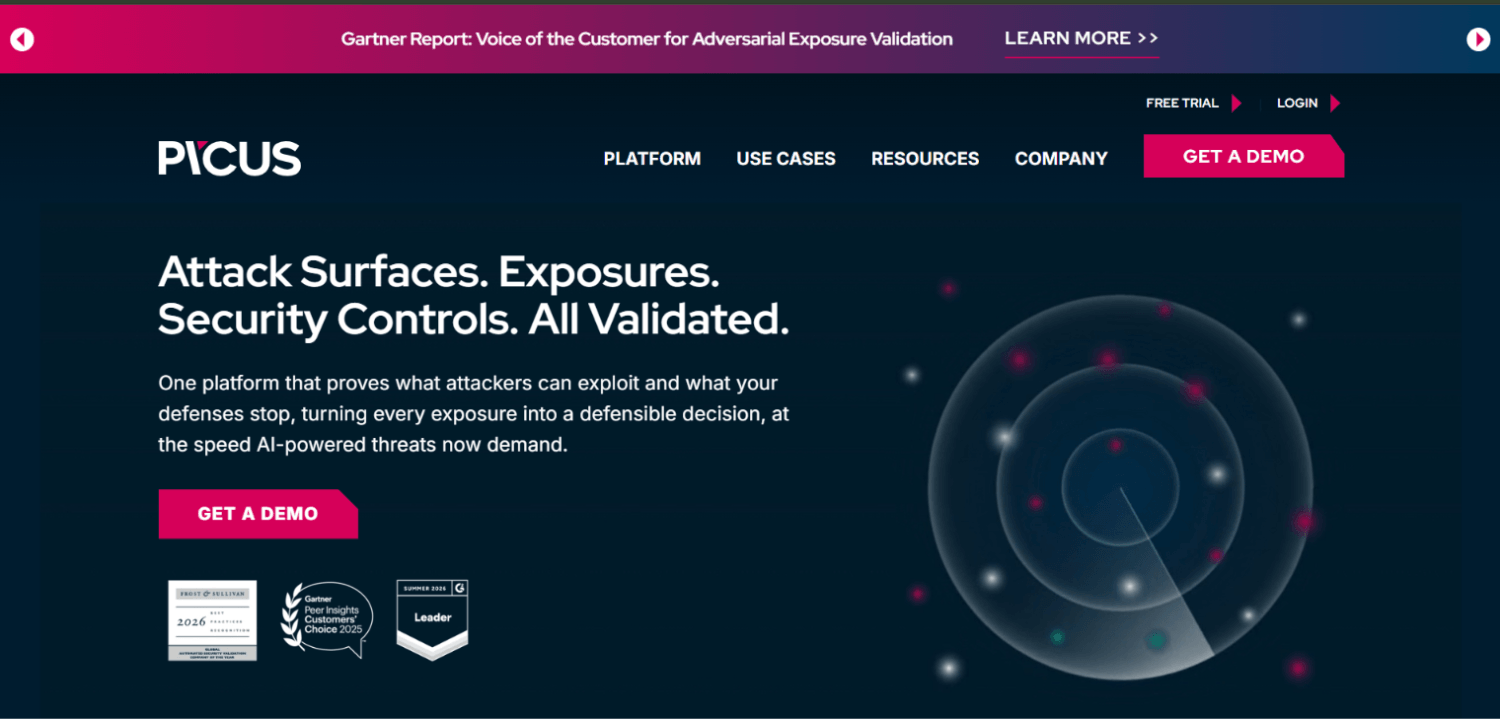
Picus Security positions its platform around what it calls the Complete Security Validation approach: run simulations, measure outcomes across prevention, detection, and log generation, and surface specific remediation content to fix the gaps in the same interface. The platform is particularly strong in SIEM integration, surfacing ready-to-use detection rules in the format of your specific SIEM vendor rather than generic Sigma rules that still need translation.
For SOC teams, the most operationally useful feature is the mitigation content library. When a scenario shows a detection gap, Picus surfaces a vendor-specific rule or configuration change alongside the gap rather than just flagging the ATT&CK technique. That is the difference between a gap report and a gap-plus-fix report. The platform maps results to sub-technique level, which matters when you are trying to explain to a detection engineer whether the gap is in the base technique or a specific execution variant.
Picus does not publish pricing. Teams report that the model is capacity-based, scaling with the number of agents and the frequency of simulation runs. Licensing conversations typically require a scoping call. Picus is a strong fit for enterprise SOC teams running Splunk, Microsoft Sentinel, or IBM QRadar who want detection content delivered alongside the gap rather than generated separately.
2. Cymulate
Cymulate differentiates on the breadth of attack vectors covered in a single platform. Beyond endpoint and network simulation, it includes email gateway testing, web application attack simulation, phishing simulation, and data exfiltration scenarios, which means a single deployment can validate controls across the full kill chain rather than just endpoint telemetry.
The immediate threat intelligence feature is where Cymulate earns practitioner attention. When a new threat actor campaign or significant vulnerability disclosure hits, Cymulate publishes a scenario within days that simulates the relevant TTPs, so teams can test whether their current controls would have caught the campaign before they read about it in a post-incident report. The operational tempo of that content pipeline is faster than most competitors.
One limitation worth naming is depth on custom scenario authoring. Cymulate provides a scenario builder, but teams wanting to emulate a specific custom threat actor with fine-grained control over payload staging and C2 behavior will find SCYTHE or AttackIQ more flexible. Cymulate is the right choice for teams that want breadth, fast threat intelligence integration, and a deployment that does not require a dedicated red team operator to run.
3. SafeBreach
SafeBreach runs one of the larger pre-built scenario libraries in the category, covering thousands of attack methods across network, endpoint, email, and cloud environments. The depth of the library is its primary differentiator. For large enterprise teams that need to demonstrate broad ATT&CK coverage across multiple business units with different security stacks, SafeBreach’s scenario breadth means fewer gaps in the initial coverage map.
The platform reports at the simulation step level, which means you can see whether a specific stage in an attack chain was blocked at prevention, logged without alerting, or missed entirely. That granularity is what detection engineers need to distinguish between a rule gap and a sensor gap. Teams without a dedicated detection engineer on staff may find the volume of output harder to process without additional workflow tooling to triage and assign findings.
SafeBreach integrates with major SIEM, EDR, and firewall platforms for automated correlation, meaning a simulation run can automatically check whether the SIEM received the expected log event, rather than relying on manual comparison. Pricing is not publicly disclosed and is typically scoped per environment size and agent count.
4. AttackIQ
AttackIQ has built the most explicit alignment to the MITRE ATT&CK Evaluations methodology of any vendor in this list. The company was a founding member of the Center for Threat-Informed Defense, and its scenario library reflects that orientation: scenarios are structured as multi-step adversary emulation plans rather than isolated technique tests, which means results map to realistic attack chains rather than individual technique checks.
For teams that have adopted a threat-informed defense program and are using ATT&CK to prioritize detection engineering, AttackIQ’s adversary emulation plans are the most directly applicable output. The platform also offers a BAS-as-a-service option through AttackIQ Ready!, which is a lighter-touch entry point for teams that do not have the internal capacity to operate a full BAS deployment. Pricing for the managed service option is not publicly disclosed.
The platform’s reporting is strong for executive communication, producing clear mappings of scenario results to ATT&CK technique coverage with trend data over time. Where it is weaker is in the speed of immediate threat intelligence scenarios: when a high-profile campaign drops, the scenario library update cycle at AttackIQ is typically slower than Cymulate. Choose AttackIQ if your program is structured around adversary emulation plans and ATT&CK Evaluations alignment. Choose Cymulate if fast-follow threat intelligence scenarios are the priority.
5. SCYTHE
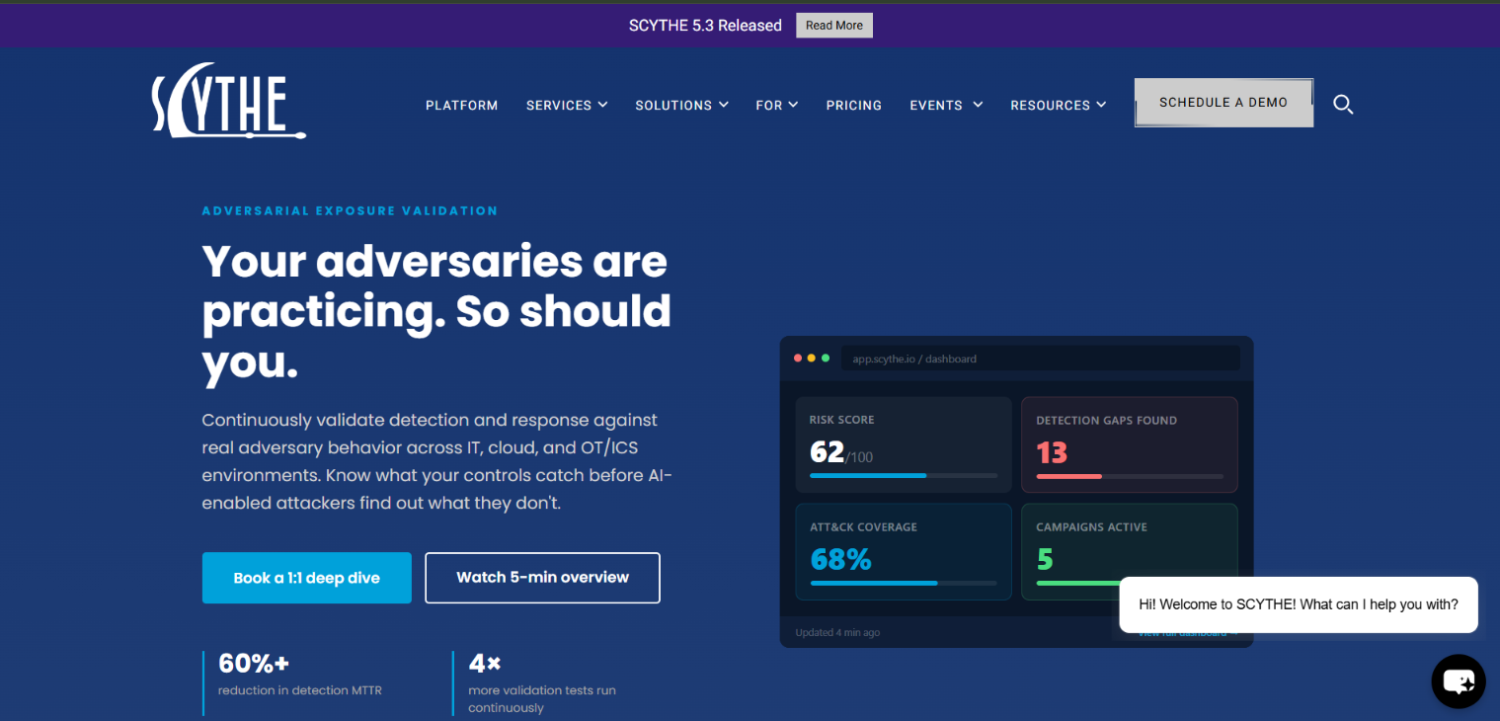
SCYTHE is the platform built for red teams and advanced adversary emulation operators, not for automated continuous validation. The platform’s threat emulation studio lets operators author custom campaigns that model specific threat actor TTPs with precise control over each execution step, including C2 behavior, payload staging, and exfiltration method. That level of operator control is what distinguishes SCYTHE from the automated BAS platforms above.
The operational implication is significant: SCYTHE produces better emulation fidelity than automated BAS, but it requires operator expertise to build and run campaigns. A team without red team capability will get less value from SCYTHE than from a platform that delivers pre-built scenario libraries. SCYTHE also offers a community library of pre-built threat actor campaigns that operators can use as starting points, which reduces the authoring burden for common adversary profiles.
Deployment is on-premises or private cloud, which makes SCYTHE the right choice for environments with strict data residency requirements or for government and defense contractors who cannot send simulation telemetry to a SaaS vendor. Pricing is not publicly disclosed. SCYTHE is a specialist tool and should be evaluated as such: it extends the reach of programs that already have red team capability by enabling precise custom emulation , it is not a first BAS purchase for a team without that foundation.
6. Pentera
Pentera takes a fundamentally different approach from the agent-based platforms above. It operates agentlessly, discovering attack surfaces and validating controls by actively attempting to exploit them from the network, without requiring endpoint agents to be pre-deployed. This makes Pentera faster to deploy and easier to run across environments where agent deployment is operationally constrained, such as OT-adjacent networks, legacy infrastructure, or environments with strict change control processes.
The platform is particularly strong in Active Directory attack path validation. It tests credential exposure, Kerberoasting paths, Pass-the-Hash opportunities, and lateral movement through domain trust relationships in a way that reflects real intrusion progression. For infrastructure-heavy environments where Active Directory compromise is the most consequential breach scenario, Pentera covers that territory more thoroughly than most endpoint-centric BAS platforms.
The agentless model has one trade-off: because Pentera actively probes the environment, it generates real network traffic and real authentication attempts. In sensitive production environments, that activity needs to be scoped carefully and coordinated with the network operations team to avoid false incidents. Pentera is not a passive simulation tool. It operates more like an automated continuous penetration test, which is powerful but requires operational planning before the first run.
7. XM Cyber
XM Cyber occupies a position adjacent to traditional BAS: it focuses on attack path simulation rather than technique-by-technique simulation. The platform continuously models how an attacker could move from any starting point in the environment to a critical asset, identifying which misconfigurations, excessive permissions, and exposed credentials create viable paths. The output is a prioritized list of chokepoints: the specific misconfigurations that, if fixed, collapse the most attack paths.
For teams looking at exposure management platforms that combine attack simulation with remediation prioritization, XM Cyber sits at the intersection of BAS and CTEM. The platform ingests data from Active Directory, cloud IAM configurations, and endpoint agents to build its graph, with coverage spanning on-premises identity infrastructure, cloud-native attack paths, and hybrid environments.
The limitation is detection validation. XM Cyber tells you which paths exist and which chokepoints to fix. It does not tell you, at the granularity of a traditional BAS platform, whether your SIEM fired on a specific ATT&CK technique. If your primary use case is detection engineering and rule validation, pair XM Cyber with a technique-level BAS platform. If your primary use case is prioritized remediation of the exposures that actually lead to critical asset compromise, XM Cyber is one of the strongest options in the market.
8. Mandiant Security Validation
Mandiant Security Validation draws its scenario library directly from Mandiant’s front-line incident response intelligence. When Mandiant investigators document the TTPs of a threat actor group during a response engagement, those behaviors translate into the scenario library. For enterprises that face named threat actor groups that Mandiant tracks, that provenance matters: the simulations reflect actual observed behaviors rather than ATT&CK technique abstractions.
The Google SecOps integration is increasingly relevant for enterprises running security operations on Google SecOps (formerly Chronicle). Security Validation results feed into the Google SecOps environment natively, which reduces the integration work that other BAS platforms require when connecting to a SIEM that was not part of the same vendor stack. For teams already aligned to the Google Cloud security stack, that integration removes a real operational friction point.
For enterprises without an existing Mandiant relationship or Google Cloud alignment, the platform’s differentiation is less compelling. The scenario library is strong, but its breadth is not notably larger than SafeBreach or Cymulate, and the pricing model reflects the enterprise positioning. Mandiant Security Validation is the right choice when Mandiant threat intelligence is already part of the security program and when the team wants simulation content curated to the specific actor groups Mandiant tracks.
9. Prelude
Prelude is built for detection engineering teams that want to run ATT&CK technique tests at the operator level without deploying a full enterprise BAS platform. The Operator tool is available in a community edition, making it one of the few genuinely free entry points in the BAS category. The platform lets detection engineers write and run individual technique tests, validate that a detection rule fires, and iterate on rule logic before promoting it to production.
For lean security teams running a detection engineering program, Prelude’s model is operationally efficient: a detection engineer writes a new rule, runs the corresponding Prelude test, confirms the alert fires, and commits the rule. The feedback loop happens within a single workflow rather than requiring a separate BAS platform deployment and a separate results export. The trade-off is scenario breadth and operational coverage: Prelude is built for technique-level detection testing, not for comprehensive multi-stage adversary emulation across a full enterprise environment.
Prelude is the right tool for a team of two to five security engineers who want to run detection-as-code development with immediate technique validation. It is not a replacement for a full BAS platform in an enterprise program that needs to demonstrate ATT&CK coverage across multiple business units, generate executive-facing trend reports, or run automated scheduled simulation across hundreds of endpoints. For teams exploring continuous exposure validation as a broader program, Prelude fits as a detection engineering component, not as the full platform.
10. Validato
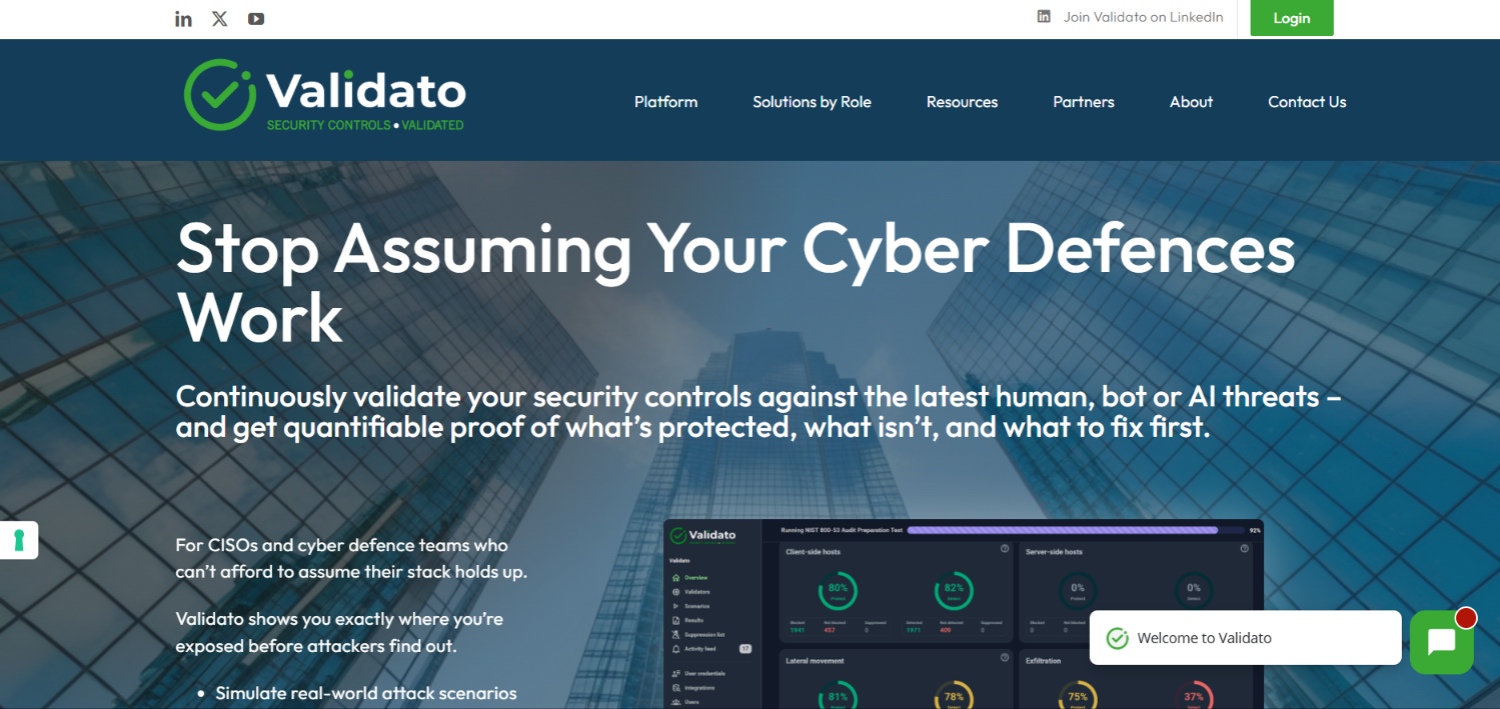
Validato is positioned as a continuous security control validation platform with explicit focus on making BAS accessible to mid-market security teams that do not have a dedicated red team or a large detection engineering staff. The platform maps scenarios to MITRE ATT&CK and surfaces remediation guidance alongside gap results, following the same pattern as Picus but with a lighter operational footprint intended for smaller teams.
For organizations building their first formal BAS program, Validato’s simpler deployment model and guided onboarding reduce the time-to-first-run significantly compared to platforms designed for enterprise red teams. The scenario library is narrower than SafeBreach or Cymulate, which is an appropriate trade-off for the target audience: a mid-market team running its first control validation program needs a manageable gap list, not an exhaustive one that exceeds its remediation capacity.
Pricing is not publicly disclosed. For mid-market teams evaluating their first BAS purchase, Validato is worth including in a shortlist alongside Cymulate, which serves a similar buyer with a broader scenario library at enterprise pricing. The right choice between them depends on whether scenario breadth or operational simplicity is the more important constraint for the team doing the evaluation.
How Does BAS Pricing Actually Scale With Agents and Scenarios?
None of the ten platforms in this list publish list pricing publicly. That is the accurate statement of the market as it stands, and it is worth understanding why rather than treating it as an inconvenience. BAS pricing scales across at least three dimensions simultaneously: the number of simulation agents deployed (tied to endpoint or node count), the number of scenarios run per period (tied to scenario library access and execution frequency), and the number of integrations to SIEM, EDR, and ticketing systems.
Per-agent pricing is the most common model, but “agent” is defined differently across vendors. For Pentera, which is agentless, pricing typically scales with the number of IP addresses or assets in scope. For XM Cyber, pricing scales with the number of entities in the attack graph. For AttackIQ and SafeBreach, it scales with endpoint agent count. When comparing quotes, normalize to the same unit: cost per protected endpoint or cost per asset in scope, per year.
Scenario library access is sometimes a separate tier. Some platforms include their full scenario library in the base license; others treat advanced threat actor emulation packs or immediate threat intelligence scenarios as add-on SKUs. Ask specifically whether the threat intelligence scenario feed, the cloud-specific scenario library, and custom scenario authoring are included in the quoted price or licensed separately.
Consider a mid-sized financial services organization with 2,000 endpoints, two security engineers, a Splunk SIEM deployment, and a CrowdStrike Falcon EDR deployment. The right BAS purchase for that environment is a platform with strong Splunk and Falcon integration, sub-technique-level gap reporting, and a scenario library focused on financial sector threat actors. That organization will spend significantly more on a platform sized for enterprise-scale multi-business-unit deployment than on one designed for its actual environment. Vendors will size the quote to the largest plausible environment if the buyer does not anchor the scope conversation explicitly.
What Should a BAS Proof of Concept Actually Test?
A BAS proof of concept that evaluates the platform on coverage percentage is evaluating the wrong thing. The question a POC should answer is: does this platform’s output become detection engineering work, or does it become a slide?
Run one scenario cluster from the Credential Access tactic, specifically the techniques most likely to succeed in your environment based on your current technology stack. For an Active Directory-heavy environment, that means testing T1003 (OS Credential Dumping) sub-techniques and T1558 (Steal or Forge Kerberos Tickets). For a cloud-heavy environment, test T1552 (Unsecured Credentials) sub-techniques and T1078.004 (Cloud Accounts). After the run, ask the vendor to show you the per-technique log output, not the heat map. Then ask: how does this output become a Jira ticket? If the vendor cannot demonstrate a direct workflow from simulation result to detection engineering ticket, the platform will produce a coverage score that lives in a slide deck and nothing else.
Also evaluate agent deployment friction during the POC. The platforms with the highest operational debt are the ones where agent deployment requires manual exceptions to endpoint security policy, where agent updates require a separate change control window, and where agents generate enough system load to trigger performance complaints. Those operational costs are invisible in a vendor demo and substantial in production. Ask the vendor for the agent resource consumption specifications in writing before signing.
For security operations teams also evaluating how their detection stack handles automated threats, the discussion of AI-assisted SOC platforms is increasingly relevant alongside BAS, particularly for teams trying to automate the triage of alerts generated by simulation runs.
Frequently Asked Questions
What is the difference between BAS and adversary emulation?
BAS refers to automated, continuous simulation of attack techniques against a production environment, typically using pre-built scenario libraries mapped to MITRE ATT&CK. Adversary emulation is a broader practice in which a team manually replicates the specific TTPs of a named threat actor, often using tools like SCYTHE or Caldera. BAS scales automation across a large environment; adversary emulation produces higher fidelity at lower scale. Most mature security programs use BAS for continuous validation and adversary emulation for periodic depth testing.
How often should BAS scenarios run in production?
Daily or near-continuous simulation is technically possible with most platforms but is operationally excessive for most teams. A weekly cadence for the full scenario library, combined with immediate runs triggered by configuration changes or threat intelligence updates, is the most common effective model. The right frequency is the one that generates a gap list your detection engineering team can actually process within the same sprint cycle. A gap list that outpaces remediation capacity creates noise, not improvement.
Can BAS replace a penetration test for compliance purposes?
Not directly. Most compliance frameworks that require penetration testing, including PCI DSS and SOC 2 examination requirements, specify criteria about scope, methodology, and examiner independence that automated BAS tools do not meet. BAS output can inform and scope a penetration test, reducing the consultant’s time on discovery and allowing the engagement to focus on the specific gaps BAS identified. Treat them as complementary rather than substitutes, and verify the specific compliance requirement language before using BAS output as a substitute in any examination.
What ATT&CK tactics do BAS platforms cover least well?
Collection and Exfiltration tactics are consistently underrepresented in BAS scenario libraries compared to Initial Access, Execution, and Lateral Movement. Scenarios that involve identifying and staging sensitive data for exfiltration require the platform to interact with real data in the environment, which most platforms avoid for obvious safety reasons. Resource Development, which covers attacker infrastructure setup outside the target environment, is also largely outside BAS scope by nature. Teams should not treat a high ATT&CK coverage score as indicating complete kill-chain validation if the score is built primarily on pre-compromise and lateral movement techniques.
What is the minimum team size to operationalize BAS output?
One dedicated detection engineer who has the mandate to write and deploy detection rules based on simulation results. Without that role, BAS produces gap reports that sit in a queue. The platforms that reduce the human requirement most effectively are the ones that surface vendor-specific detection rules or configuration changes alongside each gap, such as Picus and Cymulate, rather than producing a raw ATT&CK technique list and leaving rule authoring entirely to the team. Even with remediation content provided, someone still needs to review, test, and deploy the suggested rules in the team’s specific SIEM environment.
How do BAS tools integrate with SIEM platforms?
Integration depth varies significantly. The strongest integrations are bidirectional: the BAS platform sends a simulation event, checks whether the SIEM received and alerted on the corresponding log, and marks the technique as detected or missed based on the SIEM’s actual response. Weaker integrations require manual comparison between the simulation log and the SIEM query results. When evaluating any BAS platform for a specific SIEM deployment, ask specifically whether the integration is bidirectional and automated, and whether it supports your SIEM version, not just the vendor name.
Do BAS platforms cover cloud-native attack techniques?
Coverage is improving but remains uneven. Platforms like XM Cyber and Pentera have invested specifically in cloud attack path analysis covering IAM misconfiguration, privilege escalation through cloud service roles, and cross-account lateral movement. Traditional endpoint-centric platforms are adding cloud modules, but their cloud technique coverage at the sub-technique level is typically shallower than their endpoint coverage. For environments where cloud-native attack paths represent the primary risk, evaluate cloud-specific coverage in the POC explicitly rather than accepting a vendor’s stated ATT&CK matrix coverage count as a proxy for cloud depth.
What is the relationship between BAS and continuous threat exposure management?
CTEM, a category term that Gartner introduced, describes a program for continuously discovering, assessing, prioritizing, and validating exposures. BAS covers the validation stage of that program: it confirms whether a known exposure is actually exploitable and whether controls would detect or block the exploitation attempt. XM Cyber sits closest to the full CTEM scope by combining attack path simulation with prioritized remediation guidance. For teams building a full CTEM program, BAS is one component alongside external attack surface management and vulnerability prioritization, not a synonym for the full program.
What the Coverage Score Is Actually Telling You
A 74% ATT&CK coverage score means 74% of the techniques in a specific scenario library, at a specific scope, on a specific date, were either blocked or detected by the controls in place at that moment. It does not mean 74% of the techniques a real adversary would use against your environment are covered. The scenario library is not the adversary. The adversary will chain techniques in combinations the library may not include, exploit application logic the library does not model, and operate at a pace that differs from a scheduled simulation run.
The teams that get lasting value from BAS programs treat the score as a direction indicator, not a destination. When the score moves from 68% to 74% over a quarter, the meaningful question is not “what is our score” but “which six techniques moved from red to green, and which detection rules did we write or tune to make that happen.” That audit trail from simulation gap to detection rule to confirmed detection is the program artifact that withstands scrutiny from a board, an auditor, and a post-incident review.
For teams also tracking how their detection stack handles the alerts that BAS generates, the practical gap between a rule that fires in a simulation and an analyst who investigates the real alert is where programs actually fail. BAS validates the technical detection layer. It does not validate the human response layer. Those are different problems, and the most effective security programs measure both separately rather than assuming a fired alert equals a contained incident.