
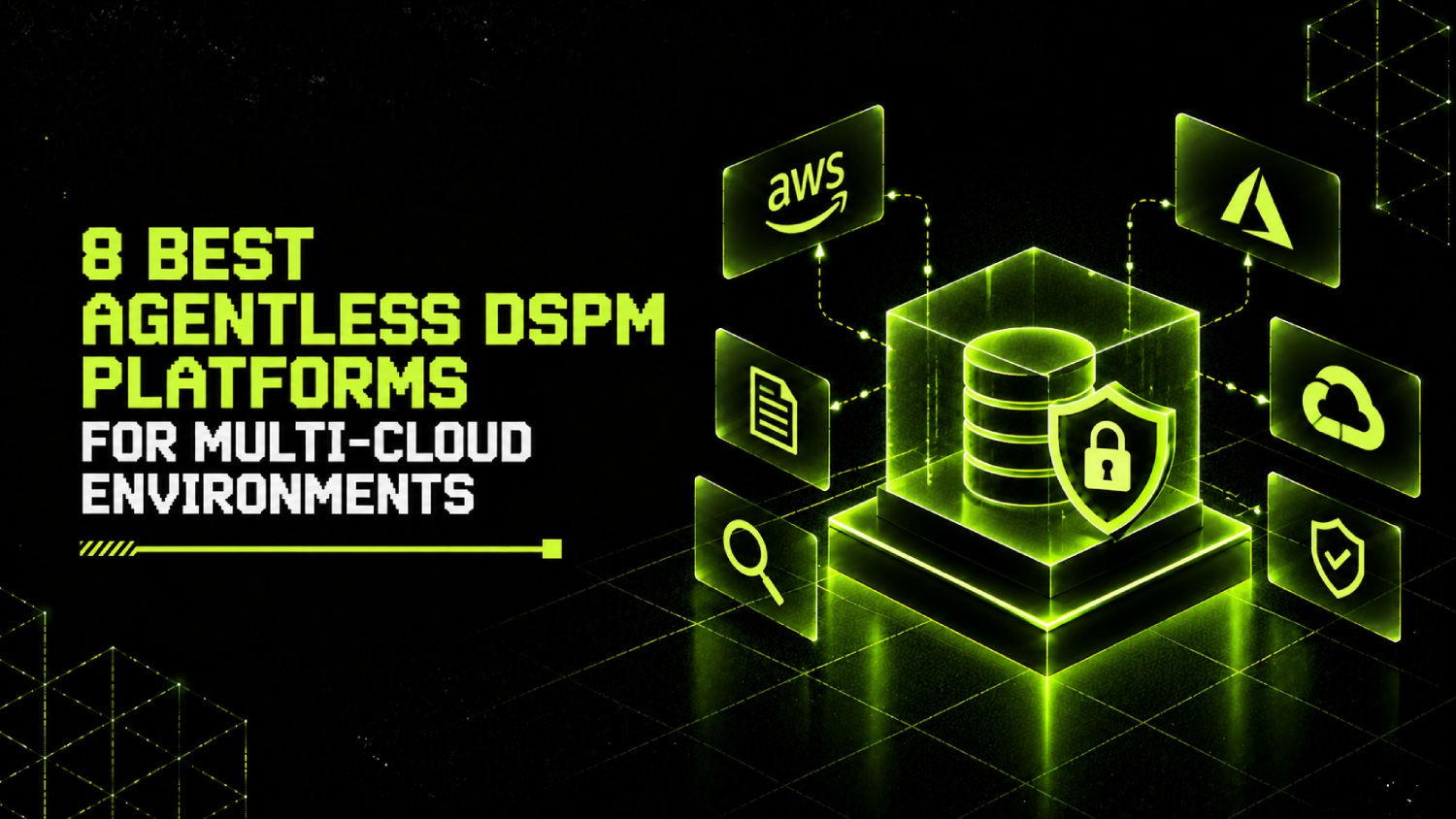
- Agentless DSPM connects via read-only cloud APIs or snapshot mounts, reaching an entire cloud estate in hours without touching running workloads , but that speed comes at the cost of data freshness and in-transit visibility.
- Snapshot scanning is accurate for data-at-rest classification but can be hours or days behind real writes; for stores with high write velocity, that lag is operationally significant.
- On-premises databases, self-managed Postgres clusters, and databases inside private VPCs with no API surface are the cases where agentless coverage reliably breaks down and an agent or proxy connector becomes unavoidable.
- The eight platforms below differ most on scan frequency, classification depth, and how they handle hybrid or on-prem data , not on the presence or absence of agents.
- Use the decision table in this article to map each data-store type to the right scanning architecture before buying anything.
The best agentless DSPM platforms for multi-cloud environments are Wiz, Orca Security, Cyera, Sentra, Securiti, Proofpoint Data Security (formerly Normalyze), Symmetry Systems, and Laminar (now part of Rubrik). Each connects via cloud provider APIs or mounted snapshots rather than installed agents, making them deployable across AWS, Azure, and GCP without coordinating with a separate agent rollout. The right choice depends on your mix of cloud-native versus on-prem stores, how frequently data changes, and whether you need real-time or periodic classification.
What Agentless DSPM Actually Means Architecturally
The term “agentless” in DSPM describes the absence of persistent software on the scanned host or database server. In practice, most platforms in this category use one of two mechanisms: direct API calls to cloud-managed services (S3, BigQuery, Azure Blob, RDS parameter groups) that return metadata and allow read-only data sampling, or snapshot mounting, where a point-in-time volume snapshot is attached to a scanner instance the vendor controls inside your own cloud account.
Snapshot mounting is the approach Orca Security and Wiz are most associated with. The scanner mounts an EBS or managed disk snapshot, reads the filesystem or database files directly, and then deletes the copy. No data leaves your cloud account. For workloads where installing software is slow, politically complicated, or operationally risky, this gets you to first-scan results in hours rather than weeks.
The architectural limitation most vendor pages omit: snapshot scanning captures the state of data at the moment the snapshot was taken. If your team writes a new S3 bucket with PII attached to a misconfigured policy at 9 AM and your snapshot cycle runs every 24 hours, that exposure is invisible until the next cycle. For a data warehouse that changes monthly, this is irrelevant. For a transactional database that processes thousands of records per hour, the lag is a meaningful detection gap.
What Does Agentless Scanning Actually Miss?
Agentless scanning misses four categories of data activity that matter to security teams: in-transit data flows between services, data processed in memory that never touches a disk the scanner can mount, real-time write events to managed databases between scan windows, and any store without a cloud API surface or snapshotable volume.
In-transit visibility is the most commonly overlooked gap. If a Lambda function queries an RDS table and writes PII to a messaging queue, an agentless scanner sees the data in RDS and may see it in the queue on the next scan, but it does not see the movement. That movement is where data lineage and data flow mapping break down. Some platforms compensate with API call log analysis (CloudTrail, Azure Monitor), which reconstructs flows from access patterns rather than watching the actual data.
The second gap is on-premises and self-managed stores. A Postgres instance running on an EC2 instance the team manages manually, or a database server sitting in a colocation facility, has no cloud API to call and no snapshot service to mount. Getting agentless coverage of those stores typically requires a proxy connector or a network-based scanner positioned in the same segment, which reintroduces deployment complexity. Most vendors in this list support on-prem via a lightweight connector rather than a true agent, but that distinction matters more in the marketing than in the operations. You are still deploying something, just smaller.
How Current Is a Snapshot-Based Inventory?
Scan frequency varies significantly across the eight platforms, and most vendors do not publish their default cycle times prominently. The practical range runs from near-continuous API polling for cloud-native managed services down to daily or configurable snapshot sweeps for block storage. The right mental model: treat API-based scanning as close to real-time for metadata (bucket policy changes, permission drift), and treat snapshot-based scanning as a daily photograph of data content.
For regulated environments where a compliance auditor asks “when did you last verify this S3 bucket contained no SSNs,” a daily snapshot scan is usually defensible. For environments where your threat model includes an insider exfiltrating data within a business day, that same cadence is inadequate. Some platforms allow shorter snapshot intervals at higher compute cost, which is where scanning frequency becomes a direct cost driver.
How Scanning Frequency Drives Cost
Every snapshot scan creates a volume clone, attaches it to a scanner instance, runs classification workloads, and deletes the clone. That cycle consumes EC2 or compute credits, egress bandwidth if the scanner is in a different region, and whatever the vendor charges for classification compute. Doubling scan frequency roughly doubles that compute spend. For organizations with hundreds of terabytes of block storage, the math can get uncomfortable quickly.
API-based scanning of managed services is cheaper per sweep because it samples data rather than reading entire volumes, but it requires the platform to have pre-built connectors for each service. A platform that covers S3, RDS, and Redshift via API but falls back to snapshot for self-managed databases will have a very different cost profile than one that stays API-native across the stack.
The SecurityOpsWire Data Store Coverage Framework
Before selecting a platform, map your data stores against four variables: scan mechanism compatibility, change velocity, sensitivity class, and compliance freshness requirement. We call this the Store-Scan Fit Matrix, and it is what the decision table below operationalizes. A store with low change velocity and a permissive freshness requirement fits snapshot scanning cleanly. A store with high change velocity and a tight freshness requirement , say, a transactional Postgres cluster holding payment records , is where you should not accept agentless-only coverage without a clear plan for the gap.
| Data Store Type | Scan Mechanism That Fits | Agentless Coverage | Gap to Address |
|---|---|---|---|
| AWS S3 / GCS / Azure Blob | API (metadata + sampling) | Strong | In-transit flows between buckets |
| AWS RDS / Aurora (managed) | API + snapshot | Good; gap is intra-scan writes | Real-time write events between scans |
| Snowflake / BigQuery / Redshift | API (query-based sampling) | Strong for data classification | Data movement between platforms |
| Self-managed Postgres / MySQL on EC2 | Snapshot or proxy connector | Partial; requires connector | Real-time activity; connector deployment |
| On-premises databases (colocation or DC) | Proxy connector / agent | Weak without connector | Significant; agent or proxy required |
| Kafka / messaging queues | API (topic sampling) | Limited; no persistent storage | In-transit data; short retention windows |
| SaaS applications (Salesforce, M365) | API (OAuth/connector) | Good for structured data | Unstructured data in attachments and chats |
| Kubernetes volumes (PVCs) | Snapshot or CSI integration | Moderate; depends on storage class | Ephemeral storage, init containers |
8 Best Agentless DSPM Platforms for Multi-Cloud Environments
1. Wiz
Wiz DSPM is embedded inside the broader Wiz cloud security platform, which means data security findings correlate directly with vulnerability and identity findings in the same graph. For teams already running Wiz for CSPM or workload protection, adding DSPM does not require a separate deployment. Wiz connects via read-only cloud APIs and snapshot mounts across AWS, Azure, GCP, and OCI.
The meaningful strength here is context: Wiz can show you a sensitive S3 bucket alongside the fact that an overprivileged IAM role has public access to it and a known-vulnerable EC2 instance has that role attached. That compound finding is harder to build when DSPM and CNAPP are separate products requiring separate ingestion. The trade-off is that Wiz DSPM is not a standalone purchase; you are buying into the platform, and teams that want DSPM only may find the pricing reflects that packaging.
Wiz does not publish list pricing; quotes are per environment. For teams evaluating whether DSPM belongs inside a broader cloud security platform or as a point product, the comparison with standalone options is worth doing explicitly. Wiz is an agentless platform by design, per its DSPM product page.
2. Orca Security
Orca Security built its architecture around the SideScanning approach, where snapshots are processed in a separate cloud account the customer controls, and no data crosses to Orca’s infrastructure. For organizations with strict data residency requirements, that architecture is relevant. Orca covers AWS, Azure, and GCP via its core SideScanning mechanism; buyers should verify current cloud provider coverage directly with Orca, as the platform’s supported environments are documented on its cloud data security page.
Orca’s DSPM sits inside a platform that also covers attack path analysis, vulnerability management, and identity risk, similar in structure to Wiz. The classification engine identifies over 100 data types and can detect sensitive data inside compressed archives and database files directly from the mounted snapshot. Scan frequency is configurable, with continuous monitoring for configuration changes via API and periodic snapshot sweeps for data content.
Where Orca is weaker: SaaS application coverage is thinner than specialists like Cyera or Securiti, and on-premises coverage requires a network-based scanner rather than the core SideScanning mechanism. Pricing is not publicly listed; Orca quotes by environment.
3. Cyera
Cyera is a DSPM-native platform that covers cloud storage, managed databases, data warehouses, and SaaS in a single scan workflow. It uses API-based connectivity without snapshot mounting, which means it does not create volume clones, and the compute cost model is different from snapshot-based competitors. Classification happens via sampling and query-based inspection rather than full-volume reads.
Cyera’s strength is breadth of SaaS connectors. It covers Google Workspace, Microsoft 365, Salesforce, Slack, and several others alongside the standard cloud storage and database services. For organizations where significant regulated data lives in SaaS rather than in cloud storage buckets, that coverage is directly relevant. The limitation is depth on IaaS-layer stores with complex schemas; Cyera’s classification accuracy on highly customized data structures is less documented than on standard formats.
Cyera does not publish list pricing on its website. It is a pure DSPM play, meaning you are not buying adjacent CSPM, CNAPP, or vulnerability management alongside it. That matters for budget framing: you are comparing against line items in existing platform contracts.
4. Sentra
Sentra positions its platform around data flow tracking alongside classification. The distinction matters: most DSPM tools tell you where sensitive data lives. Sentra attempts to also show how it moves , which services accessed which stores, what data traveled where, and where copies have been created. That data flow mapping is built on cloud-native telemetry (CloudTrail, VPC flow logs) rather than agent-based inspection.
For teams trying to answer data lineage questions for compliance , where did this record come from, which systems have touched it, where have copies propagated , Sentra’s approach is more directly useful than a pure classification tool. The limitation is that reconstructing data flows from access logs is an approximation. If two services exchange data via an encrypted channel without a structured log entry, Sentra cannot see it.
Sentra covers major cloud providers. Buyers should confirm current cloud and on-premises connector support directly with Sentra, as coverage details are not prominently listed on its public-facing pages. Pricing is not publicly listed.
5. Securiti
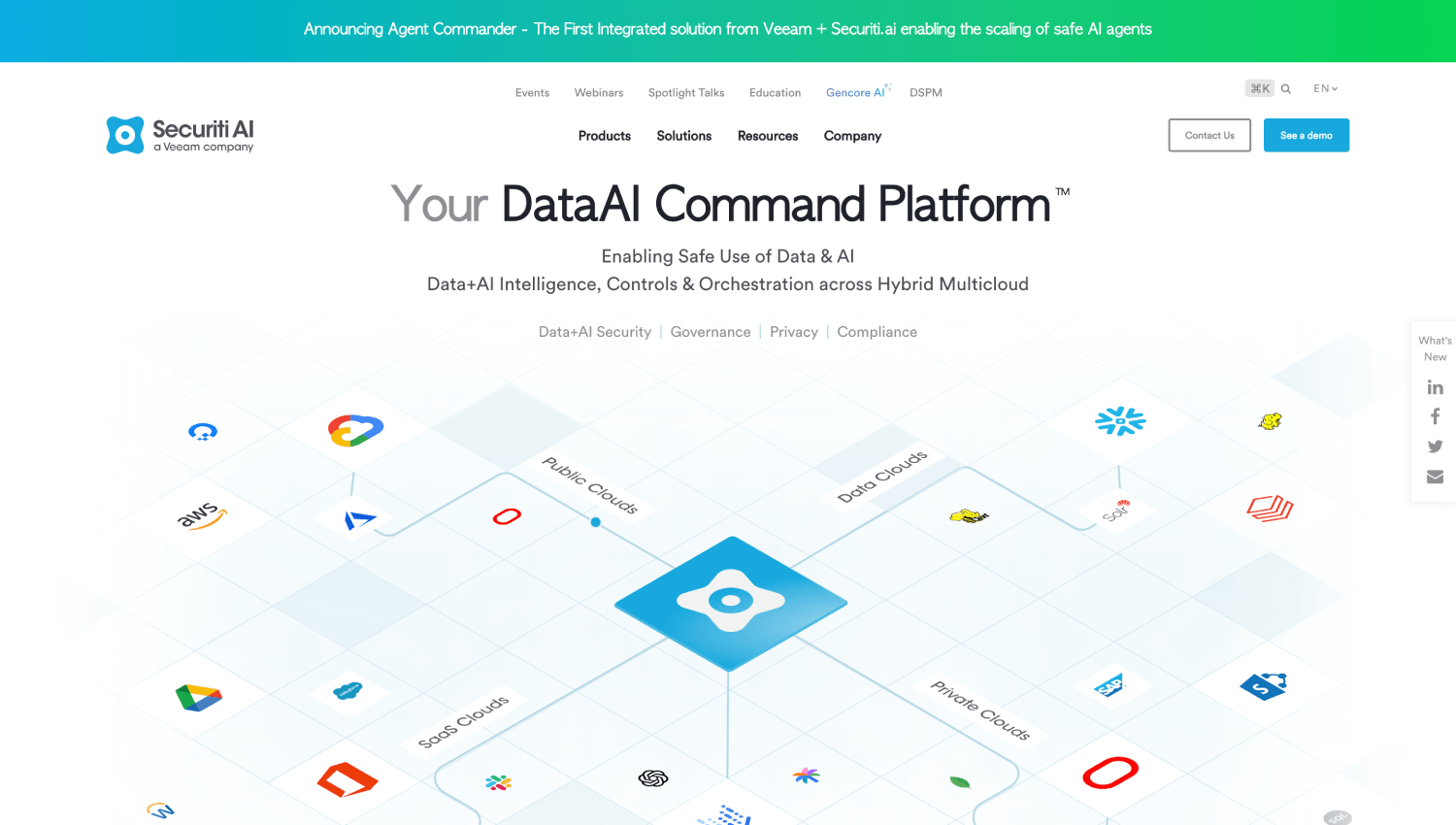
Securiti takes a broader approach than pure DSPM, combining data classification with privacy compliance workflows, consent management, and DSR automation. For organizations where DSPM is part of a GDPR, CCPA, or HIPAA compliance program rather than purely a security initiative, that integration can consolidate what would otherwise be three separate tools.
On the agentless scanning side, Securiti’s platform is designed to keep sensitive data within your environment during classification, using API-based connectors to cloud storage and managed databases. The platform also covers SaaS applications and structured data inside documents. Classification coverage includes personally identifiable information, financial data, health information, and custom data types you define. Buyers should verify specific scanning architecture details , including any claims about patented mechanisms , directly with Securiti during evaluation.
Securiti’s operational complexity is higher than point-product DSPM tools because the platform scope is wider. Teams that want DSPM and nothing else may find the platform surfaces more configuration surface than they need. Pricing is not publicly listed; Securiti quotes per deployment.
6. Proofpoint Data Security (Normalyze)
Proofpoint Data Security incorporates DSPM capabilities that originated with the Normalyze product. The approach centers on a graph-based data access intelligence model that maps not just where data lives but which identities, service accounts, and roles have access to it and at what permission level. Buyers should verify the current integration status of Normalyze capabilities within the Proofpoint portfolio directly with Proofpoint, as product integration timelines can affect which specific features are available at the time of purchase.
That access graph is what differentiates this offering from pure classification tools. Finding a bucket with sensitive data is one signal. Knowing that 47 service accounts have read access to it, 12 of which are unused in the last 90 days, is the signal that drives remediation priority. For security teams that care about the identity risk layer on top of the data risk layer, that combination is directly useful. For teams tracking non-human identity exposure specifically, the intersection with non-human identity security platforms is worth exploring as a complementary control.
Proofpoint does not publish list pricing for the data security portfolio. Buyers should verify which specific features are available in the current product versus what was present in the original Normalyze offering before signing.
7. Symmetry Systems
Symmetry Systems built its platform around the concept of Data+Identity graphs, correlating sensitive data stores with the identities that access them and the permissions that govern that access. The platform covers AWS, Azure, and GCP without agents, using API-based connectivity to both cloud storage services and identity providers. As of May 2026, Symmetry Systems announced that Zscaler has agreed to acquire the company; buyers should confirm current product availability and roadmap directly with Symmetry or Zscaler before proceeding with an evaluation.
The differentiating capability is blast radius analysis: given a compromised identity or credential, Symmetry shows what data that identity could reach, in which stores, at what classification level. That is a materially different question from “where is my sensitive data,” and it is more relevant to incident response. When a service account credential appears in a breach notification, knowing immediately which regulated data stores that account could access compresses the scoping phase of your response significantly.
For on-premises coverage and pricing details, buyers should consult Symmetry directly, as these specifics are not documented in publicly available product materials.
8. Laminar (Rubrik)
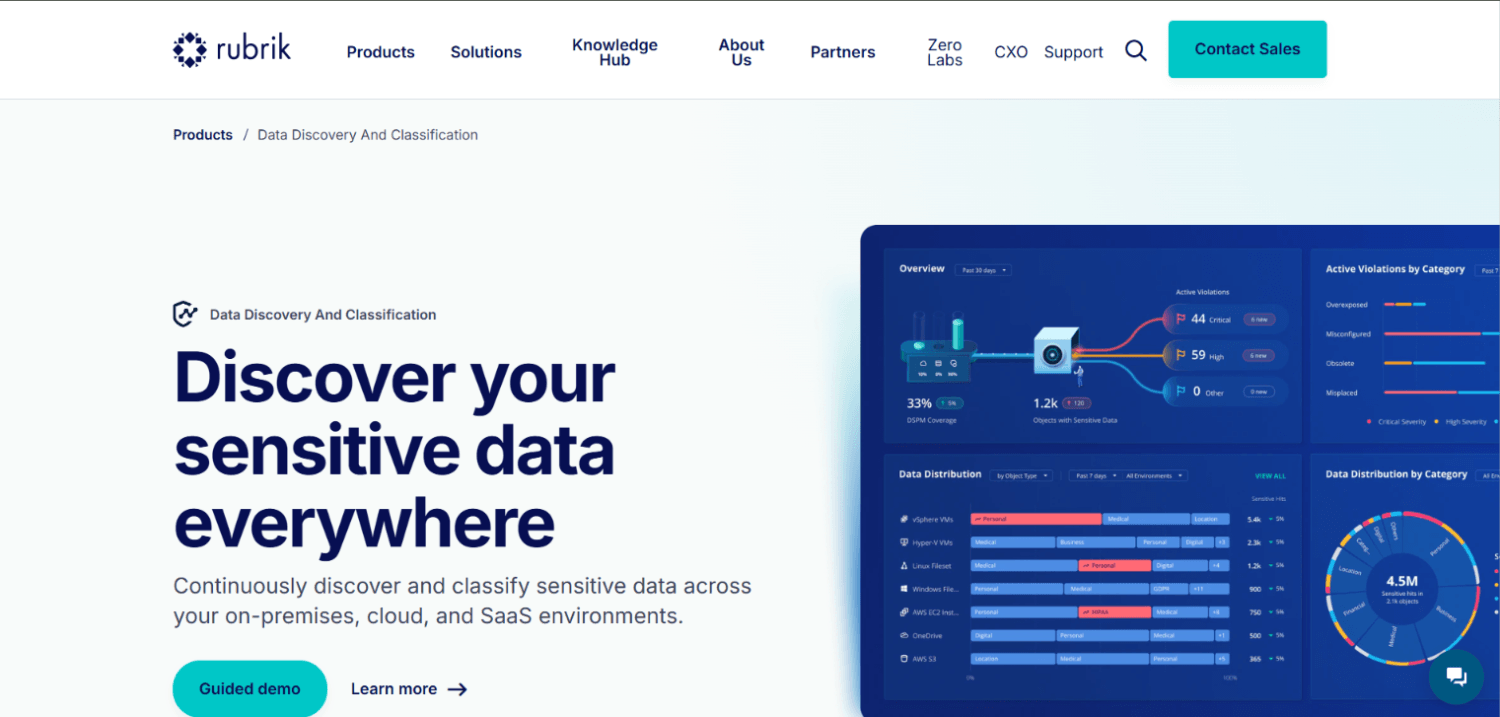
Laminar’s DSPM capabilities are now part of the Rubrik Security Cloud platform. The Laminar approach to agentless scanning used a deployed data security scanner inside the customer’s cloud account , meaning the classification compute runs in your environment, not the vendor’s, with results synced to the management plane. Sensitive data does not cross to Rubrik infrastructure during scanning.
For organizations already running Rubrik for backup and data management, the integration of DSPM into the same platform creates a converged view of data inventory, backup posture, and classification. That is a different value proposition than standalone DSPM: the backup catalog becomes a starting point for data discovery rather than a separate asset requiring independent scanning. Teams evaluating overall DSPM coverage across their cloud properties should review the broader DSPM platform comparison alongside this agentless-specific list.
Rubrik does not publish list pricing for the security cloud portfolio. Buyers coming from a standalone Laminar evaluation should confirm current feature parity between the pre-acquisition product and the integrated Rubrik offering, as product integration timelines vary.
Agentless vs. Agent-Based: Which Architecture Fits Which Team?
Agentless DSPM is the right default for cloud-native environments running managed services: S3, RDS, BigQuery, Azure SQL, Redshift, and similar. In those environments, the cloud provider exposes API surfaces that give a DSPM platform everything it needs to classify data and assess access permissions without touching a running instance. Agent deployment in this context would add operational overhead with no meaningful coverage gain.
Agent-based or hybrid scanning becomes worth the deployment cost in three specific scenarios. First, high-change transactional databases where a daily snapshot scan creates an unacceptable detection gap. Second, self-managed databases on IaaS that lack a snapshot service or a cloud API for remote access. Third, environments where in-transit data flows are part of the threat model and you need real-time inspection rather than reconstructed flows from access logs.
The practical decision is rarely binary. Most organizations with meaningful on-prem or hybrid environments will run agentless coverage for the cloud estate and a lightweight connector or agent for the stores that do not fit the agentless model. The mistake is assuming agentless covers everything and skipping the inventory step that would surface the exceptions.
Does Agentless DSPM Work for On-Premises and Self-Managed Databases?
Natively, no. Every platform in this list was designed for cloud environments first. On-premises coverage exists as an extension, not a core capability. The mechanism is typically a lightweight connector deployed in the same network segment as the on-premises store, which then proxies queries or data samples back to the DSPM platform’s classification engine. That connector is smaller than a full agent and does not require persistent host access, but it is still a deployment artifact you have to manage, patch, and monitor.
For organizations with significant on-premises data alongside cloud estates, the evaluation question is not “is this agentless” but “does the connector model cover my specific database versions and network topology, and what does the deployment process actually look like.” Asking the vendor for the connector architecture documentation before a proof of concept will save significant time. Teams running large Azure footprints alongside on-premises infrastructure should also consult the DSPM tools comparison specific to Azure environments to understand where native integrations simplify the on-prem gap.
Side-by-Side Platform Comparison
| Platform | Primary Scan Mechanism | Multi-Cloud Coverage | SaaS Coverage | On-Prem Support | Identity/Access Graph | Standalone DSPM |
|---|---|---|---|---|---|---|
| Wiz | API + Snapshot | AWS, Azure, GCP, OCI | Limited | Via connector | Yes (within Wiz graph) | No (platform) |
| Orca Security | Snapshot (SideScanning) | AWS, Azure, GCP | Limited | Via network scanner | Yes (within platform) | No (platform) |
| Cyera | API (sampling) | AWS, Azure, GCP | Strong | Via connector | Partial | Yes |
| Sentra | API + cloud telemetry | AWS, Azure, GCP | Moderate | Via connector | Yes (data flows) | Yes |
| Securiti | API (in-place) | AWS, Azure, GCP | Strong | Via connector | Partial | No (broader platform) |
| Proofpoint (Normalyze) | API + graph | AWS, Azure, GCP | Moderate | Via connector | Strong | No (within Proofpoint) |
| Symmetry Systems | API | AWS, Azure, GCP | Moderate | Via connector | Strong (blast radius) | Yes |
| Laminar (Rubrik) | In-account scanner | AWS, Azure, GCP | Moderate | Via connector | Partial | No (within Rubrik) |
Frequently Asked Questions
What does agentless DSPM mean in practice?
Agentless DSPM means the platform discovers and classifies sensitive data by connecting to cloud APIs or mounting volume snapshots rather than installing persistent software on database servers or hosts. No process runs on the scanned system. The scanner operates from a separate compute environment, typically inside your own cloud account, and reads data through read-only access paths. The result is faster deployment and lower operational overhead, at the cost of real-time visibility into data writes and in-transit flows.
How does snapshot-based scanning compare to API-based scanning?
Snapshot scanning mounts a point-in-time copy of a storage volume and reads its contents directly, covering block storage and self-managed databases. API-based scanning queries cloud service endpoints or samples data through database queries, covering managed services without creating volume copies. Snapshot scanning is more comprehensive for what is on disk but introduces lag equal to the snapshot interval. API-based scanning is closer to real-time for metadata but depends on the platform having a pre-built connector for each service type. Most platforms use both mechanisms depending on the store type.
Is Wiz agentless for DSPM?
Yes. Wiz connects to cloud environments via read-only APIs and snapshot mounting without installing agents on hosts or database servers. Per Wiz’s DSPM product page, the agentless architecture is a core design principle across its cloud security capabilities, including DSPM. Data classification runs on snapshots processed inside the customer’s own cloud account. Wiz does not function as a standalone DSPM purchase; DSPM capabilities are part of the broader Wiz platform.
Who needs a DSPM solution, and who can wait?
Organizations with sensitive data distributed across multiple cloud accounts, managed database services, and SaaS platforms , and without a current inventory of where that data lives , are the primary buyers. Regulated industries where compliance requires knowing what data you hold and who can access it have the most immediate business case. Organizations running a single cloud account with a small number of well-understood data stores can often defer DSPM in favor of simpler controls. The inflection point is usually when the data store inventory becomes too large to maintain manually or when a compliance audit requires evidence of continuous classification.
What are the real limitations of agentless data security for high-change environments?
Agentless scanning misses writes that occur between scan windows, in-transit data flows between services, and data processed in memory without reaching a persistent store. For environments where a transactional database receives thousands of new records per hour , payment processing, healthcare record systems, real-time analytics pipelines , a daily or even hourly snapshot scan creates a detection gap that may be acceptable for compliance reporting but inadequate for real-time breach detection. Teams in those environments should evaluate whether an agent or database activity monitor alongside DSPM is the right architecture, rather than relying on agentless coverage alone.
How does scanning frequency affect cloud spend?
Every snapshot scan generates temporary compute usage: a volume clone is created, a scanner instance runs classification against it, and the clone is deleted. More frequent scans multiply that compute cost proportionally. For organizations scanning terabytes of block storage, doubling scan frequency from daily to twice-daily can produce a meaningful increase in cloud compute charges, separate from the DSPM vendor’s own licensing cost. API-based scanning for managed services is cheaper per sweep because it samples rather than fully reads volumes. Optimizing scan frequency by store sensitivity class , daily for low-sensitivity stores, hourly for high-sensitivity managed databases , is worth building into the platform configuration from the start.
Which agentless DSPM platforms work best for Snowflake and data warehouse environments?
Platforms with dedicated Snowflake and data warehouse connectors , including Cyera, Sentra, and Securiti , scan these environments via API-based query sampling rather than snapshot mounting. The cloud data warehouse model is well-suited to agentless coverage because the service provider exposes structured query interfaces and metadata APIs that give classification engines direct access to schema information and data samples. The main coverage gap in these environments is data that has been exported from the warehouse into unmanaged storage or streamed to downstream systems. For a deeper evaluation of coverage in warehouse-centric environments, the DSPM platforms specifically evaluated for Snowflake covers connector depth in more detail.
What to Decide Before Shortlisting Any Platform
Before issuing an RFP or booking a demo, complete one step most teams skip: enumerate every data store type in your environment and mark whether it is managed (cloud API available), self-managed on IaaS, or on-premises. That inventory determines whether agentless coverage actually reaches your sensitive data or whether you are buying a tool that covers 70 percent of your estate and leaves the highest-risk stores dark.
For teams running AI-driven applications where training data, model outputs, or inference logs may contain sensitive information, the coverage question extends to object stores and streaming pipelines that were not previously in scope for DSPM. The intersection of DSPM and AI data security is where gaps appear fastest. The DSPM tools comparison for AI and GenAI data security covers that extension in detail.
The platforms in this list are not interchangeable. Wiz and Orca fit teams that want data security as part of a broader cloud security platform they are already evaluating. Cyera, Sentra, and Symmetry fit teams that want DSPM as a focused capability without platform lock-in. Securiti fits teams where data privacy compliance workflow is as important as security classification. Proofpoint’s portfolio makes most sense for organizations already invested in Proofpoint’s broader security stack. Laminar in Rubrik fits organizations where data protection and security share a budget and a program. The scan mechanism, the identity graph, and the on-prem coverage story are the three variables where these platforms actually diverge. Start there.