
TLDR
- CNAPP vendors are adding AI-SPM modules, but most cover only the infrastructure layer: misconfigured S3 buckets holding training data, overprivileged service accounts attached to model endpoints, public exposure of SageMaker notebooks. That is cloud security applied to AI assets, not AI security.
- The coverage gap sits at the model and application layer: prompt injection paths, sensitive data leakage through model outputs, agent tool-call permissions, and RAG pipeline data exposure. Dedicated AI-SPM tools address these; CNAPP modules generally do not.
- Consolidation into CNAPP is the right default for teams whose primary AI risk is infrastructure misconfiguration. It is the wrong default for teams running production LLM applications, autonomous agents, or fine-tuned models on proprietary data.
- Before signing the CNAPP renewal, run the coverage-gap checklist in this article. The gaps are specific and nameable. Accepting them is a legitimate risk decision. Assuming they do not exist is how incidents happen.
- Pricing behavior differs: CNAPP AI-SPM modules typically add no marginal cost when bundled, while dedicated AI-SPM tools price per model, per pipeline, or per agent. The total cost of ownership calculation only makes sense after you know which coverage tier you actually need.
For security and IT leaders weighing AI-SPM vs CNAPP coverage decisions: CNAPP vendors with AI-SPM modules secure the cloud infrastructure that AI runs on. Dedicated AI-SPM tools secure the AI systems themselves, including model behavior, prompt handling, agent permissions, and data flows through inference pipelines. For most teams, CNAPP consolidation covers the infrastructure risk adequately. Teams running production LLM applications or autonomous agents need to explicitly audit what the CNAPP module does not cover before treating consolidation as complete.
What Does “AI Security” Actually Mean Inside a CNAPP?
When a CNAPP vendor adds an AI-SPM module, they are almost always extending their existing cloud security graph to recognize AI-specific resources. That means applying CSPM-style checks to the infrastructure AI workloads run on: storage buckets containing training datasets, compute instances running model endpoints, IAM roles attached to ML pipelines, and network exposure of managed ML services like SageMaker, Vertex AI, or Azure ML.
This is genuinely useful coverage. A misconfigured S3 bucket holding fine-tuning data is a data exposure risk whether or not it is labeled as AI infrastructure. An overprivileged IAM role attached to a model inference endpoint is an identity risk that standard CSPM logic can catch. CNAPP platforms already do this well for non-AI workloads, and extending the same policy engine to AI resources is a natural and low-friction expansion.
What this approach does not cover is the AI-specific attack surface: what happens at and beyond the model boundary. Prompt injection, where an attacker manipulates model inputs to alter its behavior or extract training data, is not a cloud misconfiguration. Data leakage through model outputs, where a model surfaces sensitive information it was trained or fine-tuned on, is not detectable by a CSPM check. Agent tool-call permissions, where an autonomous agent has excessive access to downstream APIs or data stores, sit in a different control plane entirely. CNAPP’s cloud security graph has no native representation for these risks.
What Wiz, Prisma, CrowdStrike, Orca, and Sysdig Actually Ship
Wiz’s AI-SPM, which the company has positioned as the first AI-SPM integrated into a CNAPP platform, extends the Wiz Security Graph to map AI services, training datasets, model artifacts, and associated identities. Its coverage targets AI infrastructure posture: finding exposed model endpoints, misconfigured data pipelines, and identities with excessive permissions on AI resources. Wiz’s documentation describes its AI-SPM as providing visibility into AI service configurations and their connections to sensitive data, which is an infrastructure-layer capability.
Palo Alto Networks Prisma Cloud includes AI security capabilities under its broader CNAPP offering, with checks targeting AI/ML services across major cloud providers. The coverage follows a similar pattern: configuration posture of AI infrastructure, exposure analysis, and data sensitivity tagging for AI-related storage. Palo Alto Networks also separately offers AI runtime security capabilities; however, the Prisma Cloud product page does not disclose or name a distinct product called “AI Runtime Security” or “AIRS,” and the positioning of any such product relative to the standard Prisma Cloud CNAPP modules cannot be verified from available sources.
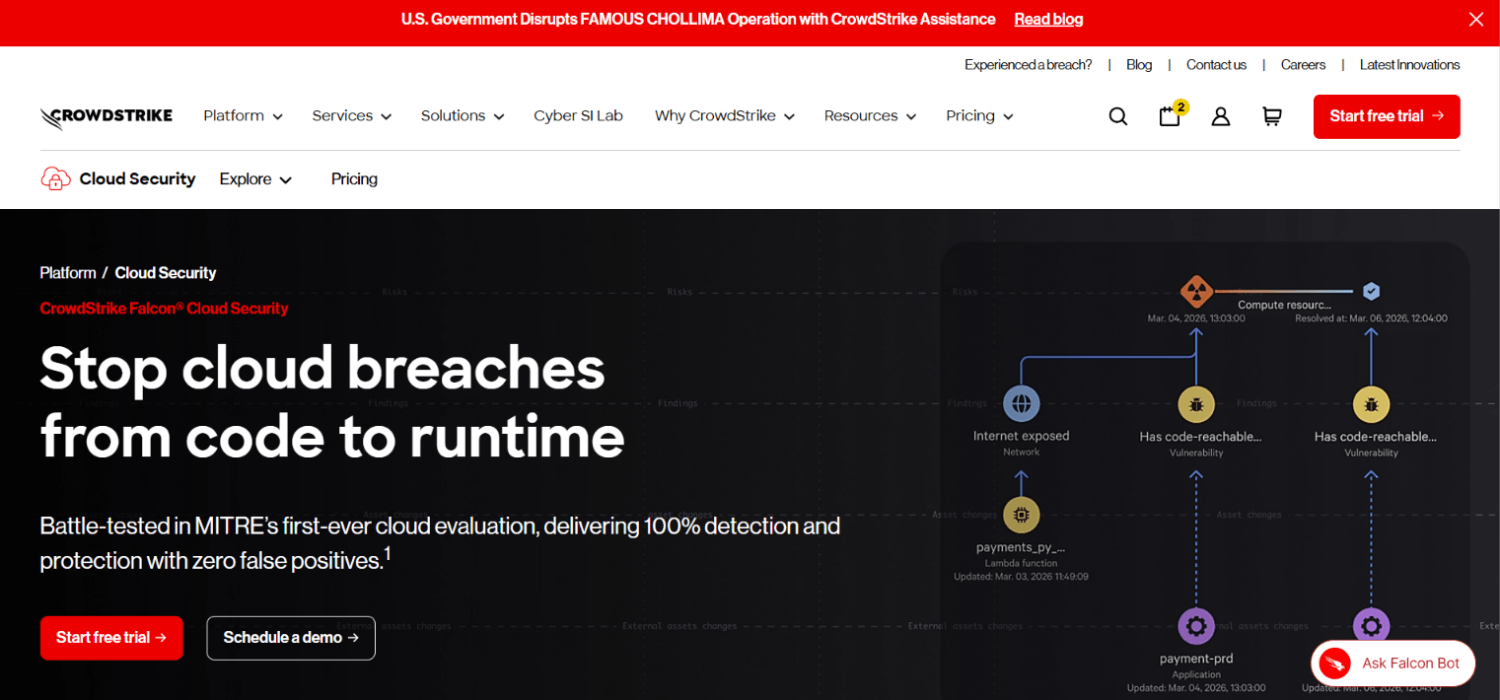
CrowdStrike’s cloud security platform covers AI workload protection through its CNAPP capabilities, primarily at the infrastructure and runtime workload layer. The platform’s AI security posture checks apply to AI services running on cloud infrastructure. CrowdStrike has also added AI-assisted detection throughout its platform, which is a different thing: AI being used as a detection mechanism, not AI systems being protected as a security target.
Orca Security covers AI service posture as part of its agentless CNAPP, scanning cloud environments for misconfigured AI services and exposed model resources. Sysdig approaches AI security from its runtime security strength, applying eBPF-based workload monitoring to detect anomalous behavior in AI workloads at runtime. Both operate primarily at the infrastructure and workload layer.
The pattern across all five is consistent: CNAPP AI-SPM modules cover the cloud infrastructure that AI runs on. None of them natively address model-layer risks as a standard included capability.
The SecurityOpsWire AI Coverage Stack Test
Before treating a CNAPP’s AI-SPM module as complete coverage, run what we call the AI Coverage Stack Test: a four-layer check that maps your actual AI deployment against what the tool monitors. The layers are Infrastructure, Data Pipeline, Model, and Agent. Most CNAPP modules pass the first two and miss the second two almost entirely.
Layer 1: Infrastructure
Does the tool find misconfigured AI service endpoints, overprivileged IAM roles on ML workloads, public exposure of model artifacts in storage, and unencrypted training data at rest? This is where CNAPP AI-SPM modules are strongest. If your AI risk is primarily infrastructure misconfiguration, consolidation is likely sufficient.
Layer 2: Data Pipeline
Does the tool track sensitive data flows into training pipelines, flag when PII or regulated data enters fine-tuning datasets, and identify shadow AI integrations pulling data from internal systems? CNAPP platforms with strong DSPM capabilities for AI data security cover parts of this layer. Without integrated DSPM, coverage here is partial at best.
Layer 3: Model
Does the tool detect prompt injection attempts, monitor model outputs for sensitive data leakage, track model versions and their associated risk posture, and flag when a model’s behavior deviates from its baseline? This is where virtually every CNAPP module stops. Infrastructure-layer tools have no visibility into inference-time behavior.
Layer 4: Agent
Does the tool discover autonomous agents, map their tool-call permissions, detect agents operating outside their sanctioned scope, and monitor inter-agent communication? Agent security is the newest and least-covered layer. CNAPP platforms do not yet represent agents as a native security primitive. This is a documented gap, not a vendor failing; the tooling category is still forming. Teams running agentic AI workflows should review AI agent discovery and monitoring tools separately.
Where the Coverage Gap Actually Hurts
Consider a company running three AWS accounts with the following AI deployment: a customer-facing chatbot powered by an OpenAI API integration, an internal RAG pipeline indexing the company’s Confluence and Sharepoint content, and a Python-based agent that can query internal databases and send Slack messages based on user prompts. Their CNAPP covers the AWS infrastructure. The gaps are specific.
The OpenAI integration runs outside the company’s cloud environment. The CNAPP has no visibility into the API call contents, the prompts being sent, or the model outputs being returned. A prompt injection attempt against the chatbot generates no alert in the CNAPP. The RAG pipeline is indexed in the cloud and the CNAPP can see the S3 bucket and the EC2 instance. It cannot see which documents are being retrieved in response to which queries, or whether the retrieval system can be manipulated to surface restricted content. The agent’s Slack and database permissions are granted through service accounts that the CNAPP may or may not inventory, depending on how they are configured, and the CNAPP has no model of what the agent is authorized to do versus what it actually does at runtime.
None of these gaps make the CNAPP wrong for this environment. They make consolidation an incomplete risk decision if the team assumes CNAPP coverage equals AI coverage. The right posture is to acknowledge Layers 3 and 4 as out of scope for the CNAPP and either accept that risk explicitly or address it with a dedicated tool. The distinction between AI-SPM and AI agent security matters here: they address different parts of the stack, and neither is a superset of the other.
What a Dedicated AI-SPM Tool Adds Over a CNAPP Module
Dedicated AI-SPM platforms built specifically for AI security coverage, rather than extended from cloud security foundations, tend to add depth in three areas: model inventory and risk scoring, inference-time monitoring, and agent governance.
Model inventory in a dedicated tool typically includes not just cloud-hosted model endpoints but also models embedded in applications, third-party model APIs in use across the organization, and shadow AI integrations that were never formally approved. This is a discovery problem, not a configuration problem, and it requires different telemetry than CNAPP platforms collect. Teams trying to understand the full scope of their AI asset exposure will find the coverage differences significant. Our AI asset discovery platform comparison covers this category in depth.
Inference-time monitoring means observing the actual inputs and outputs flowing through a model in production. This requires either a proxy architecture sitting between the application and the model API, or an SDK integration in the application layer. Neither approach fits naturally into a CNAPP’s agentless cloud scanning architecture. Vendors offering this capability include dedicated AI security platforms rather than CNAPP extensions.
Agent governance addresses what autonomous agents are permitted to do: which tools they can call, which data stores they can access, which other agents they can communicate with, and what constraints exist on their action space. This maps closely to the Model Context Protocol security problem for teams using MCP-based agent frameworks. CNAPP platforms do not currently model this permission structure.
CNAPP AI-SPM vs Dedicated AI-SPM: Coverage Comparison
| Coverage Area | CNAPP AI-SPM Module | Dedicated AI-SPM Tool |
|---|---|---|
| AI infrastructure misconfiguration (S3, IAM, compute) | Strong | Varies; some cover this, many do not |
| Sensitive data in training datasets / RAG stores | Partial (requires integrated DSPM) | Strong in most dedicated tools |
| Model endpoint exposure and network posture | Strong | Partial; infrastructure is not primary focus |
| Shadow AI discovery (unapproved integrations) | Weak; limited to cloud-native AI services | Strong; typically includes SaaS and API discovery |
| Prompt injection detection at inference time | Not covered by standard CNAPP modules | Core capability in most dedicated tools |
| Model output monitoring for data leakage | Not covered | Covered via proxy or SDK integration |
| AI agent inventory and permission mapping | Not covered | Emerging; leading dedicated tools cover this |
| Inter-agent communication monitoring | Not covered | Limited; early-stage coverage in leading tools |
| Model version and lineage tracking | Not covered | Strong in most dedicated tools |
| Compliance posture for AI regulations (EU AI Act) | Beginning to appear; limited depth | Core capability in most dedicated tools |
How Does Bundling Change the Price?
CNAPP vendors do not publicly publish line-item pricing for AI-SPM modules. Wiz, Palo Alto Prisma, CrowdStrike, Orca, and Sysdig all quote per environment, and the AI-SPM capability is typically included in a broader platform tier rather than priced separately. If you are already on a CNAPP contract that includes AI-SPM, the marginal cost of using that module is often zero. That is the consolidation argument in its strongest form: you are not buying AI security, you are activating coverage you already own.
Dedicated AI-SPM tools price differently. Pricing models in this category tend to run per model monitored, per million inference requests, per application connected, or in some cases per agent governed. Because these vendors do not publicly disclose list pricing and quote per deployment, the comparison requires a direct procurement conversation. The total cost of ownership calculation depends entirely on scale: how many models, how many applications, how many agents, and what volume of inference traffic.
For a team with 50 monitored cloud workloads and two AI applications in production, the dedicated AI-SPM cost may exceed the incremental CNAPP value by a factor that makes consolidation clearly correct. For a team running 20 production LLM applications with autonomous agents touching production systems, the CNAPP module covers perhaps 40 percent of the actual risk surface, and the dedicated tool cost may be justified.
The pricing asymmetry also runs in the other direction: adding a dedicated AI-SPM tool to an existing CNAPP does not eliminate the CNAPP cost, it adds to it. Teams evaluating a dedicated tool need to account for the full stack cost, not just the new tool’s price. That total cost framing is where the consolidation argument is often strongest for mid-market security teams with limited headcount to operate multiple platforms.
Is AI-SPM Inside a CNAPP a Real Module or a Dashboard?
The honest answer: it depends on the vendor, and the distinction matters operationally. A genuine AI-SPM integration inside a CNAPP should share the same security graph, the same policy engine, and the same finding workflow as the rest of the platform. When an AI-SPM finding is generated, it should link to the associated cloud resources, identities, and data assets the platform already tracks. If it does not, it is a separate product with a shared login screen, not an integrated module.
Wiz’s implementation, based on their published documentation, extends the Wiz Security Graph to include AI assets as first-class nodes, connected to the same identity, network, and data layers the platform already models. That is genuine integration. The questions to ask during a vendor evaluation are: can an AI-SPM finding link to the overprivileged IAM role attached to the model endpoint? Can it show you whether the storage bucket holding training data is accessible by the same external identity that has access to your production database? If the answers are yes, you have a real integration. If the AI findings exist in a separate inventory with no graph connections, you have a dashboard.
Which Teams Should Consolidate and Which Should Not
Consolidation into CNAPP is the right default for teams whose AI deployment is primarily infrastructure-hosted models accessed through managed services, with no production LLM applications that users interact with directly, and no autonomous agents touching production systems. If your AI risk is “someone left a SageMaker notebook public and the training data is in an open S3 bucket,” a CNAPP handles that completely. The infrastructure-layer coverage is real and it is already paid for.
Consolidation is not sufficient for teams running any of the following: production chatbots or copilots that process user input before forwarding to a model API, RAG pipelines indexing internal sensitive data, fine-tuned models trained on proprietary or regulated content, or autonomous agents that take actions in production systems. These deployments expose Layers 3 and 4 of the AI Coverage Stack Test, and CNAPP modules do not address them. The security team’s job in this situation is to name the gap explicitly and make a deliberate risk decision about it, not to assume the CNAPP module covers the full surface.
Teams in a heavily regulated environment facing EU AI Act obligations or sector-specific AI governance requirements will find that dedicated AI-SPM tools have built compliance reporting capabilities that CNAPP AI modules are only beginning to add. If AI compliance reporting is a near-term requirement, that is an additional argument for evaluating dedicated tools, independent of the coverage question.
For security leaders evaluating the full AI security tooling space beyond posture management, the AI-SPM tools comparison covers the dedicated tool category in detail, including which platforms address which layers of the stack.
Frequently Asked Questions
What is AI-SPM and how is it different from CSPM?
AI Security Posture Management (AI-SPM) is a category of tools that assess the security configuration and risk posture of AI systems, including models, training data, inference pipelines, and agents. CSPM focuses on cloud infrastructure configuration, while AI-SPM extends into the AI-specific attack surface: prompt handling, model output behavior, agent permissions, and data flows through AI systems. CNAPP platforms are adding AI-SPM capabilities primarily at the infrastructure layer, where the two disciplines overlap.
Do CNAPP platforms like Wiz cover prompt injection?
Standard CNAPP AI-SPM modules, including Wiz’s AI-SPM, operate at the infrastructure layer and do not cover prompt injection detection. Prompt injection is an inference-time attack against the model itself, not a cloud misconfiguration. Dedicated AI-SPM and AI guardrail platforms address prompt injection through proxy or SDK-based inference monitoring. Teams that need prompt injection coverage should evaluate those categories separately.
Is consolidating AI security into the CNAPP cheaper?
For teams already on a CNAPP contract that includes an AI-SPM module, the marginal cost of using that module is typically zero. Dedicated AI-SPM tools add a new licensing cost on top of the existing CNAPP spend. Consolidation is cheaper in unit cost terms when the CNAPP’s coverage matches the team’s actual risk surface. When it does not, the apparent savings are offset by the cost of the undetected exposure, not by additional tool spend.
What does Palo Alto Networks’ Prisma Cloud cover for AI security, and where does it stop?
Palo Alto Networks’ Prisma Cloud CNAPP covers AI infrastructure posture: misconfigured ML services, exposed model endpoints, and data governance for training datasets. The Prisma Cloud product page describes AI-SPM capabilities and AI-powered risk insights as part of the platform. Palo Alto Networks also separately references AI runtime security capabilities, but the positioning and feature scope of any distinct runtime AI security product relative to the standard Prisma Cloud CNAPP offering cannot be verified from publicly available product documentation, and teams evaluating this area should request specific scoping from Palo Alto Networks directly.
How should security teams evaluate AI agent coverage gaps?
Start with the AI Coverage Stack Test: Infrastructure, Data Pipeline, Model, and Agent. Ask the CNAPP vendor specifically whether their AI-SPM module inventories autonomous agents, maps their tool-call permissions, and generates findings when an agent operates outside its defined scope. If the answer is no to any of these, that layer is uncovered. For teams running agentic workflows, evaluate dedicated AI agent security platforms as a complement to the CNAPP, not a replacement.
Which layer of AI security do most CNAPP vendors miss?
Layers 3 and 4 of the AI Coverage Stack Test: the model layer and the agent layer. Model-layer risks include prompt injection, inference-time data leakage, and model output policy violations. Agent-layer risks include excessive tool-call permissions, agents operating outside their sanctioned scope, and unmonitored inter-agent communication. Every major CNAPP platform currently covers Layers 1 and 2 (infrastructure and data pipeline) through their AI-SPM modules. Layer 3 requires dedicated tooling or a runtime security product. Layer 4 is the least-covered area across the entire market.
Does adding an AI-SPM module to a CNAPP change the contract cost?
Major CNAPP vendors do not publish list pricing for AI-SPM modules and negotiate per environment. In most cases, AI-SPM is included in a platform tier rather than priced as a standalone add-on, meaning existing customers may activate it without a price increase. Teams evaluating new CNAPP contracts should confirm in writing which platform tier includes AI-SPM and what the scope of coverage is, because what is included in “AI-SPM” differs significantly between vendors at the feature level.
The Consolidation Decision, Named Clearly
The consolidation argument for CNAPP AI-SPM is strongest when framed correctly: you are consolidating cloud security for AI assets into the same platform that already handles cloud security for everything else. That is a good decision. Inventory, policy, findings, and workflow all stay in one place, and the coverage for Layers 1 and 2 is genuine. The mistake is treating that consolidation as equivalent to “AI security is covered.” It covers the cloud part of AI security. The AI part of AI security, meaning what happens at the model boundary and beyond, requires a different tool or an explicit risk acceptance.
Security leaders who make this decision well are the ones who run the AI Coverage Stack Test before the CNAPP renewal, not after. They know which layers their CNAPP covers, they can name what sits in the gap, and they have made a deliberate call about whether to accept that gap or address it. That is a defensible risk posture. What is not defensible is discovering after an incident that the CNAPP module everyone assumed covered AI security had never seen a single inference request.
The CNAPP vendors are building toward broader AI coverage. Runtime protection, agent governance, and model behavior monitoring will likely migrate into CNAPP platforms over the next few years, just as CSPM, CWPP, and CIEM did before them. For teams whose AI deployment is moving faster than that roadmap, the gap is present now and requires a current answer, not a futures commitment in a vendor briefing. Know exactly what your CNAPP module covers, name what it does not, and make the consolidation decision with both sides of that equation visible.